Xagħra Stone Circle: A Prehistoric Burial Complex in Malta
Site at a Glance
- Rating
- 3.6
- Popularity
- Medium
- Country
- Malta
- Primary era
- Stone Age
- Eras represented
- Stone Age
- Civilizations
- Maltese Temple Culture
- Site type
- Burial
- Remains
- Necropolis
On this page12 sections
History
Xagħra Stone Circle is a prehistoric burial complex in Malta, formed by adapting natural caves and enclosing them with standing stones. Its earliest tombs date to about 4100–3800 BC, though the complex may have begun nearer 3800 BC. Its busiest period was around 3000–2400 BC, during the Ġgantija and Tarxien phases, archaeological periods in prehistoric Malta. The burial place served the community that built the nearby Ġgantija temple. Excavations revealed one of the largest funerary complexes in the Mediterranean and Europe’s only prehistoric underground burial complex enclosed by stone.
Early burials and changing practices
Use was limited from about 3800 to 3000 BC, but pottery and dated bones show that burials continued. Some of this material may have been disturbed as the complex was enlarged. At first, the dead were placed together in collective bone repositories and covered with red ochre. Later, bodies were dismembered, and different parts were buried in separate places.
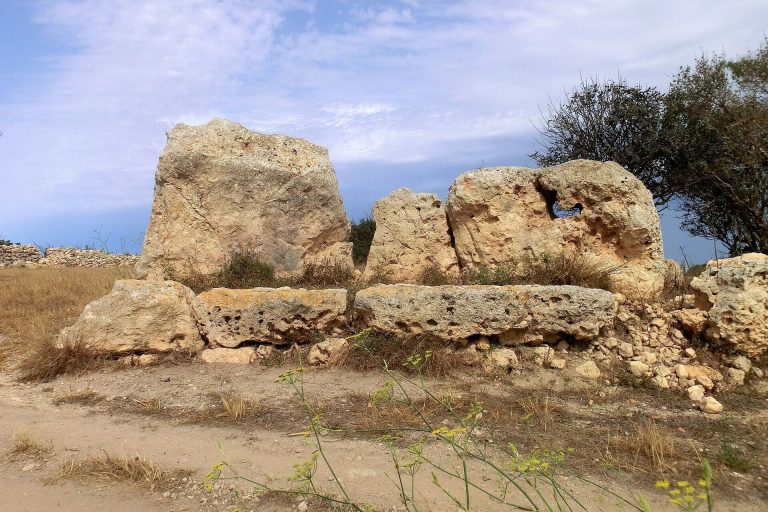
The cemetery served a wider sacred landscape. Other temples may have stood nearby. At Santa Verna, large stones are probably remnants of an important temple, while Ta’ Ġesù is another possible temple site.
Collapse and later use
The natural caves weakened and eventually collapsed before 2000 BC. During the Bronze Age, a prehistoric period associated with the use of bronze tools, the area was probably used for domestic rather than funerary purposes. Remains from the Tarxien Cemetery and Borġ in-Nadur phases were found there. The land was later farmed until the twentieth century.
Rediscovery and archaeological study
The French artist and draughtsman Jean-Pierre Houël recorded the site in the eighteenth century. In the 1820s, Charles Frederick de Brocktorff painted it during excavations by Otto Bayer, a colonel and Governor of Gozo. Bayer’s work damaged much of the surface structure. The site was filled in by the 1830s, and its location was eventually forgotten. Gozitan researcher Joe Attard Tabone rediscovered it in 1964 and helped block a proposed housing development in the 1980s.
Major excavations took place from 1987 to 1994, involving the University of Malta, the Maltese Museums Department and the University of Cambridge, with the University of Bristol involved in later work. A second underground burial complex was found in 2004. The site became commonly known as the Brochtorff Circle after de Brocktorff’s painting, although who first used that name is unknown. The names Xagħra Stone Circle and Gozo Stone Circle can suggest a monument unlike stone circles in northern Europe and the British Isles. In 2009, archaeologist David Trump proposed Xagħra Circle as a more suitable name.
Later research used accelerator mass spectrometry, a method for estimating dates from archaeological samples, to produce further estimates for burials. Studies of isotopes, which can provide evidence about diet and environment, indicate changes in diet and climate linked to the local environment. Ancient DNA from three individuals points to origins in both the eastern Mediterranean and the Adriatic–central European region during the third millennium BC. Analysis of recovered teeth has also examined disease and other health conditions. The site is government-owned, managed by Heritage Malta and protected in Malta’s Class A heritage category.
Remains
Enclosure and cave network
Stone enclosure and entrance
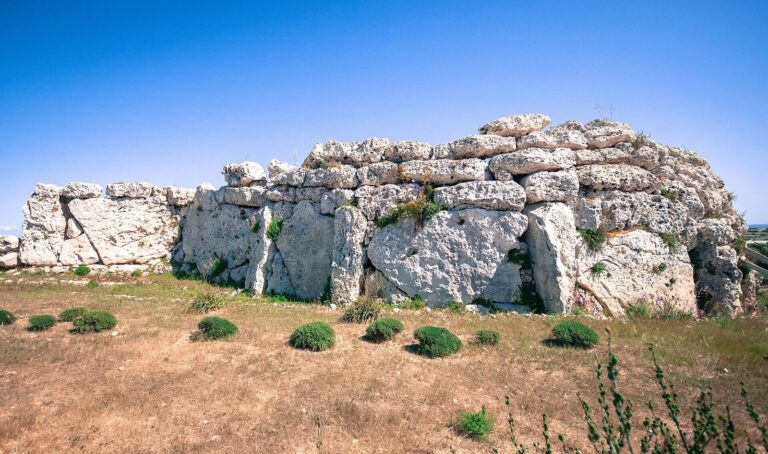
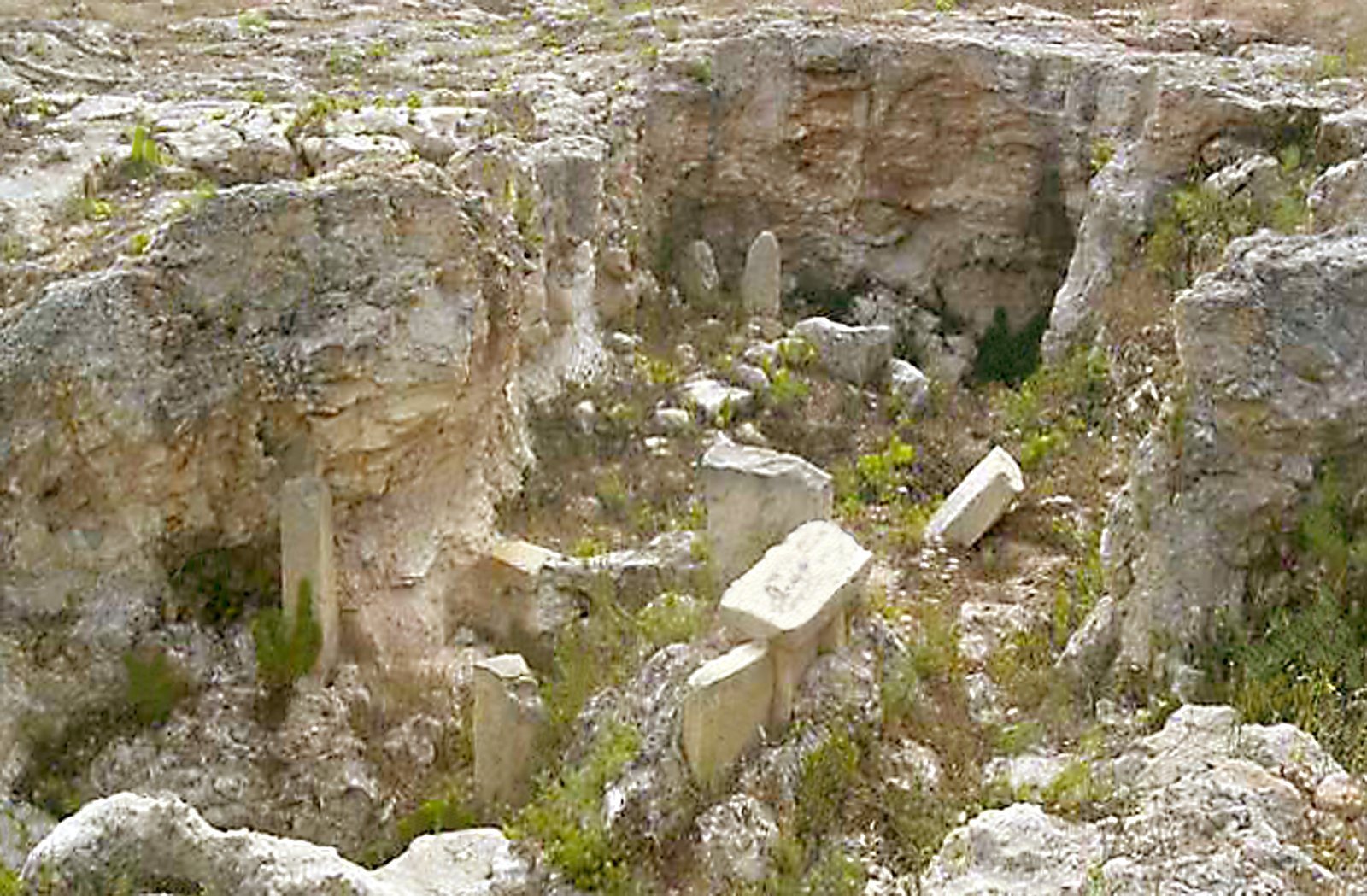
The complex covers about 40 by 40 metres and lies roughly 130 metres above sea level. A roughly circular enclosure, about 40–45 metres across and around 120 metres in circumference, surrounded the caves; about 26 metres of the circle is visible today. Standing stones formed part of this ritual area. Two large pillars and a stone threshold marked its entrance, with stairs probably descending below. The pillars were still standing in 1828 but were later removed.
Natural caves and internal layout
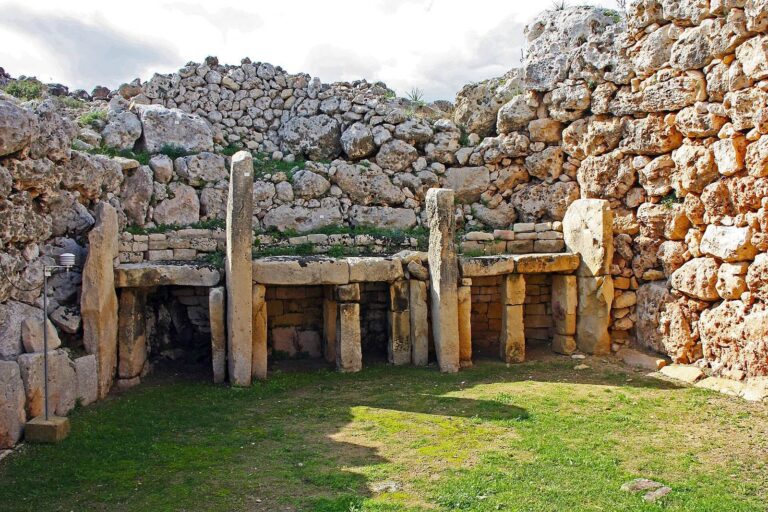
Unlike the carved underground burial complex at Ħal-Saflieni, Xagħra used natural caves joined by passages. The underground layout was clover-shaped, with burial spaces formed along the cave passages and a central access descending as much as four metres. During the Tarxien phase, an outer wall was added and upright stone slabs divided the caves into smaller burial areas. A large stone vessel was set at the centre. Large stones were also placed to support weakened cave roofs; fallen roof sections were found in the eastern cave zone.
Burial spaces and finds
Southeastern burial chambers
A shaft in the southeastern part of the complex leads to two Żebbuġ-phase chambers, numbered 269 and 270 and dated to about 4100–3800 BC. They held the remains of 65 individuals. Finds there included an anthropomorphic head resembling one from the Żebbuġ burial complex. Natural cave vaults also collapsed during the Neolithic, leaving fallen sections within the site.
Human remains
The excavated deposits include about 220,000 human bones, representing an estimated 450–800 individuals, as well as around 800 skulls, animal bones and approximately 11,000 teeth. The second burial complex found in 2004 contained about 70 bodies.
Burial goods and figurines
Objects from the complex include pottery, flint and obsidian blades, and beads and pendants made from shell, bone and stone. Polished greenstone axes came from Sicily, Calabria or southern Italy, and possibly northern Italy. Tarxien-phase grave goods consisted of small figurines in terracotta and soft stone, including full-bodied female figures also found at other sites of the period.
Near the large stone vessel, two statuettes depict corpulent figures seated together on what may be a bench or bed. They wear black-painted pleated skirts, and their legs are coloured with red ochre. One holds a smaller figure of a similar kind; the other holds a bowl. Nearby were small limestone idols, three in human form and one shaped as a phallus. Excavations also recovered architectural fragments.