North Leith Parish Church: A Church of Scotland Congregation in Leith
Site at a Glance
- Rating
- 4.7
- Popularity
- Low
- Country
- United Kingdom
- Primary era
- Modern
- Eras represented
- Modern
- Civilizations
- British
- Site type
- Religious
- Remains
- Church
On this page14 sections
History
North Leith Parish Church was a Church of Scotland congregation in Leith, now part of Edinburgh, Scotland, served over time by successive buildings. Its connection with Holyrood Abbey reaches back to 1128, when King David I granted land for the religious house’s construction. This association preceded the foundation of the church itself. In 1493, Robert Bellenden, head of Holyrood Abbey, built St Ninian’s Chapel on abbey land beside the Water of Leith.
The chapel was rebuilt after the Scottish Reformation, the sixteenth-century establishment of Protestant churches in Scotland, and a replacement church opened in 1586. In 1606, the Scottish Parliament made North Leith a parish with both civil and religious responsibilities. The congregation belonged to the Church of Scotland, Scotland’s national Presbyterian church, and was governed regionally through the Presbytery of Edinburgh.
Among the congregation’s ministers were Henry Charteris, serving from 1620 to 1627; George Wishart in 1638; Andrew Fairfoul from 1641 to 1652; and John Knox from 1653 to 1662. Fairfoul later became Archbishop of Glasgow. This John Knox was not the Protestant reformer, who died in 1572. During the period when Cromwell’s soldiers displaced him, the minister preached at the nearby Citadel. Later ministers included Thomas Wilkie (1672-1682), James Lundie (1687-1696), David Johnston (1765-1824), James Buchanan (1828-1840), Andrew Wallace Williamson (1882-1883), and Hugh Osborne Douglas (1942-1951).
The church appears to have used the ancient burial ground of St Nicholas, about 100 metres to the north, until 1656, when the ground was built over for the Citadel fortress. Burial arrangements between then and the establishment of the Coburg Street burial ground in 1664 are uncertain. After the Madeira Street church opened, its limited burial space led families to favour Coburg Street for burials with relatives.
A Larger Church for North Leith
A Dutch-style tower was added to the older church in 1675. By the eighteenth century, rot had made extensive renovation necessary, but the building remained too small for its congregation. A replacement was completed in 1816 on Madeira Street, in fields beyond Leith’s built-up area. The congregation’s minister’s residence, Leith Mount, was built on Ferry Road in 1825, after the former residence on Quayside Street was abandoned.
North Leith’s parish covered much of the area’s north-west, including the Fort housing scheme, Leith Docks, Ocean Terminal, the Royal Yacht Britannia, and the Scottish Government offices at Victoria Quay. Leith had been an independent town before becoming part of Edinburgh in 1920. Thomas Gladstones (1732-1809), a prosperous Leith merchant, served for more than 40 years as an elder, a lay leader in the church, for the Hill district. He was the grandfather of British prime minister William Ewart Gladstone.
The 1843 Disruption and the Free Church
In 1843, North Leith had no settled minister. This vacancy contributed to the Disruption, a major split within the Church of Scotland that led to the formation of the Free Church of Scotland. Six hundred members and every elder left the congregation to establish North Leith Free Church. William MacKenzie became its first minister. Robert MacDonald succeeded him in 1857 and organized a larger Free Church on Ferry Road, completed in 1859. MacDonald presided over the Free Church General Assembly as its Moderator in 1882.
Congregational Mergers
In 1968, North Leith Parish Church united with Bonnington Church, forming Leith North & Bonnington Church and continuing to use the Madeira Street building. A further union in 1982 with Leith St Ninian’s Ferry Road Church created a congregation that retained the name North Leith Parish Church.
In March 2024, the congregation merged with South Leith Parish Church to form North & South Leith Parish Church, which uses the South Leith building. The Madeira Street congregation held a concluding service there on 25 March, marking 208 years of continuous worship in the building and bringing together other Leith congregations. The building hosted a Good Friday evening service on 29 March, part of an arrangement in which Leith’s five Church of Scotland churches took turns hosting one another’s congregations. Madeira Street church received Category A listed-building protection in 1970, Scotland’s highest category for buildings of special architectural or historic interest.
Remains
Madeira Street Church
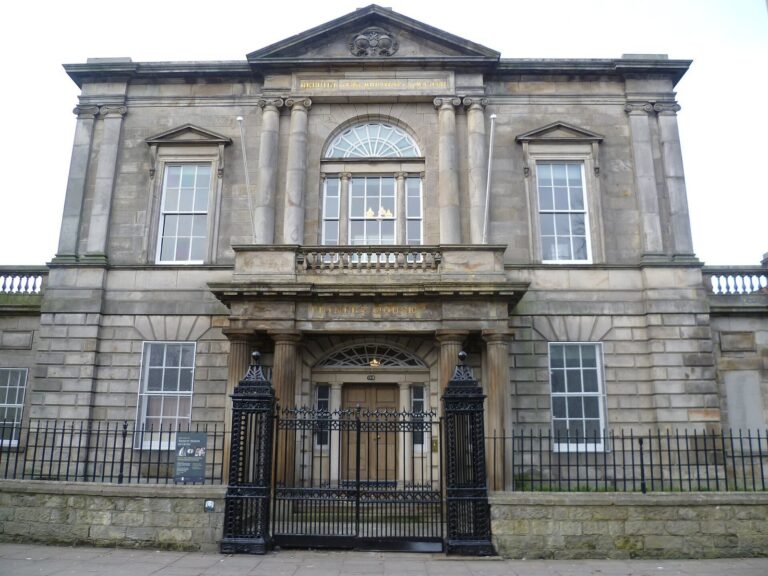
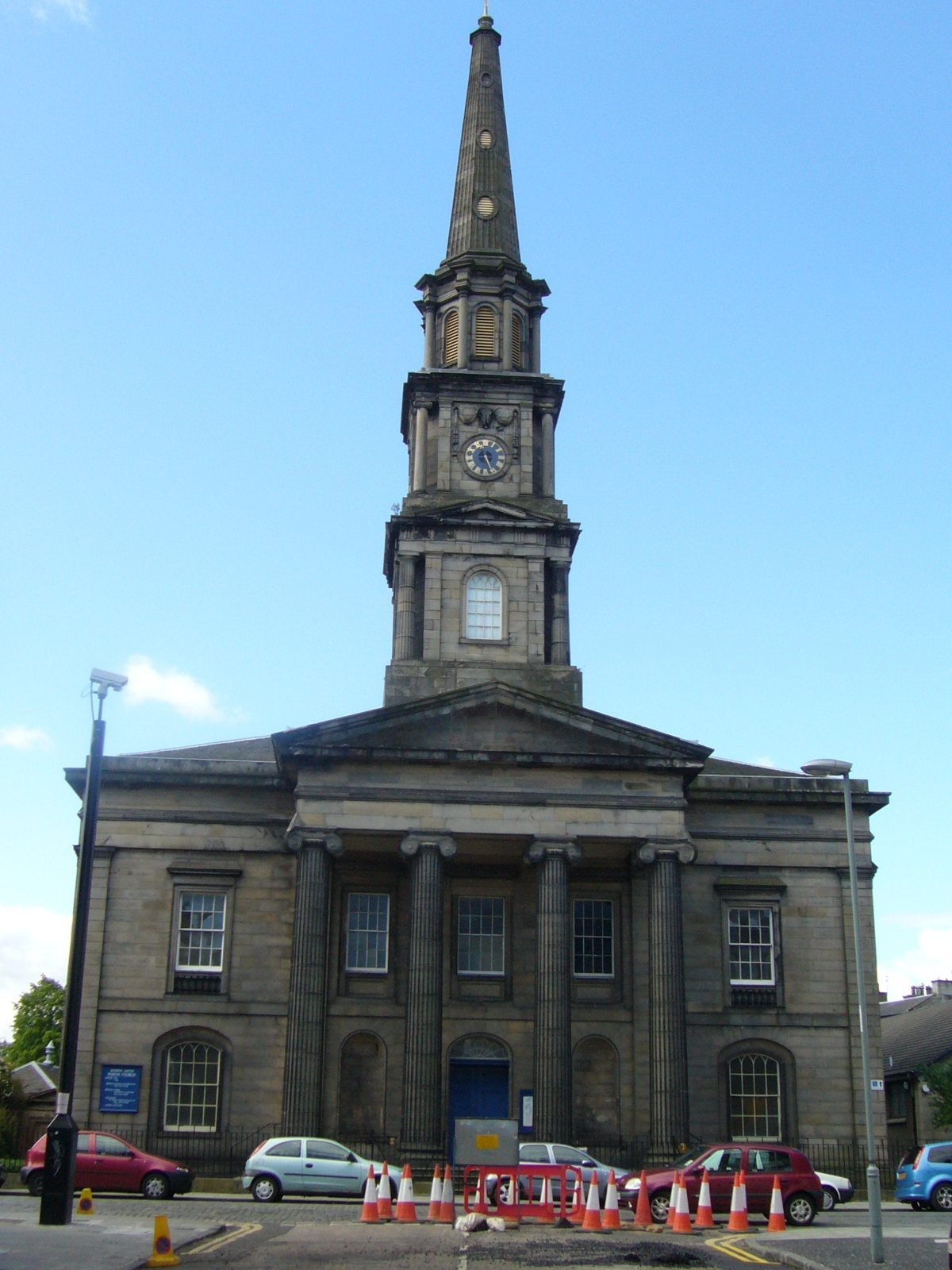
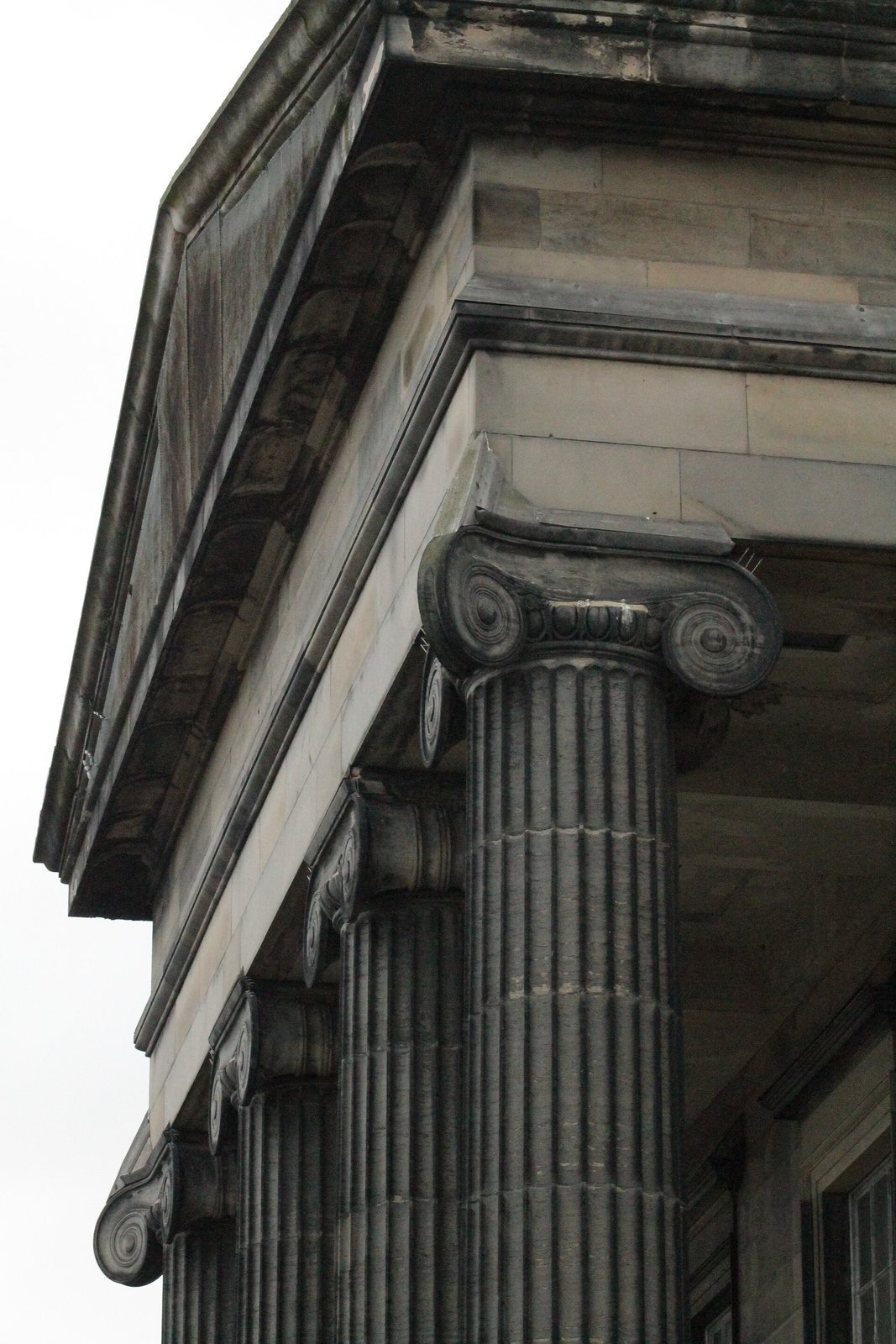
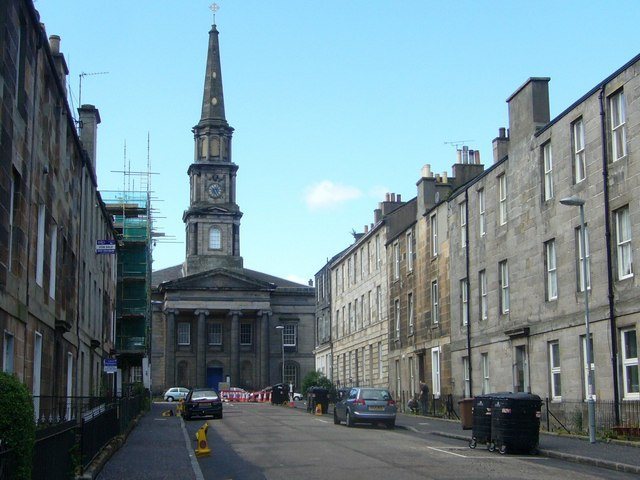
Designed by Scottish architect William Burn, the Madeira Street church has a Neoclassical exterior drawing on ancient Greek and Roman forms. Its portico is supported by four large Ionic columns, a classical Greek type with scroll-shaped capitals. A clock tower and slender spire rise above the building. It was planned to accommodate 1,300 people. Wadsworth of Manchester supplied a pipe organ in 1880. Bombing damaged the church in 1941, and repairs were completed by 1950.
The Earlier Church
Galleries were installed inside the older church during its extensive eighteenth-century renovation. Its Dutch-style tower, added in 1675, survives incorporated into a mill.
Churchyard and Burial Grounds
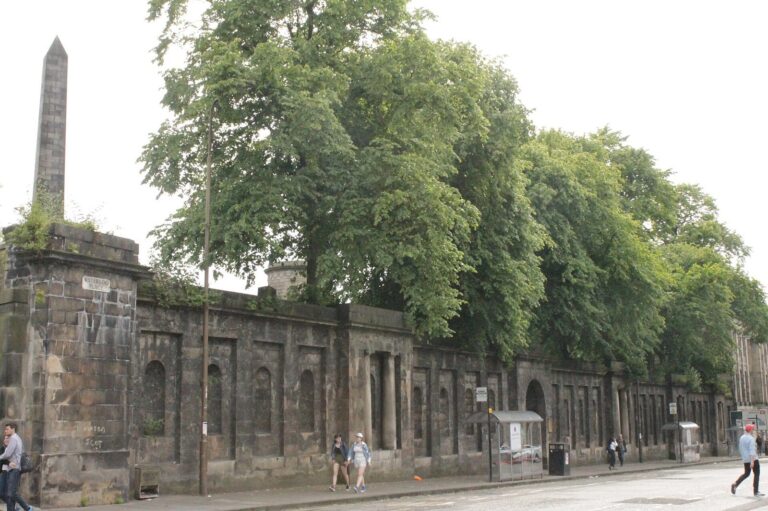
Coburg Street Burial Ground
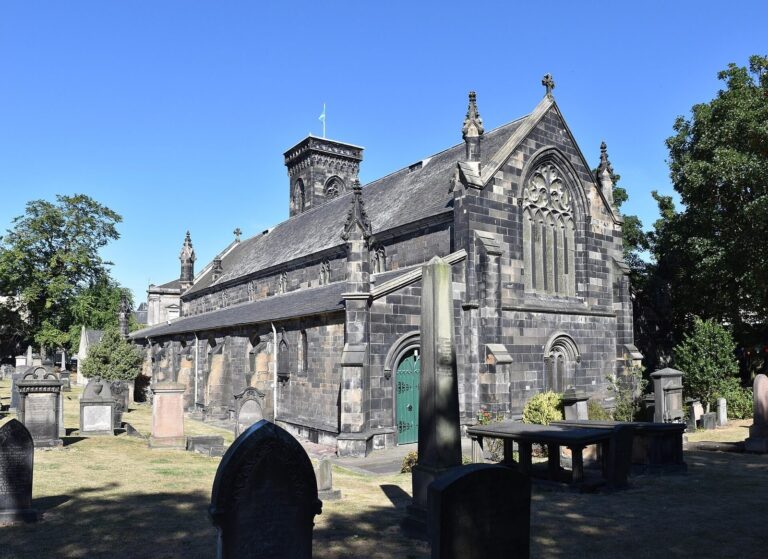
The Coburg Street burial ground lies apart from the old church and formerly reached the Water of Leith. The Water of Leith Walkway was formed along the burial ground’s inner edge in 1981, and a number of graves were lost during the work. Those buried there include poet Robert Nicoll, the Reverend David Johnston, and Colonel Anne Mackintosh, associated with the military leadership of the Jacobite rebellion, a movement supporting the Stuart claim to the British throne.
Gladstones’ Tomb
An altar-shaped raised tomb for Thomas Gladstones stands in St Ninian’s old churchyard.
Associated Buildings
Leith Mount
Leith Mount, the minister’s residence, occupied a substantial plot on Ferry Road south-east of the church. Its grounds included gardens and orchards. The site was cleared in 1920 for Leith Theatre.
North Leith Free Church, Coburg Street
The first North Leith Free Church stood at the corner of Coburg Street and North Junction Street, east of the parish church, and could hold 1,000 people. The former church site was redeveloped as tenements.
North Leith Free Church, Ferry Road
The later Free Church stood south of the original building and had room for 1,100 people. It was demolished in 1981. A datestone from the building was salvaged and reused in the church’s halls.