Tour Sans Venin: The Keep of the Château de Pariset
Site at a Glance
- Popularity
- Medium
- Country
- France
- Primary era
- Medieval
- Eras represented
- Medieval
- Civilizations
- Holy Roman Empire
- Site type
- Military
- Remains
- Castle
On this page7 sections
History
Tour Sans Venin is a ruined castle tower at Seyssinet-Pariset in Isère, France, associated with the thirteenth-century Château de Pariset. It is the castle’s last surviving remnant, although the tower’s broader history remains conjectural.
The Château de Pariset
An inquiry in 1339 recorded the castle as belonging to the Dauphins of Viennois, the rulers of Dauphiné, whose hereditary title was Dauphin. Other documents mention the castle’s lords in connection with a territorial dispute with Sassenage and an act concerning the Dauphin’s ownership.
The tower is also counted among the Seven Wonders of Dauphiné, a label for notable places in the historic region.
Traditions about the name
The origin of “Sans Venin” is explained by several unverified stories. Some say snakes could not approach or live near the castle, or that local soil healed snakebites. Another tale attributes the effect to soil a returning crusader lord brought from near the Holy Sepulchre, the traditional tomb of Jesus in Jerusalem.
Other versions credit Roland, a Frankish hero of medieval epic tradition described as Charlemagne’s nephew, with scattering soil from Paris to repel crawling creatures. Additional explanations propose that a temple to Isis, an ancient Egyptian goddess associated with magic and protection, once stood there; that viper’s bugloss grew on the rock; or that “Sans Venin” expressed the town’s wish for peace.
A different proposal derives the name from Tour Saint-Véran. In this explanation, the saint’s name became Vérin, then San Verin in Franco-Provençal, a Romance language historically spoken in the Alpine region, before taking the form Sans Venin. The theory was challenged in the nineteenth century because the nearby chapel was said to have always been dedicated to the Virgin. A separate dedication of the tower to Saint Véran was nevertheless considered possible.
Remains
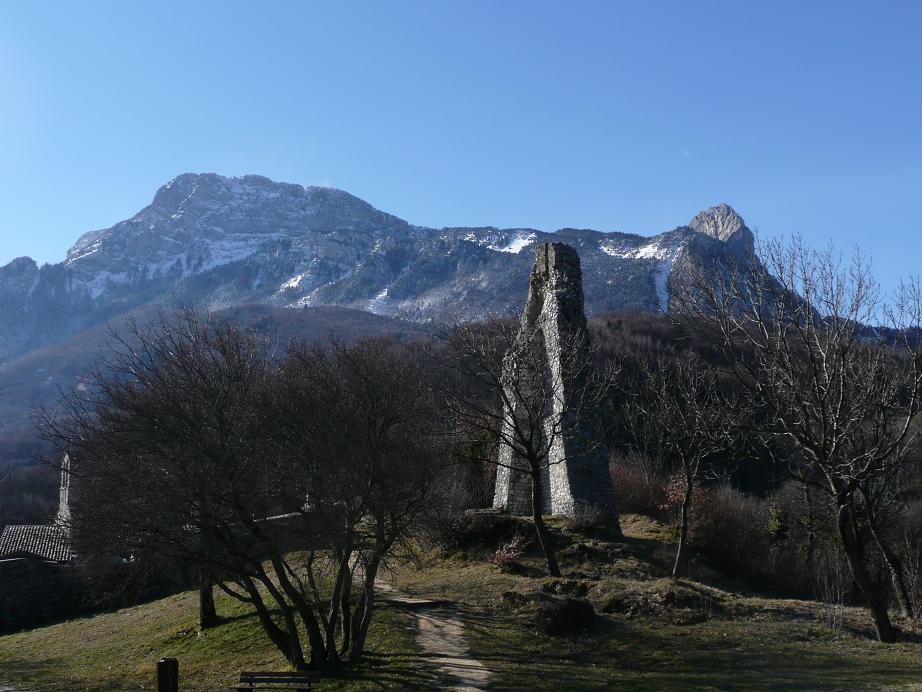
The remains occupy a hill in the heights of Seyssinet-Pariset, at 666 metres above sea level on the foothills of the Vercors, about 450 metres above Grenoble. The site includes the ruined castle tower, possible traces of other castle structures, a chapel at its foot, and a telecommunications transmitter. Views extend across the Isère and Drac valleys and the Chartreuse and Belledonne ranges; Mont Blanc is visible in clear weather.
Castle remains
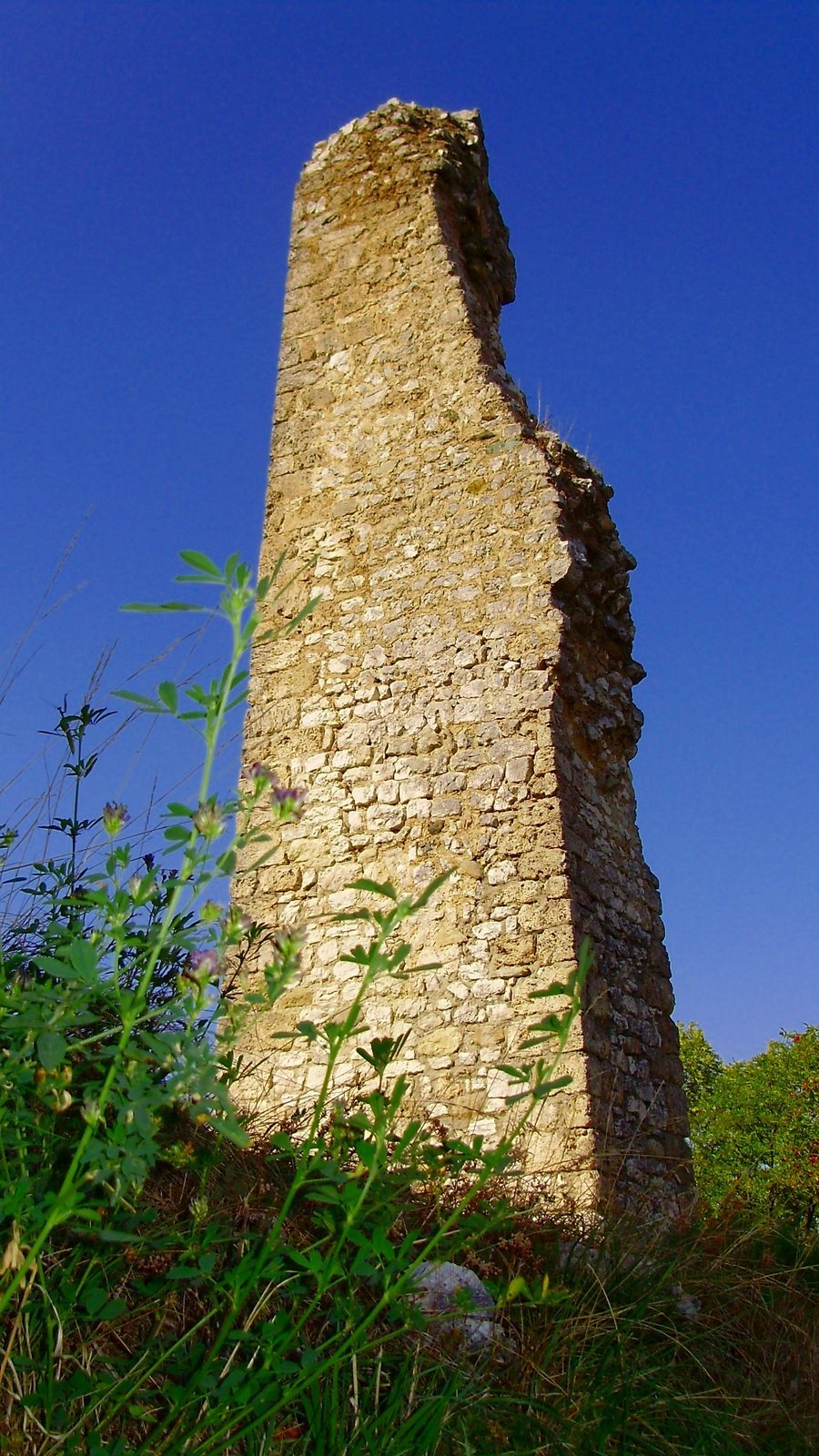
One angle of the ruined structure identified by many medievalists as the keep is clearly visible. A keep was a castle’s principal fortified tower. Possible traces of curtain walls, which enclosed a castle’s outer court, a round tower, and a cistern, a structure for storing water, have also been discerned, though tentatively.
Notre-Dame de Pariset Chapel
The small Notre-Dame de Pariset chapel stands at the foot of the former tower. It dates to the thirteenth century and is Romanesque, a medieval style associated with rounded arches and heavy masonry. Its roof is covered with canal tiles, curved tiles arranged to channel rainwater.
Telecommunications transmitter
A telecommunications transmitter identified as “Grenoble 2 – Tour sans Venin” also occupies the site.