Château de Chaulnes: A Former Seigneurial Residence in France

Site at a Glance
- Rating
- 4.6
- Popularity
- Low
- Country
- France
- Primary era
- Early Modern
- External website
- Open
- Eras represented
- Early Modern, Modern
- Civilizations
- French
- Site type
- Domestic
- Remains
- Manor House
On this page10 sections
History
Château de Chaulnes is a former seigneurial residence at Noyarey in France, built in the second half of the seventeenth century as the Chaulnes family established itself in Dauphiné. A seigneurial residence served as the principal home and administrative center of a local noble family. The château occupied an important place in the history of the Noyarey domain, which passed through several noble, ecclesiastical, military, and private owners.
Origins of the Chaulnes domain
An earlier building, probably a hunting pavilion, had served as a residence for the baron of Sassenage. In 1531, Anne de Montaud sold the lands of Veurey and Noyarey to François Vachon. Antoine de Chaulnes acquired the lands from Marc de Vachon in 1613, and the Noyarey domain later returned to the Chaulnes family through Marguerite de Chissé, the wife of Claude de Chaulnes. The family’s earlier origins were associated either with Picardy or with the Tonnerrois in Burgundy.
Joseph de Chaulnes secured the elevation of the domain to a marquisate through letters patent issued in March 1684 and registered by the Parlement of Dauphiné on 19 August that year. A marquisate was a territorial lordship held by a marquis, while letters patent were formal royal documents establishing or confirming legal privileges. Joseph’s brother Paul de Chaulnes, bishop of Grenoble from 1721 to 1725, later headed the domain.
Ecclesiastical ownership and the Caulet family
Guinetière de Chaulnes, the last descendant of this branch and without a direct heir, left the lands of Noyarey and Veurey to Grenoble General Hospital when he died in 1741. The hospital, burdened by debt, sold the lands in 1743 to Jean de Caulet, bishop of Grenoble from 1727 to 1771. He used the château as a summer residence.
The property subsequently passed to Jean de Caulet’s nephew, Tristan de Caulet, Marquis de Grammont. He was a knight of Saint-Louis and a member of the Beauveau company of the King’s bodyguard, a royal elite guard formation. After Tristan’s death during the Terror, the period of intense political repression during the French Revolution conventionally dated to 1793–1794, the château passed to Adélaïde Caulet.
The Thomas and Deverre periods
Joseph-Marie Thomas, a military intendant responsible for military administration and logistical affairs in Grenoble, acquired the château in 1830. Charles X had granted him a personal barony in March 1827, and the title was made hereditary for his son in June 1845. Thomas altered the building by adding two turrets at its ends. After his death in 1849, his son Hippolyte Gatien Baron Thomas inherited the domain and died there on 25 July 1878.
Because the inheritance was divided among several heirs, the Thomas family sold the estate to the family of General Édouard Deverre. A newspaper article dated 8 July 1927 reported that General Deverre had been assassinated on the Grenoble–Lyon train while returning from the château, which was then owned by his nephew, Captain Jean-Victor Deverre. Jean-Victor later completed his military career as a general and kept the property until his death in 1973.
Later uses and changing names
After the First World War, American patronesses associated with the Methodist Episcopal Church of New York established several orphanages. One institution for boys occupied the château’s outbuildings before the children were transferred to another institution in La Tronche.
The Deverre family acquired the domain during the 1920s, and the château was sold to a restaurateur during the 1980s. It remains privately owned. In the twenty-first century, interior restoration, including work on the grand staircase, has supported its use for weddings, seminars, exhibitions, and other private and public events. The property was listed in Noyarey’s cadastres between 1849 and 1914 as “Château des Glairons” and “Maison et Chapelle des Glairons,” names connected with the nearby Glairons area and its sandy ground on the silty basin of a former bed of the Isère. The château and domain were in generally good condition in 2020.
Remains
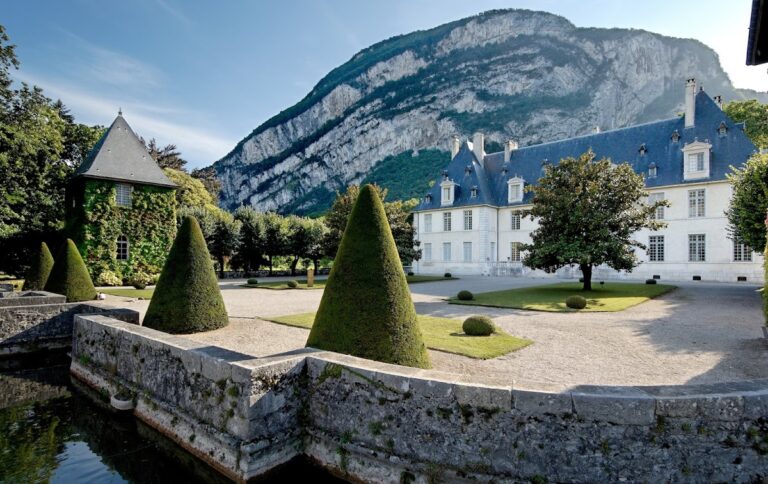
The château stands on an eminence at the foot of the Vercors cliffs, above the Isère valley and near the entrance to Noyarey from Sassenage and Grenoble. Its estate includes the principal residence, a garden, a pond, a small ruined chapel, and a large terrace oriented toward the rising sun, with views toward the Chartreuse massif.
The principal residence
Seigneurial house
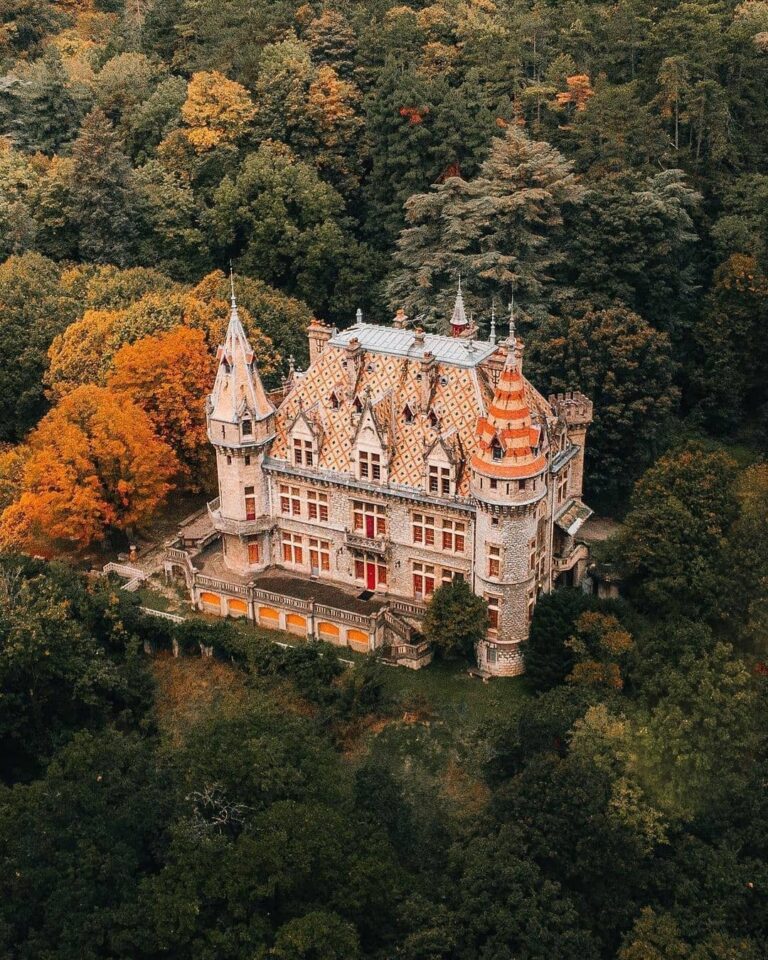
The main building retains the form of a large seigneurial house. Its principal block has two storeys and a vaulted cellar. The exterior was altered in the nineteenth century by the construction of two square turrets at opposite ends of the building, giving the residence a more prestigious appearance.
Interior finishes
Inside, the château retains old parquet flooring and mosaic floors. The rooms have undergone numerous restorations, including work on the grand staircase. Large rooms within the residence can accommodate up to 200 people and are used for receptions, seminars, exhibitions, and other events.
Garden and estate features
The grounds contain a garden, a pond, and a small chapel that survives in a ruined state. A broad terrace faces the rising sun and is oriented toward the Chartreuse massif. Together with the residence, these features form the surviving estate around the former Chaulnes family home.
Nearby sites