Jazak Monastery: A Serbian Orthodox Monastic Complex
Site at a Glance
- Rating
- 4.9
- Popularity
- High
- Country
- Serbia
- Primary era
- Early Modern
- Eras represented
- Early Modern, Modern
- Civilizations
- Austria-Hungary, Habsburg, Habsburg Austria, Hungarian
- Site type
- Religious
- Remains
- Monastery
On this page10 sections
History
Jazak Monastery is an active Serbian Orthodox women’s monastery in Jazak, Serbia, under the Eparchy of Srem, an Orthodox diocese. Its eighteenth-century complex grew from the earlier Stari Jazak after the remains of Emperor Stefan Uroš V brought pilgrims and helped prompt the construction of a larger monastery. The central church, dedicated to the Holy Trinity, reflects the Baroque style, a European tradition known for elaborate forms and ornament.
Stari Jazak and the imperial relics
Tradition places the founding of Stari Jazak in the late fifteenth century and credits Despot Jovan Branković, a Serbian ruler whose title was a high rank in late medieval Serbia. The monastery’s earliest written mention dates to 1522, in a Triod, an Eastern Orthodox liturgical book, copied by the monk Lavrentije. Monks at Stari Jazak also copied religious books.
Monastic life appears to have stopped for a time during the seventeenth century. It may have resumed during the Great Migration of Serbs in 1690, a major migration of the Serbian population. In 1705, the monk Hristofor brought the remains of Emperor Stefan Uroš V from the Church of the Dormition in Gornje Nerodimlje, now in Kosovo, to Stari Jazak. Uroš was the last ruler of the medieval Serbian Nemanjić dynasty. His relics raised the monastery’s standing and attracted pilgrims from Srem and other parts of Serbia. As the church and accommodation could no longer serve the growing number of visitors, a new, larger monastery was planned.
The eighteenth-century monastery
Work on the new monastery began in 1736, during the leadership of Metropolitan Vićentije Jovanović, a senior Orthodox bishop, and Abbot Stefan Dimitrijević. Metropolitan Pavle Nenadović consecrated the Holy Trinity Church on June 7, 1758. The old monastery’s inventory, including Uroš’s relics, was moved to the new complex. Serbs in Novi Sad, Baja, Osijek, Šid, Šašinac, and elsewhere in Srem contributed to its construction.
After the monks moved, Stari Jazak became a women’s monastery. Empress Maria Theresa’s decree of 1773 dissolved it, and its buildings soon fell into ruin and were demolished. The new Jazak Monastery held imperial privileges during the eighteenth century. In his assessment of the monasteries of Fruška Gora, art historian and academician Dejan Medaković placed Jazak third for its contribution to Serbian spiritual life, after Krušedol and Vrdnik.
War and restoration
After the First World War, agrarian reform took 250 jutra of land from the monastery, using a traditional measure whose size varied by region and period. The land was returned in neglected condition in 1928. Temira Popović took responsibility for managing it under an agreement with Archimandrite Valerian Pribićević, a senior monastic cleric. The largest and most detailed renovation works on the complex took place from 1926 to 1930, during Pribićević’s tenure.
Heavy fighting took place nearby in the summer of 1942. On August 19, as Yugoslav Partisans, a communist-led resistance movement, withdrew, they set fire to the monastery; part of a building burned. German forces removed roof tiles and other materials for reuse, while German troops and the Ustaše, a Croatian fascist movement, looted and devastated the buildings. Vladimir Tkalčić, director of Zagreb’s Museum of Arts and Crafts, removed 79 objects with Ustaše support. Ustaše officer Anton Bauer took the remaining valuables.
The complex was renovated after the war, and extensive work took place again in the 1990s. Serbia recognized the monastery as a cultural monument in 1949; it is state-protected as a Monument of Culture of Exceptional Importance.
Tradition and the present community
A tradition recounts that in the winter of 1983 the Athonite monk Porphyrios Bairaktaris, later venerated as Saint Porphyrios of Kavsokalyvia, telephoned the abbess. He warned her that Yugoslav communist authorities had poisoned the monastery’s water to kill the nuns and close the monastery. He advised her to use a spring in a nearby forest and described its location, although he had never visited Serbia. The tradition treats the episode as spiritual clairvoyance, a claimed ability to perceive things beyond ordinary senses. Eleni Konstandoulaki recounted it in spring 1995, and Dragana Simić confirmed and added details in 1996. The monastery remains an active women’s community. Abbess Paraskeva Drapšin has led it since 1990, and the community comprises eleven nuns.
Remains
The present complex
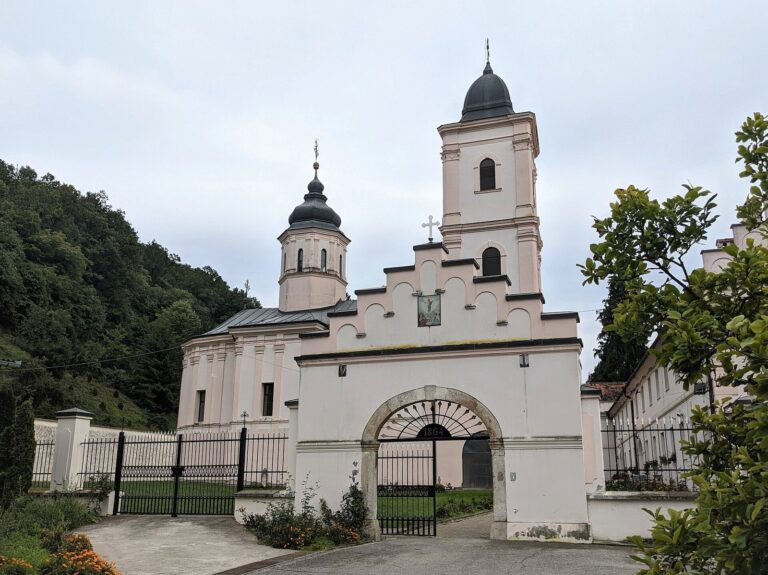
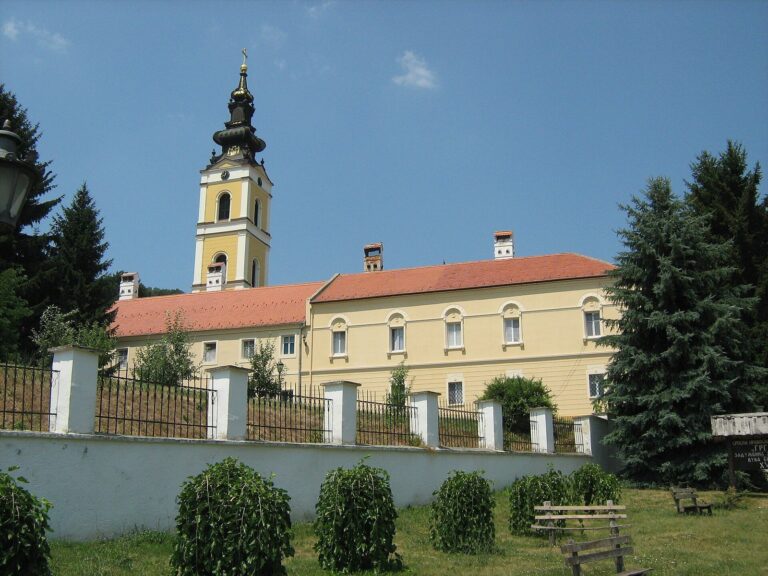
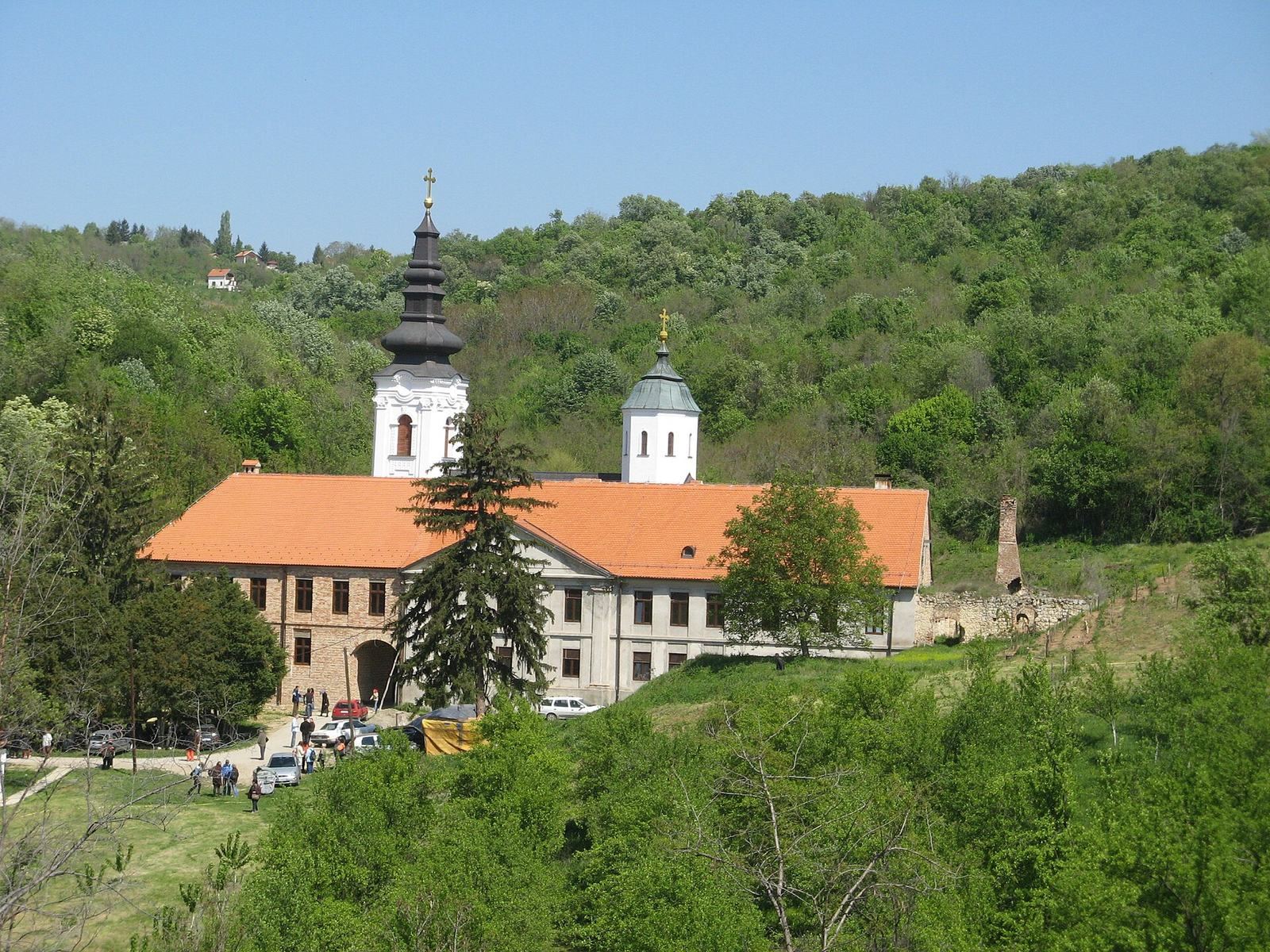
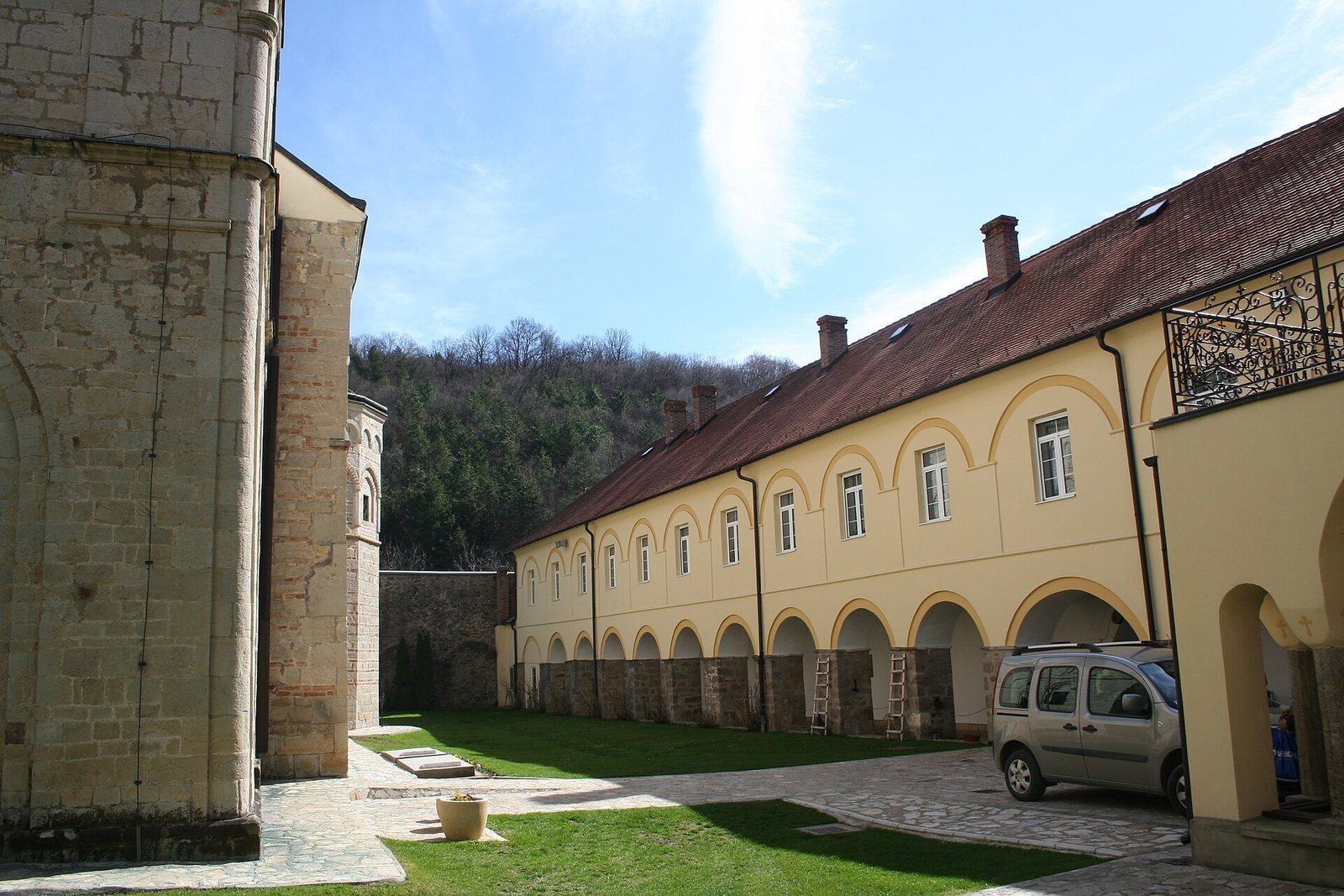
The monastery stands on level ground at the end of a small valley on the southern slope of Fruška Gora, in the area of Gradac within Jazak village. It lies between two clearings. The complex is arranged around a central church, with residential buildings enclosing the courtyard on three sides. A high wall with a covered, arched entrance forms the fourth side. A monastic estate settlement stands immediately beside the complex, along the road toward Jazak village.
Holy Trinity Church
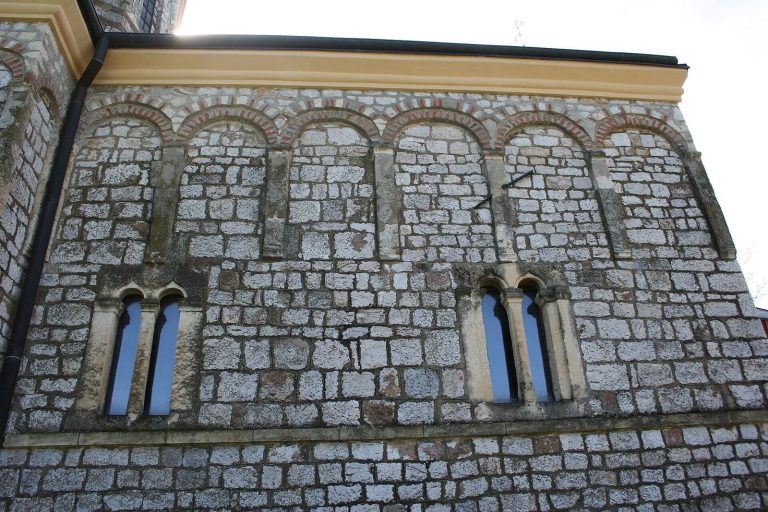
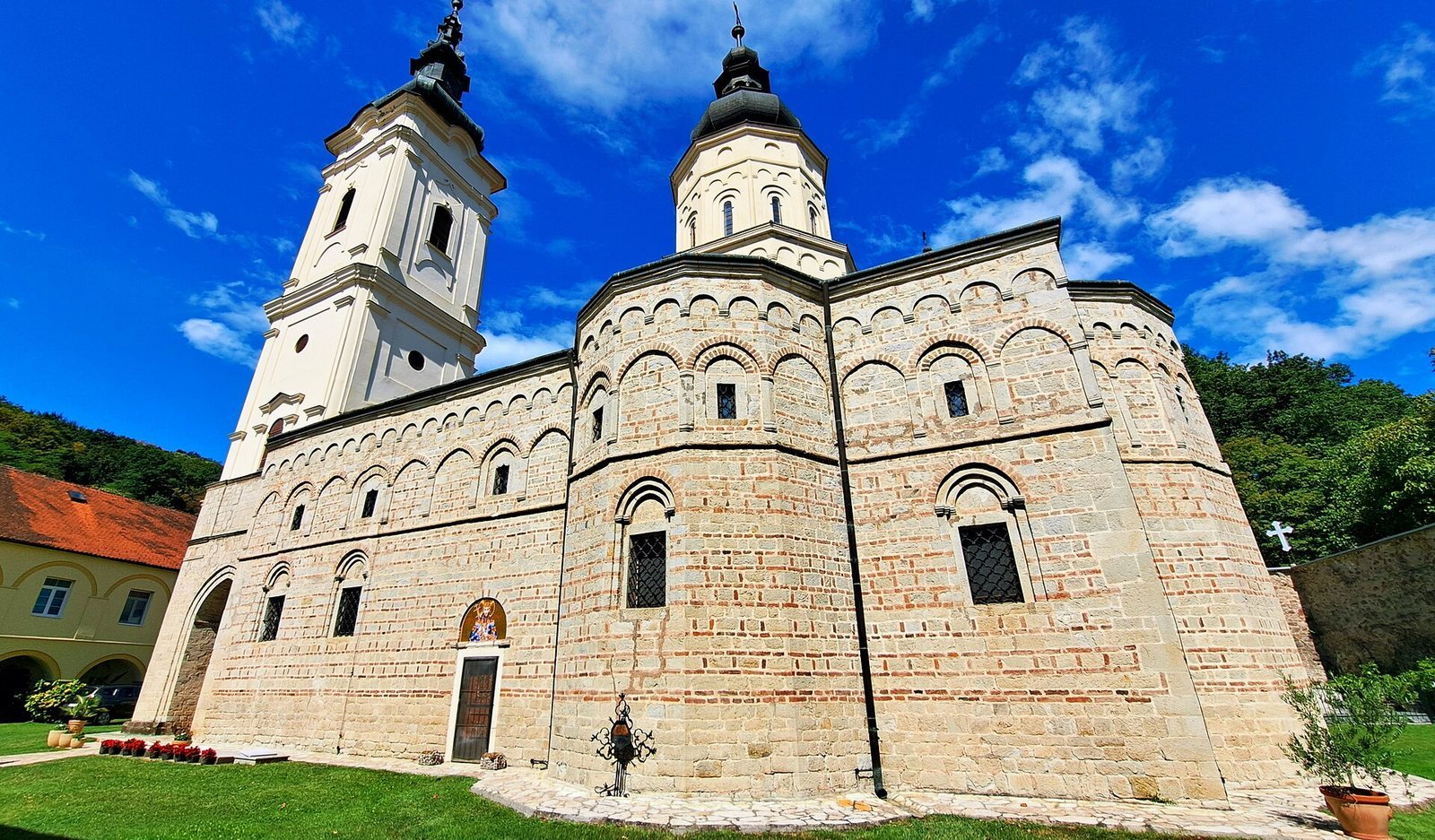
The church combines traditional Serbian design with Baroque forms and is built of red brick and white stone. Its façade has decorative elements in a Turkish style. A massive, three-storey Baroque bell tower stands against the church’s western façade. Its completion is dated either to 1753 or to the beginning of the nineteenth century.
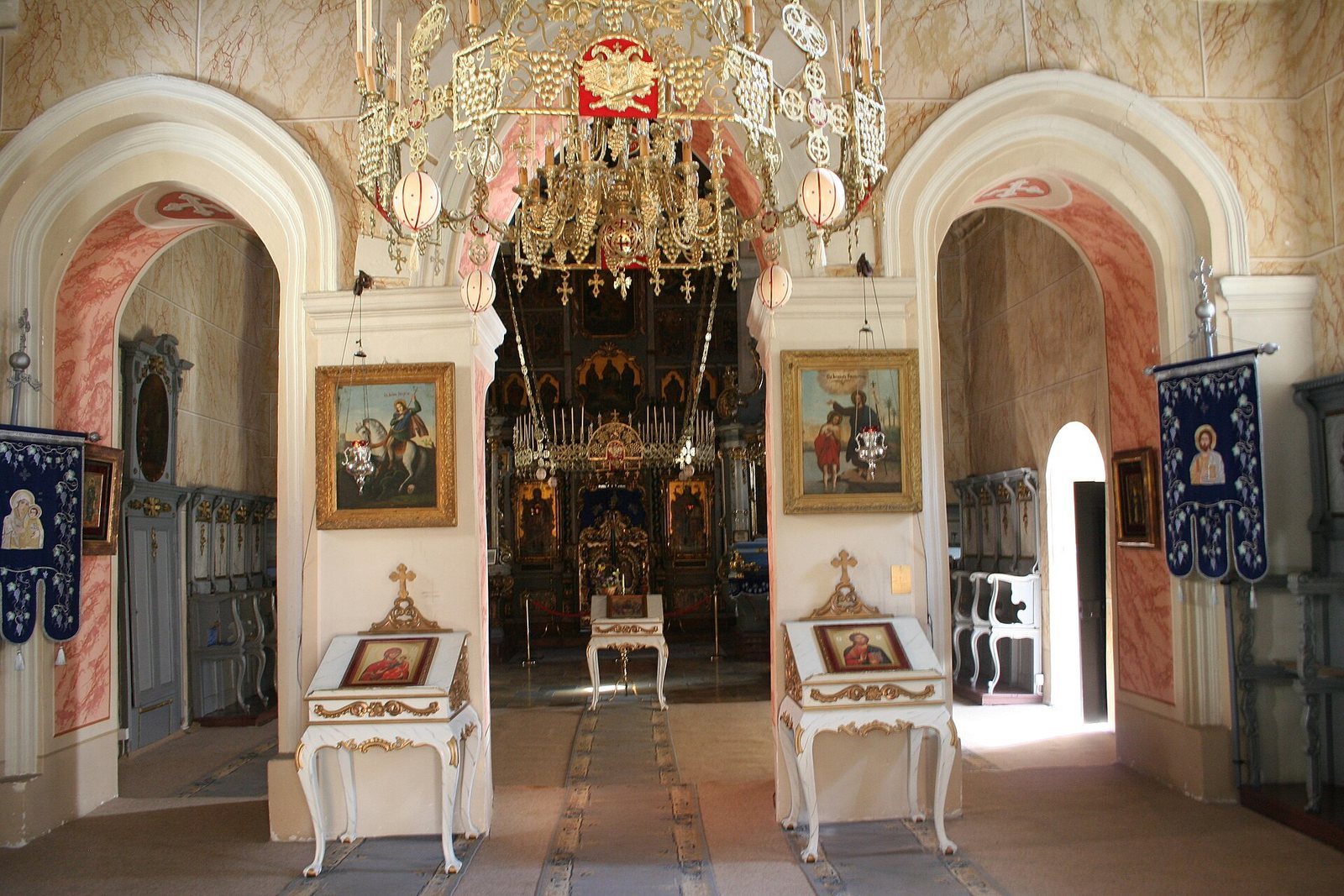
The church’s iconostasis, a screen of icons separating the sanctuary from the main worship space, contains 58 icons made between 1759 and 1769. The paintings are associated with Dimitrije Bačević and his assistants Teodor Kračun and Dimitrije Popović. Their style is Ukrainian Baroque, a regional form of Baroque shaped by Eastern Christian traditions, with some influence from transitional eighteenth-century Serbian religious painting. Engraver Marko Vujatović is credited with the carved woodwork. The icons include Serbian saints, among them the Branković despots, Stefan Štiljanović, and Archbishop Arsenije Sremac.
Three Baroque thrones in the church are decorated with icons: the throne of Tsar Uroš, dated 1776; the throne of the Virgin, dated 1779; and the hierarch’s throne, for a senior Orthodox bishop, dated 1784. The interior remained unpainted for a long period. In 1899, Pavle Čortanović painted oil images of saints and the Evangelists, the traditional authors of the four canonical Gospels, on the pendentives, curved surfaces that connect a square space to a dome.
Residential buildings and grounds
The western residential wing contains a library, a ceremonial dining hall, and a treasury holding valuable objects. A passage corridor runs through one wing of the residences, and graves lie within the monastery grounds.
Stari Jazak
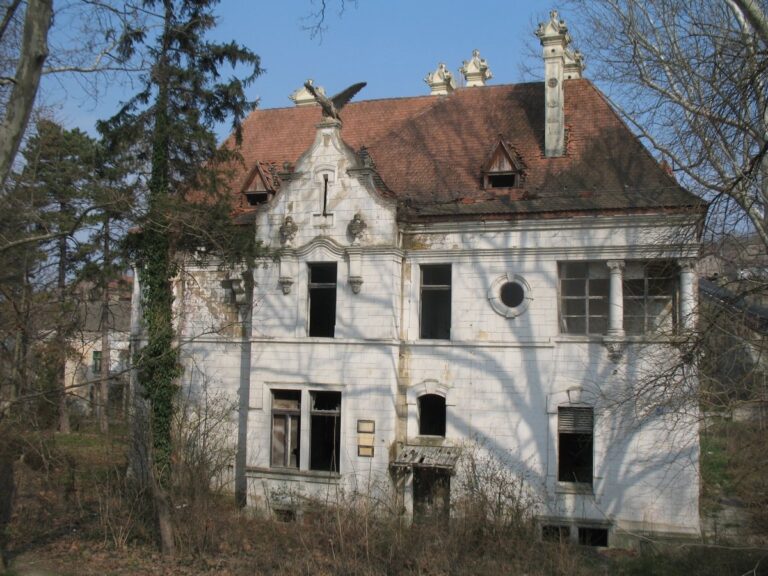
The remains of Stari Jazak lie about two kilometres north of the present monastery. Its church was dedicated to the Presentation of the Virgin Mary in the Temple and was painted. Ruins of the former monastery remain at the site.