Bhangarh: A Fort and Abandoned Settlement in Rajasthan
Site at a Glance
- Popularity
- Very High
- Country
- India
- Primary era
- Early Modern
- Eras represented
- Early Modern
- Civilizations
- Mughal, Rajput
- Site type
- Settlement
- Remains
- Town
On this page9 sections
History
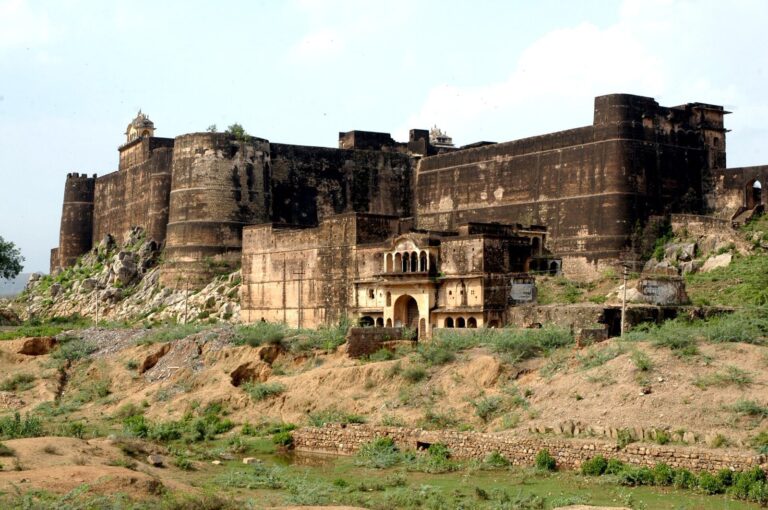
Bhangarh is a ruined settlement and fort in Alwar district, Rajasthan, India. It is also identified as a prehistoric site. Bhagwant Das, ruler of Amer and a member of the Kachwaha Rajput clan, a ruling clan associated with Amer and Jaipur, established Bhangarh in 1573 as a residence for his second son, Madho Singh. Bhagwant Das is also credited with building the fort that year.
Foundation and succession
Madho Singh was the younger brother of Man Singh I, a general of Akbar, the third Mughal emperor. Madho’s sons were Sujan Singh, Chhatra Singh, and Tej Singh; Chhatra succeeded him as ruler of Bhangarh.
Mughal connections and annexation
Ajab Singh, Chhatra Singh’s son, held the rank of mansabdar, an imperial position with military and administrative responsibilities. He founded a settlement in his own name. His son Kabil Singh and grandson Jaswant Singh lived there, while another son, Hari Singh, lived at Bhangarh and later became its ruler.
During the reign of Aurangzeb, the sixth Mughal emperor, two of Hari Singh’s sons converted to Islam and were given Bhangarh. After Mughal power weakened, Sawai Jai Singh II, an eighteenth-century Kachwaha ruler, killed the brothers and forcibly annexed the town in 1720.
Decline and local traditions
Chhatra Singh’s death in 1630 was followed by Bhangarh’s gradual decline. Its population fell after the annexation, and the town has remained uninhabited since the famine of 1783.
One local tradition links the fort’s destruction to a yogi, an ascetic practitioner of yoga, who meditated there. The story says he agreed to the fort’s construction on the condition that its shadow never reached his meditation place. As construction continued upward and the shadow fell there, he cursed Bhangarh.
A separate legend tells of a princess and a practitioner of traditions associated with Tantra who tried to win her. Enchanted oil caused a rock to roll toward him and kill him, after which he cursed both the town and the princess. These stories account for Bhangarh’s association with hauntings and its nickname, the haunted fort.
Remains
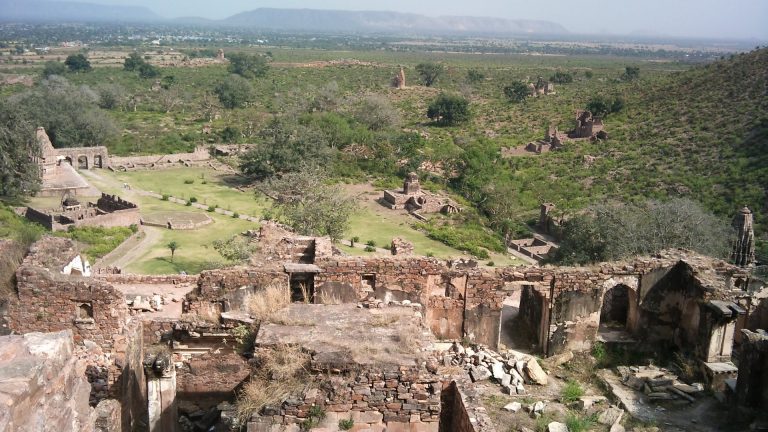
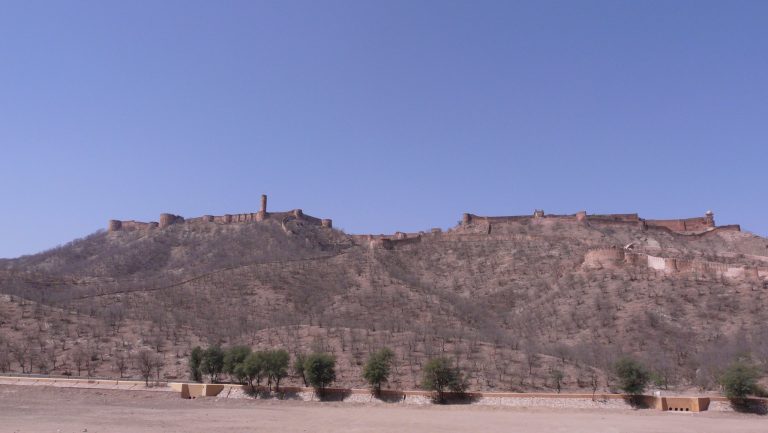
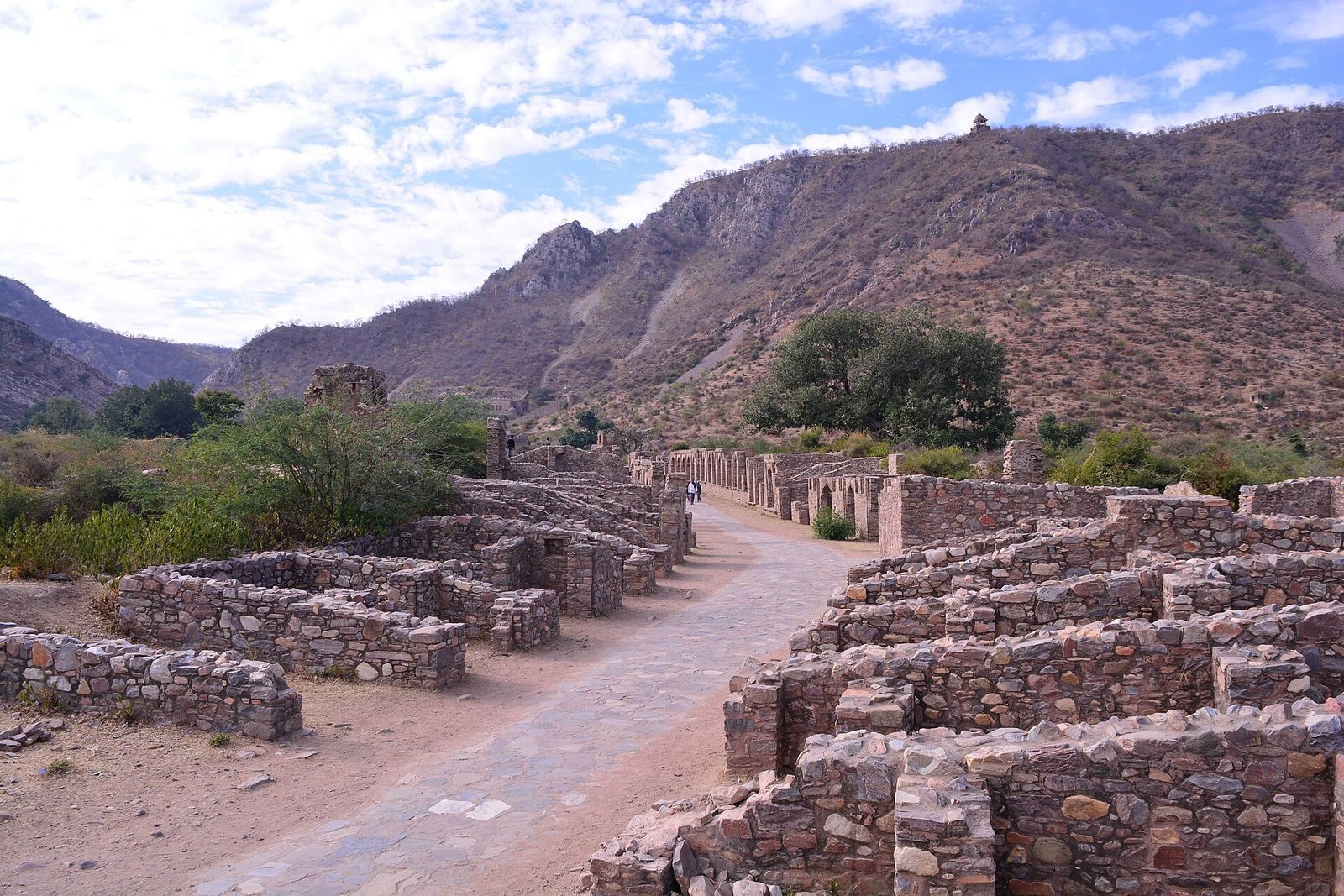
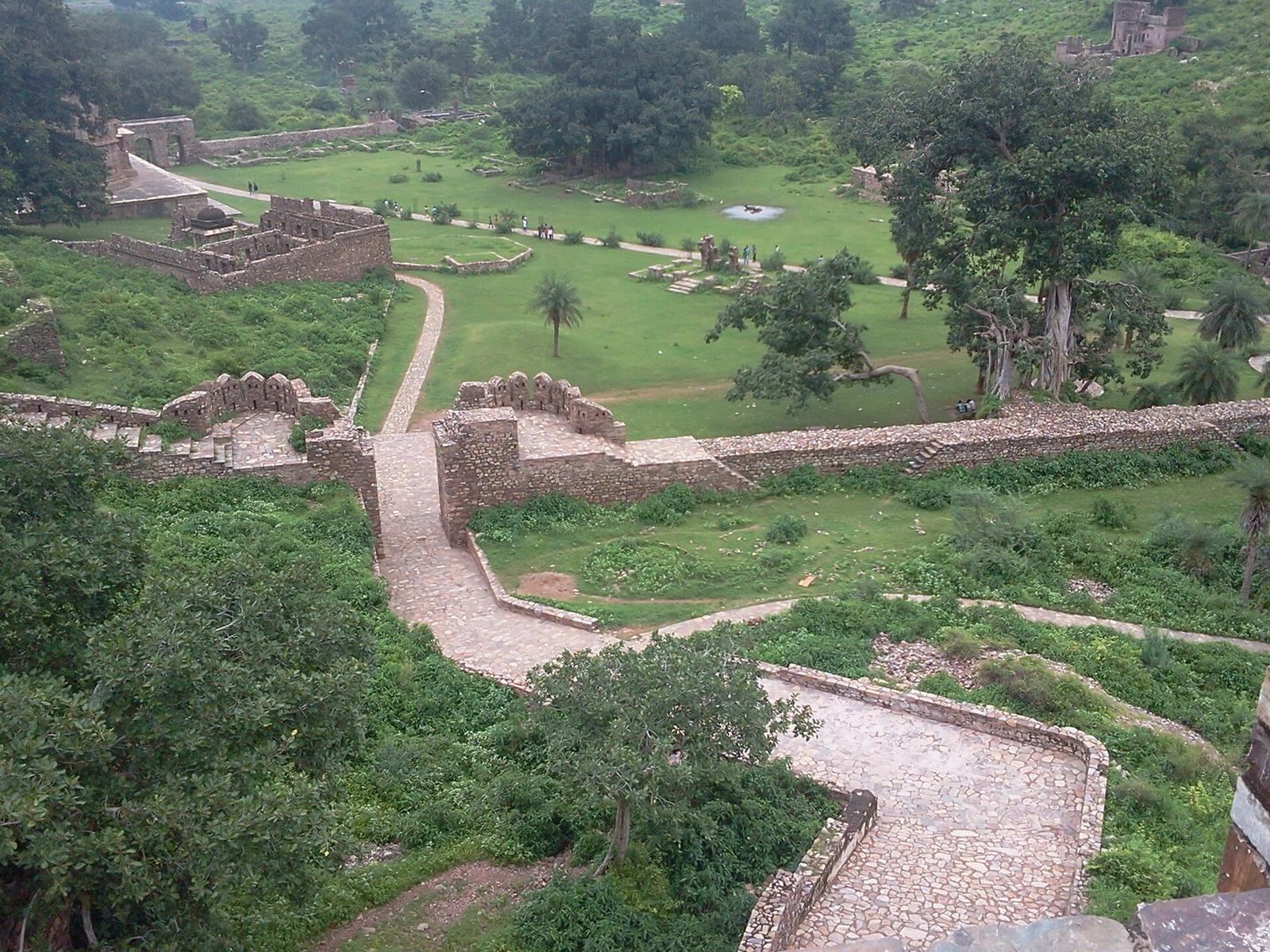
Bhangarh lies at the edge of the Sariska Tiger Reserve, with hills surrounding the fort. A line of defensive walls separates the town from the plain, and five gates pass through this boundary. A further wall encloses the fort itself.
Buildings within the fort
Market and residences
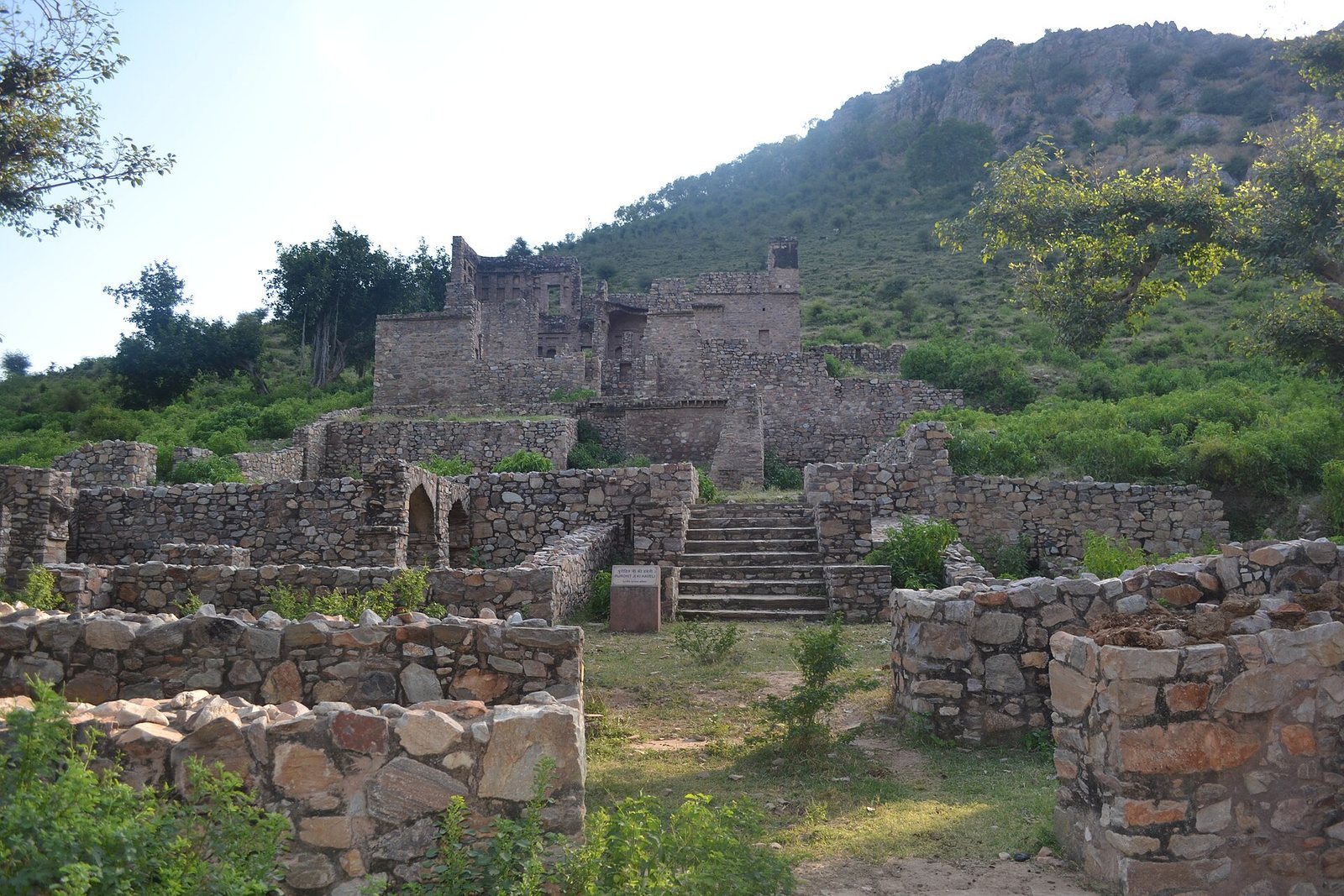
Several ruined havelis, or large traditional houses, stand to the right on entering the fort. Farther along, the market follows a road lined on both sides by rows of ruined, two-storey shops.
Palace
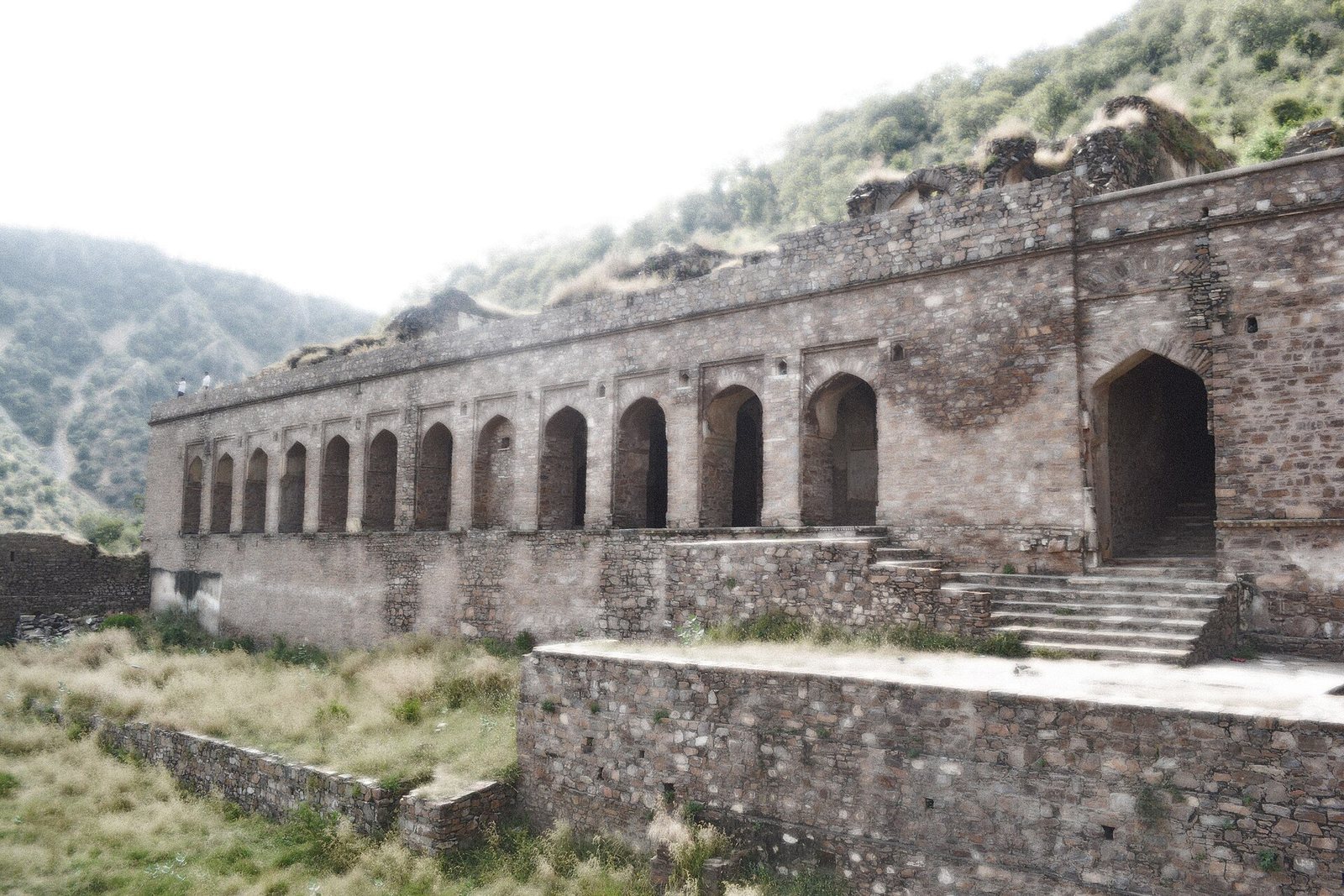
A three-storey palace stands at the far end of the fort. A double enclosure surrounds it, and it is also described as protected by two inner defensive structures across the valley. Its upper storey has almost completely collapsed.
Temples, mosque, and memorial
The complex includes Hindu temples dedicated to Gopinath and Keshav Rai, names associated with Krishna; Someshwar, an epithet of Shiva; and the Hindu deities Hanuman and Ganesh. Other temples honor Vishal Devta (a deity) and Lavina Devi (a goddess). A mosque also forms part of the complex. A samadhi, a memorial or tomb often associated with a Hindu ascetic, remains at Bhangarh and is linked by local tradition to the yogi.