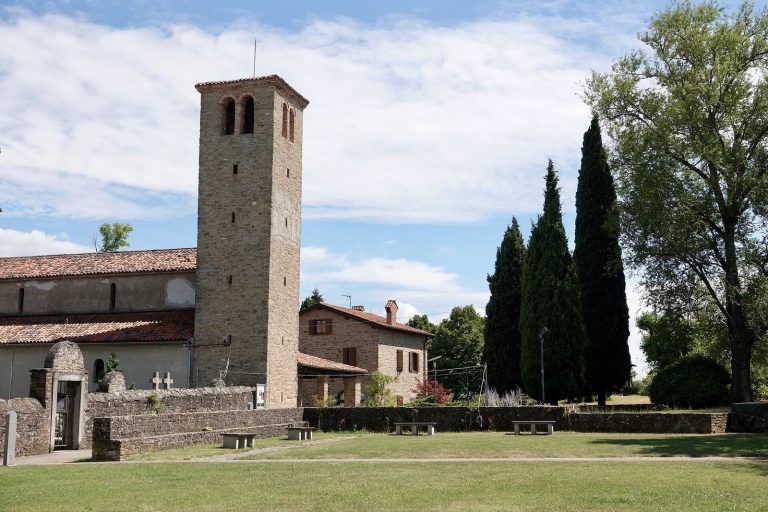
St. George’s Parish Church in Piran, Slovenia
Site at a Glance
- Rating
- 4.7
- Popularity
- High
- Country
- Slovenia
- Primary era
- Early Modern
- Eras represented
- Classical, Medieval, Early Modern, Modern
- Civilizations
- Austria-Hungary, Habsburg, Holy Roman Empire, Roman, Venetian
- Site type
- Religious
- Remains
- Church
On this page18 sections
History
St. George’s Parish Church is the active Roman Catholic parish church of Piran, Slovenia, dedicated to the town’s patron, Saint George, a Christian martyr traditionally portrayed as a dragon-slayer. The present building took shape in a major rebuilding begun after 1595 and was reconsecrated in 1637, with an exterior in Venetian late Renaissance forms. Today the parish belongs to the Diocese of Koper.
Early Christian and medieval churches
Christian remains in Piran date to the sixth century. The earliest identified church remains beneath and around the present building date to the ninth and tenth centuries, while a church on the hill is known to have existed by the twelfth century.
A Romanesque basilica, a church arranged around a central nave and side aisles, preceded the later Gothic church. By the late twelfth century, the church had a parish priest and a chapter of canons, a body of clergy attached to a church. It served as the principal church of a growing town.
The Gothic church, built in a later medieval architectural style, replaced the earlier basilica and was consecrated in 1344. Its construction coincided with Piran’s growth as a port under the Republic of Venice, a maritime state whose influence extended across the northern Adriatic. A local legend tells that Saint George saved the town from a severe storm on 21 July 1343. His feast is celebrated on 23 April.
Rebuilding under Venetian influence
Major rebuilding began after 1595, as the medieval church deteriorated and its arrangement no longer suited contemporary worship. The three-aisled church gave way to a spacious single-nave building with an elongated sanctuary. Its exterior adopted Venetian late Renaissance forms, while the interior was organized to accommodate a series of side altars. The church was reconsecrated on 25 April 1637, by which time its furnishings and decoration were complete.
Venetian stonemason Bonfante Torre was closely involved in the rebuilding. An inscription records a renovation led by him in 1608. The complex also gained a freestanding bell tower and a replacement baptistery. Work on supporting walls for the church hill began in 1641, followed by arches and vaults from 1663 to 1804. These works reinforced the slope and enlarged the terrace. The church’s position also served observation of the port, coast, and sea routes.
Restoration and present role
In 1881–1882, Trieste architect Giovanni Righetti directed a major restoration that altered the interior decoration, furnishings, and aspects of the architectural arrangement. His intervention shaped the church’s appearance for much of the twentieth century.
Archaeological and architectural investigations in the 1990s revealed earlier building remains, while conservation restored furnishings and recovered some seventeenth-century interior features. Work completed in 1998 strengthened the terrace supports. Further structural and restoration work in 2002–2005 included the interior paintings and sculpture. Conservation continued in the twenty-first century on the altars, artworks, tower, and baptistery. The baptistery was restored in 2014, the bell tower’s interior stairs in 2018, and its exterior renovation was completed in 2025. The church complex and its furnishings are protected as immovable cultural heritage and were declared a monument of national importance in 1999.
Remains
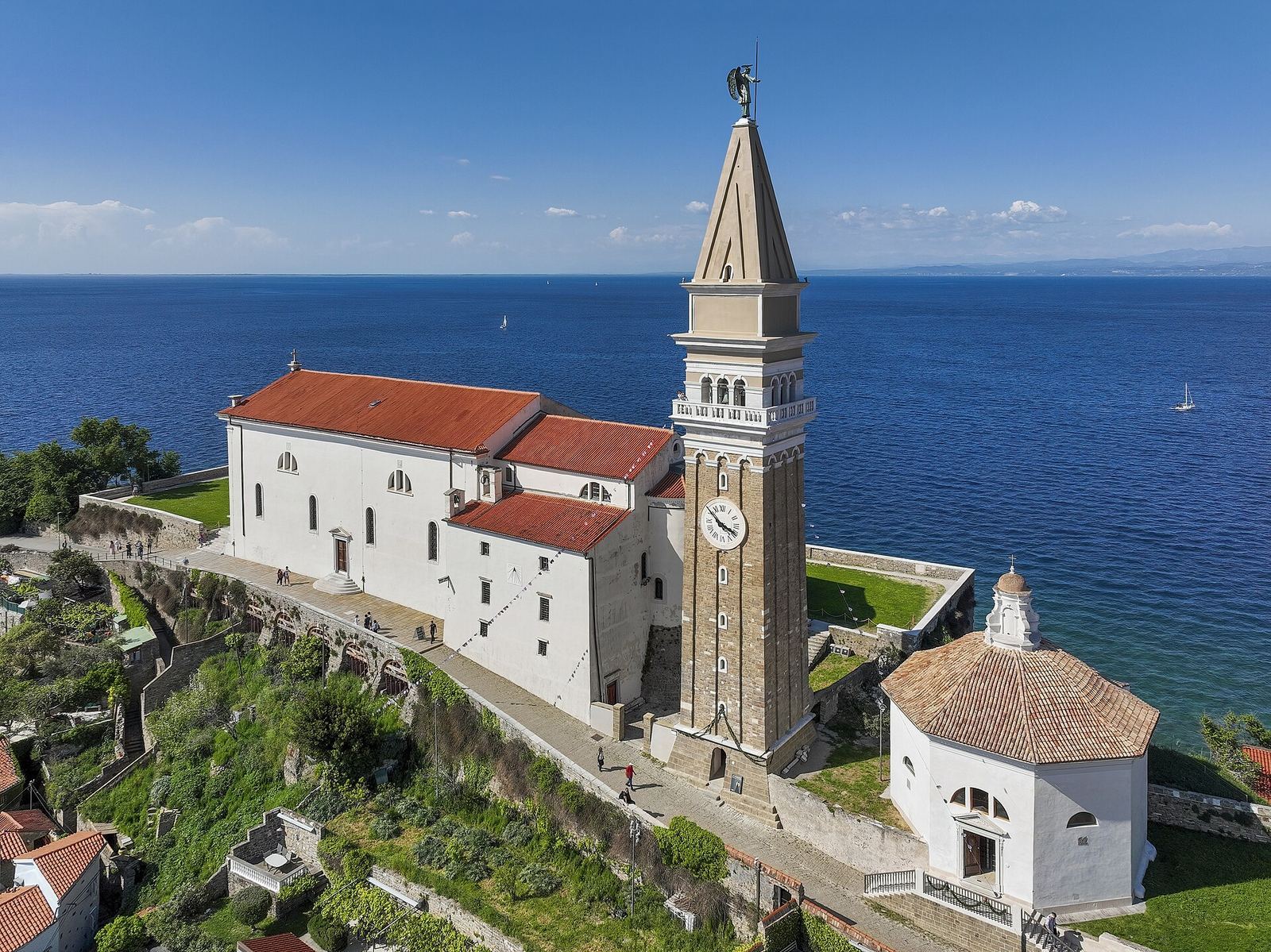
The complex occupies a high terrace on the ridge of Piran’s peninsula, above the historic town and the Adriatic. The church, freestanding tower, and baptistery form its principal buildings. The broad open space in front of the west facade was formerly the parish cemetery. Vaults, arches, and retaining walls support the artificial terrace, with stone arches reinforcing its sea-facing side.
Church architecture and furnishings
West facade
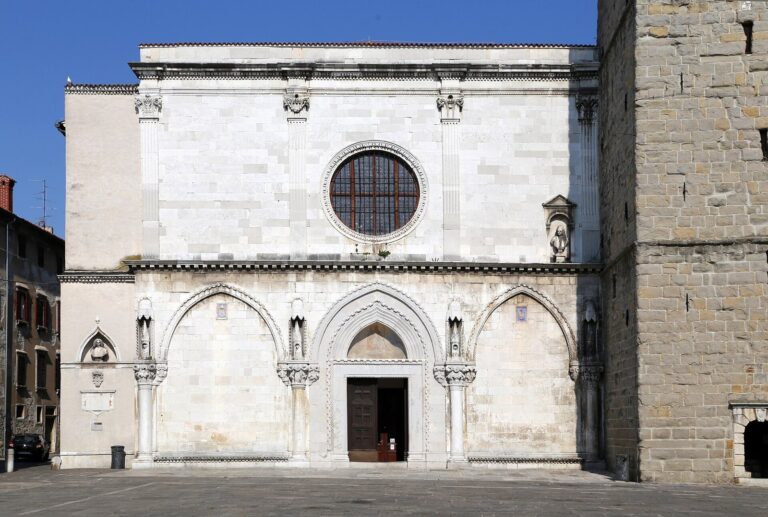
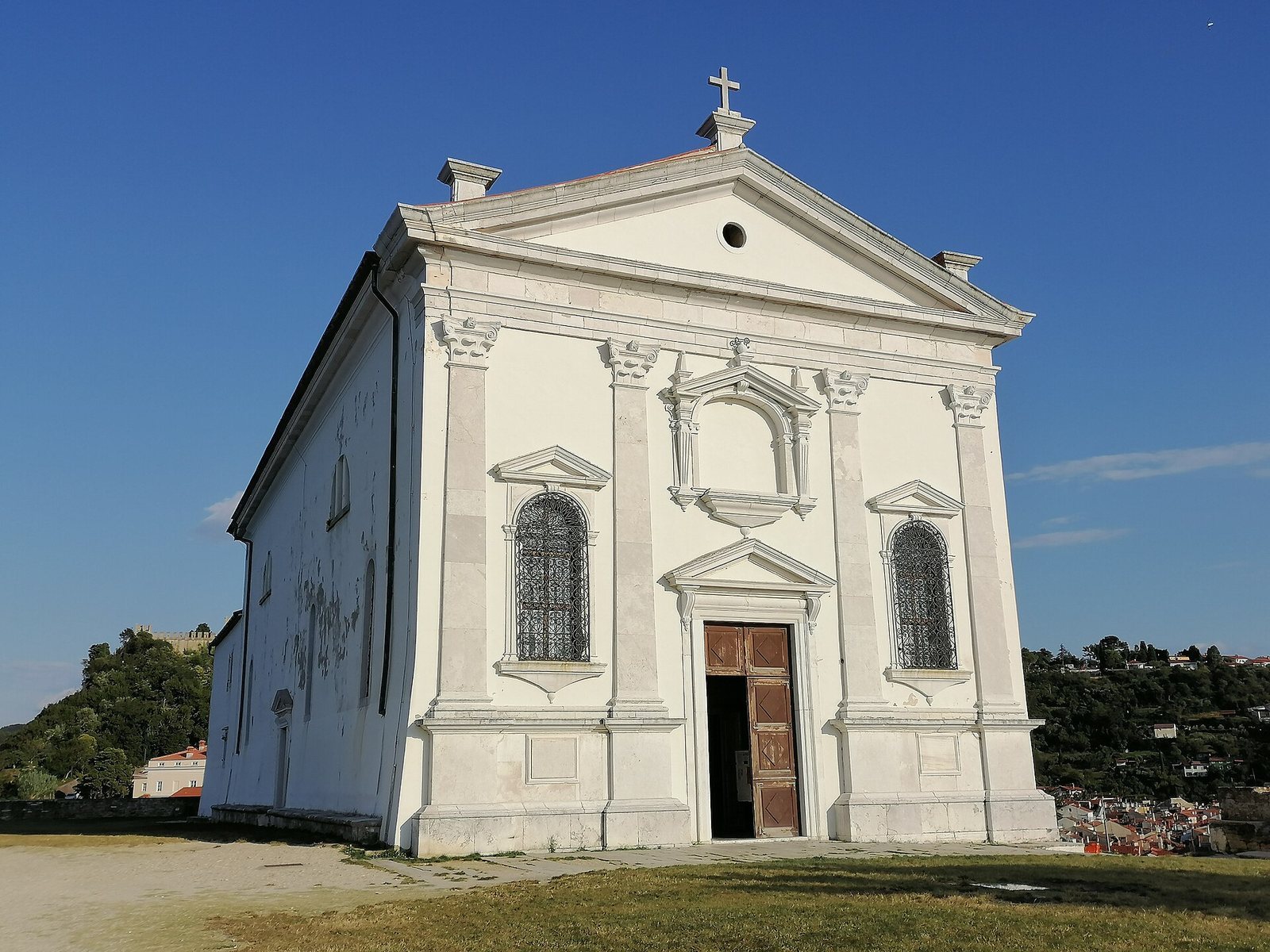
The symmetrical west facade is composed like a temple front. Pilasters, shallow columns attached to the wall, support an entablature, the horizontal structure above them, and a triangular pediment, the upper triangular part of the facade. Its design reflects Venetian Renaissance architecture and the influence of Andrea Palladio, but the church is not attributed to Palladio. A later Baroque pedestal was intended to carry a statue of Saint George. Stone plaques at the bases of the pilasters bear inscriptions commemorating the church’s consecrations and a later renovation.
Nave and sanctuary
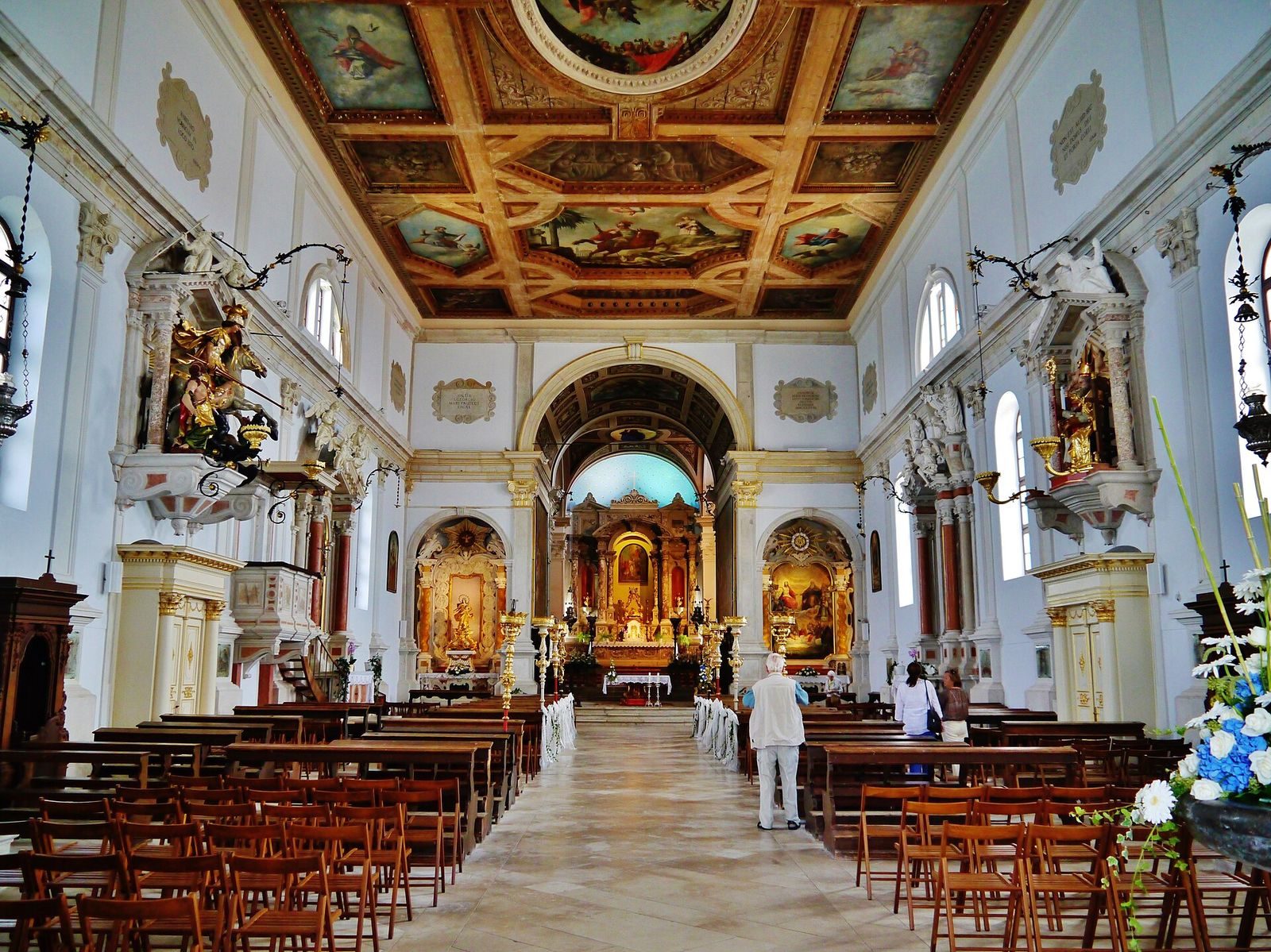
The church has one broad nave, the main space for the congregation, and an elongated sanctuary, the area around the principal altar, divided into two nearly square bays. The first sanctuary bay has a barrel vault, a continuous tunnel-shaped ceiling. Stone and brick walls are plastered, and a pitched roof covered with ceramic tiles tops the nave. Inside, pilasters divide the nave into bays with niches and side altars. A richly painted wooden coffered ceiling, formed of recessed panels, covers the nave. A broad triumphal arch separates it from the sanctuary, where stone altars stand in niches. Lower rooms contain the sacristies and museum spaces. Choir stalls in the sanctuary were intended for the chapter of canons and the town’s podestà, its civic magistrate.
Altars
The church has seven altars: the main altar and six side altars dedicated to Saint Christopher, the Souls of the Faithful Departed, Our Lady of Mount Carmel, Our Lady of the Rosary, the Holy Name of Jesus, and the Holy Family. Gasparo Albertini made the colored-stone main altar in 1788; Righetti later altered it. Bonfante Torre made some of the church’s stone furnishings and the pulpit. Two side altars date to the first quarter of the eighteenth century and are attributed to Venetian sculptors Paolo and Giuseppe Groppelli.
Paintings and sculpture
An eighteenth-century painting of the Virgin and Child with Saints George, Nicholas, and Mark is in the sanctuary. Giovanni Pagliarini’s 1844 painting The Martyrdom of Saint George, 8.5 metres high, was intended for the main altar but now hangs on the north wall of the sanctuary’s second bay. Paintings by Angelo de Coster from 1705–1706 depict The Miracle of Saint George and The Mass at Bolsena, a Catholic tradition concerning a Eucharistic miracle associated with the Italian town of Bolsena.
The painted ceiling includes scenes of Saint George, Saint Maximilian of Celeia, the Apostles, and the Doctors of the Church, saints recognized for authoritative teaching and contributions to theology. Its central oval shows The Glory of Saint George, alongside another image of his miracle. Together, the paintings present George as both martyr and dragon-slayer; in Christian art, the dragon commonly represents evil. A sculpture of Saint Nicholas dated 1640 occupies a niche in the south wall. Opposite it, a painted and gilded wooden group carved by Venetian sculptor Giovanni Maria Gasperini in 1677 shows Saint George on horseback with a dragon and a princess sometimes identified as Saint Margaret.
The sanctuary holds an important early-fourteenth-century Gothic crucifix. Before the church’s renovation, it was displayed in the baptistery; it probably came to Piran from the Bernardine monastery church. Other Gothic crucifixes of the early fourteenth century are among the church’s historic furnishings.
Organ
The organ stands on the choir loft above the main entrance. Venetian organ builder Pietro Nacchini, also known as Petar Nakić, made it in 1746 with 16 stops, each controlling a rank or set of pipes that produces a particular tone. Its present arrangement differs substantially from the original. During the First World War, larger metal pipes were removed for melting down to make arms, badly damaging the instrument. Later work included a new manual keyboard in the early nineteenth century, repairs by Giorgio Bencz in 1936, adjustments by Vinko Rebolj in 1956, and restoration in 1995.
Bell tower and baptistery
Bell tower
The separate, four-sided bell tower stands east of the church, between the sanctuary and baptistery. Including the statue at its summit, it rises 46.45 metres. Modeled on the freestanding bell tower of St. Mark’s Basilica in Venice, it has an open bell stage, a pyramidal spire, and a revolving figure of the Archangel Michael that acts as a weather vane. The present tower was built between 1600 and 1615. An earlier Gothic tower stood west of the church, in front of the facade, before its demolition in the early seventeenth century.
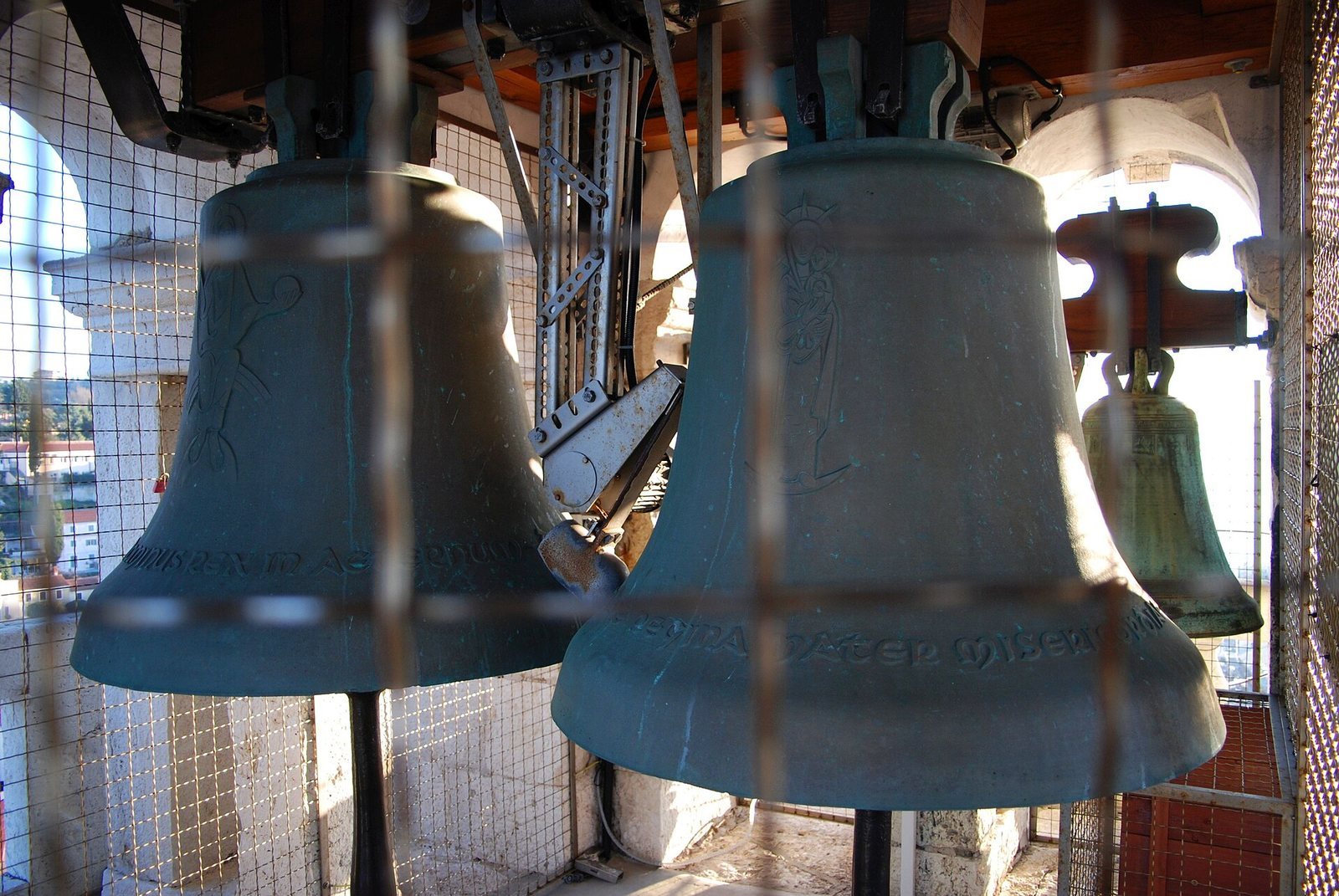
Four bells are listed in the tower: two large German bells weighing 800 and 600 kilograms, an hour bell dated 1477, and a small quarter bell. The 1477 bell came from the earlier tower and still strikes the hours. Two cracked bells removed from the tower are stored in the parish garden. The historic clock mechanism also survives.
Baptistery
The freestanding baptistery, a building used for Christian baptism, stands behind the sanctuary. Completed in 1650 to replace an earlier medieval baptistery, it has an octagonal Baroque plan, a domed interior, and a light-admitting lantern. Its plan, roof, lantern, exterior reliefs, and a window with interlaced ornament continue features of the medieval building, which stood in front of the church. Stone steps lead to the entrance. Iseppo Manaresi and Andrea Torre made the two-flight staircase in 1694; Torre also made the altar of Saint Odoric.
The main altar was designed by Giovanni Sartori and made by Iseppo and Pietro Manaresi in 1691–1693. It contains an image of Christ’s baptism by an unidentified Venetian painter. Other paintings include a late-seventeenth-century Virgin and Child with saints attributed to Ambrogio Bono and Ferdinand Quaiati’s nineteenth-century Sorrowful Mother of God.
The stone baptismal font was made from a first-century Roman funerary monument. Its reused surface bears reliefs of a dolphin and a winged boy. The stone was probably used in Piran’s first baptistery.
Archaeology and collections
Archaeological remains
An archaeological area beneath the nave preserves remains from pre-Roman, Roman, late-antique, early-medieval, Romanesque, and Gothic phases. Excavations around the church also exposed successive remains of earlier buildings.
Parish museum and stonework collection
The parish museum occupies rooms in the sacristy and former rectory. Its collections include liturgical vestments, church vessels, sculpture, paintings, documents, and objects connected with the parish and town. The treasury holds a silver figure of Saint George on horseback, a foot-shaped container for a religious relic, and other metalwork. A stonework gallery displays pieces recovered during archaeological investigations, including fragments from earlier churches and objects dating from antiquity to the later Middle Ages. A wooden model made around 1590 depicts the earlier Gothic church and was partly altered during the seventeenth-century rebuilding.
Glass Stations of the Cross
Slovenian artist Mira Ličen Krmpotić made the glass Stations of the Cross installed in 2013. The work comprises fifteen pieces created using fused glass and was blessed by Koper Bishop Jurij Bizjak on 22 March 2013.