La Torre-La Janera Megalithic Site: A Prehistoric Burial and Ceremonial Landscape
Site at a Glance
- Popularity
- High
- Country
- Spain
- Primary era
- Stone Age
- Eras represented
- Stone Age, Bronze Age
- Civilizations
- Unclassified
- Site type
- Burial
- Remains
- Necropolis
On this page9 sections
History
The La Torre-La Janera megalithic site is a prehistoric monument landscape in the municipalities of Ayamonte and Villablanca, Huelva Province, Andalusia, Spain. It was used from the fourth through the third millennia BC, across the Copper Age, a period of increasing copper use before bronze became widespread, and into the beginning of the Bronze Age. Its earliest megaliths may date to the fifth or fourth millennium BC, while most of the monuments and burial mounds date to about 3750–3500 BC.
Prehistoric use
Dolmens, structures made from upright stones that often supported a capstone, stone cists (small stone-built burial chambers) and burial mounds are thought to have served as graves and ritual places. Offerings accompanied the dead. Enclosures, platforms and cists may point to continued ceremonial use in a later period. The landscape appears to have remained without settlement while in use for roughly 2,000 years.
Survey and protection
A survey carried out in 2018 before planned avocado cultivation identified megaliths and burial areas. The regional government then introduced protective measures and divided the area into four zones, most of them reserved for archaeological investigation. Agricultural use was restricted to about 220 hectares. In 2020, La Torre-La Janera was designated an Asset of Cultural Interest, Spain’s formal protection status for cultural property.
Investigation since 2020
More detailed investigations took place between January 2020 and June 2021. Photogrammetry, which uses photographs to record and measure terrain and features, helped select areas for excavation. A research project on the megaliths and menhirs of the Lower Guadiana ran from 2021 to 2026; initial descriptions appeared in 2021, followed by a detailed study in 2022.
Remains
The megaliths occupy about 90 hectares within an area associated with a 600-hectare estate. The site lies on hilly ground on the left bank of the Guadiana, near the river and the Atlantic coast, about 15 kilometres from the sea. Sea level was about two metres higher when the stones were built. La Torre-La Janera forms part of the Lower Guadiana megalithic complex and adjoins the La Chacoca megalithic area to the north.
Menhirs and engravings
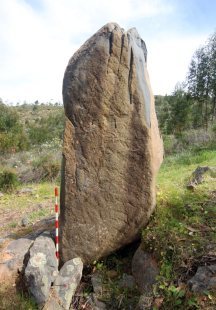
Menhirs, or large standing stones, range from one to three metres high; some remain upright while others lie on the ground. Counts place the complex at about 750 megalithic elements, including 526 menhirs. A 2026 inventory also lists about 750 elements, specifying 400 individual menhirs, 86 of them decorated, as well as 214 cairns (stone mounds) and stone markers. More than 100 megaliths are described as bearing motifs. Their geometric designs include isolated lines and grids, cut, pecked or rubbed into the stone.
Stone arrangements
The site includes stone rows, stone circles, enclosures and platforms, as well as three large geometric arrangements: a U-shaped or horseshoe-shaped alignment, an H-shaped arrangement and an elliptical one. The H-shaped feature measures about 100 by 80 metres and consists of three connected walls incorporating six menhirs. The elliptical arrangement covers almost two hectares, extends about 200 metres along its long axis and has at least six surrounding terraces. Some alignments may have been connected with observing astronomical events or seasonal cycles.
Burial structures
Dolmens have small chambers and stand alone or in groups; some rise no more than half a metre. Circular or oval groupings of dolmens measure between six and seventeen metres across. The site also contains burial mounds and stone cists, alongside 41 stone sarcophagi, some designed to hold several bodies.
Quarries and stone
Quarries for extracting and working greywacke, a type of sandstone, and conglomerate, a rock formed from rounded fragments cemented together, are associated with the complex. A greywacke quarry lies beside the elliptical arrangement.