Kunidomi-Nakamura Kofun: A Late Kofun-Period Burial Mound in Izumo
Site at a Glance
- Popularity
- Medium
- Country
- Japan
- Primary era
- Medieval
- Eras represented
- Medieval
- Civilizations
- Yamato
- Site type
- Burial
- Remains
- Burial Mound
On this page13 sections
History
Kunidomi-Nakamura Kofun is a kofun, a Japanese monumental burial mound, in Izumo, Shimane Prefecture, Japan. It dates to the late sixth or early seventh century, during the Kofun period, and belongs to the Nakamura Kofun Group. Its burial chambers preserve evidence of successive interments and later actions affecting the remains and grave goods.
Discovery and investigation
The mound had been noted by 1925, but its large stone burial chamber was revealed during construction work in 2002. At first it appeared not to have been robbed, and its exposure raised concern that the grave goods might deteriorate. An early assessment suggested a mid-fifth-century date and a mound about 16 metres across.
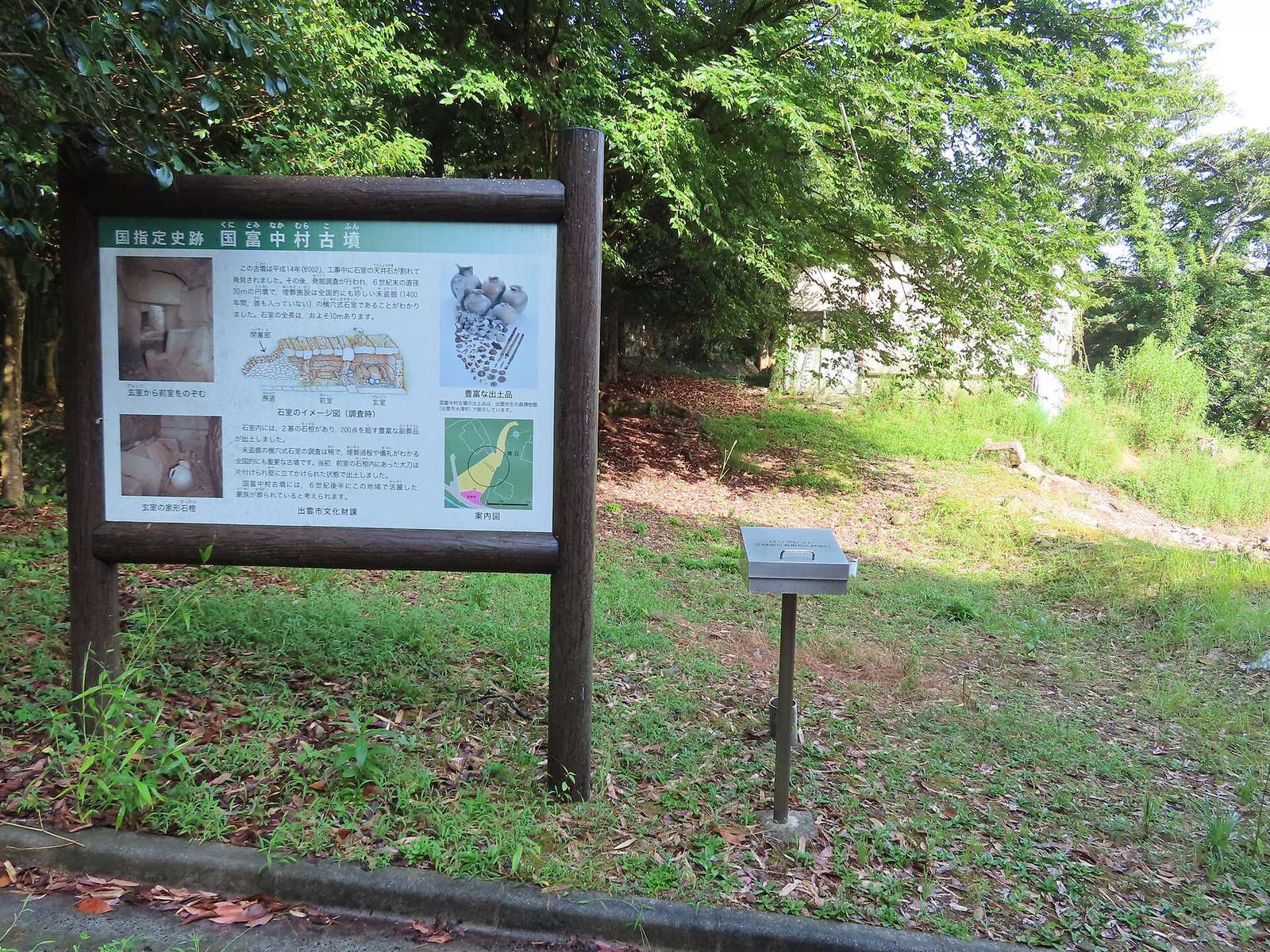
Investigations followed in 2002 and 2003, then from 2006 to 2012. The first two established that the mound was round and contained a burial facility with several chambers. Later work, undertaken in response to construction impacts and the need to protect the mound and chamber, revised the dating to the late sixth or early seventh century and the diameter to about 30 metres. It also clarified the site’s dimensions and burial practices. The chamber was not fully excavated, so it could be preserved. On March 27, 2013, the site became a National Historic Site of Japan. Its official name changed from Nakamura No. 1 Kofun to Kunidominakamura Kofun.
Burial sequence and ritual interpretation
The burial sequence is understood to have begun with an interment in the rear chamber, followed after an interval by another in the antechamber. After further periods of time, people entered the chambers again in two episodes, probably at around the same time in each. During the first, grave goods were scattered or shifted, and the bodies may have been moved and gathered together. Sediment accumulated before a later re-entry, when objects were moved again and the sarcophagus in the rear chamber was damaged.
Damage to human remains, grave goods, and the sarcophagus has been interpreted as a rebirth-prevention ritual, intended to stop the dead from returning or being reborn. This reading connects the practices with beliefs about death and Yomi, the land of the dead in early Japanese mythology. Ideas of seeking rebirth for the dead and preventing it coexisted in the Yayoi period, which preceded the Kofun period, and in the Kofun period itself. Breaking the sarcophagus lid is considered an unusual part of the rite. Comparable practices are known at burial sites from Kyushu to the Kanto region; other sites in Shimane offer parallels involving damage to human remains, swords, and a wooden coffin.
Remains
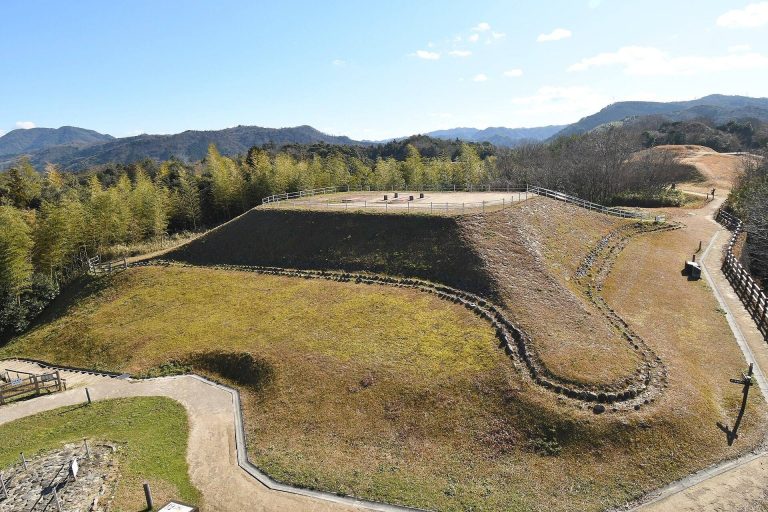
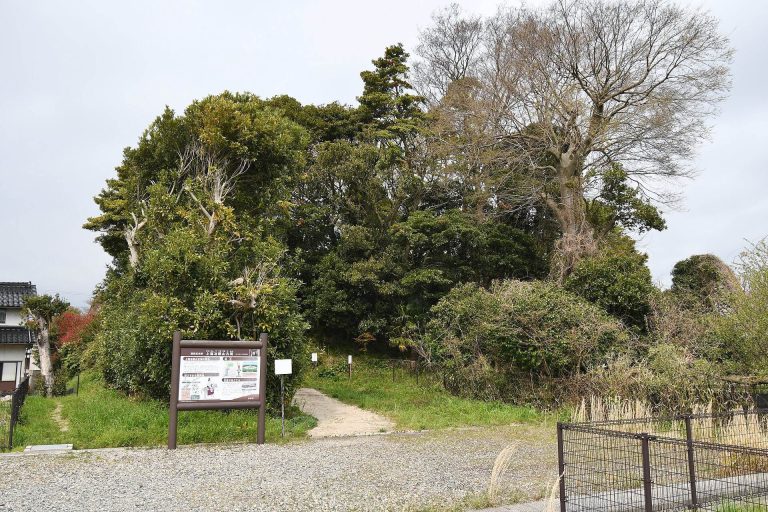
The mound stands on the southern foot of Mount Tabushi, at the eastern end of the east–west Mount Kitayama massif north of the Izumo Plain. Its original outline is now difficult to discern after river-borne debris flows and human destruction. It was round, with an estimated diameter of about 30 metres; the distance from the burial chamber’s presumed central position to the mound’s edge is about 15 metres. With the surrounding ditch included, the site measured about 42 metres across. The mound had an initial and a secondary phase and is thought to have been at least 4.5 metres high.
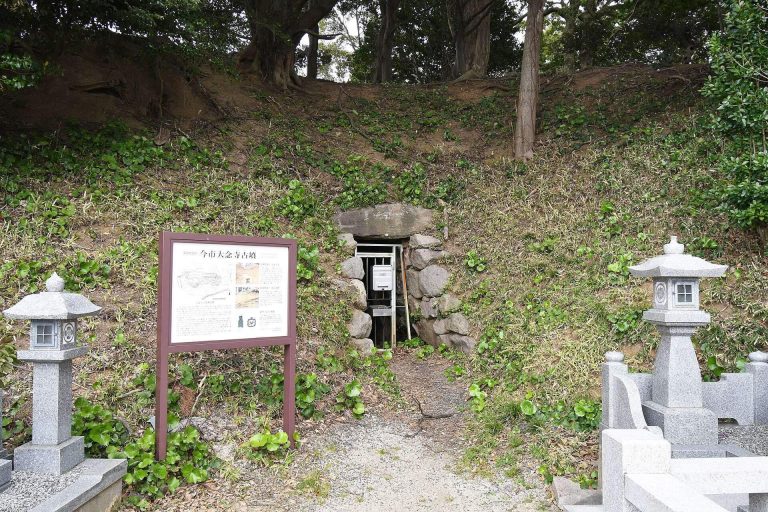
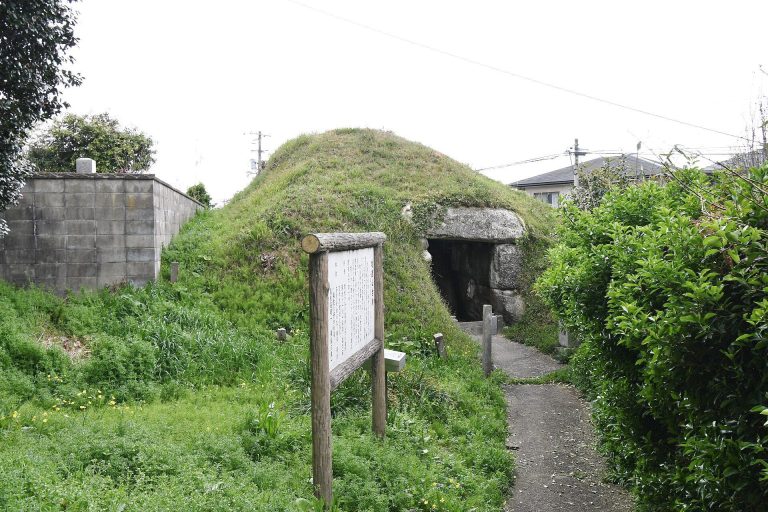
The burial facility opens to the southwest, toward the mountains rather than the plain. That orientation is unusual in this setting and may be related to southwest-facing entrances at other broadly contemporary burial mounds in the Izumo Plain. The multi-chambered structure is at least 9.3 metres long and was built from locally available sandstone. Its entrance passage is largely blocked with stones, including natural stones that helped preserve the arrangement inside.
Stone burial facility
The facility consists of a rear chamber, an antechamber, and an entrance passage. The chambers differ in shape and in the way their walls were built, while their entrances and pebble-covered floors share features. The rear chamber’s stones are more carefully worked than those in the antechamber.
Rear burial chamber
The rectangular rear chamber measures about 3.3 metres long, 1.9 metres wide, and 2 metres high. Carefully shaped stones form its side and rear walls in three courses. The rear wall uses stones cut to fit closely together, a method also found at another burial mound in the area. Two split stones span the ceiling. Projecting stones form the entrance jambs, with a lintel resting directly on them. Pebbles gathered from several locations cover the floor.
Inside is a side-opening stone sarcophagus, or coffin, assembled in the shape of a house. It measures about 2.1 metres long, 0.9 metres wide, and 1.9 metres high. The coffin is made of tuff, a volcanic rock not available nearby and thought to have been specially obtained. Its lid was broken into several pieces; some fragments were turned over, and hammer marks were noted. The damage and reversal are considered deliberate.
Antechamber
The antechamber is slightly narrower than the rear chamber and has a trapezoidal plan, wider at the back. It measures about 2.5 metres long, 1.2 to 1.5 metres wide, and 1.8 metres high. Its side walls have five to eight courses of stone laid by a different method from the rear chamber. Three split stones span the ceiling, and the entrance treatment and pebble floor resemble those of the rear chamber.
An assembled, box-shaped stone coffin in the antechamber is about 2.05 metres long and 0.7 to 0.9 metres wide. Its side stones stand about 30 centimetres high along the long sides and about 45 centimetres high along the short sides. The coffin is made from the same sandstone as the chamber.
Entrance passage
The passage is estimated to be trapezoidal, about 1.4 metres long, 1.05 to 1.2 metres wide, and 1.55 metres high. Its side walls are built in six courses of thin stones, with two split stones spanning the ceiling. Pebbles also cover its floor.
Burial goods
Mirror, ornaments, and bells
A bronze mirror about 7.6 centimetres across, decorated with a bead pattern, came from the rear chamber. It is thought to have been made in the Japanese archipelago and may originally have been inside the stone coffin. The personal ornaments included a gold ear ring in the rear chamber and a silver one in the antechamber. Both have copper cores covered with thin sheets. The oval gold example measures 3.41 by 3.11 centimetres; the corroded silver one is now roughly circular and measures 2.3 by 2.4 centimetres.
A green glass magatama, a curved comma-shaped bead, and a small dark-blue glass bead were found in the rear chamber. A dark-blue glass round bead came from the entrance passage. Four nearly identical bells, made of bronze with gold covering, were found in the rear chamber. Each is about 4 centimetres in diameter and 5 centimetres high.
Swords and arrowheads
Three damaged swords were found, two in the rear chamber and one in the antechamber. They appear to have been placed or propped up after being damaged. One propped sword in the rear chamber has Japanese-style fittings and a blade 96.9 centimetres long. Another there has gold-covered bronze fittings and a 74.9-centimetre blade. The antechamber sword, also propped up, has a pommel shaped like a gui, a flat ceremonial tablet, and a 77.1-centimetre blade. Three small knives in the antechamber are thought to have been moved there from one of the coffins.
Sixty iron arrowheads formed three groups. One group was stored in a quiver, while another lay with damaged arrow shafts; both were near the rear wall of the rear chamber. A third group, scattered after being damaged, was near the chamber entrance. The groups differ in shape and specification.
Horse equipment
Damaged horse equipment occurred in three groups, one in the rear chamber and two in the antechamber. The finds include three sets of saddle fittings, two sets of stirrup suspension fittings and buckles, three sets of bits, two pendants, two cross-shaped fittings, at least one buckle, and twelve decorative fittings. They also include two ornamental bosses, raised decorations used on horse harnesses.
Pottery and clay objects
Sue ware, a high-fired Japanese stoneware, was found between the rear wall of the rear chamber and the entrance to the antechamber. The vessels include lidded bowls, a flask, pedestal cups, and horizontal bottles. Only those along the rear wall may retain their original burial arrangement. The finds include 61 pieces of Sue ware. Jars in the Izumo style, some with smaller jars attached, and other jars came from mound trenches and the entrance-blocking area.
Small fragments of cylindrical haniwa, clay funerary objects associated with kofun, came from the mound trenches and entrance-blocking area, but their details could not be identified. Other recovered materials were not associated with the burial mound or had uncertain dates. They include Yayoi pottery, Haji ware, an unglazed earthenware, other ceramics, and celadon.