Orthodox Church of the Holy Spirit, Vilnius: Principal Church of the Holy Spirit Monastery
Site at a Glance
- Popularity
- Medium
- Country
- Lithuania
- Primary era
- Early Modern
- Eras represented
- Early Modern, Modern
- Civilizations
- Polish–Lithuanian Commonwealth, Russian
- Site type
- Religious
- Remains
- Church
On this page14 sections
History
The Orthodox Church of the Holy Spirit is the principal church of the Holy Spirit Monastery in Vilnius, Lithuania. Founded as a wooden church in 1597, it later became a stone building and took on a character shaped by Vilnian Baroque, a regional form of Baroque architecture associated with Vilnius, and subsequent changes. It remains an active Orthodox church affiliated with the Russian Orthodox Church, part of Eastern Orthodoxy, and the Diocese of Vilnius and Lithuania, a bishop-led church jurisdiction. The monastery serves as the diocese’s headquarters. Together with the associated Monastery of Saint Mary Magdalene, it is among Lithuania’s only surviving Orthodox monasteries.
Foundation and monastic community
Sisters Theodora and Anna Wołowicz financed the first church on land they owned. Theodora was married to the regional governor of Brest, and Anna to the governor of Smolensk. The church offered a home to the Orthodox Holy Trinity Brotherhood after its former church passed to Greek Catholics, Eastern Christians in communion with the Roman Catholic Church who follow the Byzantine rite. The brotherhood then took the name Holy Spirit Brotherhood. The church probably became a monastery around 1609, with a school, an almshouse for poor people, and a printing press. By 1611, it was the only Orthodox church in Vilnius that had not come under Greek Catholic control.
With the permission of Władysław IV, king of the Polish–Lithuanian Commonwealth, a stone church replaced the wooden building in 1634. It was dedicated to the Descent of the Holy Spirit upon the Apostles. In 1677, Dmitry, a monk-priest who later became a senior bishop known as Metropolitan of Rostov, preached there at the invitation of Clement Trizna, the monastery’s senior figure and the brotherhood school’s rector.
War, fire, and rebuilding
Swedish forces devastated the monastery and church in the early eighteenth century. In 1708, Tsar Peter I supplied substantial materials to support their restoration. Fires in 1748 and 1749 destroyed the church. Rebuilding under architect Johann Christoph Glaubitz continued until 1753, with interior work carrying on afterward.
Nineteenth-century change
In 1810, the church’s superior, Archimandrite Timofey Sambikin, a senior monastic cleric, became involved in a scandal after performing a marriage in a Jewish home during Bright Week, the week after Orthodox Easter. The groom was the gravely ill Colonel Zelenin, who had already had three children with the woman he married. Zelenin died three days later, and the marriage was declared invalid. Sambikin was temporarily barred from priestly ministry; the restriction was lifted on 7 May 1812 by Seraphim, the new Archbishop of Minsk.
During the 1812 war with France, Napoleon’s soldiers looted and desecrated the church. Donations from Vilnius merchant Alexander Slutsky helped pay for repairs. In 1814, the relics of the Vilnius martyrs Anthony, John, and Eustathius were found in a crypt beneath the altar, where they had been secretly kept since 1661.
A rebuilding campaign led by diocesan architect A. Porto in 1836–1837 reshaped the church’s exterior. Further changes to the church and bell tower, prompted by Governor-General M. N. Muravyov, sought to remove Baroque details regarded as signs of Catholic influence; this work was completed by 1873. Archbishop Joseph Semashko established an underground chapel for the martyrs in 1850, and their relics were transferred there in 1852. Archbishop Juvenaly Polovtsev, who had led the diocese since 1898, was buried at the monastery in 1904.
Evacuation and restoration
As German forces approached in August 1915, the martyrs’ relics and most of the monastery’s residents were evacuated to Moscow. Two monk-priests and one monk-deacon remained. The relics were first kept at Donskoy Monastery and were later used in atheist propaganda.
The church suffered severe damage during the Second World War. Patriarch Alexy I of Moscow and All Russia provided repair funds and helped secure the martyrs’ return. The relics were flown back to Vilnius on 26 July 1946. Extensive renovations took place under Metropolitan Chrysostom in the 1990s, and in 1997 the relics’ sarcophagus was moved from the crypt. The church is protected by the state as a cultural heritage site of national significance.
Remains
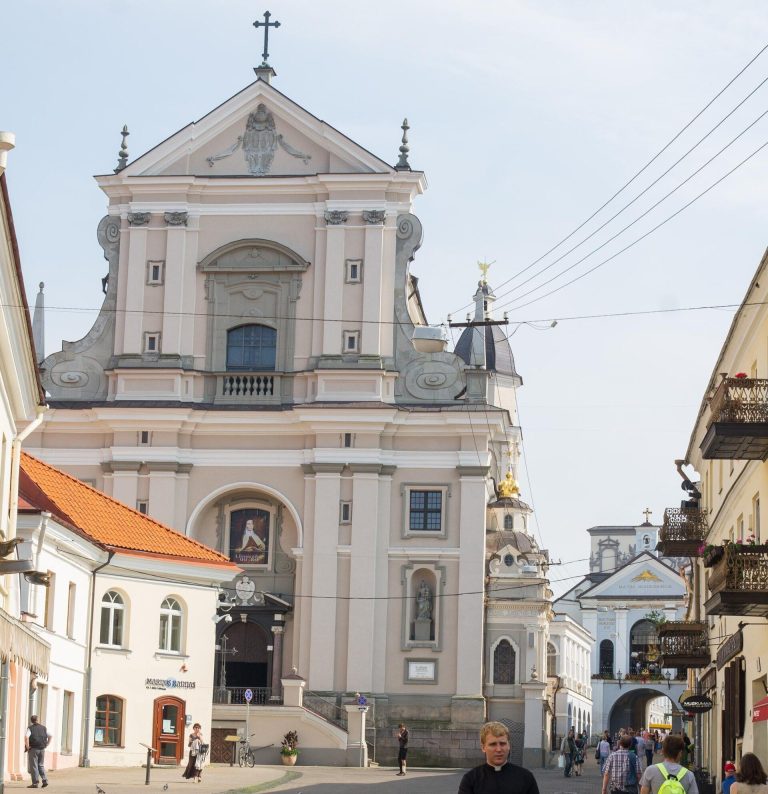
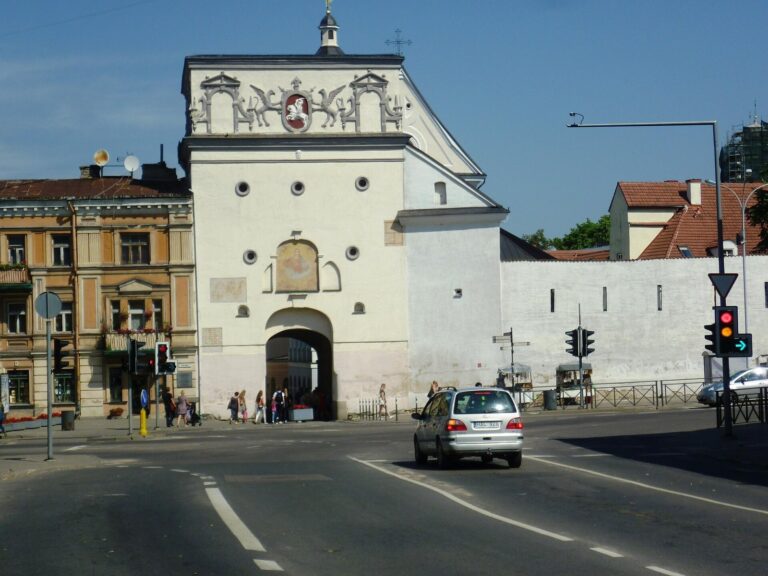
The brick church stands in Vilnius Old Town within the Holy Spirit Monastery complex, near the Gate of Dawn and the Church of St Teresa. Its layout and appearance combine Vilnian Baroque with later architectural changes. A separate bell tower and a monastery entrance gate are also part of the complex.
Church building
Plan and exterior
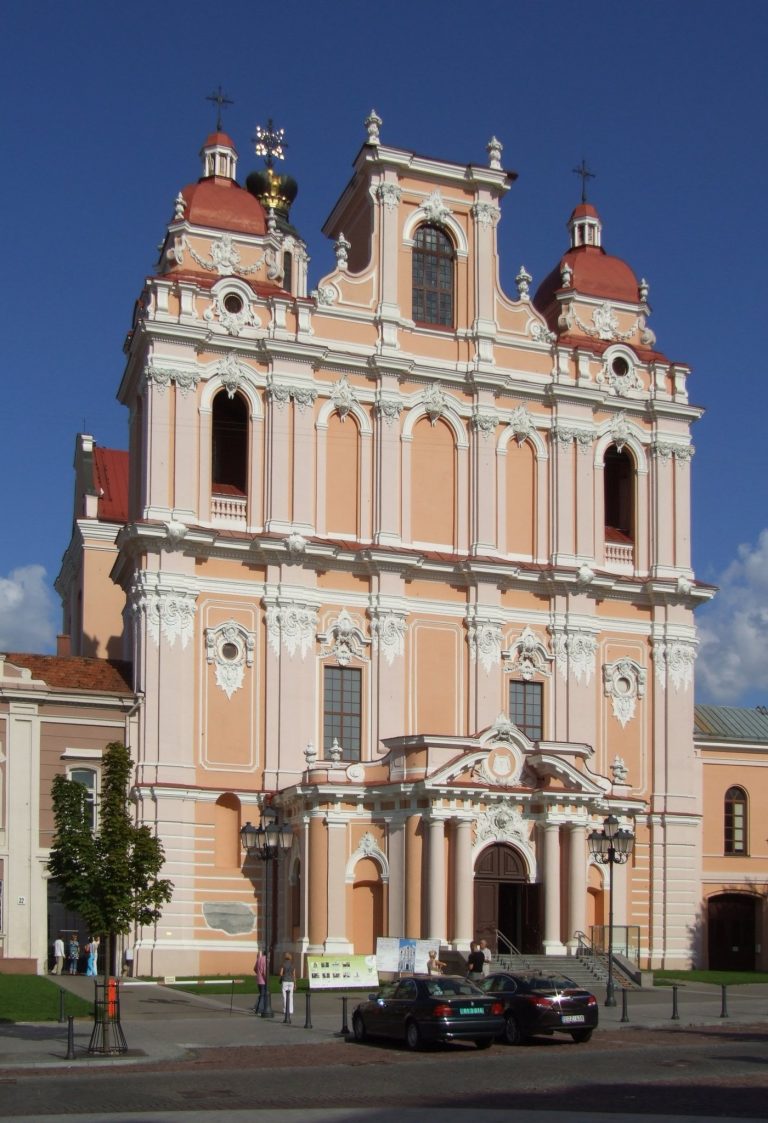
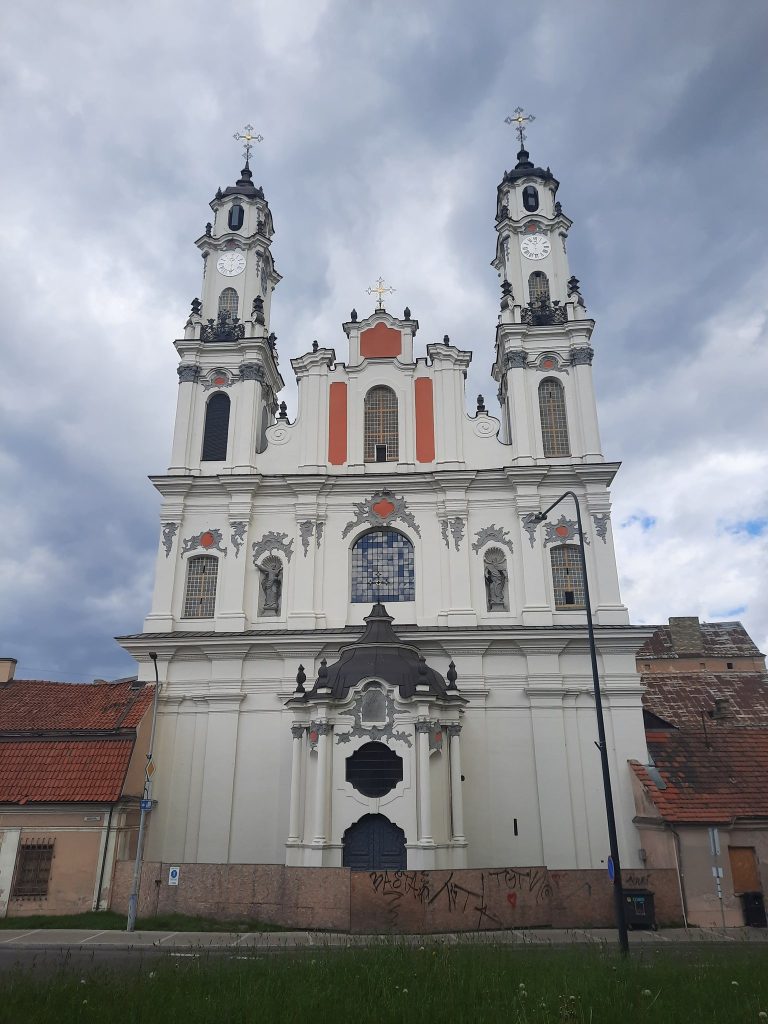
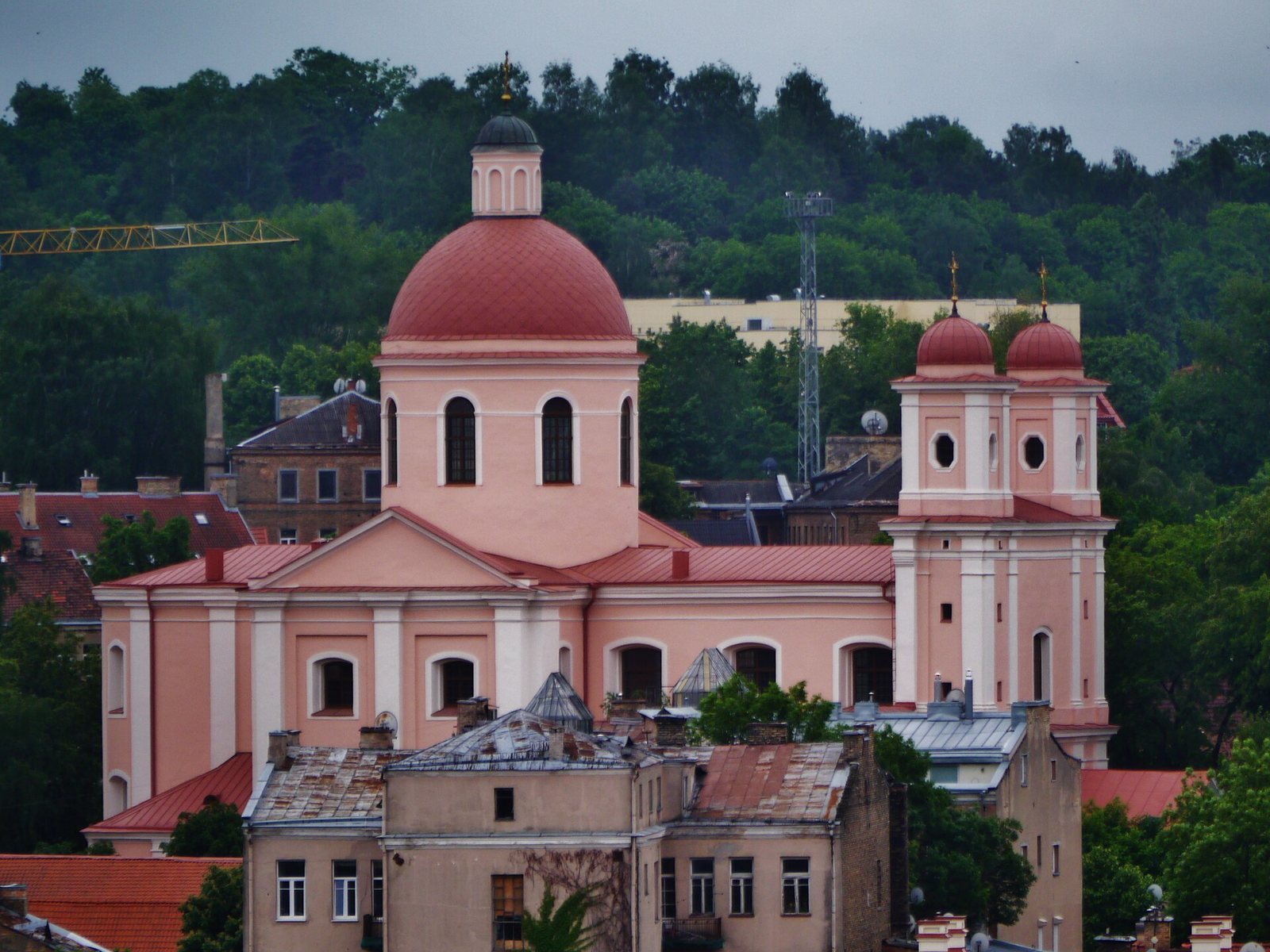
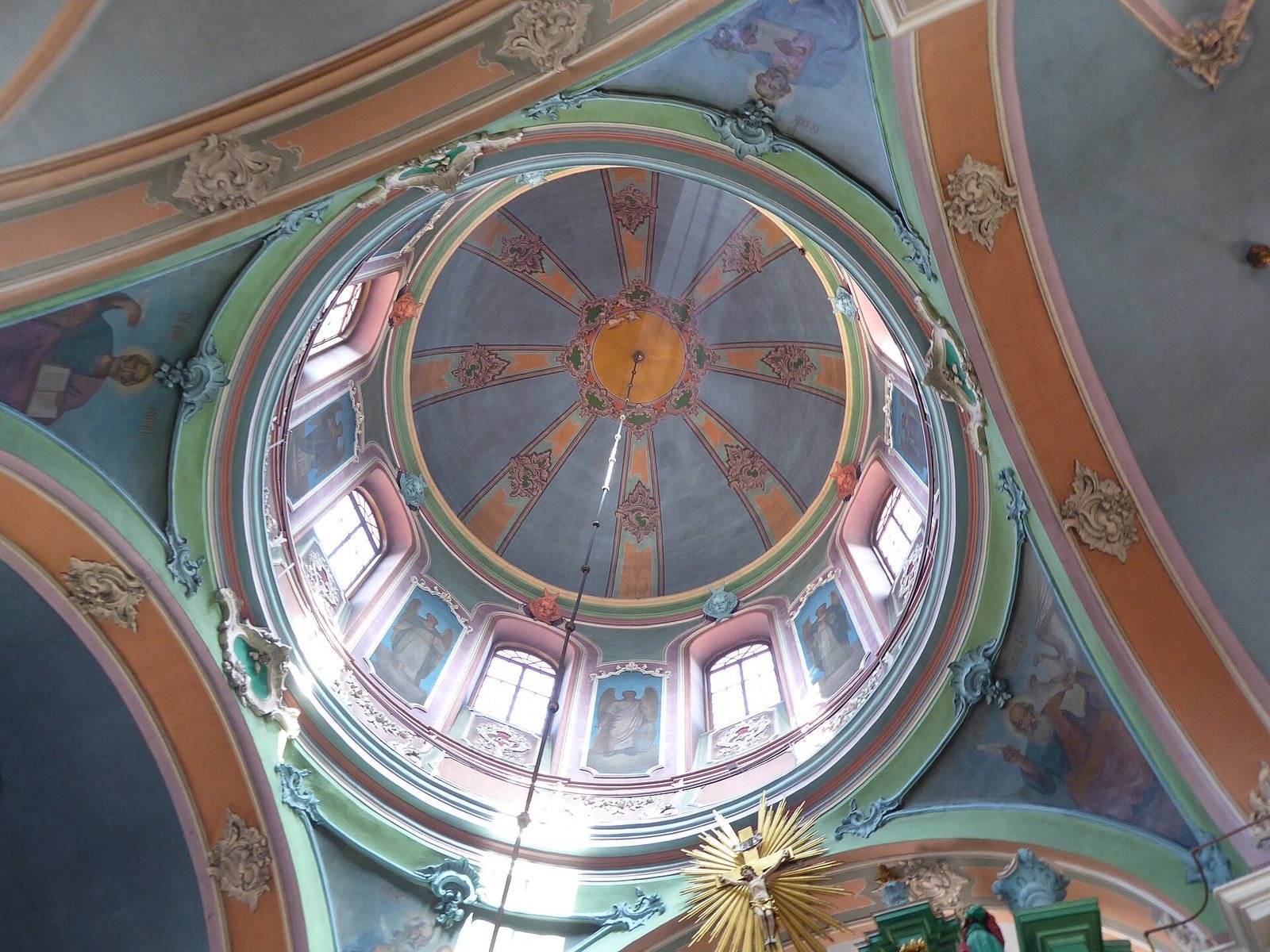
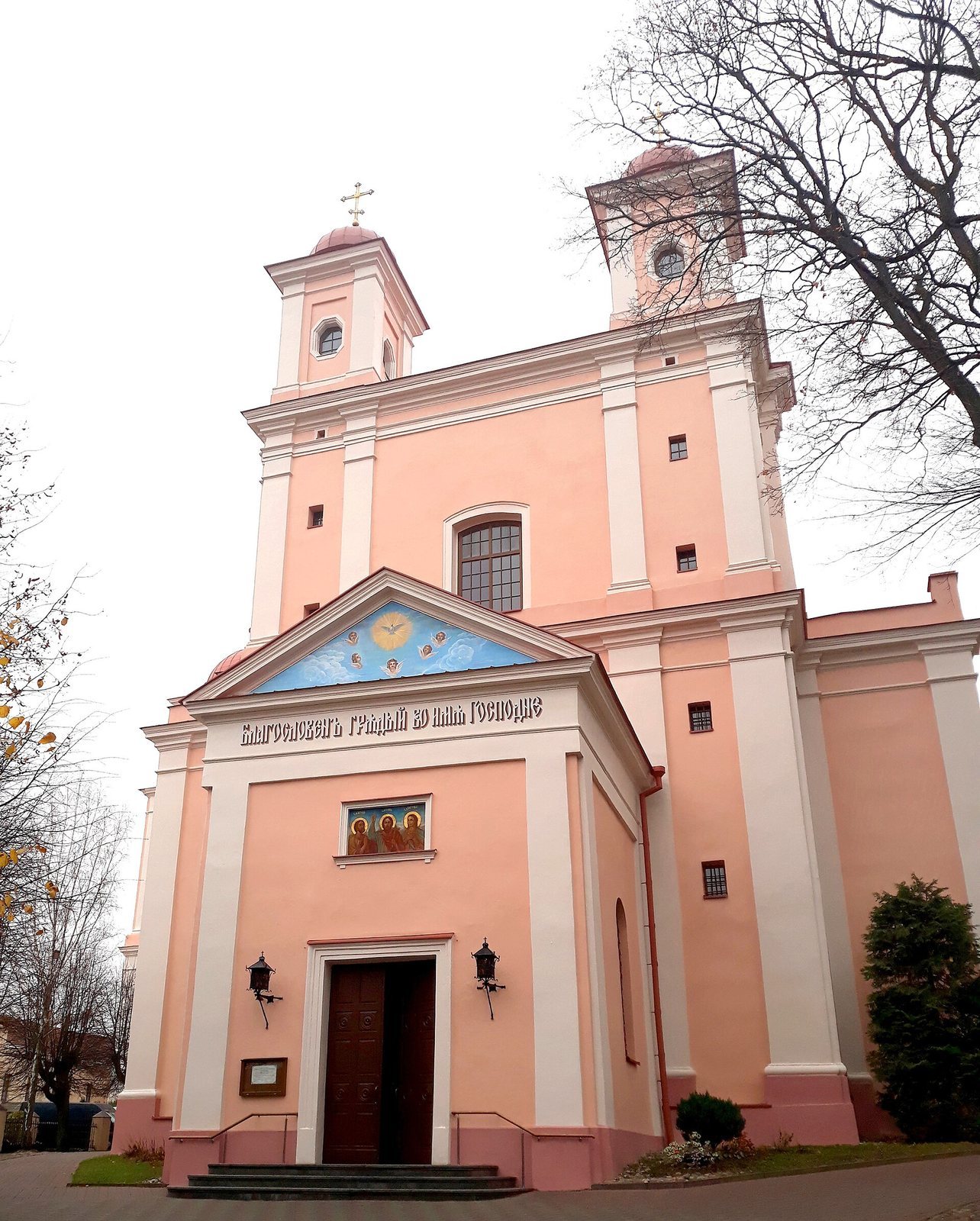
The church has a Latin-cross plan, with a long main space crossed by a transverse arm, and three naves, or lengthwise divisions. Chapels divide the side naves, giving the overall building a rectangular form. A high dome rises over the crossing, reaching 49 metres. The symmetrical exterior has two small towers topped by cupolas and a projecting entrance vestibule. Shallow, column-like Doric pilasters frame the façade. The arrangement has been compared with Vilnius Jesuit churches, particularly St Casimir’s, identified as the city’s first church of that type.
Architectural changes
Later work altered the church’s Baroque exterior. A wavy gable between the towers and adjoining scroll-shaped ornaments were removed, and the dome was raised on a tall supporting drum. The church also acquired Byzantine Revival features, drawing on Byzantine architectural forms, while Baroque details remain prominent inside.
Interior and furnishings
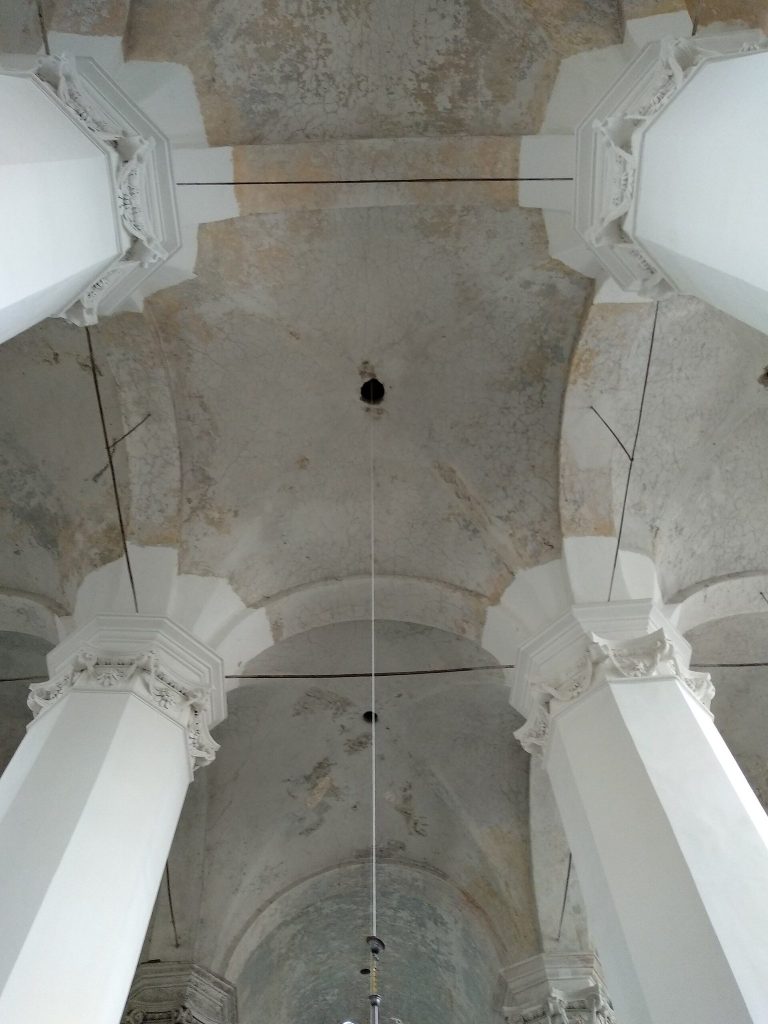
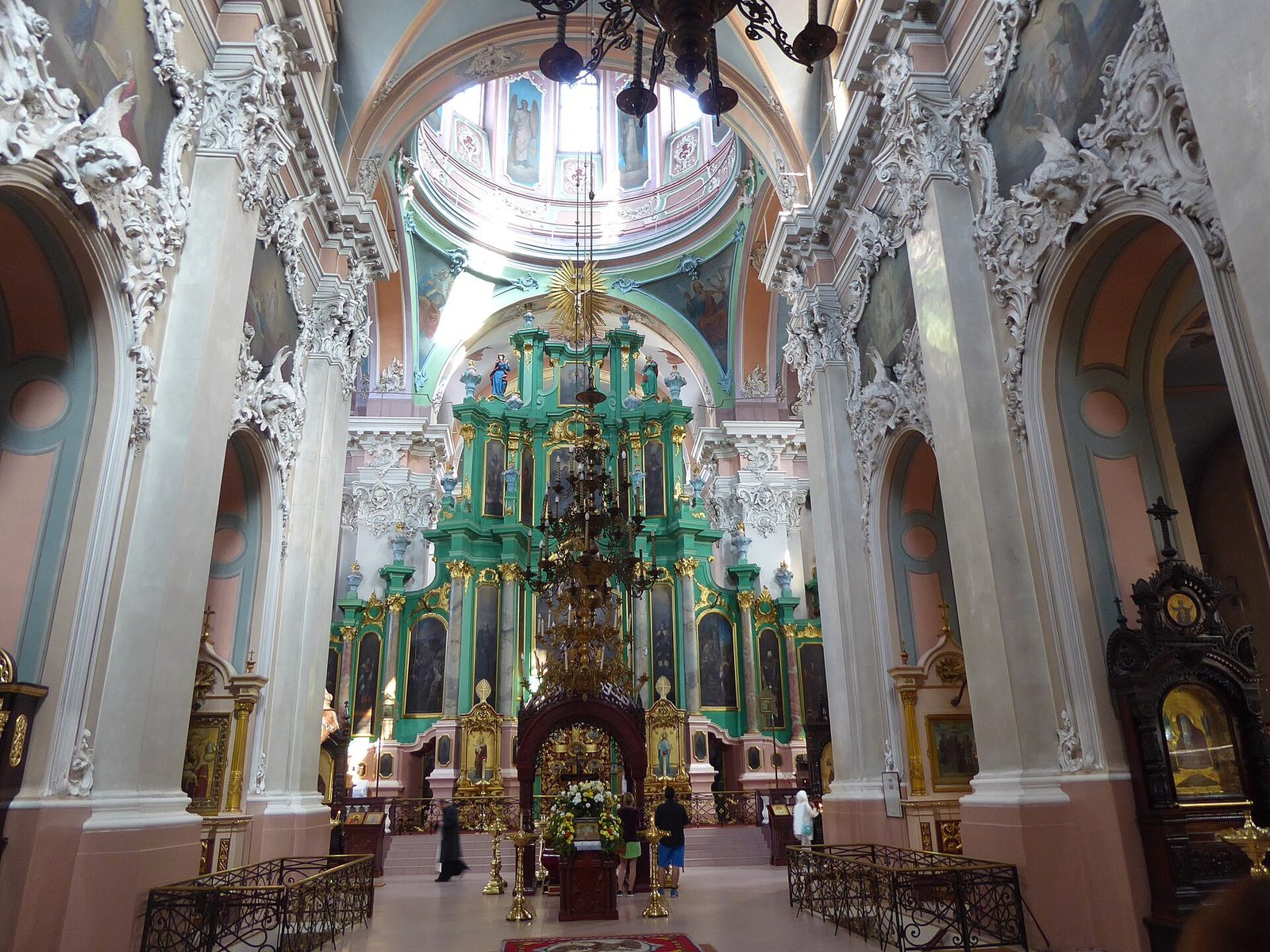
The interior combines Baroque details, Orthodox frescoes, and deep-blue and green decoration. It includes sculptures made using scagliola, a material worked to imitate marble. The carved wooden Baroque iconostasis, an icon-bearing screen separating the sanctuary from the worship space, has three tiers and dates to 1753–1756; Glaubitz designed it. The church has one iconostasis. Pilasters have a simulated white-marble finish, and the stucco is white. Icons by Ivan Trutnev decorate the church, including an Annunciation icon funded by Empress Maria Alexandrovna.
Martyrs’ chapel and relics
The underground chapel dedicated to the Vilnius martyrs lies within the church. Beneath the altar, the crypt is the chamber where their relics were secretly kept before their discovery. A carved wooden reliquary, a container for holy remains, was added in 1853. It holds the relics of Anthony, John, and Eustathius beneath a canopy in front of the iconostasis. The martyrs’ feast falls on 27 April. A church tradition is to cover their relics in black during Lent, white at Christmas, and red on other major religious holidays.
Other monastery structures
Bell tower
The massive bell tower stands apart from the church. Originally late Baroque in style, it was remodelled in the Classical style during the later alterations to the complex.
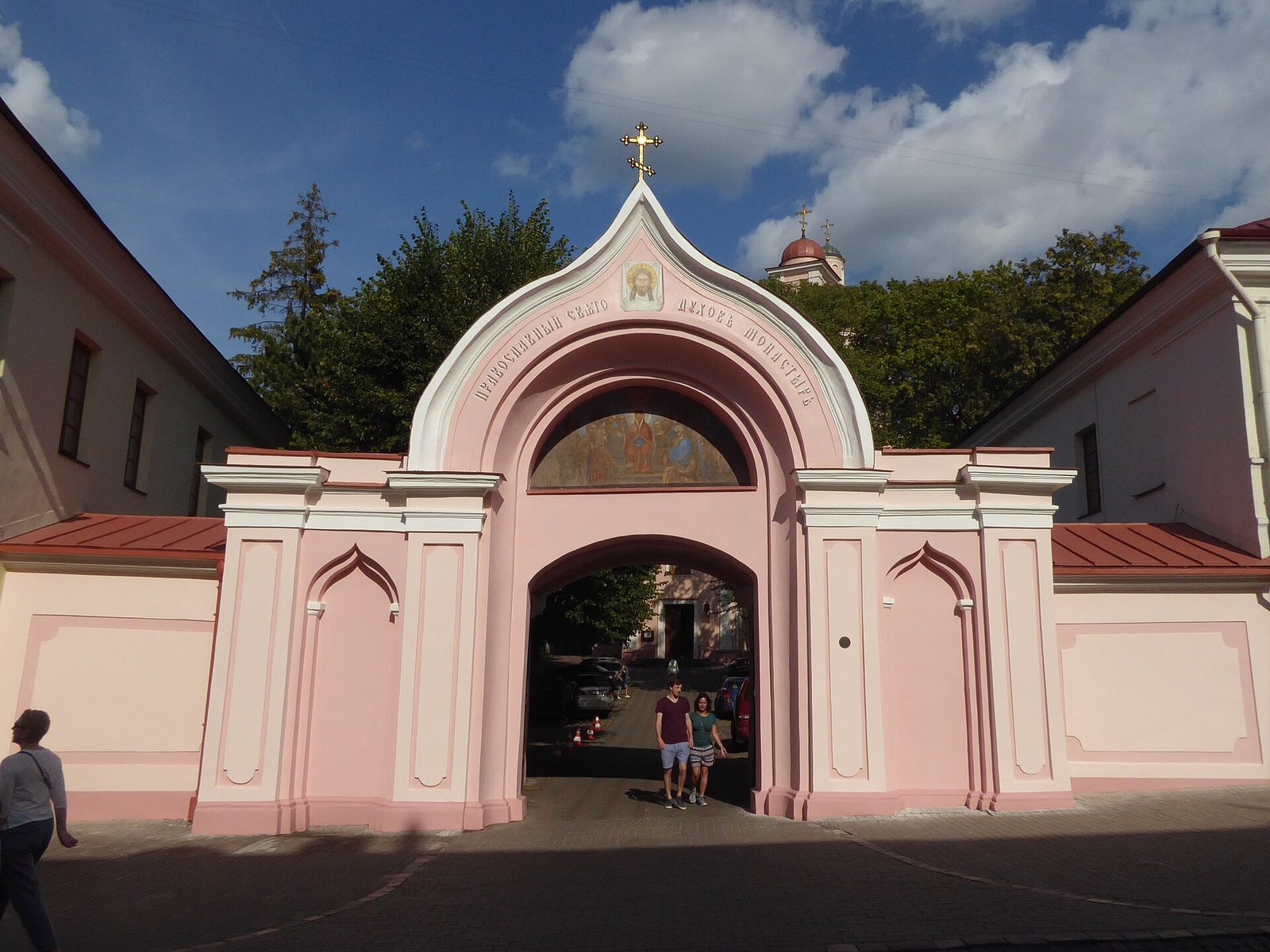
Monastery gate
The monastery gate was built in 1845 with funds donated by Vilnius Governor-General F. Ya. Mirkovich. Its design draws on medieval Russian architecture.