Inchaffray Abbey: An Augustinian Monastery in Scotland
Site at a Glance
- Popularity
- Medium
- Country
- United Kingdom
- Primary era
- Medieval
- Eras represented
- Medieval
- Civilizations
- Kingdom of Scotland
- Site type
- Religious
- Remains
- Monastery
On this page6 sections
History
Inchaffray Abbey is a medieval Augustinian monastery near Madderty in Strathearn, Scotland, founded in 1200 by Gilbert, Earl of Strathearn, and his first known wife, Maud d’Aubigny. It developed from an earlier religious community and became a house with extensive holdings and close ties to the region’s ruling family.
Foundation and growth
A community of clerics called the brethren of St John of Strathearn occupied the site before the priory was established. A church dedicated to John the Evangelist is known to have existed there around 1190. Gilbert and Maud founded the priory in memory of their first-born son, Gilchrist, who had been buried at the site in 1198. The earlier community joined the new house, whose first prior was Malis, a local hermit.
The Augustinian house was dedicated to the Virgin Mary and John the Evangelist and associated with the Diocese of Dunblane, the district administered by a bishop. Its founding charter granted it five churches: St Cathan of Abruthven, St Ethernan of Madderty, St Patrick of Strogeith, St Makkessog of Auchterarder and St Beanus of Kinkell. The priory was granted to the Augustinians of Scone Abbey and became an abbey in 1221.
The name Inchaffray is popularly derived from the Gaelic innis abh reidh, meaning “island of smooth water.” Its earliest recorded form is the Latin Insula missarum, “island of the masses,” interpreted as “island of the offerings.” A charter of Jonathan, Bishop of Dunblane, uses the form “Inche Affren,” while other recorded forms indicate that the Latin name was a translation.
Medieval influence
In 1237, Pope Gregory IX issued an order to transfer the seat of the Diocese of Dunblane to Inchaffray, but the move did not take place. The abbey received patronage from the earls of Strathearn and Scottish kings. Its estates and dependent churches eventually extended from Uist in the west to Balfron in the south. It also became a customary burial place for the earls of Strathearn; Jonathan, Bishop of Dunblane, and Malise, 6th Earl of Strathearn, were buried there.
In 1275, a levy of one-tenth of religious houses’ income was imposed to support a crusade, a Christian military expedition authorized by the Church. Inchaffray’s annual income was assessed at £246, making it the fourth-wealthiest Augustinian house in Scotland after St Andrews, Scone and Holyrood.
The community also worked to make the surrounding wetlands cultivable. By 1218, the monks had begun reclaiming nearby land, and the abbey ordered a nine-mile drainage ditch, the Pow of Inchaffray, to improve the marshland.
Late medieval decline and secularization
Before the Battle of Bannockburn in 1314, a major Scottish victory over an English army, Abbot Maurice carried the relics of St Fillan to bless the Scottish forces. His support gained the favor of Robert I of Scotland, and Maurice later became Bishop of Dunblane.
Laurence Oliphant, a commendatory abbot appointed to hold the abbey’s office and revenues, came from a prominent Strathearn family. He was killed at the Battle of Flodden in 1514, a conflict between Scottish and English forces. By 1561 the abbey’s income had fallen to £667, placing it third-lowest among the Scottish Augustinian abbeys included in the levy. Serious cases of simony, the buying or selling of church offices or spiritual benefits, were also associated with its decline.
During the Scottish Reformation, the sixteenth-century transformation of the church and its institutions, Inchaffray was secularized in 1556 as a lordship for a member of the Drummond family. James VI visited James Drummond at Inchaffray on 5 October 1601. The property later passed to the earls of Kinnoull, and the abbey was neglected before being abandoned.
Abandonment and damage
A road cut across the site in 1816 destroyed much of the remaining abbey fabric. The surviving ruins are designated a scheduled monument.
Remains
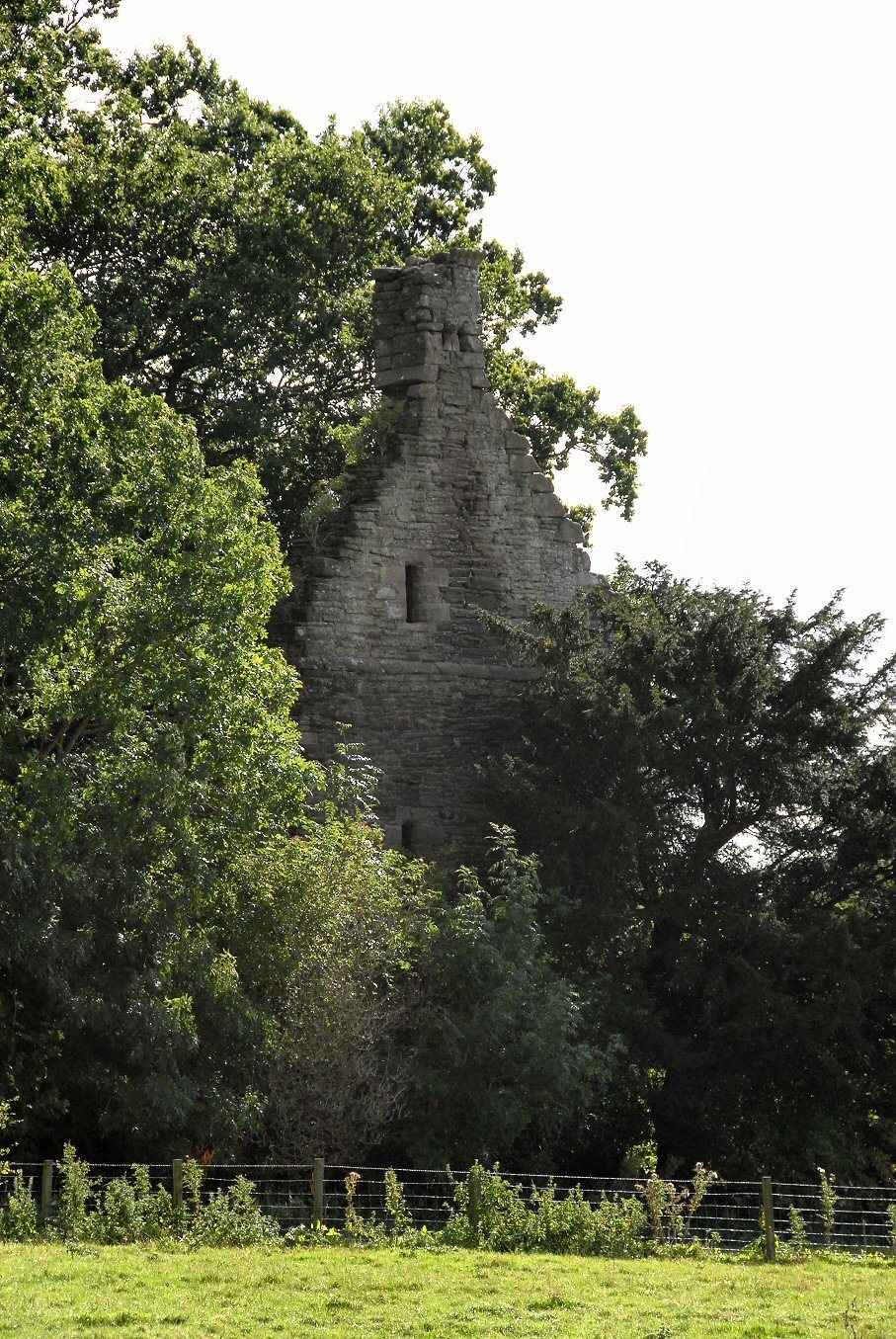
The abbey stood on rising ground near Madderty. Before the surrounding marshes were drained, this ground formed an island; the wetlands were known for their eels. Today, an earth mound and fragments of walls survive, including sections of the outer walls and a gable-end wall on private property. A main chimney also remains. Earth banks separate the ruins from the intensive agriculture around them. Vegetation has spread among the remains, obscuring parts of the site and making some sections difficult to access, while the gable-end wall can be seen from the road.