Castle in Nové Dvory: A Noble Residence and Estate Centre in Czechia
Site at a Glance
- Popularity
- Medium
- Country
- Czechia
- Primary era
- Early Modern
- Eras represented
- Early Modern
- Civilizations
- Habsburg, Habsburg Austria, Holy Roman Empire, Kingdom of Bohemia
- Site type
- Domestic
- Remains
- Castle
On this page10 sections
History
The Castle in Nové Dvory is an aristocratic residence in Czechia whose history began on land acquired by Sedlec Abbey in 1278. Its later Renaissance residence and Baroque rebuilding accompanied the growth of the estate, while the castle eventually became offices and housing for estate employees.
Abbey land and Renaissance residence
Sedlec Abbey, a monastery of the Catholic Cistercian order, established a farmyard on the property. By 1370, the farmyard was known as Nový. It was burned during the Hussite Wars, fifteenth-century Bohemian conflicts associated with the religious reform movement of the preacher Jan Hus. The property then passed to the Royal Chamber, the Crown’s administrative and financial authority. After the abbey was restored, the farmyard returned to its ownership.
Hynek Martinický of Chřenovice bought the property in 1552, and Karel of Žerotín acquired it from Hynek’s descendants in 1558. Karel’s son, Kašpar Melichar of Žerotín, later commissioned a residence in the Renaissance style, a European cultural and architectural period. The estate then included nine villages, while the site of Nové Dvory itself comprised the farmyard and a sheepfold. In 1593, the estate became an administrative unit. Both singular and plural forms of its name remained in use until the late seventeenth century.
Wartime destruction and rebuilding
After Kašpar Melichar, the estate passed to his daughter Eliška Polyxena and her husband, Petr Vok Švihovský of Rýzmberk. Swedish troops under General Johan Banér burned the castle in 1639, during the Thirty Years’ War, a major European conflict fought from 1618 to 1648. The fire reduced the building to its perimeter walls. Their son, Bedřich Kašpar Švihovský, inherited the estate as a minor in 1642 and arranged essential repairs. After his early death, his underage daughter Anna Marie inherited it. Once she was an adult and married, she sold the estate.
Ownership changed quickly, passing to Ferdinand Maxmilián of Kounice from 1674 to 1677 and Jan Kašpar of Montani from 1677 to 1679. Bernard František Věžník of Věžník bought the estate in 1679 and began a late-seventeenth-century rebuilding. He served as a councilor of the Chamber Court, the royal judicial institution, and as governor of the Čáslav region. He received the rank of count in 1694.
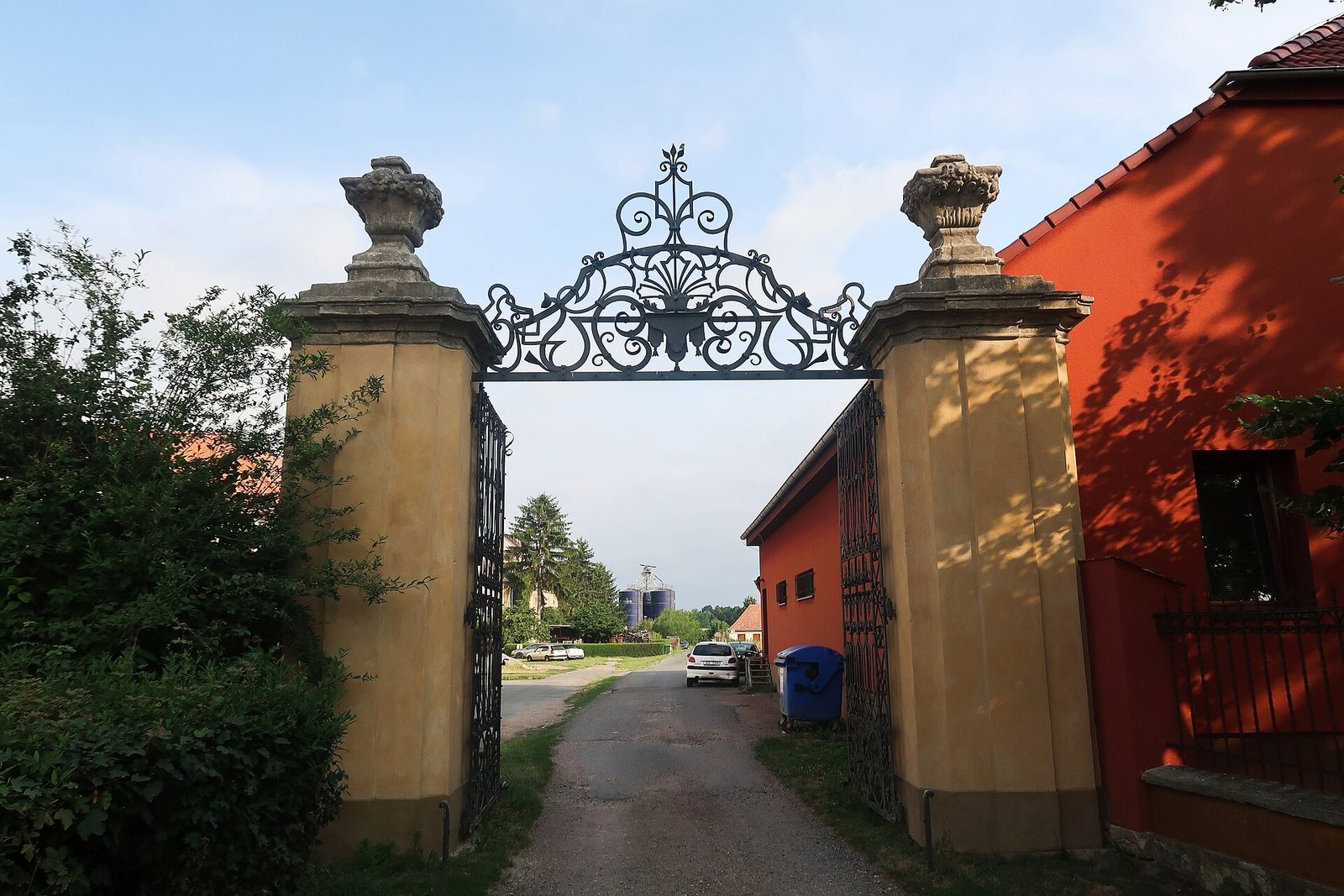
Bernard František secured market-town status for Nové Dvory in 1701, when the Kutná Hora Gate and a column dedicated to the Virgin Mary were built on the square. In 1702, Archduke Joseph, later Emperor Joseph I, visited for a deer hunt. On that occasion, Bernard František received the title of Imperial Count, a rank within the Holy Roman Empire distinct from his earlier count’s title in the Kingdom of Bohemia.
Eighteenth-century owners
Bernard František’s son Romedius Jan inherited the estate but died without children in 1720. His mother, Barbora, née Švihovská of Rýzmberk, took control and sold it in 1722 to František Antonín Pachta of Rájov. In 1725, Pachta bought another part of the estate, including Třebešice and Radvančice, from Romedius’s brother Josef Jaroslav Věžník. Pachta, who had received the rank of count in 1721 and held positions at the imperial court, continued work on the park. Emperor Charles VI stayed at the estate twice in 1723 while travelling to Prague for his coronation. Pachta’s costly way of life left him in debt, and the estate came under financial administration in 1727.
Count Karel Josef Batthyány bought Nové Dvory at public auction in 1728. A Hungarian nobleman and field marshal who later held state and ministerial posts, he seldom stayed at the castle. In August 1750, Maria Theresa and her husband, Francis Stephen of Lorraine, spent a week there during a major Austrian army exercise in the region. Batthyány stayed at the neighbouring Dominican monastery because the castle could not accommodate him. The imperial couple attended a second exercise in August 1754. Batthyány, then chief steward to the future Joseph II and required to live in Vienna, decided to sell his Bohemian estates. All nine of his children had died in childhood.
The Chotek estate and later use
Jan Karel Chotek bought Nové Dvory in June 1764. The estate then comprised 14 villages and seven farmyards. Alterations to the castle began in the 1780s and continued under Jan Rudolf Chotek. The Choteks made Kačina, built about two kilometres northeast between 1802 and 1822, their principal family residence and moved there in 1823. Nové Dvory thereafter housed estate offices and employees’ apartments, while the administrative estate retained the name Nové Dvory. By the end of the nineteenth century, it covered 3,512 hectares.
Emerich Chotek, the family’s last owner of Nové Dvory, died in 1911, after which the family property was divided. His nephew Quido Thun-Hohenstein inherited Nové Dvory and Kačina. In 1945, under the Beneš decrees, postwar Czechoslovak presidential decrees that addressed property confiscation, the castle passed into state administration. The Local National Committee, a local administrative body, established an elementary school in the building. The castle remains in use as an elementary school and after-school club and is owned by the market town of Nové Dvory.
Remains
Castle and courtyard plan
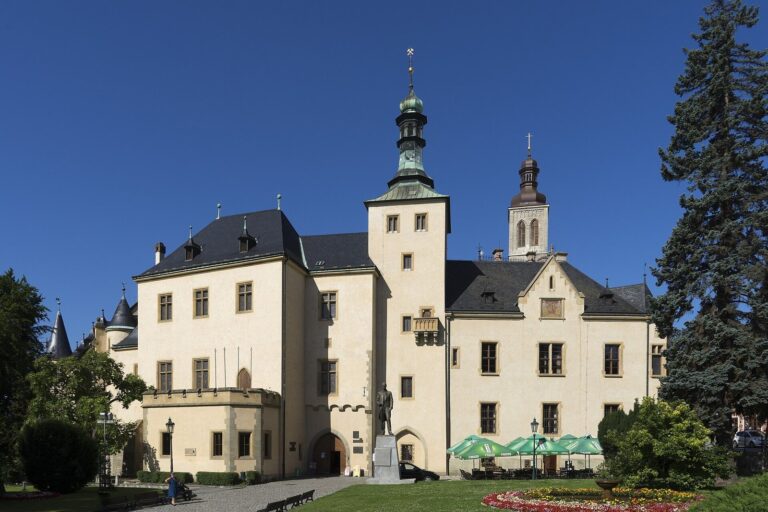
The castle stands on the western side of the town square. Its two-storey, four-wing plan encloses a courtyard, and the early Baroque rebuilding, in the later European style associated with elaborate, dramatic forms, created two courtyards. Much of the earlier Renaissance building was replaced, but part of it survives within the west wing.
Southern entrance front
The southern entrance front has a narrow projecting wing at its western end, where apartments for school employees are located. During the Chotek alterations of the 1780s, the southern entrance wing was demolished to create a forecourt open to the square. New service buildings were added to the west wing.
Eastern corridor and staircase
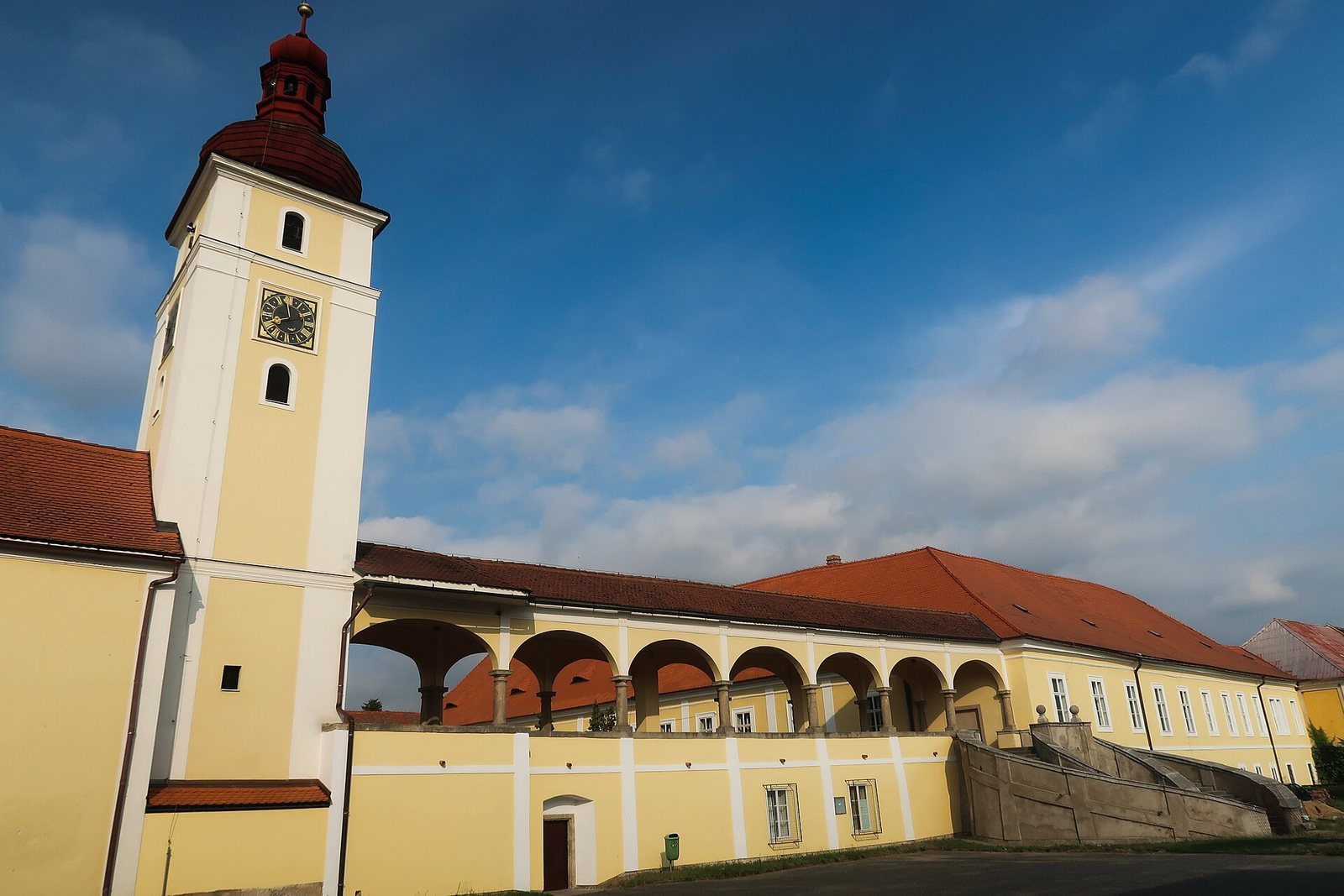
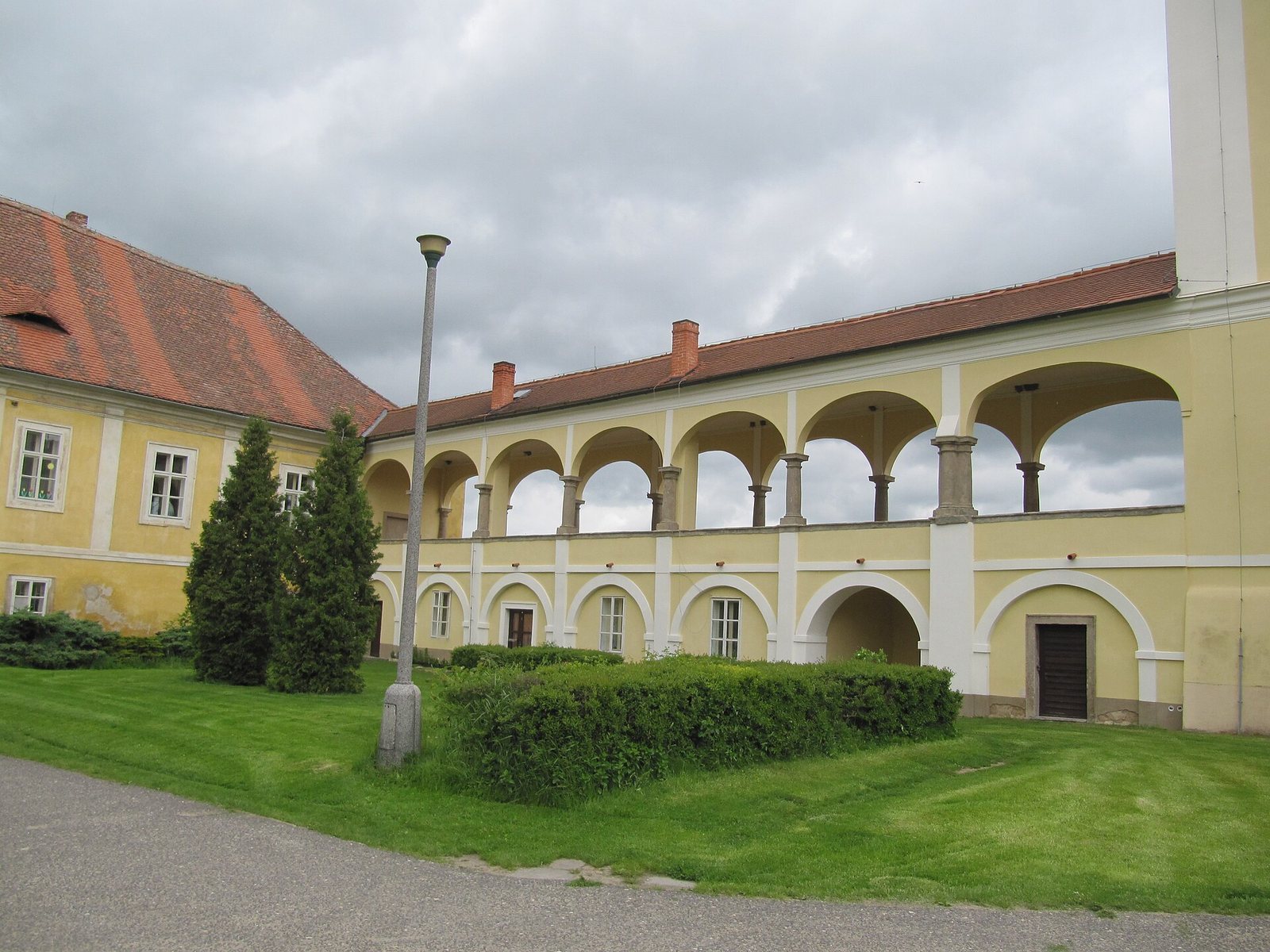
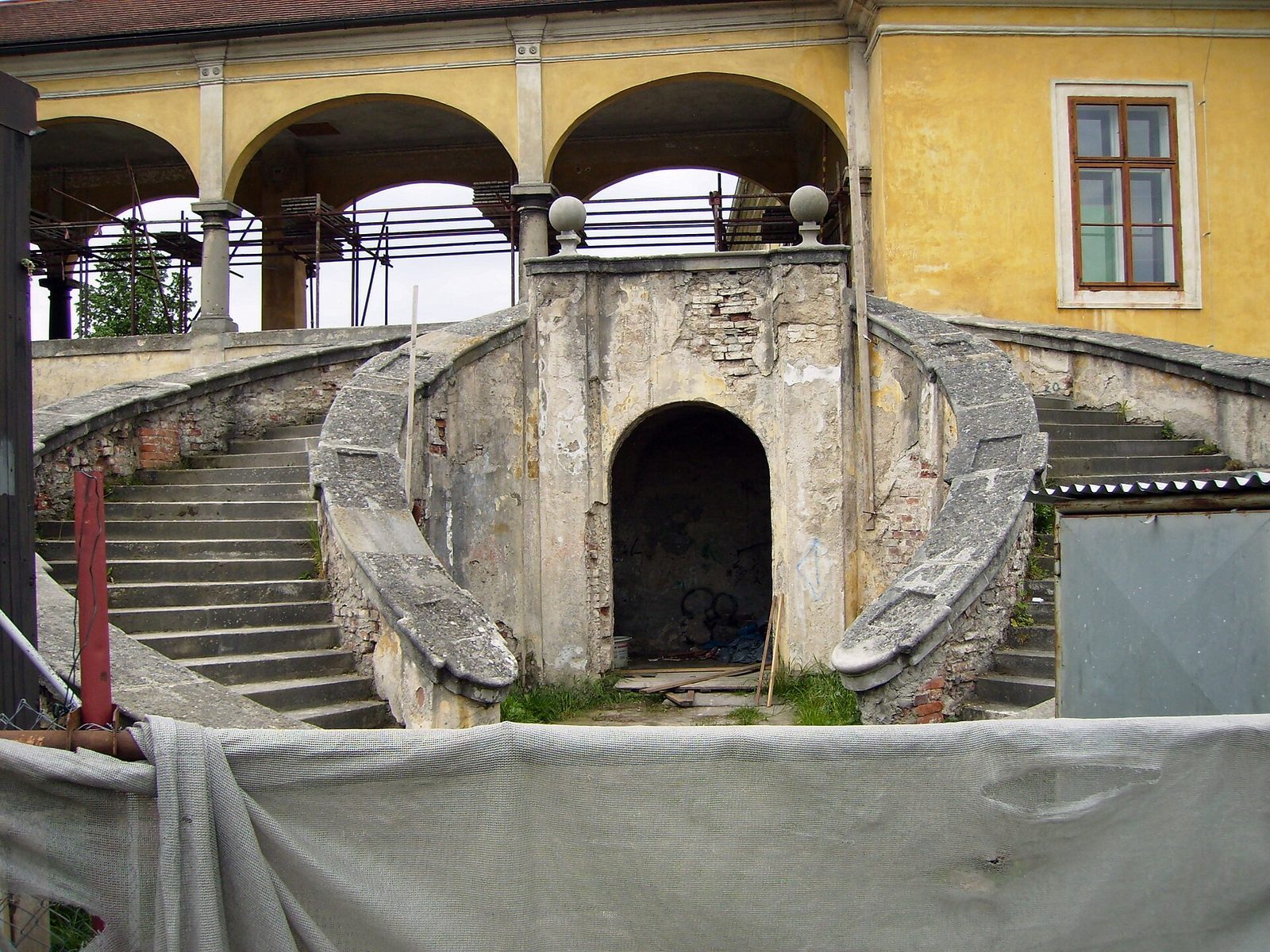
An arcaded corridor, a passage lined with arches, links the castle’s eastern side to St Martin’s Church, built in 1696. Between the corridor and the castle, a Baroque staircase formerly led to the park. The corridor and staircase are regarded as the complex’s most valuable architectural elements.
Farm buildings and park
Extensive farm buildings lie north of the castle, and some are used by private companies. During the Chotek alterations, new trees were planted in the park and a theater was built there. The park later fell into disrepair, and most of the land immediately around the castle was converted to fields.