Imperial Villa of Vicarello: Roman Villa, Sanctuary, and Baths
Site at a Glance
- Popularity
- Medium
- Country
- Italy
- Primary era
- Classical
- Eras represented
- Classical, Early Modern, Modern
- Civilizations
- Papal States, Roman
- Site type
- Religious
- Remains
- Sanctuary
On this page17 sections
History
The Imperial Villa of Vicarello is a Roman villa, sanctuary, and baths complex near the north shore of Lake Bracciano in Italy. Emperor Domitian developed its villa estate and baths as a connected project during his reign, AD 81–96, while the healing sanctuary had drawn visitors for centuries beforehand.
Sanctuary and pilgrimage
Human activity at the springs reaches back to at least the second millennium BC. By Etruscan times, a healing sanctuary associated with Apollo stood there. During the Roman Republic, the site became a pilgrimage destination. By the third century BC, visitors came from nearby cities, including Rome, and from Campania, aided by connections to a network of roads crossing Italy.
Domitian’s estate and the aqueduct
Lake Bracciano rose suddenly around AD 60, flooding villas and other lakeside infrastructure. Domitian, a Roman emperor of the Flavian dynasty, probably acquired extensive land around the lake and Vicarello to secure additional water supplies. He built a new villa partly over two earlier Republican villas that had themselves been partly submerged. Brick stamps and inscriptions connect the development of the villa and baths as a unified project. Domitian’s takeover of the baths probably restricted their use to the imperial court, although public use is known from before and after his reign.
Domitian probably also began a project to carry spring water from Vicarello to Rome. It had made little progress by the end of his reign, and Nerva and then Trajan brought it to completion as the Aqua Traiana. The Roman estate was called Vicus Aurelius, a name linked to its later ownership by Marcus Aurelius, who ruled from AD 161 to 180. The estate’s name is considered the origin of Vicarello.
Later history
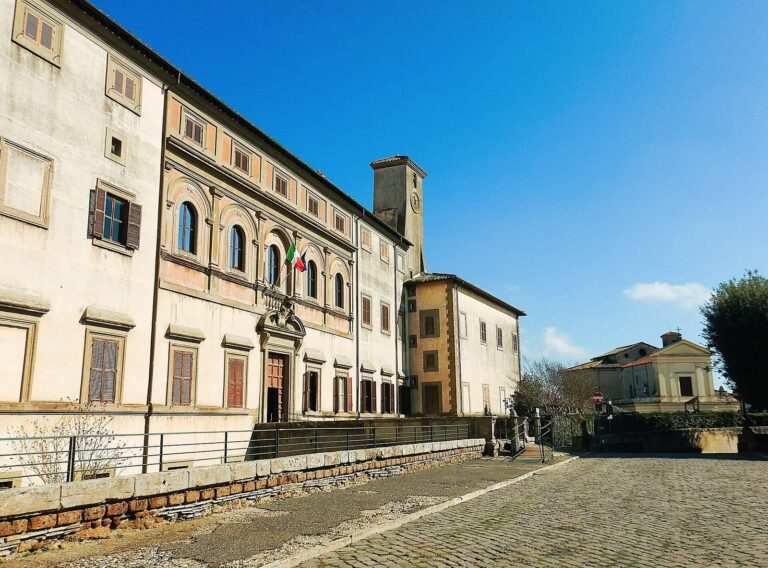
After the Roman Empire fell, the baths were partly destroyed, first by Saracens and later by the Longobards. In the sixteenth century, the Orsini family built a hunting lodge on the remains of the Roman villa or settlement, overlooking the lake. Valadier remodeled the lodge in the seventeenth century as the palazzo known as Villa Valadier. The bath area was sold to the Roman Hungarian College in 1692, and a thermal-bath establishment was built there in 1737.
In 1852, expansion of the eighteenth-century baths involved demolishing parts of the complex and an ancient pool. The work exposed a large votive deposit in a pool drain, which was recovered from scalding water. Excavations beneath Villa Valadier took place in 1912. Parts of the ancient sanctuary and baths were excavated in the 1970s and left exposed.
German nuns managed the baths from 1930 to 1970. After the estate was sold to the Vicarello Agricultural Society in 1983, the baths closed and remained abandoned. Vicarello Spa took over the company in 1989. In 1999, the area became protected as part of the Regional Natural Park of Bracciano-Martignano.
Remains
The ancient remains occupy two main areas within the private Vicarello estate, a park of about 2,000 hectares near Lake Bracciano. One area contains the settlement and villa remains; the other is the sanctuary and bath complex beside the natural springs. An Etruscan cemetery extends across the lower slopes on both sides of the Roman baths.
Villa and settlement
Villa Valadier
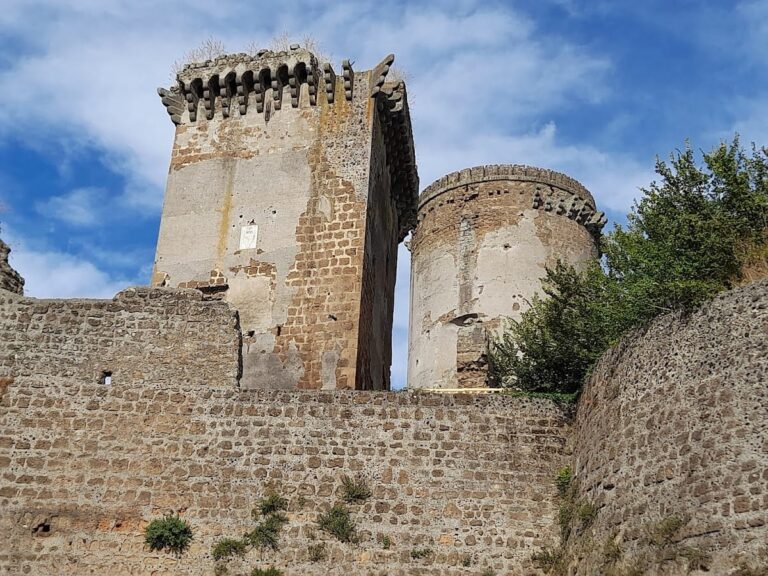
The now-disused Villa Valadier overlooks the lake and stands over remains of the Roman villa or settlement. The Orsini hunting lodge and Valadier’s later palazzo occupy this ancient settlement area.
Roman villa and estate
The Roman villa’s main centre occupied a prominent position, partly over two earlier Republican villas. It rested on an eleven-arched covered gallery that supported a platform and now lies beneath Villa Valadier. The estate’s agricultural area included warehouses and an olive-oil mill. A paved road connected the villa to the baths, whose Roman-period name was Aquae Apollinares.
Sanctuary and baths
Hot spring and thermal complex
A hot spring, measuring about 56°C, lies at the heart of the sanctuary and still flows into a nearby stream. An abandoned eighteenth-century resort hotel was built over it. About 50 m east of the spring stands a monumental bath complex with late-Flavian rooms, built in brick-faced masonry probably under Domitian. The complex is aligned differently from the structure around the spring. It used hot and cold spring water to supply rooms at different temperatures.
Water monument and statue of Apollo
The baths included a nymphaeum, a monumental structure associated with water, dedicated to Apollo. Its large rounded recesses were arranged in a hemispherical plan, a form associated with Flavian imperial residences, particularly those linked to Domitian. A statue of Apollo, made from Pentelic marble and originally more than 2 m tall, was found in place in the nymphaeum. Dating to the second century AD, it is now in the Archaeological Museum of Bracciano.
Springs and water supply
Cold-spring house
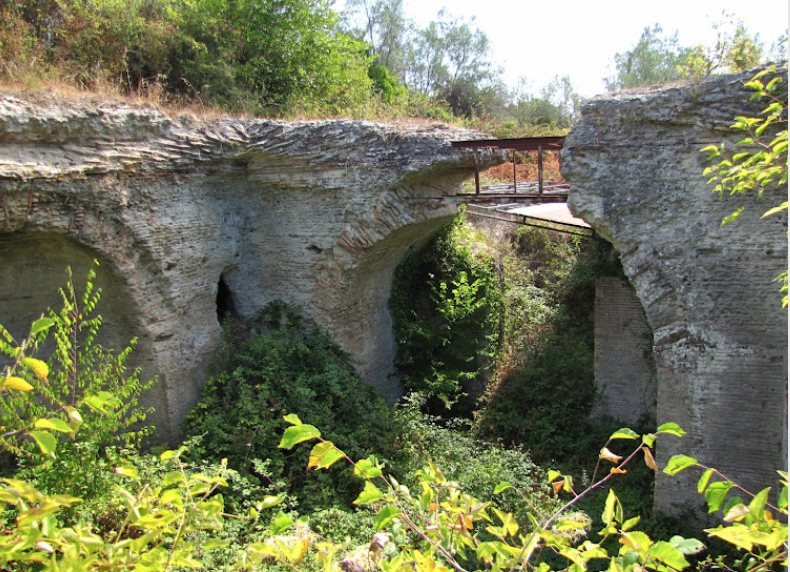
About 200 m north of the baths, cold-water springs were gathered in an underground vaulted springhouse on a narrow, irregular terrace. The structure lies 12–15 m above a bridge, against a deeply fissured cliff. Its main vaulted chamber is 41.5 m long. A gallery measuring 27.5 by 1.3 m receives water from the south; a narrower northern channel extends for 14 m. At its north end, another channel brings water from a rock face to the west, and the combined flow passes through a steep outlet.
The main springs emerge from the gallery’s west wall at the foot of 13 arches built against exposed rock. An arcade above ground, with arches twice as wide as those below, was constructed over them; most of it has collapsed. The arcade supported the underground arches and the fragile cliff face, and probably also formed a monumental feature visible from the baths below.
Channels and aqueduct
A southern feeder channel was probably added to carry water to Domitian’s nymphaeum and villa. Northern springs may also have been directed to the Porcareccia cistern, which measures 10 by 40 m. A map from 1789 shows a conduit following the ravine’s western slope and crossing the stream on a bridge. The source and traces of the Aqua Traiana are associated with this area. Aqueduct remains extend from the lake to the watershed of a stream descending the south-facing slope in the Fosso delle Ferriere ravine.
Cemetery and votive finds
Etruscan cemetery
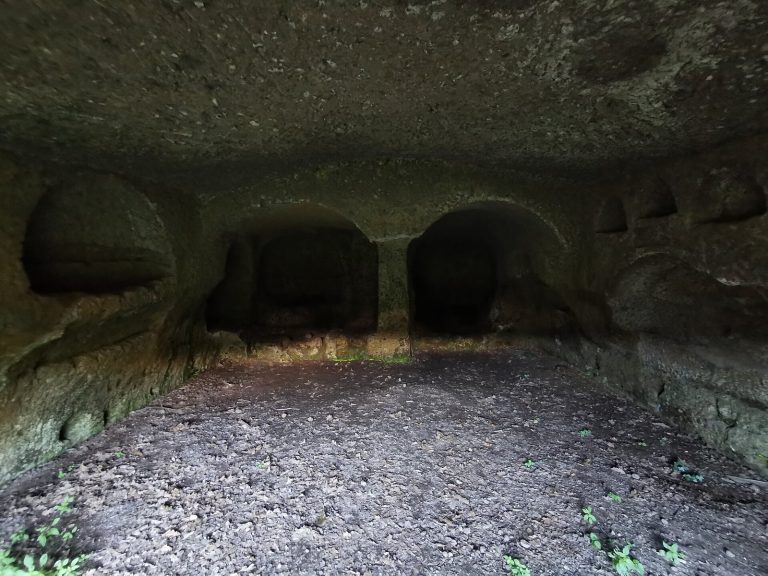
The cemetery covers the lower slopes on both sides of the Roman baths and is associated with the lost centre of Sabazia or Sabate. Field surveys identified it in 1986 and 1992.
Votive deposit
The deposit exposed in 1852 contains material reflecting activity from Neolithic times onward, with substantial finds from the Iron Age and later periods. It included about 40 gold, silver, and bronze vessels dedicated to Apollo, as well as thousands of coins dating from the first to the fourth centuries AD. Most of the finds are now in the National Museum. Four engraved silver goblets, known as the Vicarello Cups, describe a route between Cádiz and Rome and name roadside stopping places along the way. Votive objects from the baths site also date to the seventh century BC.