Church of the Assumption of the Virgin Mary, Stará Boleslav: A Baroque Pilgrimage Church
Site at a Glance
- Popularity
- Medium
- Country
- Czechia
- Primary era
- Early Modern
- Eras represented
- Early Modern
- Civilizations
- Habsburg, Habsburg Austria, Holy Roman Empire, Kingdom of Bohemia
- Site type
- Religious
- Remains
- Church
On this page22 sections
History
Construction and expansion
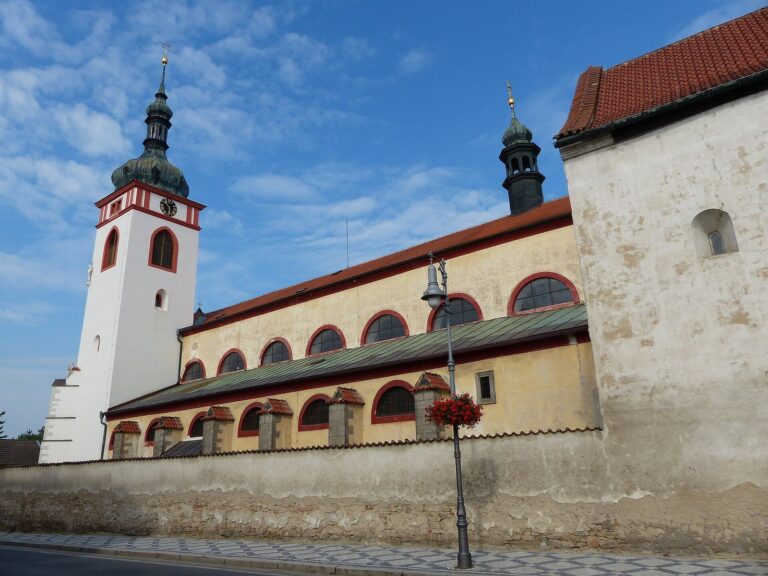
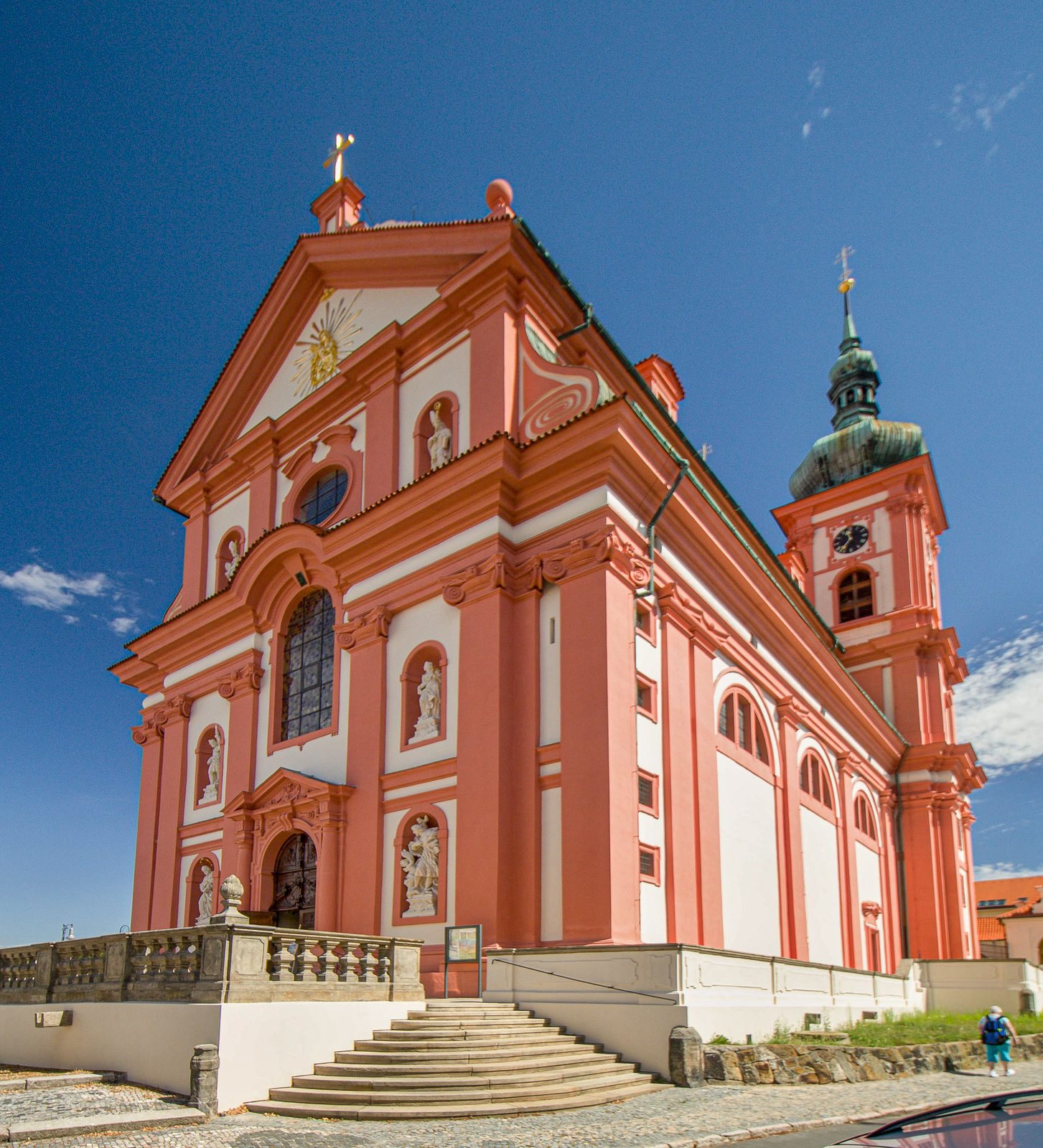
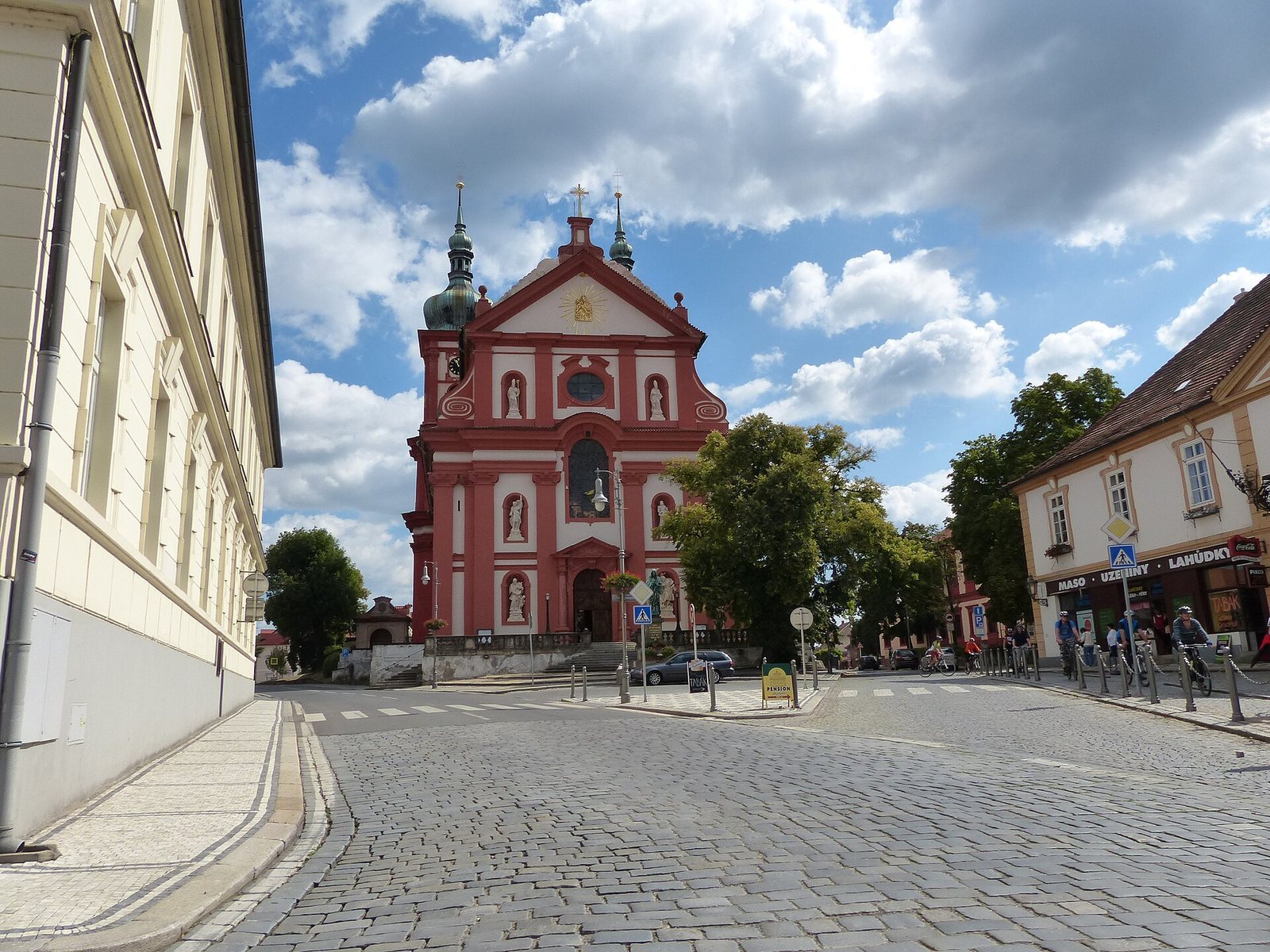
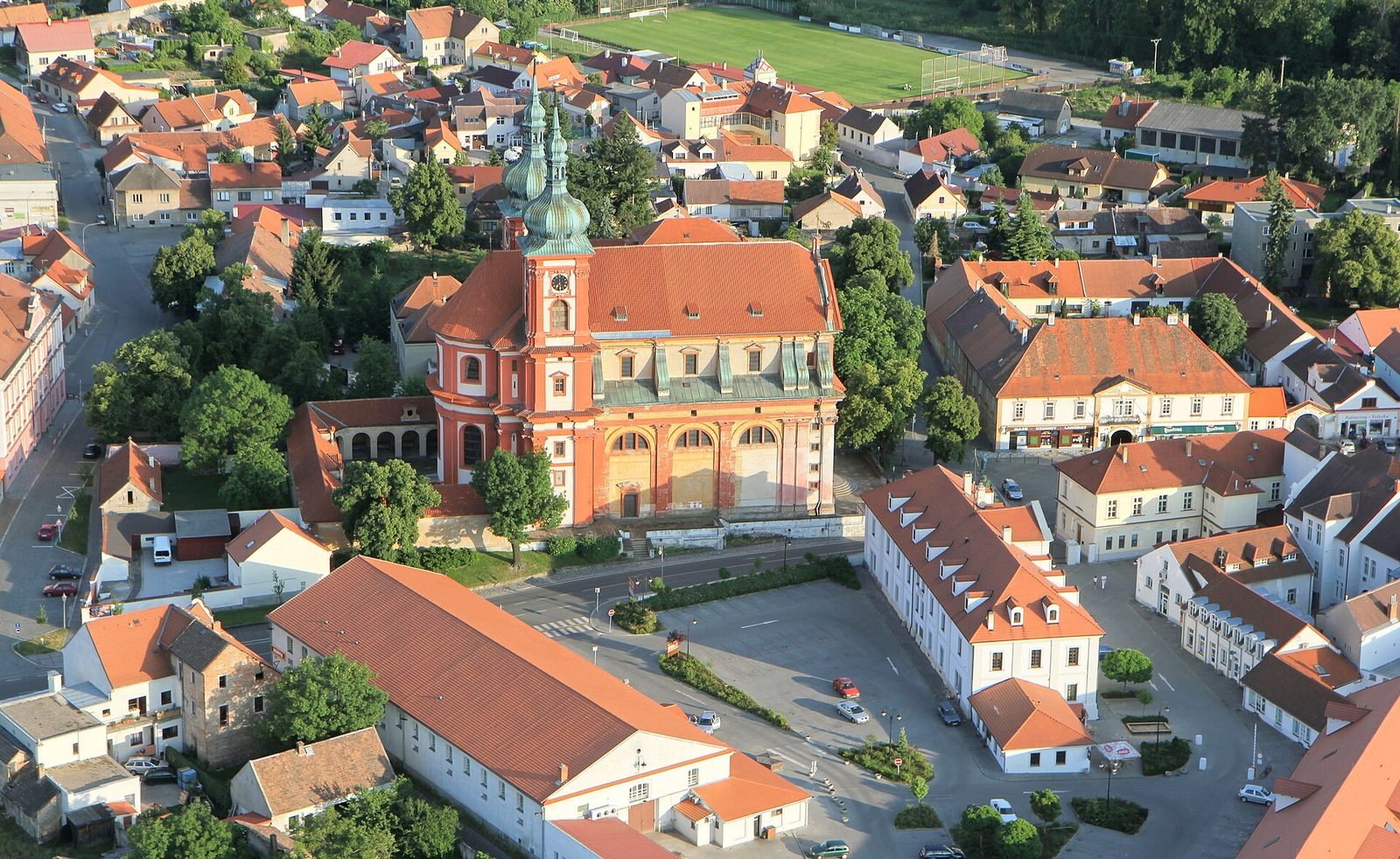
The Church of the Assumption of the Virgin Mary is a Roman Catholic parish and pilgrimage church in Stará Boleslav, Czechia. This Baroque basilica was built from 1613 to 1625 to replace a Gothic church that had become too small for the growing numbers of pilgrims. Its design is probably by the Italian architect Giovanni Maria Filippi, with construction directed by Jakub de Vaccani. The local Chapter of Sts. Cosmas and Damian, a clergy body responsible for the church’s religious and institutional life, undertook the work with substantial support from Emperor Matthias, his wife Anna, and Catholic nobles. The church was consecrated in 1690.
Building work continued in later decades. Abraham Leuthner completed the north tower in 1675. A new west façade was designed in 1736, and Kilian Ignaz Dientzenhofer designed the south tower, built in 1748–1749.
Pilgrimage and chapel patronage
A pious tradition places the discovery of the Palladium of the Czech Lands in 1160, when it was supposedly found while a field was being ploughed. Stories connect the object with St. Ludmila, an early Christian duchess and grandmother of St. Wenceslas, a tenth-century Bohemian duke and patron saint; with Prince Bořivoj; and with the missionary brothers Cyril and Methodius. One tradition says Wenceslas wore it on a strap around his neck. Stará Boleslav became the country’s most important pilgrimage site during the Baroque period, with devotion long centered on Wenceslas. The church has kept the Palladium for centuries. A palladium is an image or object believed to offer special protection to a community.
Czech noble families furnished the church’s six side chapels from the mid- to late seventeenth century. Paul of Morzin and his wife Elisabeth founded the Morzin Chapel, whose altar framework was erected in 1640. Adam the Younger of Waldstein owned the Waldstein Chapel. It was described as deserted in 1637 and was occupied by Swedish troops. Archbishop of Prague Jan Bedřich of Waldstein later arranged its furnishing and consecrated it, together with the main altar, on 21 May 1690. Ferdinand William Slavata and his wife Maria Renata began furnishing their chapel in 1668. František Antonín Berka of Dubá arranged the furnishing of his chapel in 1672–1673 while abroad on a Grand Tour, an educational journey through Europe traditionally taken by young aristocrats; he was then 23. Count Karel Maxmilián Lažanský and, successively, his two wives commissioned the Lažanský Chapel. Humprecht Jan Černín and his wife Diana Maria founded the Černín Chapel.
Custodianship and later events
Jesuits cared for the church until their order was suppressed, after which the local chapter resumed responsibility. The Chapter of Sts. Cosmas and Damian had been present in Boleslav since the eleventh century. From 1929, Redemptorists cared for the pilgrimage site, until the Communist regime forcibly ended their work in 1950. The chapter then returned with greatly reduced authority and membership, represented in practice by a capitular dean and parish priest. It was re-established after 1990 with canons who did not reside there. Pallottine priests managed the church and parish from 2003 to 2008; diocesan priests now provide pastoral care.
In May 1757, fighting during the Seven Years’ War reached the church’s immediate surroundings. Prussian cavalry major general Carl Ernst von Wartenberg was killed and buried in the church crypt. The cemetery east of the cloisters closed in 1835, and burials moved to a new cemetery near the chapel of Blessed Podiven. Repairs carried out under the Architectural Heritage Rescue Programme between 1995 and 2014 helped maintain the church.
During the St. Wenceslas pilgrimage on 28 September 2014, three crowns blessed in Rome by Pope Francis were placed on the Palladium. At a Marian pilgrimage on 18 August 2024, Cardinal Dominik Jaroslav Duka, emeritus Archbishop of Prague, celebrated Mass and placed a reliquary containing relics of St. Wenceslas, St. Adalbert, St. Ludmila, and St. John of Nepomuk into an altar.
Remains
Plan and exterior
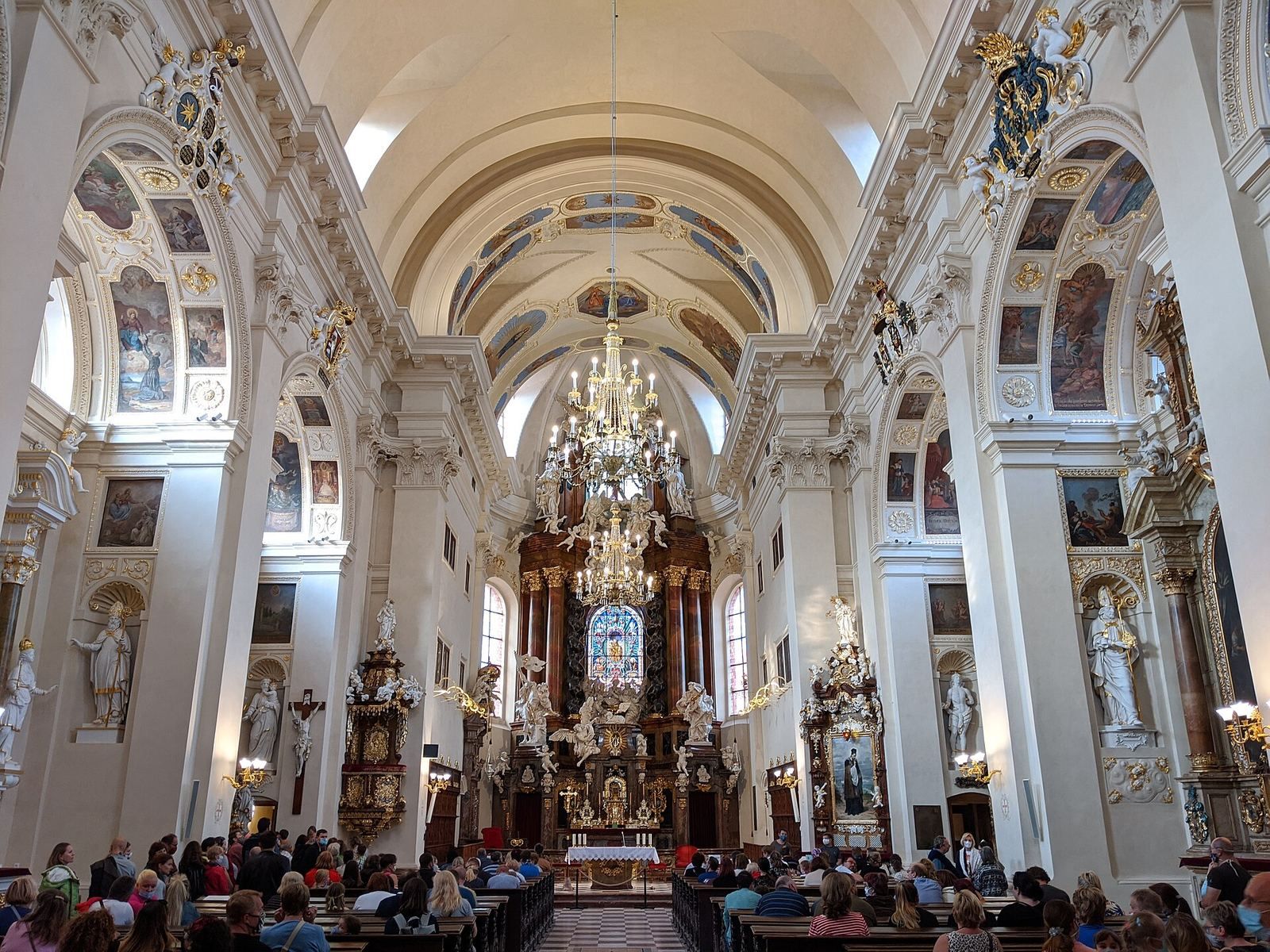
The church is built of stone, brick, and stucco, with its altar at the eastern end. Its plan consists of a single long nave with a barrel-vaulted ceiling and half-moon-shaped sections called lunettes, flanked by three pairs of side chapels. This early Baroque arrangement developed in Italy in the late sixteenth century after the Council of Trent, a Catholic council whose reforms shaped worship and church practice. It gave worshippers a view toward the sanctuary and helped carry sound through the church, while the chapels supported private devotion.
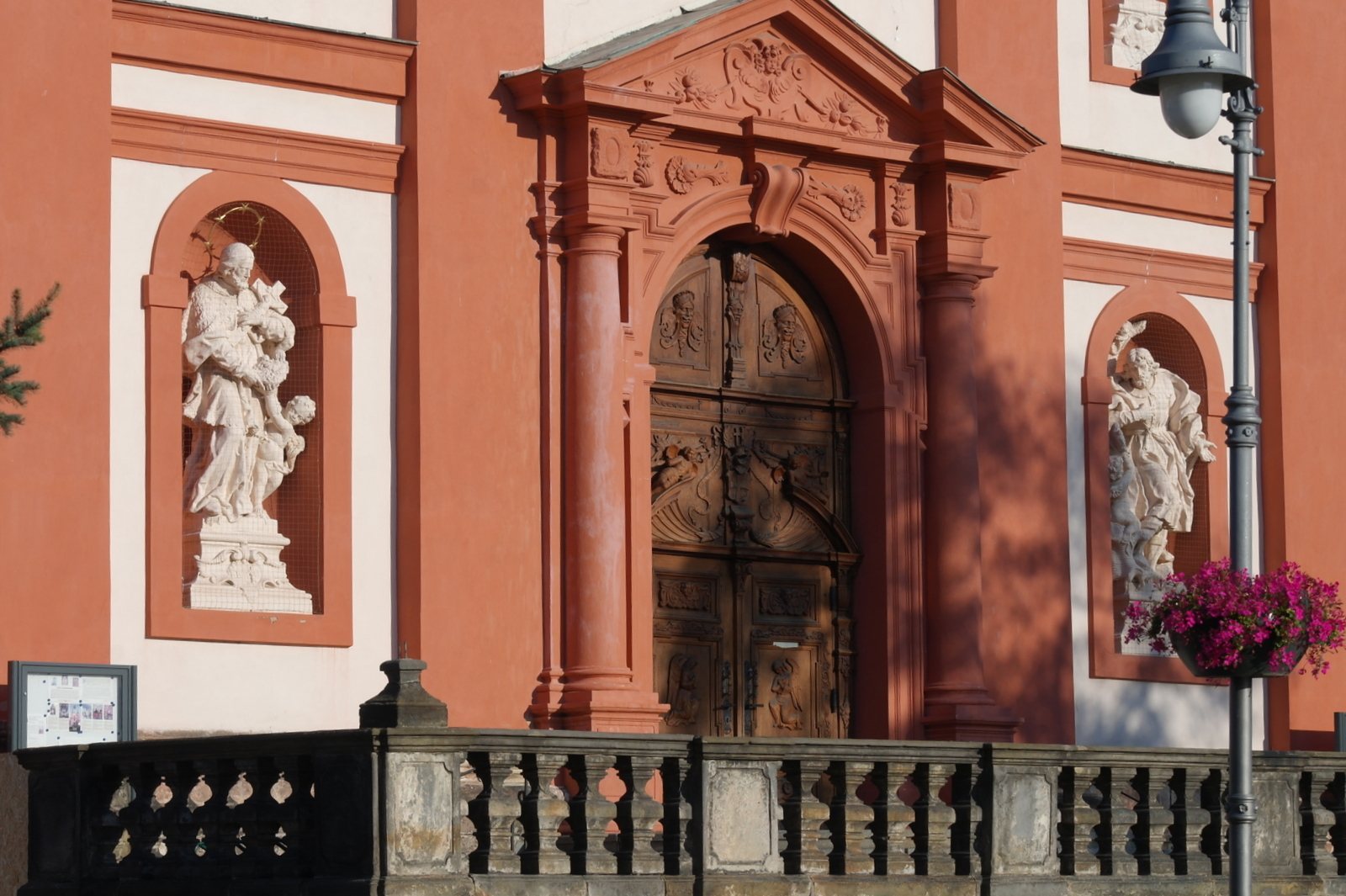
The west façade has niches containing statues of St. John of Nepomuk, Blessed Podiven, St. Wenceslas, St. Ludmila, St. Adalbert, and St. Procopius, each holding the Palladium. A statue of Christ the King was installed in 1935 where a well had stood in front of the church.
Interior and furnishings
Main altar
The monumental main altar, designed by František Maxmilián Kaňka, was completed and consecrated in 1723. Its sculptural decoration, produced by the workshop of Matthias Bernard Braun in 1719–1721, presents the Assumption of the Virgin Mary as a dramatic scene. Statues of St. Wenceslas and St. Ludmila stand at the column bases; figures of the chapter’s patrons, Sts. Cosmas and Damian, are placed on the horizontal structure above the columns.
Palladium shrine
On the north side of the presbytery, the area around the main altar, stands an altar with a marble shrine. Its doors carry a silver openwork grille and Sternberg stars. The Palladium was kept there until 1778. A small portable altar known as a throne displayed it during Marian Masses and pilgrimages. Small altars holding relics were also placed on the tables of the other altars for occasional veneration.
Pulpit and altar of St. John of Nepomuk
The church’s pulpit is a late-Baroque work dating to 1743. The south-side altar of St. John of Nepomuk was made in 1744 and includes a painting by Josef Mathauser.
Morzin Chapel
On the south side of the nave, the Morzin Chapel is dedicated to the Immaculate Conception of the Virgin Mary. Its paintings of the Virgin Mary and, above, the Holy Spirit are attributed to Antonín Stevens.
Waldstein Chapel
The south-side Waldstein Chapel is dedicated to the Nativity of the Virgin Mary. Its main painting is based on a work by Pietro da Cortona, while Jan Kryštof Liška painted the image of God blessing in the upper section.
Slavata Chapel
The south-side Slavata Chapel contains an altarpiece of the Adoration of the Magi, painted by Josef V. Hellich in 1877, with a depiction of the Holy Trinity above it.
Berka Chapel
On the north side, the Berka Chapel is dedicated to the Presentation of the Lord, also known as the Purification of the Virgin Mary. Its painting is by Francesco Cozza.
Lažanský Chapel
The north-side Lažanský Chapel is dedicated to the Presentation of the Virgin Mary in the Temple. Its main painting of that subject is by Karel Škréta the Elder and his son, who shared his name.
Černín Chapel
The north-side Černín Chapel is dedicated to the Annunciation. Jan Bedřich Hess painted its Annunciation and a scene of Adam and Eve beside the Tree of Knowledge.
Chapel of Blessed Emperor Charles I
A side chapel dedicated to Blessed Emperor Charles I of Austria was consecrated in 2011. In 2020, a reliquary, a container for sacred relics, holding one of his relics was placed on its altar.
Cloisters and eastern grounds
Cloisters
Cloisters built between 1728 and 1731 surround the church on three sides. Václav Kramolín painted scenes about the discovery and veneration of the Palladium across their walls and vaulted ceilings in 1775. The South Bohemian painter František Anděl repainted the murals in 1882.
Krieger tomb
A tomb erected in the cloister courtyard in 1793 commemorates Erasmus Dionýsius Krieger, provost of Stará Boleslav and auxiliary bishop of Prague. It includes two sandstone figures in mourning and an urn, made by Josef Malínský in 1793.
Cemetery chapel
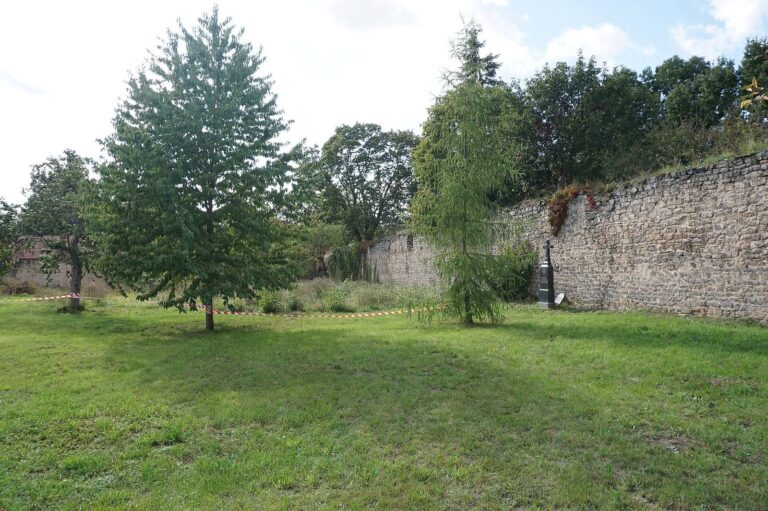
The cemetery lay east of the cloisters, with a small Baroque chapel dedicated to St. Benedict set into its eastern wall. Repeated repairs altered the chapel’s original character.
The Palladium
The Palladium of the Czech Lands is a Gothic metal relief of the Madonna dating to the mid-fourteenth century. It is cast from an alloy known as Corinthian copper, made from gold, silver, platinum, and copper. In the seventeenth or eighteenth century, the relief was fitted into a silver frame set with gemstones.