Saint Mary Church in Luže: A Baroque Pilgrimage Church
Site at a Glance
- Popularity
- Medium
- Country
- Czechia
- Primary era
- Early Modern
- Eras represented
- Early Modern
- Civilizations
- Habsburg, Habsburg Austria, Holy Roman Empire, Kingdom of Bohemia
- Site type
- Religious
- Remains
- Church
On this page13 sections
History
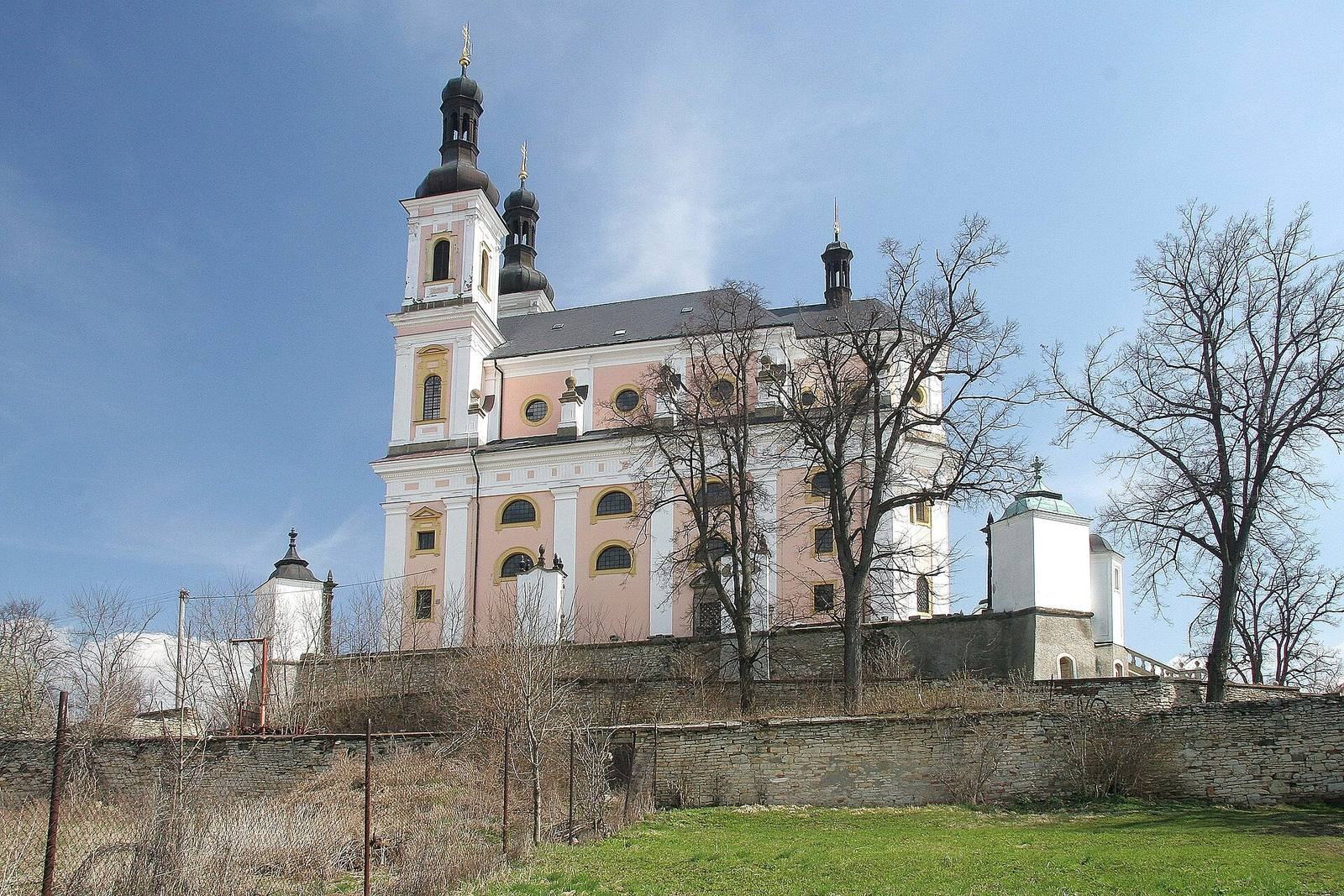
Saint Mary Church in Luže, Czechia, is a Roman Catholic parish and pilgrimage church dedicated to Our Lady Help of Christians, a Catholic title for Mary as a protector. The present Baroque building, in a European style associated with dramatic forms and elaborate ornament, was built from 1689 to 1696 on Chlumek. Its development as a pilgrimage centre was closely linked to devotion to a family image of the Virgin Mary and the patronage of Maria Maximiliana Eva Teresa Hýzrlová of Chody, born Countess of Žďár.
The Marian image and first chapel
In the 1660s, Maria Maximiliana received from her brother a family image of Our Lady Help of Christians, also called the Passau Madonna. The family regarded it as a protective relic and believed it had been touched to a miraculous original. That original, painted around 1552 by Lucas Cranach the Elder, was especially revered; Maria Maximiliana’s parents had brought the family image to Bohemia in 1622. It travelled with the family and was first kept in a small chapel at Košumberk Castle.
After the deaths of her three children, including her only daughter to reach adulthood, who died in 1684, Maria Maximiliana’s Catholic faith deepened. As devotion to the image grew, she made it available to local worshippers, intending also to strengthen Catholicism on her estate. She had a pilgrimage chapel built on Chlumek between 1667 and 1669. Jesuits, members of a Catholic religious order, took part in caring for the pilgrimage site from 1669.
Construction of the church
A Jesuit residence and a small house for Maria Maximiliana were established beside the pilgrimage complex between 1678 and 1683. In 1684 she donated the Košumberk estate to the Jesuits. Four years later, she inherited part of the Žďár family property with four sisters and used family resources for a larger church. The original chapel was demolished in 1689 because it was considered inadequate, and work began on the present church.
Italian builder Bernardo Minelli designed the church. Giovanni Battista Alliprandi participated in the project, and Pavel Ignác Bayer joined later. Maria Maximiliana died on 17 October 1690, before construction was complete. The church was finished in 1696, and on 7 September that year the Marian image was solemnly moved from the Jesuit residence into the church. Work on the interior continued until 1708, and the church was consecrated in 1713. In 1698 Maria Maximiliana’s body was transferred to a tomb in front of the main altar. The church soon became one of the most frequented pilgrimage churches in Bohemia.
Jesuit use and later history
The Jesuits staged religious dramas in the church until their order was temporarily suppressed in 1773. The residence beside the church lost its second storey in 1823, was damaged by fire in 1949, and was later converted into apartments.
The church became a cultural monument in 1958. Repair work took place between 1995 and 2014 under the Architectural Heritage Rescue Programme. In 2018, the church and its grounds, including the terrace ambulatory, chapels, stairways, enclosing wall, gates, and former Jesuit residence, were declared a national cultural monument.
Remains
Setting and exterior
Church and hillside setting
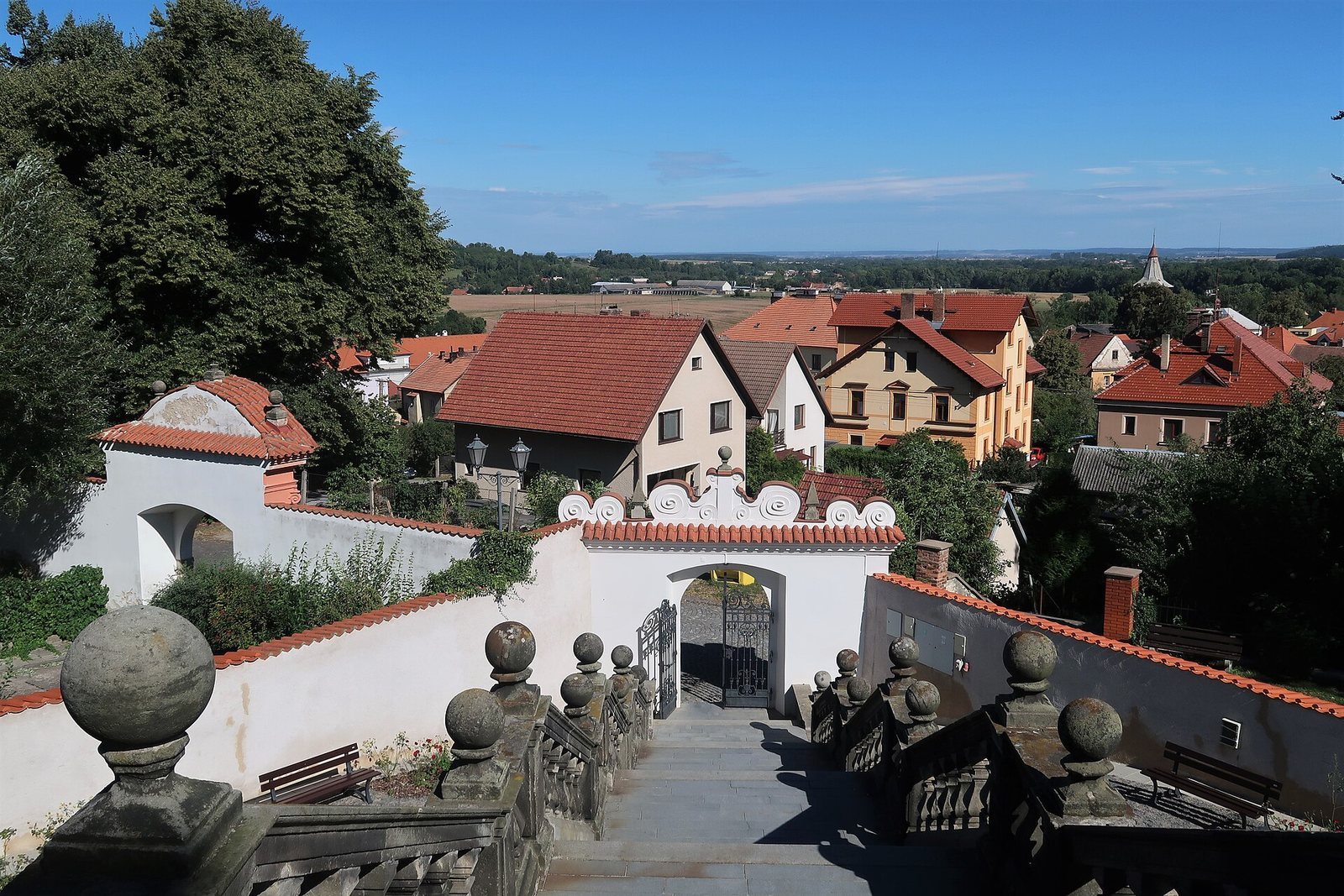
The church stands on Chlumek above a deep valley of the Novohradka River, in the Svitavy Hills. The rise belongs to the Novohradská stepped upland in the Loučenská Tableland, whose landscape descends toward the Polabí lowlands. The church is a prominent feature of Luže and the surrounding landscape, visible from a distance. Chlumek is also locally described as a Marian holy mountain.
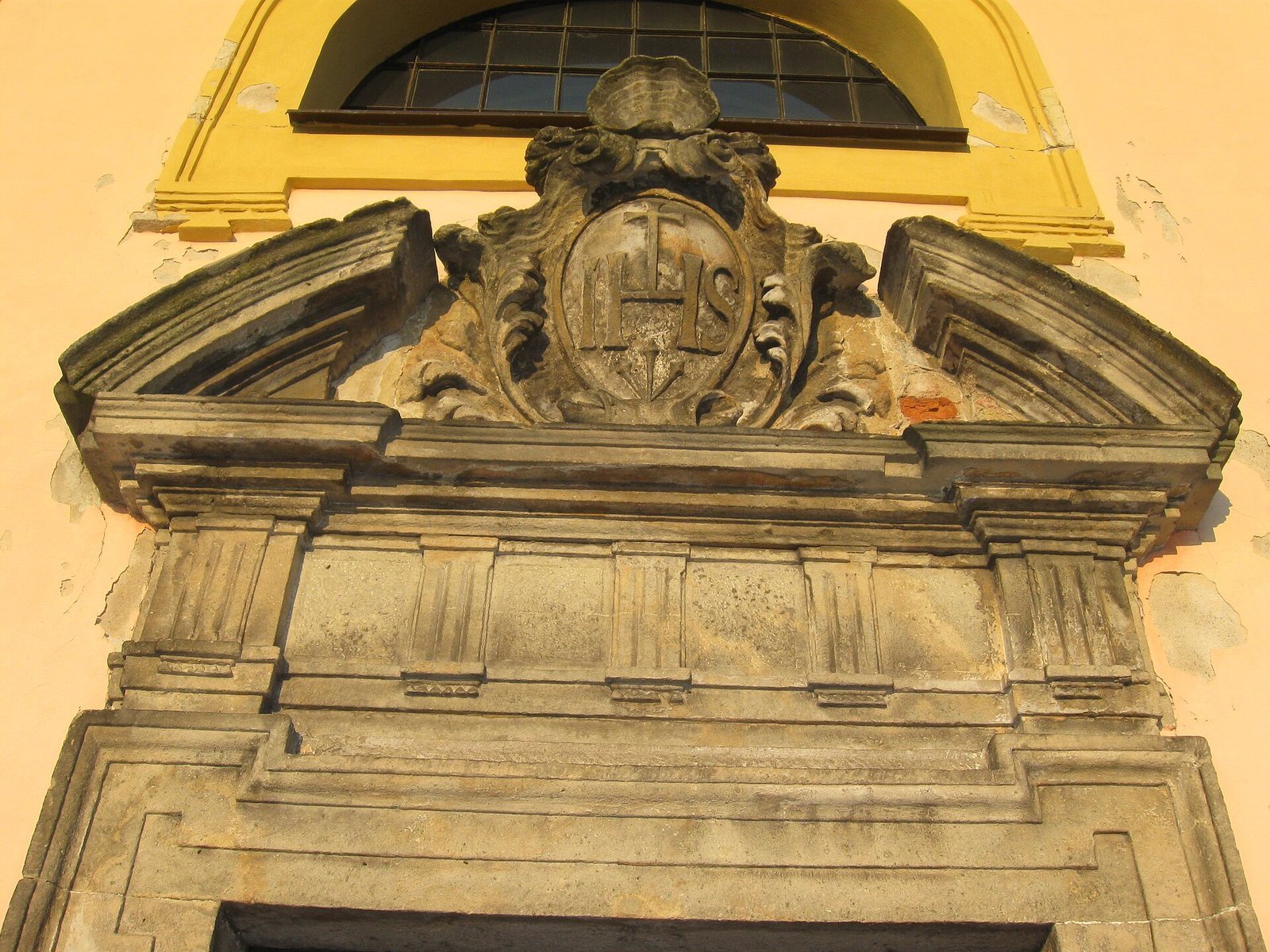
The single-nave church has side chapels, galleries, high clerestory windows that light the central nave, and a narrower, set-back presbytery, the area around the main altar. Its front has two towers, pilasters, which are shallow column-like projections, and a three-sided gable. At the east end, the presbytery projects in three sides. A columned entrance portal bears Maria Maximiliana’s coat of arms and the date 1700. Niches in the front hold statues of Saint Joseph and Saint Joachim.
Ambulatory, chapels, and approaches
A terrace-like ambulatory, a covered passage around a church, encircles the building. It contains four oblong chapels at the corners and four more along the sides. Two monumental stairways follow the church’s axis, while another runs diagonally toward the former Jesuit residence. An enclosing wall and entrance gates complete the grounds.
Former Jesuit residence
The former Jesuit residence stands southeast of the church and forms part of the pilgrimage complex. It is now converted into apartments.
Interior and furnishings
Marian chapel and main altar
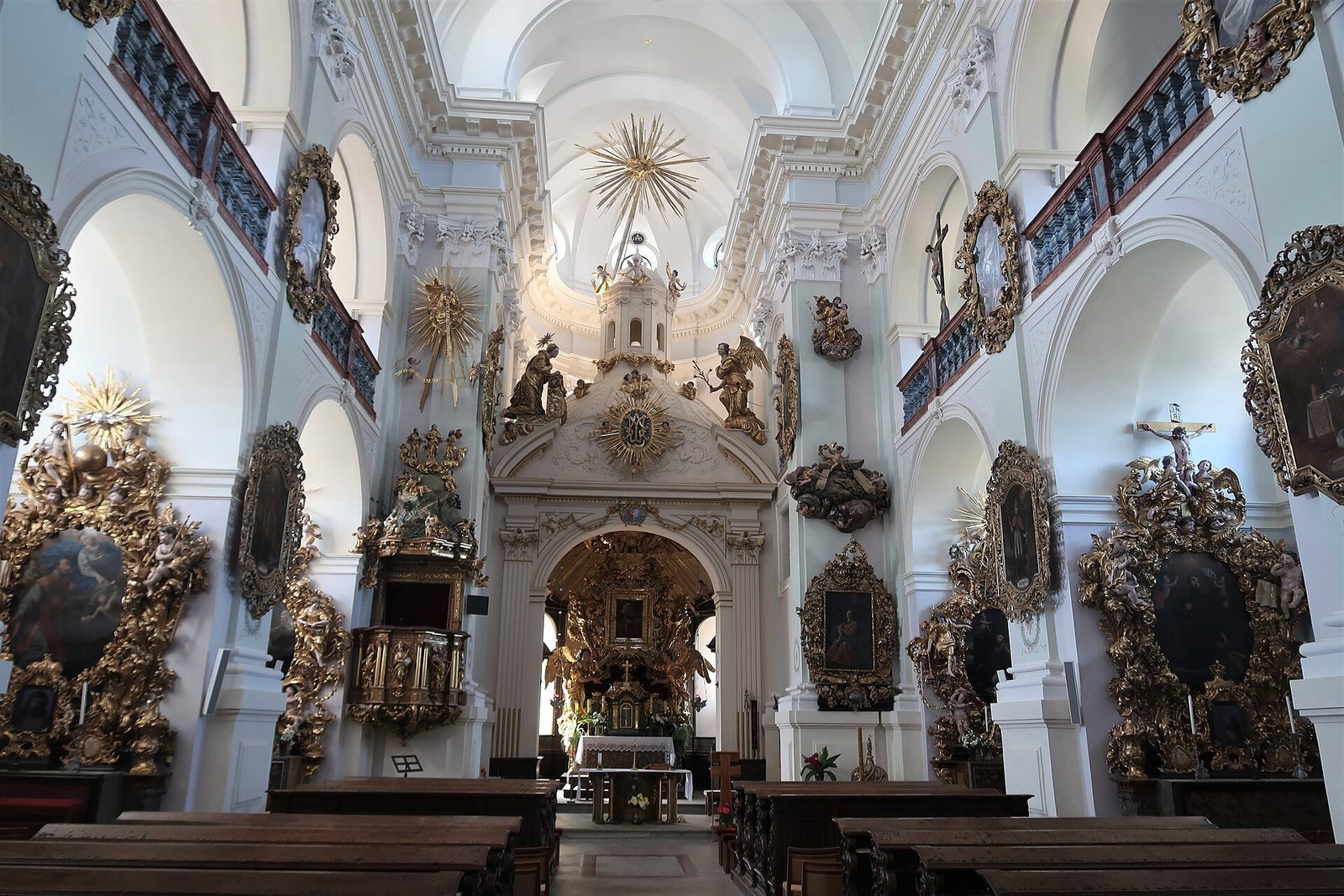
A circular masonry chapel occupies one bay and the end of the presbytery, rising to about the height of the gallery parapets. A semicircular arch, framed by pilasters and sections of entablature, the horizontal structure supported by the pilasters, provides a view into the chapel and access to it. Its cornice forms an open semicircular gable. The chapel has a vaulted ceiling and a polygonal roof lantern, a raised structure that admits light.
The main altar is a large, freestanding architectural composition with a sculpted Annunciation, the episode in which the angel Gabriel tells Mary she will bear Jesus. Beneath the dome is a richly decorated tabernacle, the receptacle for the consecrated Eucharist, containing a copy of the Marian image. The central image of Our Lady Help of Christians, or the Passau Madonna, has a silver frame dated 1694. A carved surround of cornucopias filled with flowers and fruit is supported by two larger-than-life angels.
Nave chapels and paintings
Six side chapels in the nave have altars with paintings of Saint Anne, Saint Ignatius, Saint Barbara, Saint John of Nepomuk, Saint Francis Xavier, and Saint Apollonia. Jan Jiří Heinsch painted these works in 1705 and 1706. Other paintings include Ecce Homo, Saint Stanislaus Kostka, and Our Lady of Sorrows, along with further images on altars and walls.
Sculpture and other furnishings
The church’s sculptural decoration includes Saint Rosalia, the archangels Michael and Raphael, and Saint Odilia. Another group depicts the Transfiguration, the account of Jesus appearing in divine glory to his disciples, with Moses and a second figure. Saint Joseph and Saint Joachim also appear at the main entrance.
Jiří František Pacák is the principal sculptor associated with the interior. His works include the Saint Apollonia altar and the pulpit. He is also believed to have made sculptures for the main altar, including its two monumental angels and Annunciation group, as well as a figure of God the Father above the pulpit and statues of Saint Joseph. Several artists produced the extensive woodcarving; Jesuit brothers and the sculptors or woodcarvers F. Baugat, J. Kostelník, and F. M. Brabenec are also associated with the church’s furnishings. A tombstone commemorating Maria Maximiliana is in the chapel of Saint Barbara. The organ has two sections with acanthus-leaf woodcarving.