Chisoku Kofun: A Fifth-Century Burial Mound in Japan
Site at a Glance
- Popularity
- Medium
- Country
- Japan
- Primary era
- Classical
- Eras represented
- Classical
- Civilizations
- Unclassified
- Site type
- Burial
- Remains
- Burial Mound
On this page11 sections
History
Chisoku Kofun is a burial mound in Japan, constructed in the first half of the fifth century as one of six subsidiary tombs associated with Tsukuriyama Kofun. Together, the principal mound and its subsidiary tombs form the Tsukuriyama Kofun group. The tomb belongs to the Kofun period, an era named for monumental burial mounds built for powerful individuals.
Construction and regional connections
Chisoku Kofun was probably built after Tsukuriyama Kofun. Its varied haniwa, clay objects placed on or around burial mounds, resemble those from the principal tomb more closely than the assemblages of the other subsidiary tombs. Its early horizontal stone chamber, a burial space entered through a passage, is a representative example of a chamber type found on Honshu and has strong affinities with forms from Kyushu.
The chamber’s links with Kyushu have been taken to suggest contact between that region and Kibi, an ancient area in what is now western Honshu. This contrasts with nearby Sakakiyama Kofun, whose remains point to connections with the Korean Peninsula. The difference has been interpreted as evidence that the ruler of Kibi, buried at Tsukuriyama Kofun, maintained regional ties without relying on the Yamato polity, the early political power centered in the Yamato region, as an intermediary.
Looting, protection, and investigation
Chisoku Kofun and Sakakiyama Kofun were plundered in 1912. Recovered objects were sent to the Imperial Household Museum, and most were later returned to the area. An investigation in 1913 found the chamber flooded, and its findings were reported in 1919. On March 3, 1921, Chisoku Kofun was designated a National Historic Site as the fifth tomb in the protected group comprising Tsukuriyama Kofun and its six subsidiary tombs. Another investigation took place in 1936, with results published in 1938. Flooding inside the chamber continued after a photograph was taken in 1987.
In 1998, a nearby household donated objects attributed to the 1912 discoveries to the Okayama City Board of Education. The collection may also contain material from Sakakiyama Kofun. Three-dimensional recording in 2009 revealed deterioration of the decorated partition stone. Archaeological and conservation work followed from 2010 to 2013, including a survey above the first chamber and confirmation of the mound’s extent. The fourth investigation, in 2013, uncovered a second stone chamber.
Remains
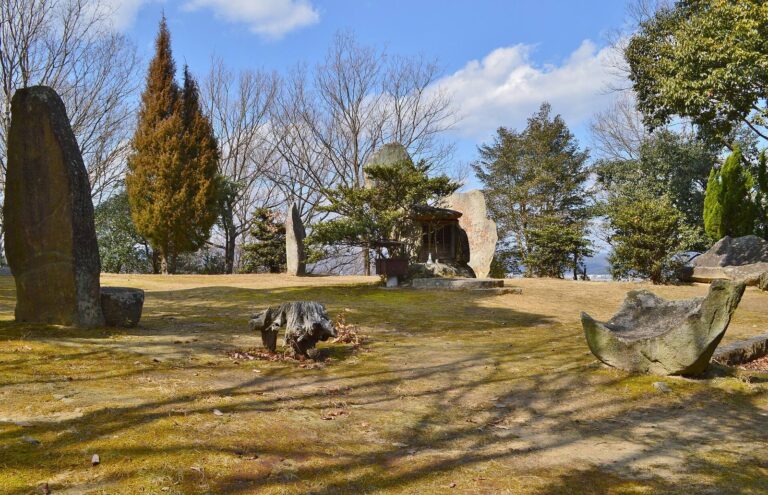
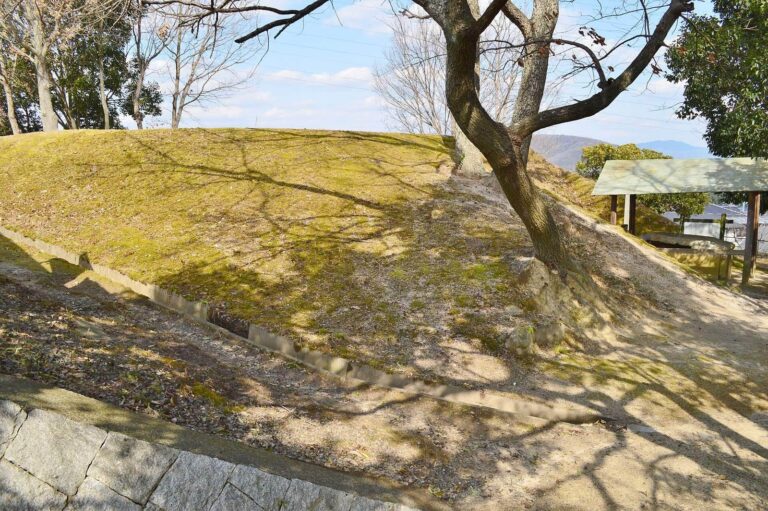
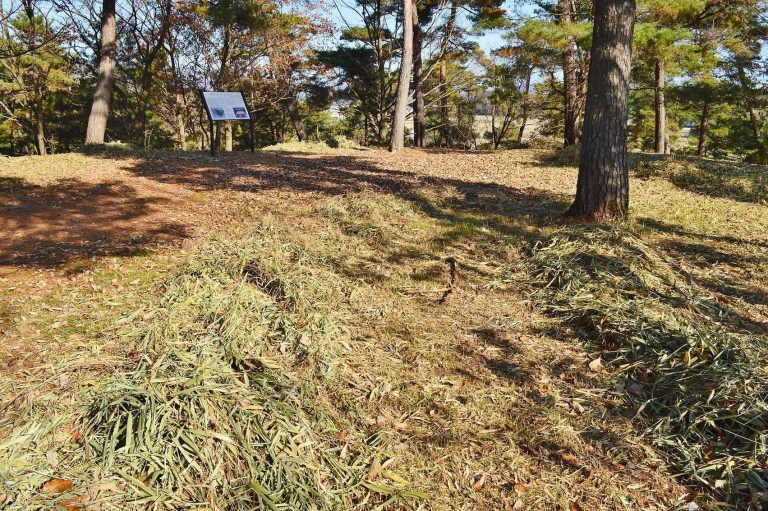
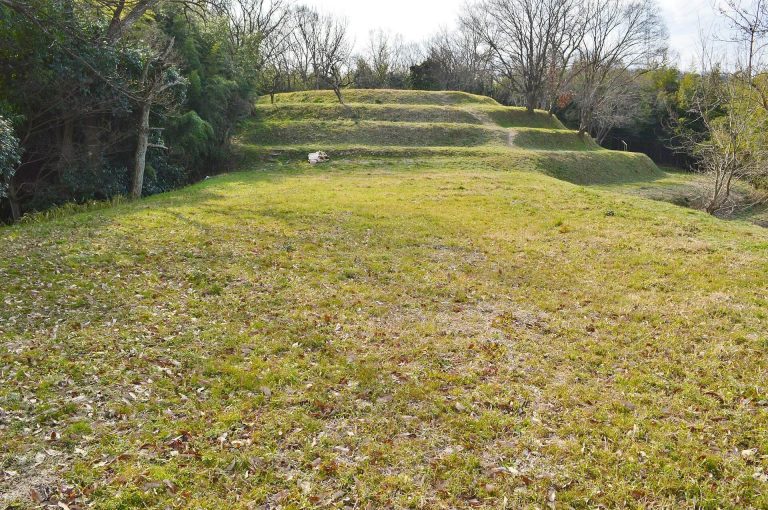
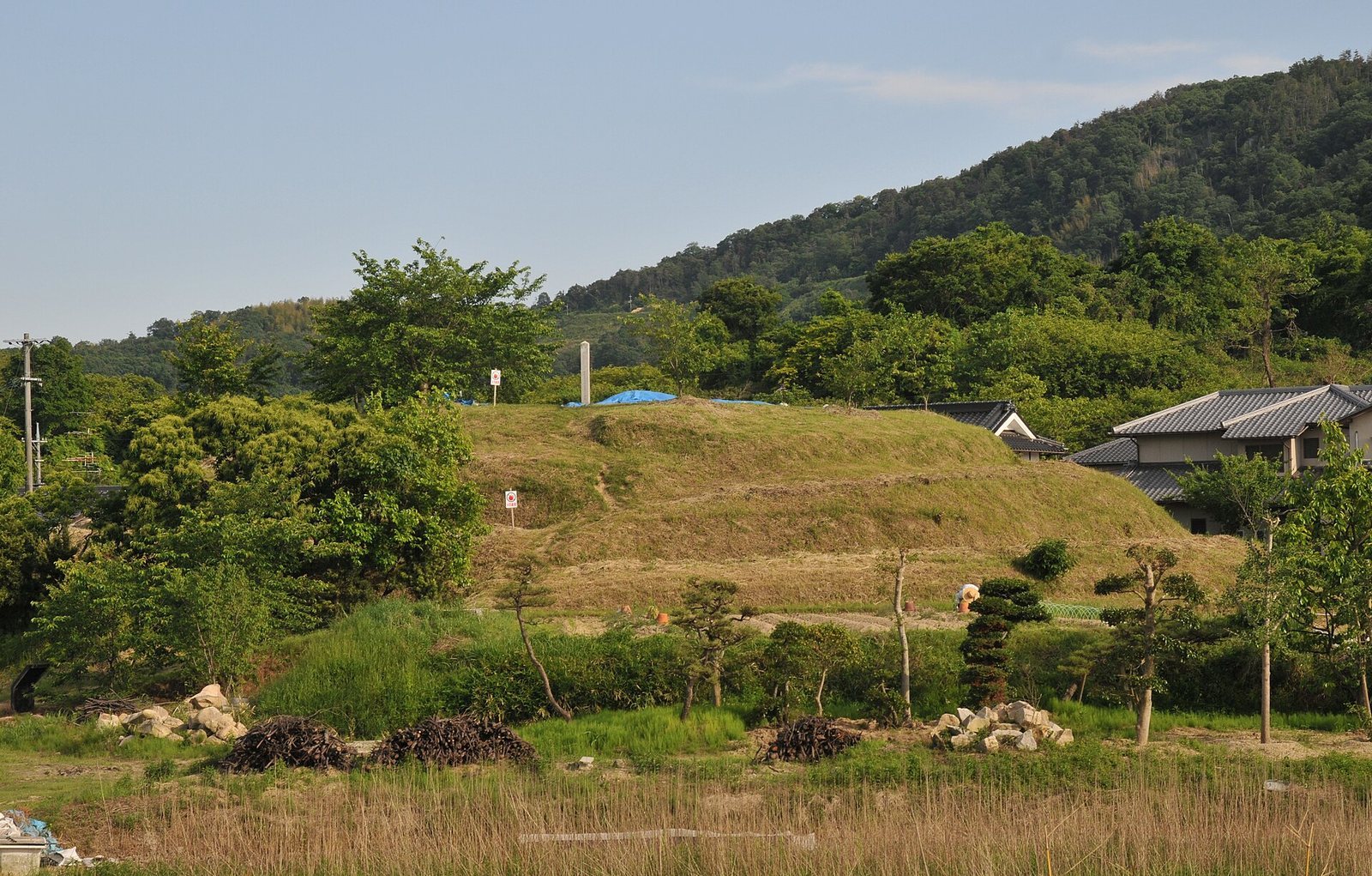
The mound stands on a hill on the west bank of the Ashimori River, in front of Tsukuriyama Kofun’s forepart. It has a keyhole layout, with a rounded rear section and a short, rectangular front section pointing northwest. A moat traces the mound’s outline.
Mound and layout
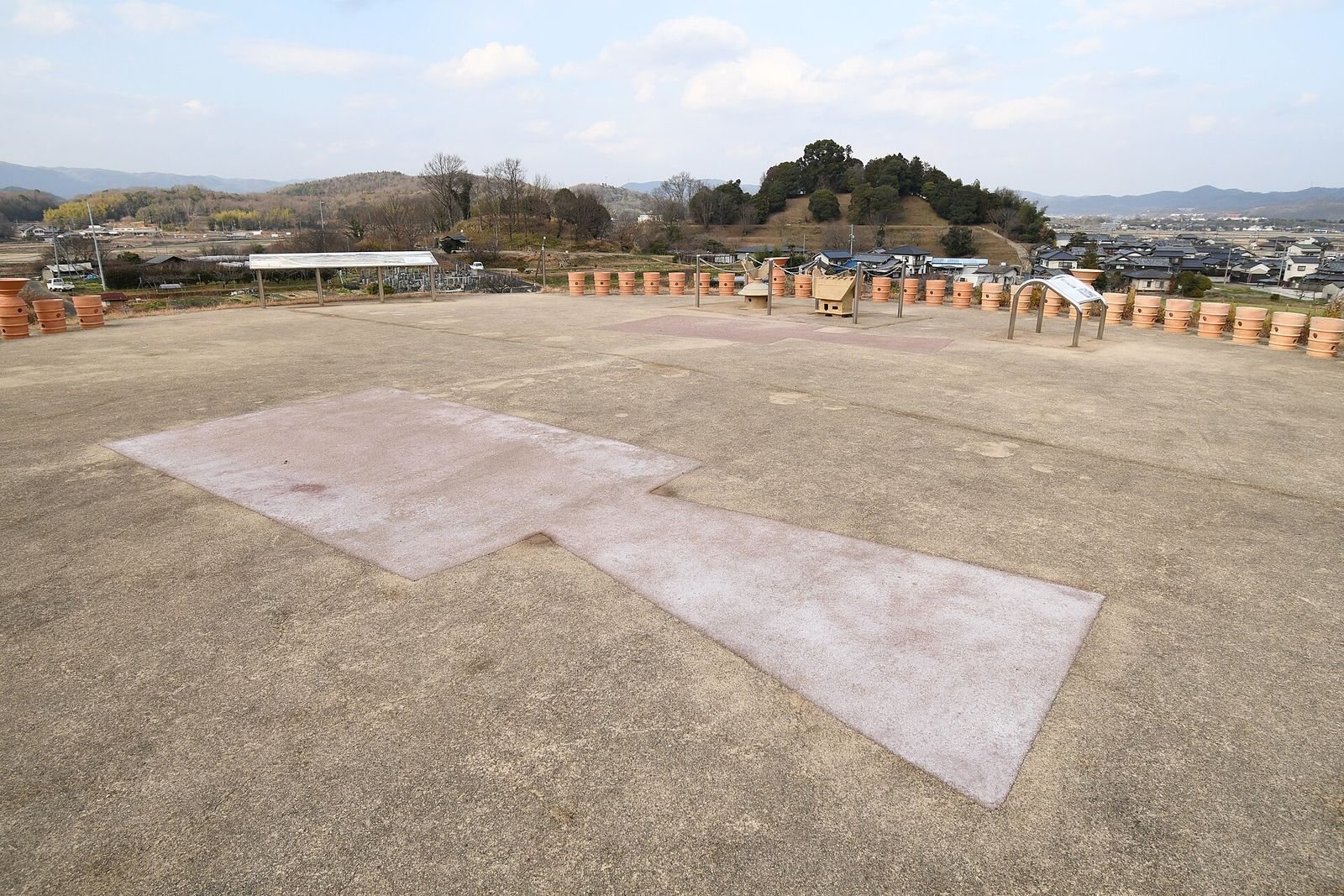
The mound is about 81 metres long. Before recent investigations, its length was estimated at about 74 metres. The rear section is about 63 metres in diameter and at least 7.4 metres high; the front section is 26 metres wide. The rear rises in three tiers, while the front has one. Natural ground forms the lower part of the rear section to about 2.5 metres above its base, with earth fill above.
Stone chambers
First chamber
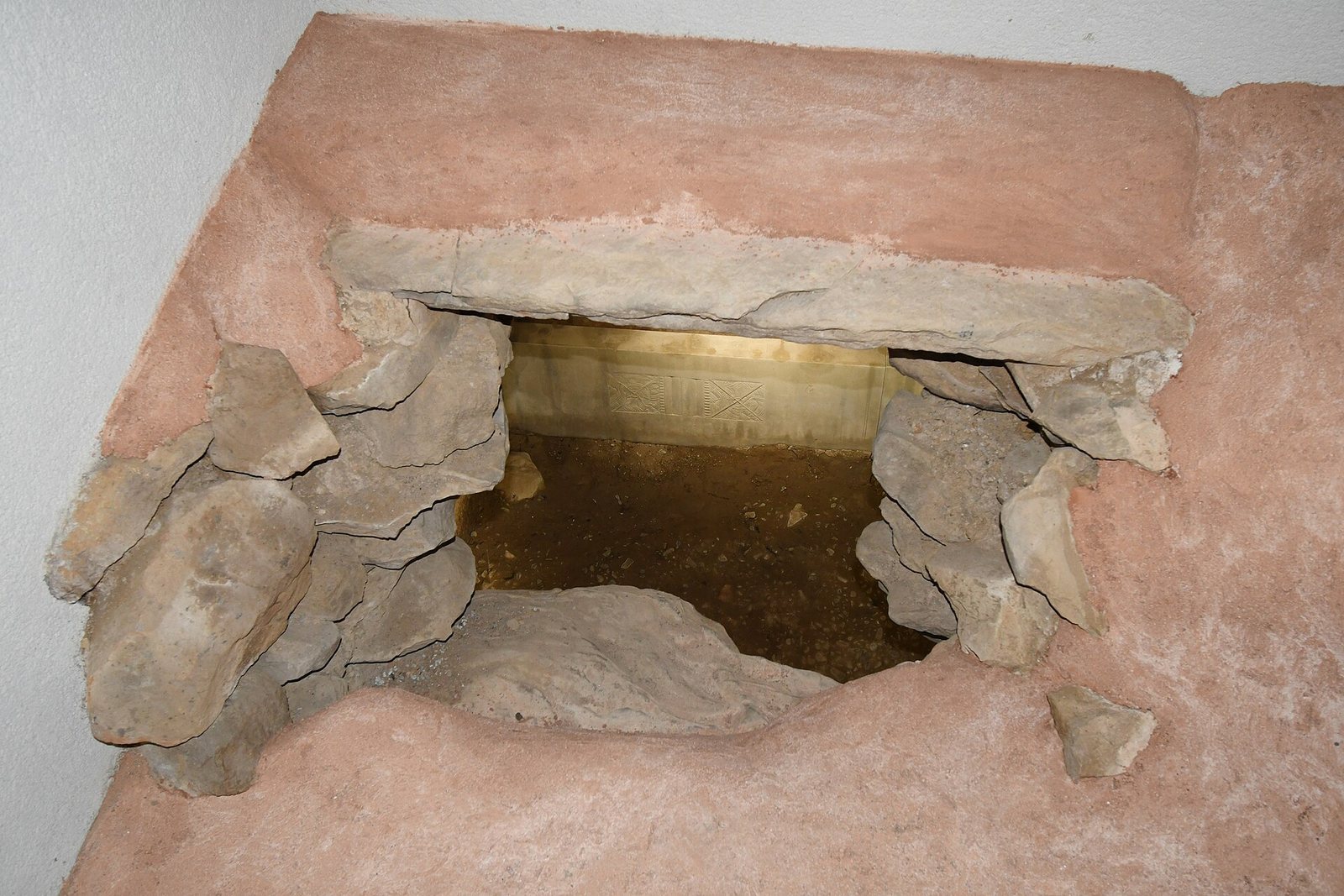
The first chamber lies in the west-central part of the rear mound and opens southeast. Its burial space measures 3.45 metres long, 2.6 metres wide, and about 2.6 metres high. Flat slabs of andesite, a type of volcanic rock, from Kagawa form the chamber, whose walls retain red pigment. The rear and side walls slope strongly inward toward a domed ceiling; a standing slab forms the front wall. The entrance is sealed, and an opening remains in the ceiling.
Stone barriers line all four walls. The rear barrier is andesite, while the others are sandstone from Amakusa in Kumamoto. Four slabs line each side, and the entrance barrier has a U-shaped cut. The rearmost side slabs, rear barrier, and partition stone together form the burial bed, with a floor of three sandstone slabs. The passage widens outward, and its entrance is thought to have been at the mound’s top. Three stones form the chamber ceiling, with one covering the passage. Its relatively rectangular plan has led some to classify it as Chikuhi-type rather than Higo-type, two regional categories of ancient burial chamber.
The partition stone consists of two sandstone slabs from Amakusa. The larger is about 1.62 metres long, 0.52 metres wide, and 0.13 metres thick. Its front bears a straight-and-arc motif, combining straight and curved lines, while its upper surface has a key-shaped design. After its deterioration was identified, the stone was removed in December 2011 and placed at the Okayama City Archaeological Center; a replica now occupies its position in the chamber. This was the third removal of a decorated chamber element from a Japanese tomb, following removals at Kitora Tomb and Takamatsuzuka Tomb.
Second chamber
The second chamber lies east of the first, in the central eastern part of the rear mound. It opens southeast like the first chamber and is higher in the mound. Its ceiling had collapsed when it was discovered in 2013. The chamber measures 2.5 metres long, 2.2 metres wide, and more than 2 metres high. Its stones are mainly local granite, with some andesite. Its position and shared opening direction with the first chamber have been taken to indicate that both were included in the mound’s original plan, with the second built after the first.
Burial goods and haniwa
Burial goods
The 1912 excavation yielded objects attributed to Chisoku Kofun, though some may have been mixed with finds from Sakakiyama Kofun. The excavation report listed two modified five-beast bronze mirrors, one with a band of semicircles and squares; 12 comma-shaped bronze fittings; a jade magatama, a curved ornamental bead; iron arrowheads; and a fragment of a helmet fitting. Jasper tubular beads, small glass beads, a sword, an axe, and pieces of armor were also inferred from the circumstances of discovery, with the armor possibly connected to the helmet fragment.
A later collection attributed to the 1912 finds includes an imitation alligator-dragon bronze mirror measuring 12.43 centimetres across, eight comma-shaped bronze objects, two agate magatama, 17 jasper tubular beads, three jujube-shaped jasper beads, and 11 small glass beads. The mirror differs from the two described in the excavation report. This collection, too, may include objects from Sakakiyama Kofun.
Haniwa
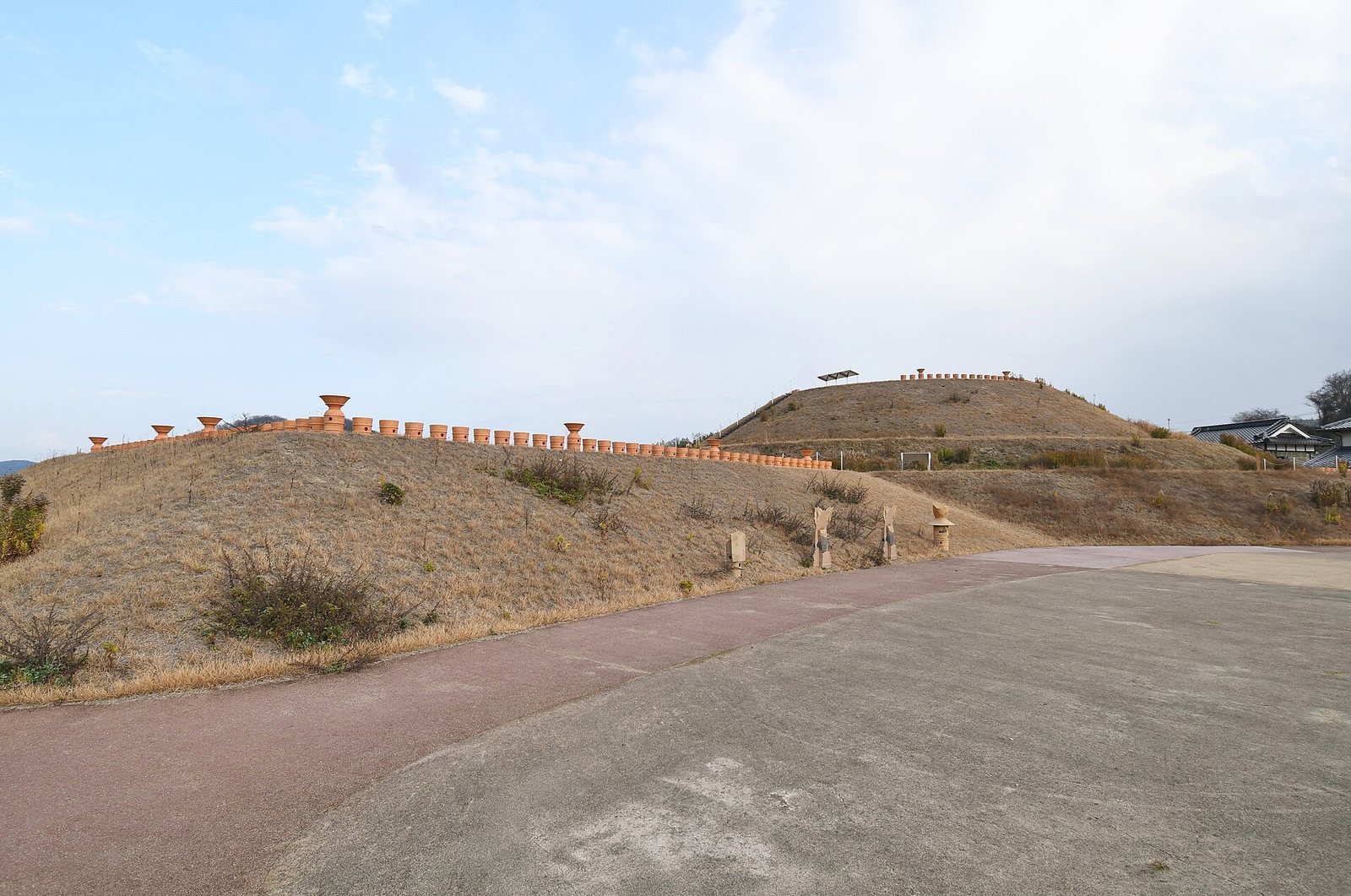
Excavations of the mound recovered many cylindrical haniwa, including examples shaped like morning-glory flowers. Figural examples represent quivers, shields, parasols, houses, and armor. The range of figures is richer than that found at the second and fourth tombs of Tsukuriyama Kofun and resembles assemblages from large keyhole-shaped tombs. Quiver-shaped examples carry straight-and-arc designs comparable to pieces collected at Tsukuriyama Kofun.