The Philae Obelisk at Kingston Lacy: An Ancient Egyptian Monument
Site at a Glance
- Popularity
- High
- Country
- United Kingdom
- Primary era
- Classical
- Eras represented
- Classical, Modern
- Civilizations
- British, Ptolemaic
- Site type
- Civic
- Remains
- Obelisk
On this page10 sections
History
The Philae Obelisk is an ancient Egyptian monument in the garden at Kingston Lacy in the United Kingdom. It was one of a pair erected in the second century BC beside the eastern monumental gateway of the Temple of Isis on Philae, an island in the Nile in Upper Egypt. Ancient Egyptians held Philae sacred through a tradition that Osiris, a major god associated with the dead and the afterlife, was buried there.
Removal and installation in England
In 1815, British traveler and collector William John Bankes encountered the obelisk and recognized that its Egyptian and Greek inscriptions might help scholars understand hieroglyphs. He acquired it and a large fragment of its broken companion. On a return journey to Egypt in 1818–1819, he arranged for both to be removed with the help of Giovanni Belzoni, an Italian explorer and engineer.
The operation involved difficult and risky transport. A temporary loading quay collapsed under the obelisk’s weight, sending the stone into the water. It was recovered and carried by barge down the Nile cataract with little damage. The separately excavated pedestal was taken to a low bank on the mainland, where it remained for two years in danger of being swept away by floodwater. It was eventually hauled overland to avoid the river rapids. The heaviest stone weighed nearly 11 tons, and nineteen horses were needed to haul it into position at Kingston Lacy.
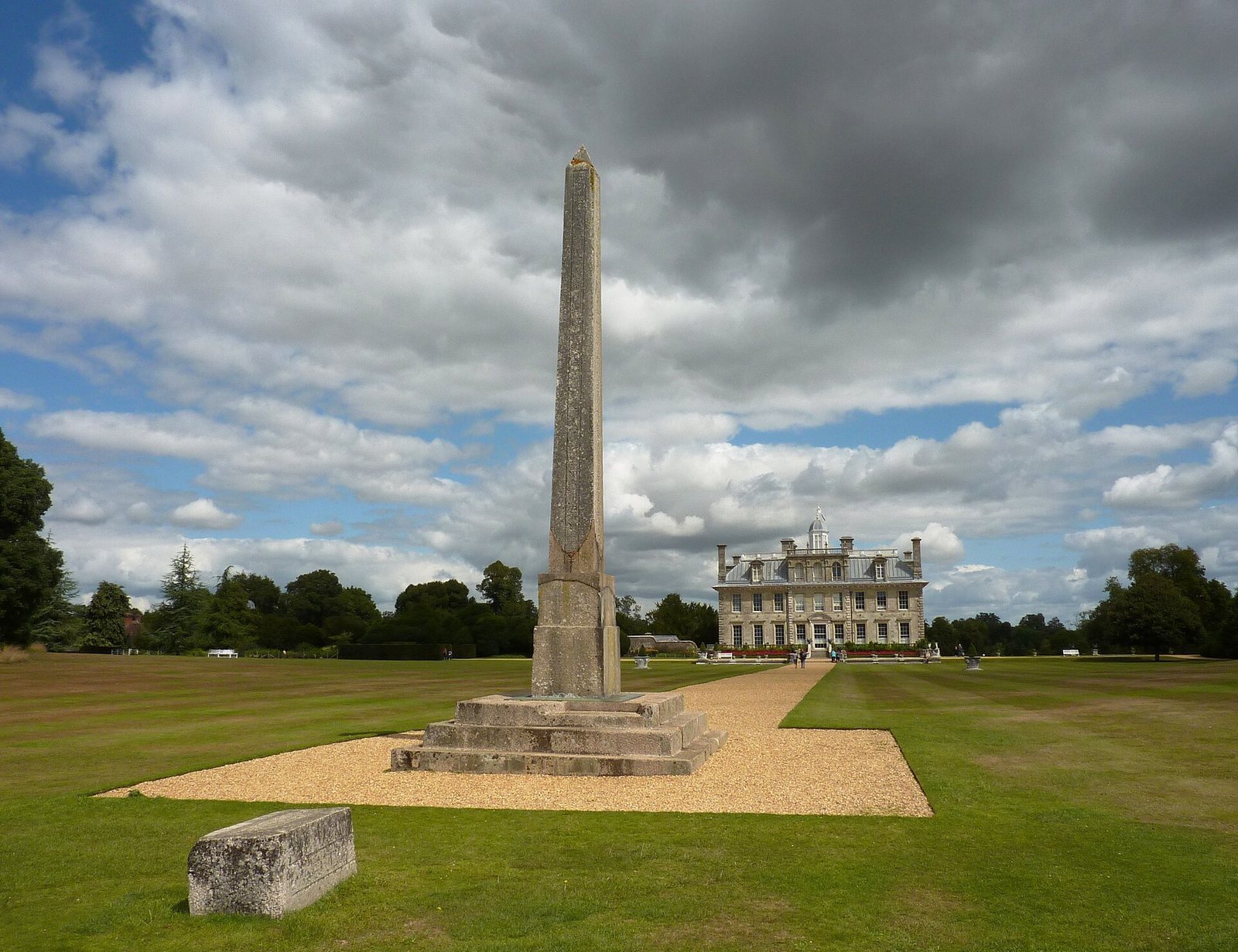
The obelisk reached England in 1821, the first Egyptian obelisk brought to the United Kingdom. Arthur Wellesley, Duke of Wellington, chose its position south of the house and laid its foundation stone in 1827. Wellington later provided a gun carriage for its transport to Kingston Lacy in 1829, while erection work continued until 1839. George IV supplied granite from the ruins of Leptis Magna, an ancient city in present-day Libya, for repairs to the base of the shaft. An English inscription on the monument recounts its history and movements.
Hieroglyphic decipherment and later study
The paired Egyptian and Greek inscriptions drew the attention of scholars working to decipher hieroglyphs. Bankes proposed that oval frames around royal names, called cartouches, on the obelisk contained the name Cleopatra. Thomas Young had already identified the name Ptolemy in cartouches through his study of the Rosetta Stone, an ancient inscription that repeats a decree in Greek, Demotic, and hieroglyphic writing.
A lithograph of the obelisk sent to French scholar Jean-François Champollion supported his proposed hieroglyphic spelling of Cleopatra. Champollion announced his decipherment in 1822. Bankes, Young, and their associates also challenged him over the credit they believed their own work deserved. Their progress had been hindered by the mistaken idea that hieroglyphic signs mainly represented whole words or meaningful word elements.
While the monument was in London, artist George Scharf made lithographs of the obelisk and its inscriptions, which Bankes circulated among people studying Egyptian writing. Prussian Egyptologist Karl Richard Lepsius examined the monument and published its text in 1839. In 1887, historian Ulrich Wilcken examined the inscriptions; later publications drew on observations made by nineteenth-century scholars.
In 1981, the obelisk passed to the National Trust with Kingston Lacy house and estate. It is a Grade II* listed building, an English designation for buildings of particular importance and more than special interest.
Remains
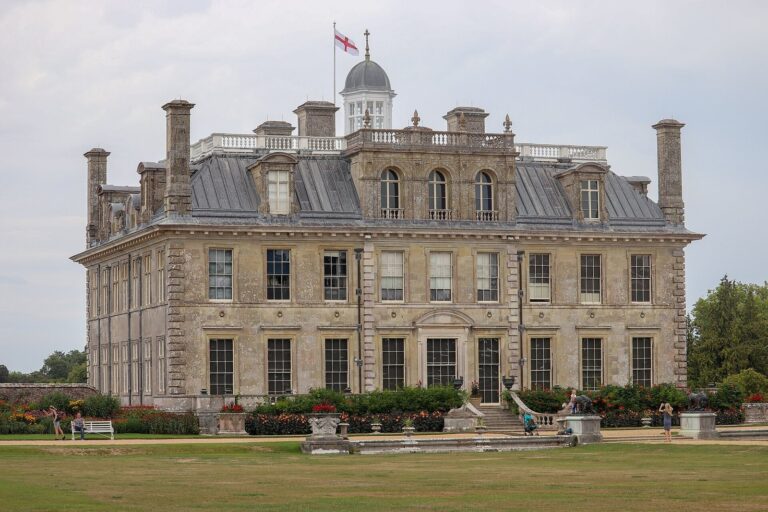
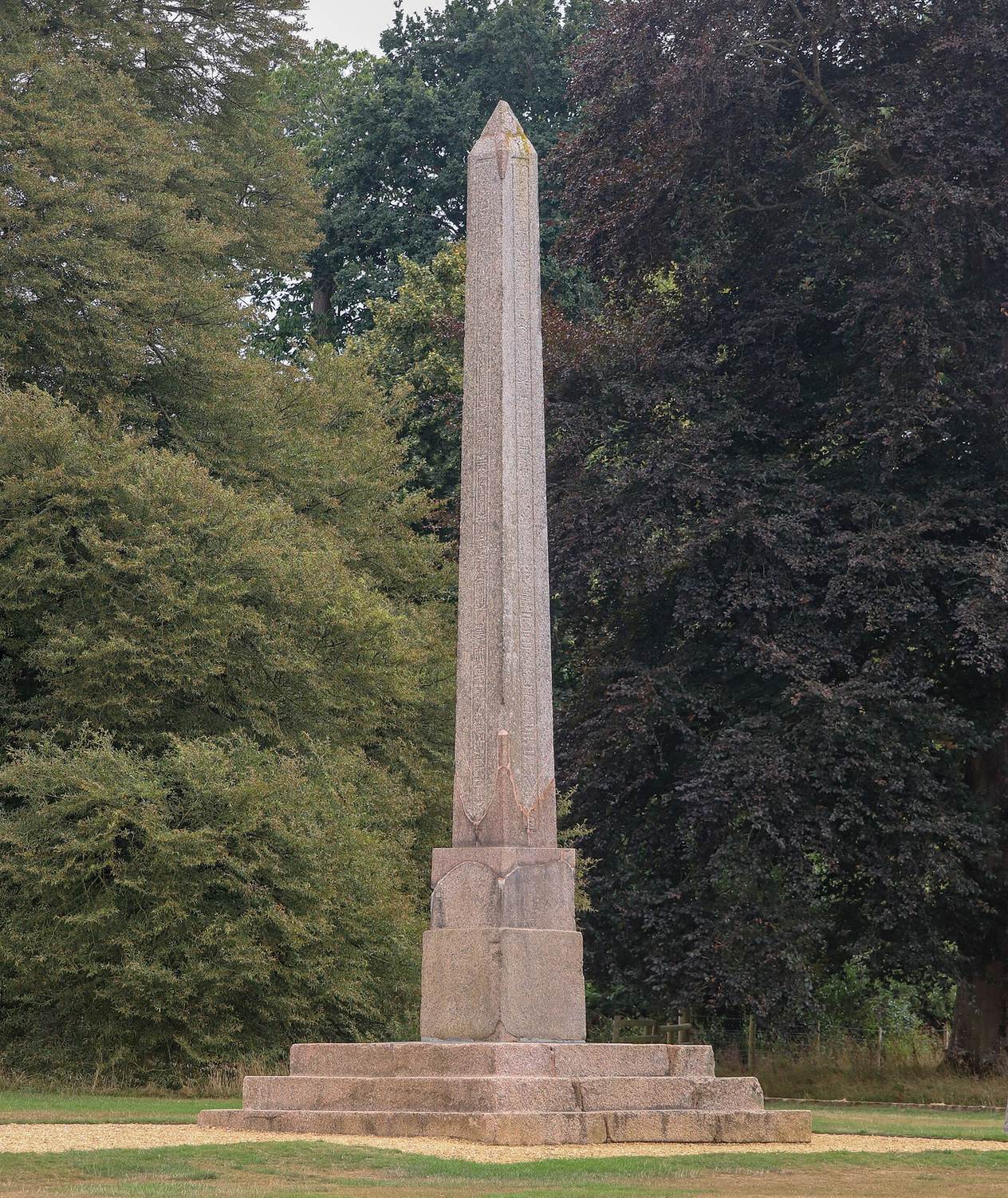
The monument stands in the garden south of Kingston Lacy house. Made of pink granite, it has a long shaft, a rectangular base, and a pyramid-shaped top called a pyramidion. Its lower shaft is a modern restoration; with the modern base, the obelisk stands about seven metres high.
The monuments in the garden
The Philae Obelisk
The shaft and base carry texts in Egyptian hieroglyphs and Greek. A separate English inscription recounts the monument’s journey. The obelisk’s surviving form includes modern restoration to the lower shaft and base.
Fragment of the companion obelisk
The companion obelisk was broken in antiquity. A large piece brought to Kingston Lacy is displayed as a ruin on a nearby lawn.
Inscriptions
Egyptian hieroglyphic text
The hieroglyphic text runs along the shaft and is dated to 131–124 BC. Imaging examinations in October and November 2014 and in spring 2015 included photographs taken from different angles, three-dimensional imaging, and Reflectance Transformation Imaging, a photographic method that uses changing light angles to reveal surface detail. The work confirmed that Scharf’s lithograph accurately represented the hieroglyphic text.
Greek text
The Greek inscription is on the base and is dated to 124–117 BC; the petition and response it records belong to 118–117 BC. The text is catalogued as number 424 in the Corpus of Ptolemaic Inscriptions, a scholarly catalogue of inscriptions from Ptolemaic Egypt. Priests of the Temple of Isis asked to be relieved of the expense of ceremonially receiving visiting military and royal officials. Ptolemy VIII Euergetes II, Cleopatra II, and Cleopatra III, rulers of the Ptolemaic dynasty, approved the request and directed the governor to stop requiring this service.
The Greek and Egyptian texts do not closely correspond. The opening half of the Greek text was painted red, while the rest was carved into the stone. By 2014, weathering made the Greek inscription particularly difficult to read. Digital examination enabled small corrections to the recorded Greek text and detected possible traces of the painted writing.