Kuveždin Monastery: A Serbian Orthodox Monastery in Fruška Gora
Site at a Glance
- Popularity
- High
- Country
- Serbia
- Primary era
- Modern
- Eras represented
- Early Modern, Modern
- Civilizations
- Austrian Empire, Habsburg, Habsburg Austria
- Site type
- Religious
- Remains
- Monastery
On this page14 sections
History
Kuveždin Monastery is a Serbian Orthodox monastery in western Fruška Gora, Serbia, within the Eparchy of Srem, an Orthodox diocese. Tradition attributes its foundation in 1520 to Serbian despot Stefan Štiljanović, a late medieval ruler, but the date is uncertain. Ottoman records from 1566–1569 provide the earliest secure evidence that the monastery already existed. Dedicated to Saint Sava and Saint Simeon, it helped spread devotion to these early Serbian saints among local Serbs in Srem.
Foundation and Ottoman rule
An Ottoman record from 1566 names the institution as the Monastery of Saint Sava, also known as Kuveždin, near the village of Vanđinac. In 1569, Abbot Stefan was at the monastery when a June liturgical book was handwritten. Metropolitan Pajsije, a senior Orthodox bishop, later associated Kuveždin’s patrons with those of Šišatovac. He named Stefan Štiljanović and Teodor, a senior regional ruler, and said that builders Jovan and Gašpar had come from the coastal region.
The monastery was probably abandoned toward the end of Ottoman rule in Srem. In 1650, Sinan-beg of Mitrovica planned to demolish the deserted monasteries of Kuveždin and Petkovica and use their materials for a building in Mitrovica. Pajsije asked Abbot Kiril of Šišatovac to redeem the properties and protect them by paying Sinan-beg 100 groschen, a historical coin, each year. After the monks agreed, Pajsije secured a written guarantee from the bey, an Ottoman military or administrative leader.
Resettlement and monastic ties
Monks from Vinča stayed at Kuveždin for a time around 1683. During the Great Turkish War, a major conflict between the Ottoman Empire and its opponents from 1683 to 1699, monks from Slanci arrived in 1695. Led by Abbot Ananije, they settled in the abandoned monastery and brought valuable church objects to Srem. The brotherhood of Šišatovac asserted its rights to Kuveždin because it had paid to redeem the monastery. Patriarch Arsenije Čarnojević urged its monks to let the newcomers stay in case they later returned to Serbia, and advised them to repair Petkovica. The Slanci monks remained at Kuveždin, though they may have returned to Slanci in 1717.
In 1718, Archbishop Vićentije Popović of Karlovci settled a dispute over the land by dividing it between the brotherhoods. The monks reconciled, referring to their monasteries’ shared patrons, builders and building stone. Monks from Slanci again took refuge at Kuveždin during the Austrian–Ottoman conflict that began in 1737. In 1744, Patriarch Arsenije IV Šakabenta considered making Kuveždin a dependent monastery of Hilandar, an Orthodox monastery on Mount Athos.
Kuveždin held substantial lands and had the dependent monasteries of Petkovica and Divša, each a few kilometres away. Hired workers on its estate lived in a separate, one-street settlement below the monastery. Called Kuveždinski Prnjavor, it was later known as Prnjavor and became part of Divoš after the Second World War. The monastery observed Saint Sava’s feast on January 27 and the Transfiguration on August 19.
Women’s monastery and the Second World War
The monastery was looted in 1914. After the First World War, its buildings were used as an orphanage, while agrarian reform took 225 jutara of its best arable land. A jutara is a traditional unit of land area. In 1923, the Serbian Orthodox Church’s Holy Synod formally established Kuveždin as a women’s monastery, the first in the Church after a centuries-long interruption, and appointed Melania Krivokućanin as abbess. The first sisterhood had 24 members and held 350 jutara of poor forest and about 75 jutara of arable land, divided into 22 parcels.
By the 1930s the sisterhood had grown to more than 50 nuns, many of them Russian women who had left Russia after the October Revolution. In 1938, the Belgrade monastery of Vavedenje became dependent on Kuveždin.
During the Second World War, the monastery endured occupation, looting, fires and demolition. In May 1941, Ustaša official Stipe Rukavina became commissioner, with Marijan Debeljak as his deputy. The Ustaše were a Croatian fascist movement, and the Independent State of Croatia, which occupied Fruška Gora, was a wartime state allied with the Axis powers. During the Annunciation liturgy that year, novice Angelina Radojčić and her three sisters were caught in a bombing. Ustaše arrested them, Russian nun Angelina Gracheva and other nuns. Thirty-two nuns and their abbess were taken to the Caprag camp near Zagreb.
After her release, Gracheva sought help for the sisterhood. The nuns were rescued and met at Vavedenje on September 27, 1941. Russian nuns later moved to the Belgrade dependency, fearing to remain in Fruška Gora under occupation. Looting of Kuveždin’s property began on September 6. An inventory made at handover on September 15 listed 58 items: 22 from the church, 32 from the treasury and four from the chapel. It also listed about 150 library books.
A unit of about 120 Ustaše soldiers occupied the residential quarters. Buildings were damaged in fires deliberately started during fighting with Partisans, a Yugoslav resistance movement. After the Ustaše withdrew, Partisans controlled the surviving part of the quarters and used it as a command post. Kuveždin also formed part of their bases on Fruška Gora and housed a large supply depot with workers.
In spring 1944, German forces and Ustaše mined the church, residential quarters and service buildings. Nun Jelena returned to retrieve icons from the rubble and hid about 20 in the chapel. She was captured and killed, and the icons were thrown onto her. The monastery archive, most of its library and part of its treasury, including church vessels, were destroyed or lost.
Postwar decline and restoration
After the war, communist authorities confiscated the monastery’s estate, including 22 hectares in the 1946 agrarian reform. Kuveždin became deserted. Bricks taken from the western and northern residential quarters were reused in cultural centres in Divoš and Čalma. Two nuns and a novice lived beside the surviving chapel; three nuns were there in 1969.
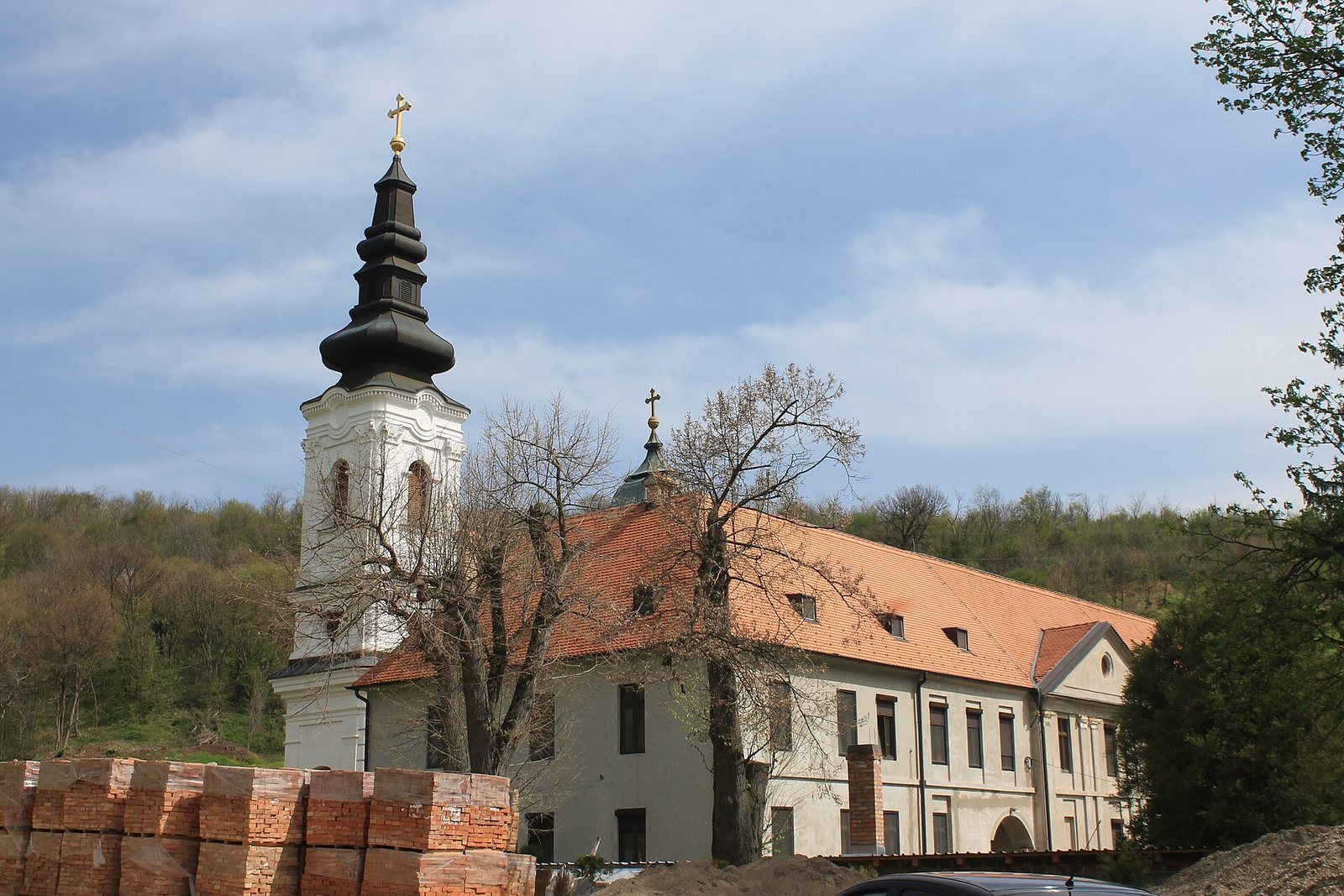
The church and southern residential building were partly restored in 1973–1975. Kuveždin received protection as a cultural monument in 1990 and is listed as a Monument of Culture of Exceptional Importance. A broader restoration began in 1997 under the Institute for the Protection of Cultural Monuments in Sremska Mitrovica. The bell tower was restored in 2004, and later work restored the church, entrance gate and residential building.
Remains
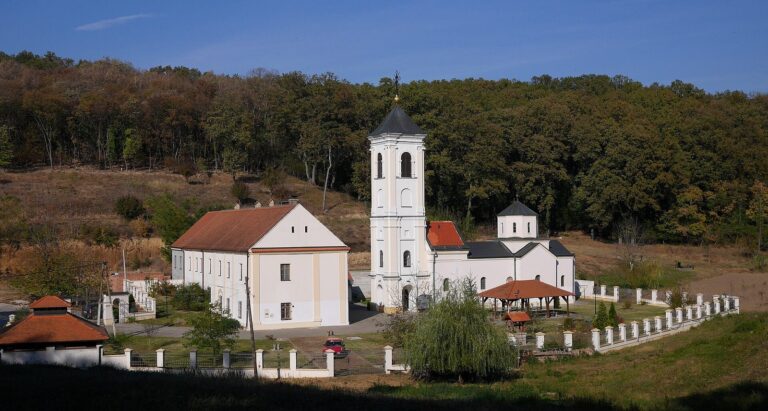
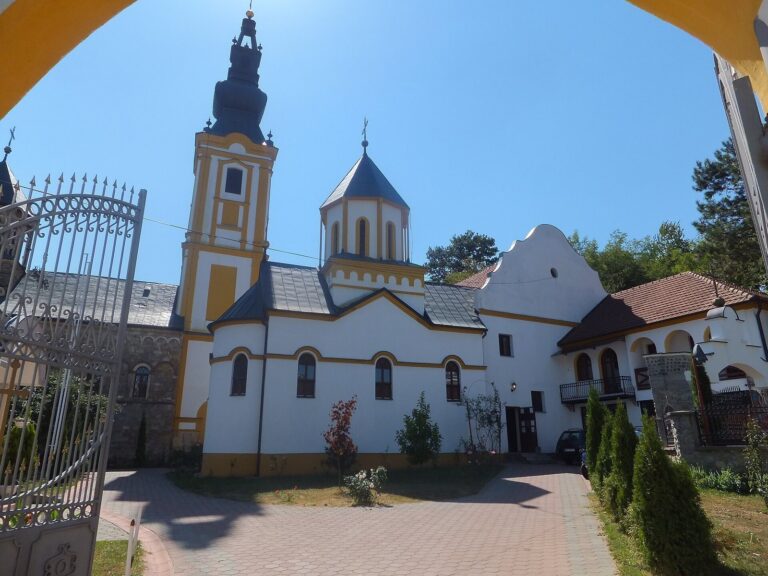
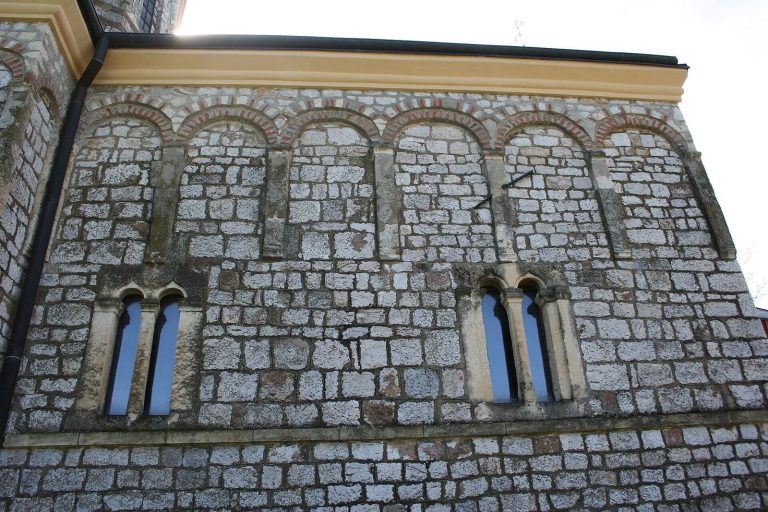
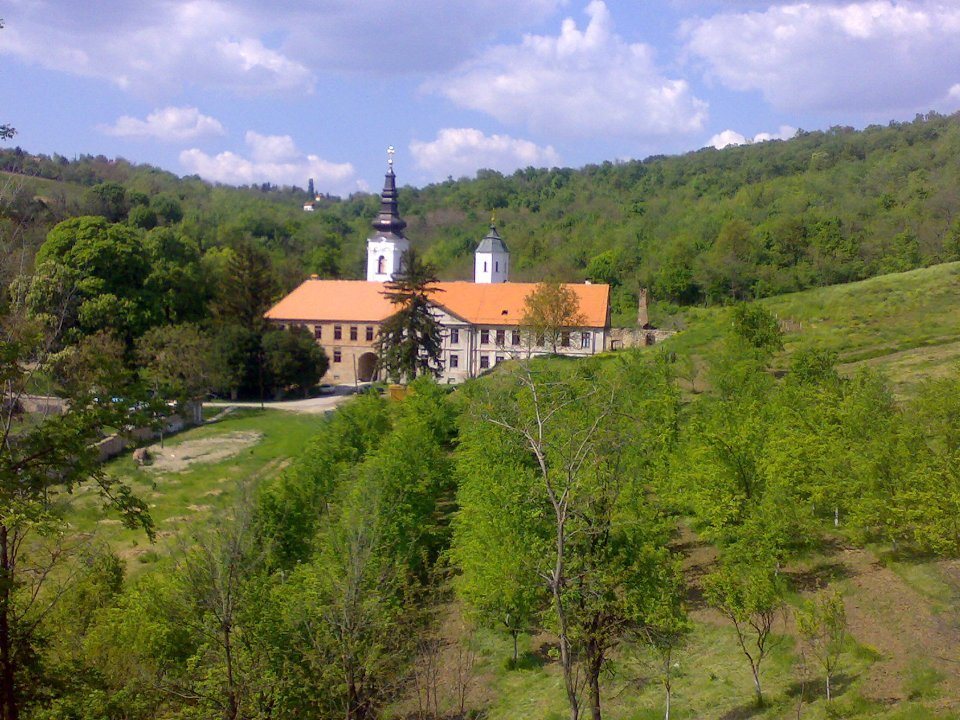
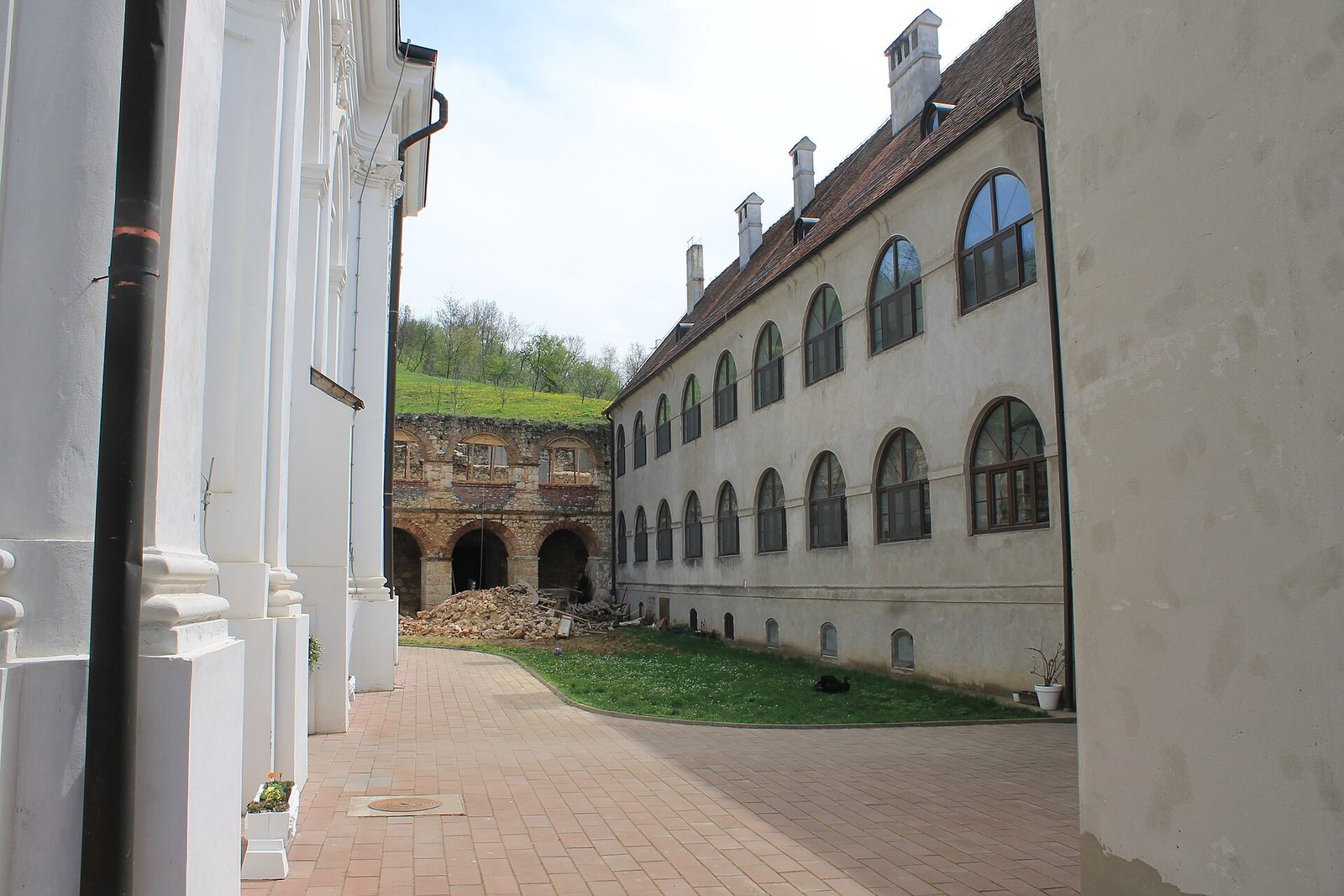
Kuveždin stands in a narrow valley in the western part of Fruška Gora, about 150 metres above sea level and roughly two kilometres north of Divoš. A stream of the same name runs along the western edge of the complex, while sparse woodland surrounds it on three sides. The estate and garden extend to the south, toward the village. The rectangular arrangement of the monastery’s early 19th-century residential quarters enclosed the complex on four sides. The surviving ensemble includes the church, the southern side of the quarters, the entrance gate and a nearby residential building.
Church and bell tower
Church of Saint Sava
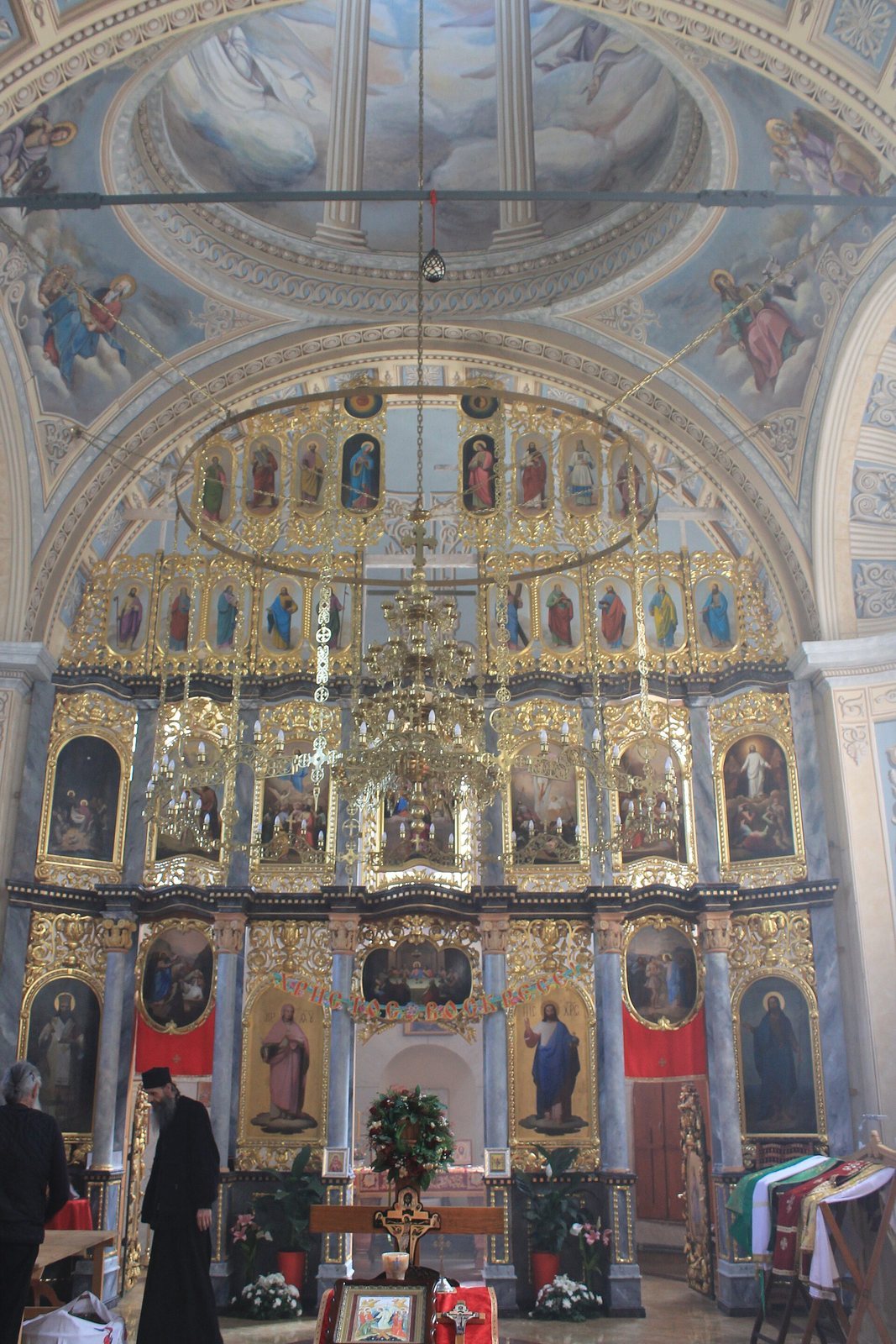
The old church had two domes. An inspection in 1753 described it as a stone building, whitewashed outside and roofed with oak shingles. A new church replaced it in 1816 and was built against the bell tower. During the Second World War, the church’s domes and their supports collapsed, along with its vaults. Pavle Simić’s mid-19th-century iconostasis, a screen of icons separating the sanctuary from the main body of an Orthodox church, and his wall paintings lay among the ruins. Simić’s paintings date to 1848–1853. The restored church forms part of the present complex.
Janko Halkozović painted the old church’s iconostasis in 1722; it was given to a church in Opatovac in 1758. Georgije Dević carved the woodwork for the new iconostasis, choir stalls and tables between 1834 and 1836.
Bell tower
The three-storey bell tower was built in 1803 in the Baroque style. It collapsed during the wartime destruction and has since been restored.
Residential quarters and chapels
Residential quarters
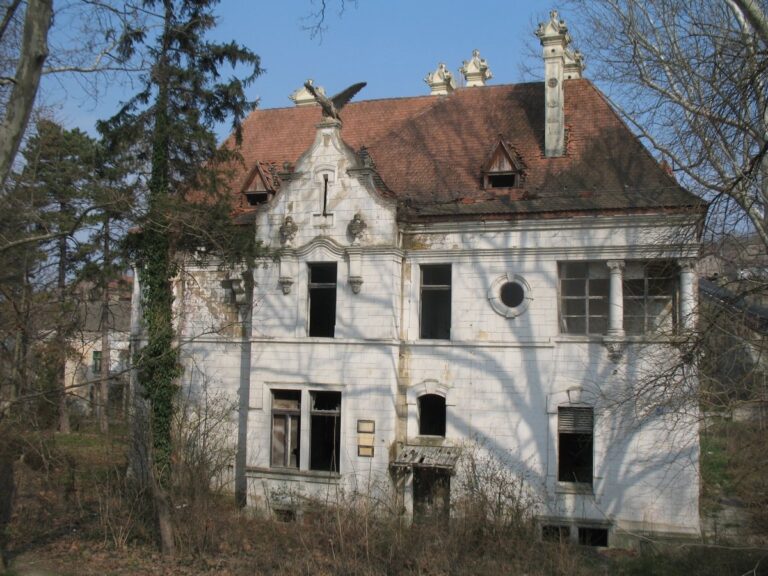
Work on the residential quarters began in 1810. Built in the early 19th century in the Classical style, they formed the four sides of a rectangular enclosure. The western and northern sections were later damaged and their bricks removed for reuse. The southern side has been partly restored.
Courtyard chapel
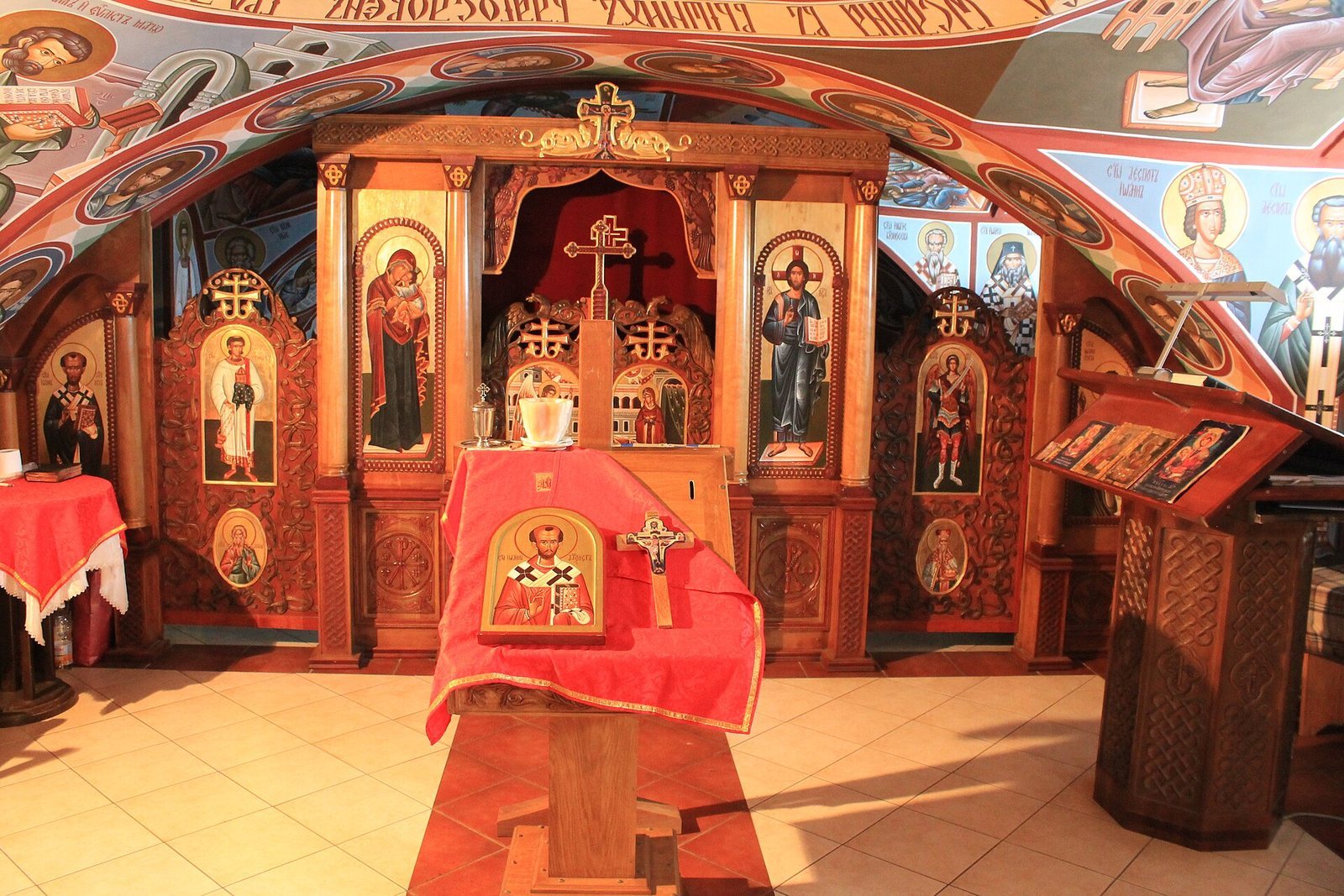
A chapel dedicated to Saint John Chrysostom stands in the monastery courtyard. It survived the wartime destruction and held about 20 icons that Jelena had recovered from the church ruins.
Winter chapel
A small chapel dedicated to the Intercession of the Theotokos, an Orthodox title for Mary, stood in the residential quarters south of the principal church. It was used for services during the coldest winter days.
Cemetery chapel and former collections
On a rise south of the monastery, a chapel dedicated to the Ascension was built in 1788 to serve the cemetery. Monastic burials lay around it, and icons from Simić’s iconostasis were later transferred there.
The monastery treasury formerly held a silver chalice made in 1559, gilded on the inside and bearing an Old Russian inscription; a gold communion spoon set with eight precious stones and bearing an image of Saint George; a five-loaf vessel from 1758; and an engraving by Zaharija Orfelin from 1772. The library held about 500 works, including 19 Serbian liturgical books, 15 handwritten and four printed. Most of the library and part of the treasury were destroyed or lost during the war.