Dominican Church in Vienna: A Baroque Roman Catholic Parish Church
Site at a Glance
- Popularity
- High
- Country
- Austria
- Primary era
- Early Modern
- Eras represented
- Early Modern, Modern
- Civilizations
- Austria-Hungary, Austrian Empire, Habsburg, Habsburg Austria, Holy Roman Empire
- Site type
- Religious
- Remains
- Church
On this page28 sections
History
The Dominican Church in Vienna, also known as St. Maria Rotunda, is a Roman Catholic parish church in Vienna, Austria, dedicated to Our Lady of the Rosary. The Rosary is a Catholic devotional prayer. The church belongs to the Archdiocese of Vienna and follows the Roman Rite, the principal liturgical tradition of the Latin Church. The present building is a Baroque church, in an early modern European style, built by the Dominican Order on a site occupied by two earlier churches.
The Dominican foundation and Gothic church
Duke Leopold VI brought the Dominicans, a Catholic order associated with preaching and theological study, to Vienna in 1226. He gave them land near the Stubentor for a monastery and chapel. The first Romanesque chapel, in a medieval architectural style, was consecrated in 1237. The complex grew between 1240 and 1270, and a new choir followed in 1273.
After two fires, the Dominicans decided in 1283 to build a larger church in the Gothic style, another medieval architectural tradition. Cardinal Niccolò Boccasini, a Dominican who later became Pope Benedict XI, consecrated its choir in 1302. The church’s nave was extended from 1458 to 1474.
Damage and rebuilding
During the first Ottoman siege of Vienna in 1529, the church suffered heavy damage. The choir was demolished, and part of the nave was taken apart. Much of its building material was reused to strengthen the city wall. The church then fell into increasing disrepair.
The Dominicans began constructing the present church in 1631. Emperor Ferdinand II laid its foundation stone on 6 May that year. The structural work was complete by 1634, and the church was consecrated on 1 October. The dome and façade were added between 1666 and 1674. At the time, the church was Vienna’s second-largest, after St. Stephen’s Cathedral.
Modern changes and status
Pope Pius XI raised the church to the rank of minor basilica in 1927. This is an honorary church title, distinct from being a cathedral. The church is also a protected monument in Austria. Nearby bomb impacts during the Second World War damaged its masonry and dome. Renovation work in 2020 to 2022 repaired that damage and restored frescoes and paintings.
Remains
Exterior and plan
Building and layout
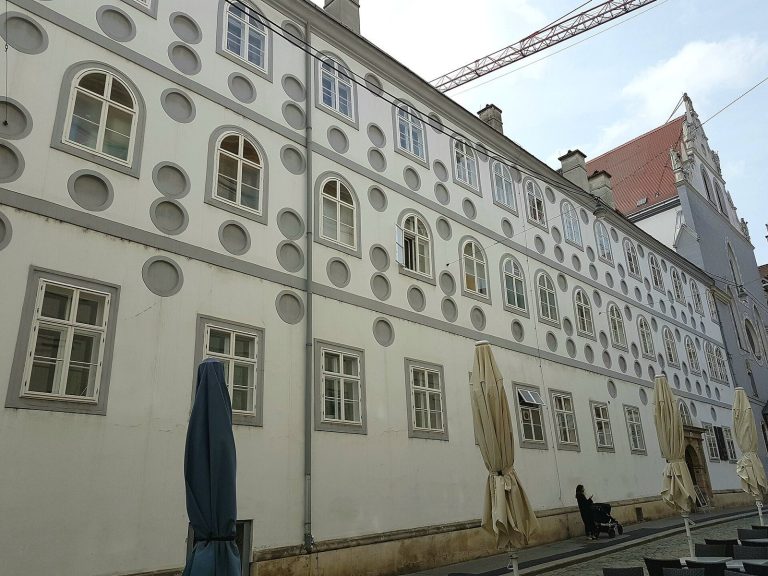
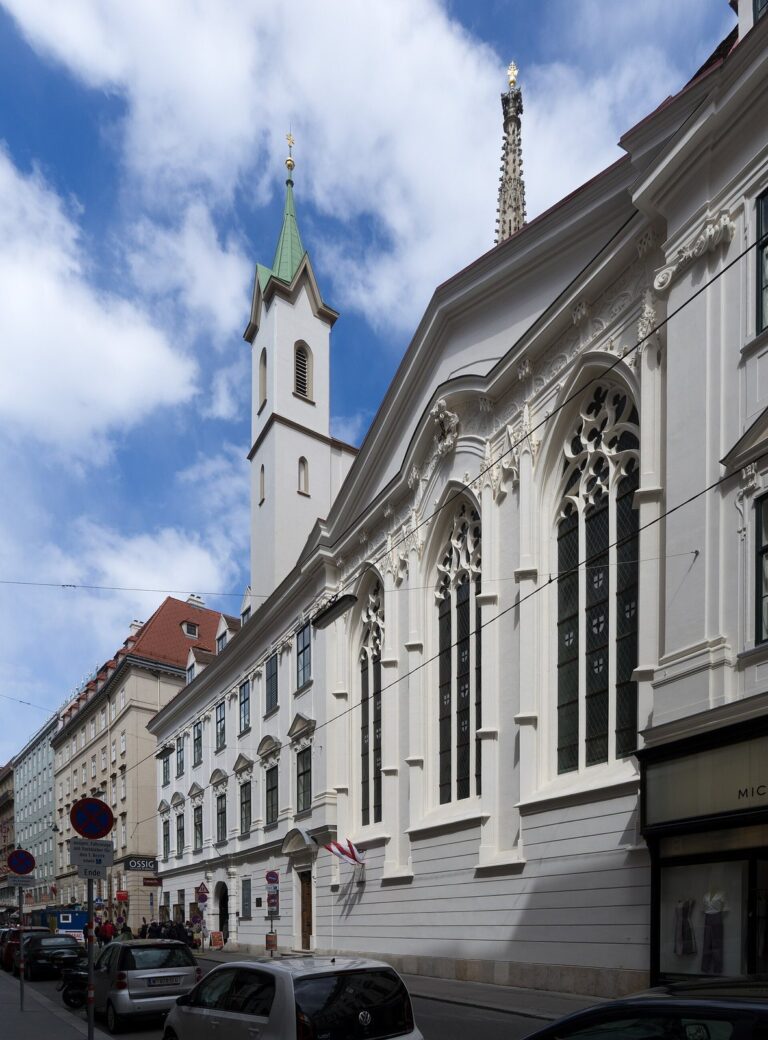
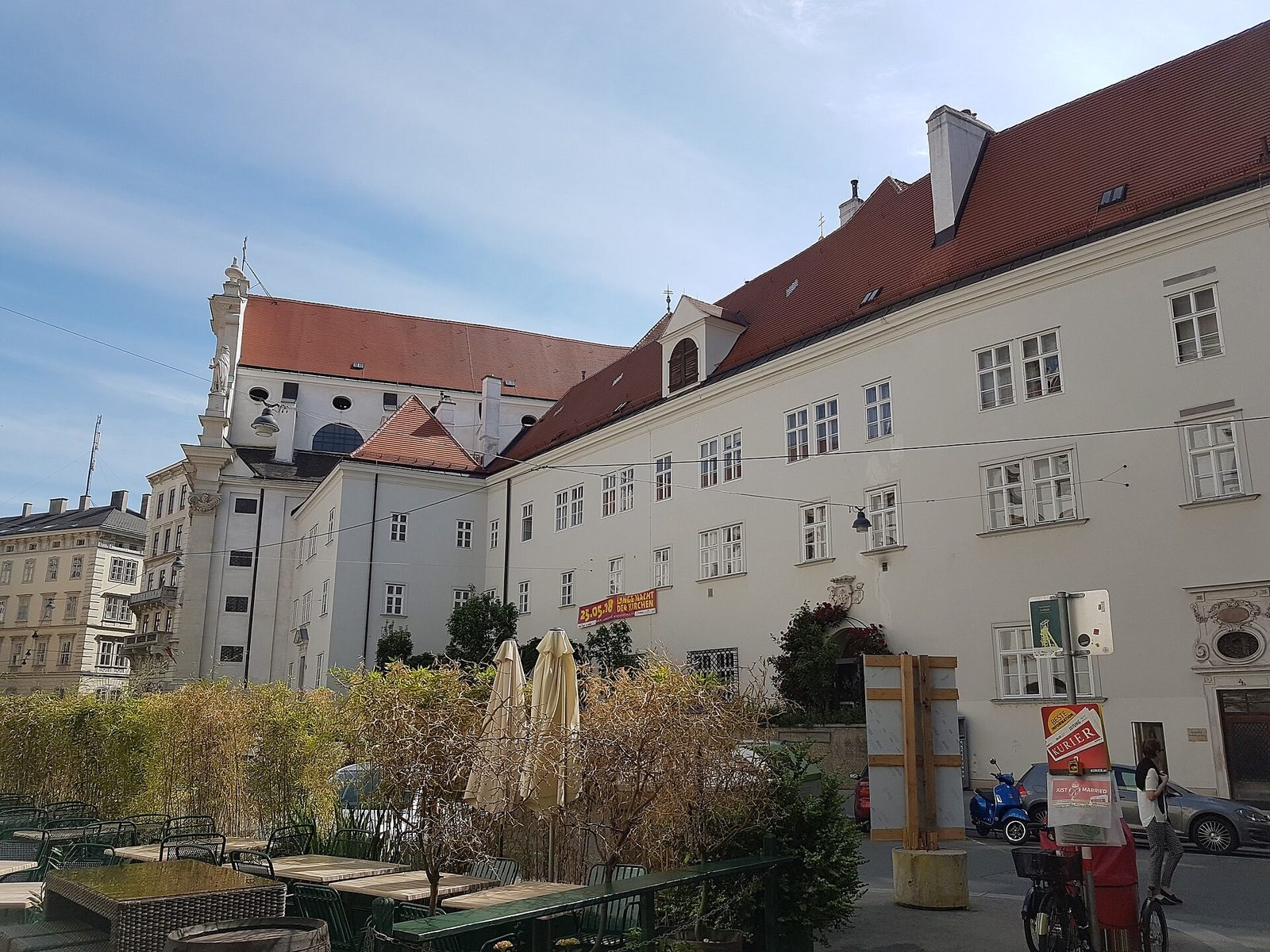
The present church is an oblong Baroque building with a dome, standing on the Dominican Bastion near the site of the original monastery. Its façade faces northwest. Italian builders and artists contributed to its construction and decoration. The interior has a central nave, three side chapels on each side, a transept (the crosswise arm of a church), a choir, and an apse (the rounded or polygonal end, usually containing the sanctuary). Each side chapel has a gallery above it with a shallow balcony. The nave measures 46.54 metres long, 20.90 metres wide, and 22.10 metres high; the dome rises to 23.80 metres.
Façade and sculpture
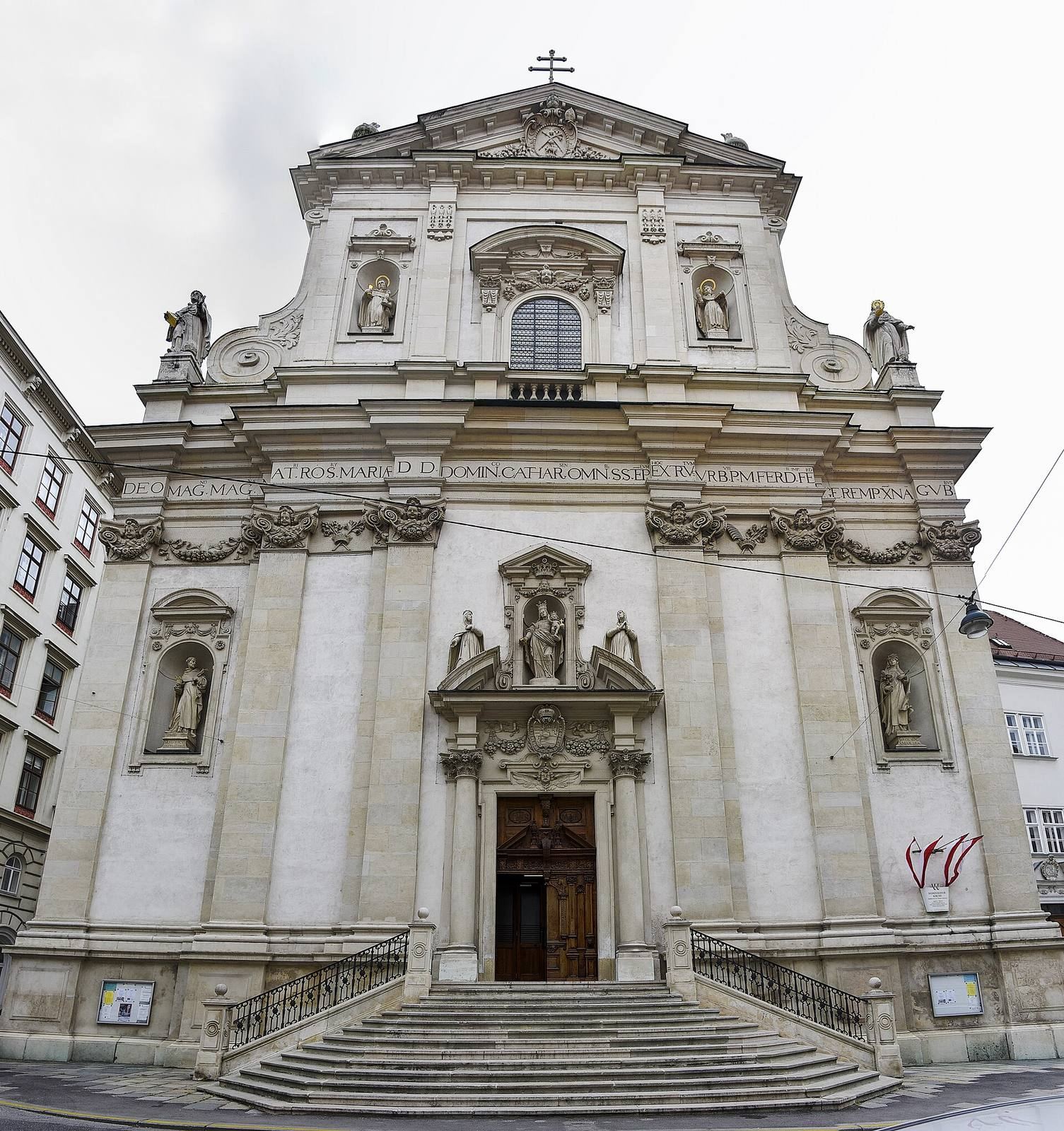
The façade draws on early Baroque churches in Rome, whose design was influenced in turn by the Dominican church of Santa Maria Novella in Florence. Prominent columns support a cornice beneath a large rectangular gable with a dormer window and a crowning pediment. A statue of Our Lady of the Rosary stands over the entrance. Eight further stone figures represent Dominican figures: Catherine of Siena and Agnes of Montepulciano kneel; Luis Beltrán and Rose of Lima occupy niches on the lower level; Hyacinth of Poland and Vincent Ferrer stand in upper-level niches; and Albertus Magnus and Thomas Aquinas are placed at the upper corners.
Ceiling paintings and dome
Nave ceiling
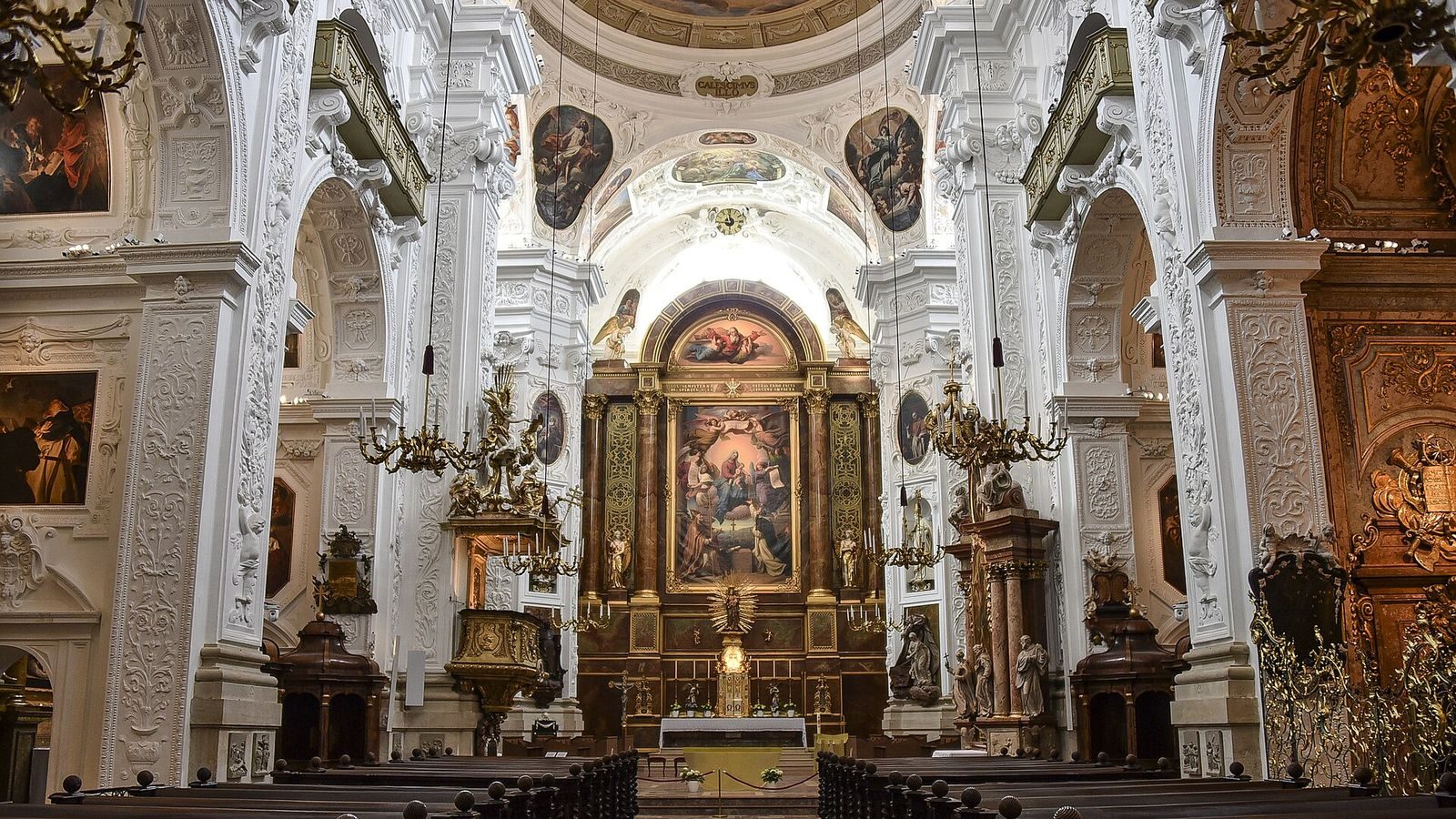
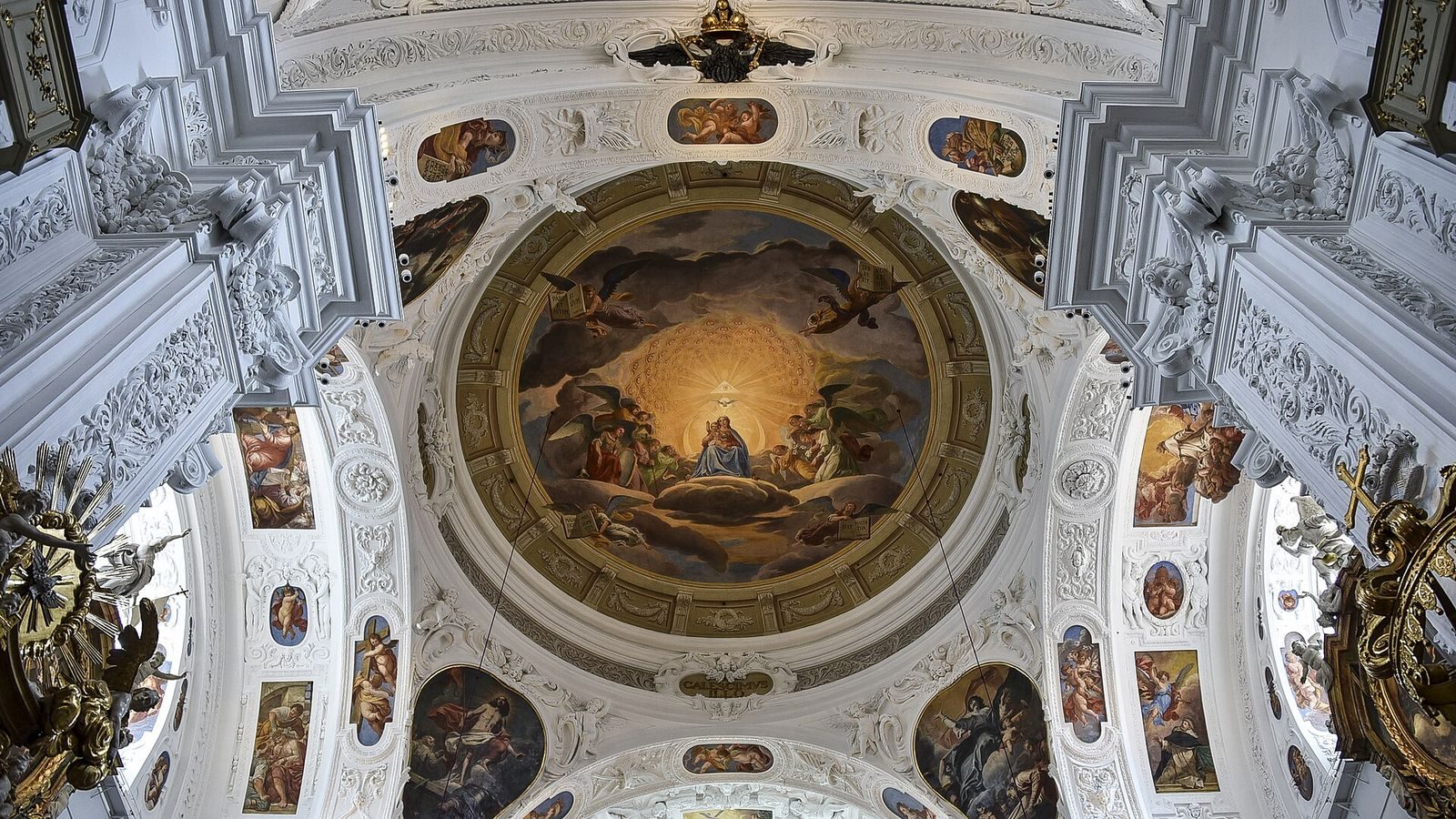
The barrel-vaulted ceiling of the nave carries 46 paintings on Marian themes. Matthias Rauchmiller received the commission on 18 March 1675. Three principal scenes show the Marriage of the Virgin, Mary as Bride of the Holy Spirit, and the Presentation of Mary. Their colours and composition reflect the influence of the Flemish Baroque painter Peter Paul Rubens. Semicircular windows bring light into the interior, illuminating the ceiling paintings and stucco decoration.
Presbytery, transept, and apse
Frescoes in the presbytery, the area around the main altar, and the arms of the transept are attributed to Carpoforo Tencalla and date to 1675-76. Tencalla is also associated with paintings in the apse depicting the battles of Muret in 1213 and Lepanto in 1571. The paintings present both as Christian victories attributed to the intervention of the Rosary. Tencalla is also associated with paintings on the side-chapel walls.
Dome
Nikolaus van Hoy is credited with the original dome painting. Around 1820, a new, shallow dome was installed, and Franz Geyling painted its replacement in 1836. The scene shows Mary and the Child beneath the golden light of the Trinity, surrounded by kneeling angels.
Altars, pulpit, and chapels
High altar
Karl Rösner made the high altar in 1839-40 as a wooden structure finished to resemble red marble. Its tall form replaced an earlier Baroque altar and follows the Spanish style. Red Corinthian columns frame Leopold Kupelwieser’s 1840 painting of Pope Pius V instituting the Feast of the Rosary. The painting measures 720 by 430 centimetres. A gilded-brass tabernacle dates to 1885. During the 2020-22 renovation, workers removed the altar’s pediment-shaped upper section to admit light through the southeast-facing main window. The change brought more light into the church, though less than in its early Baroque period. The renovation also replaced a decayed wooden altar platform from the 1960s with a modern, congregation-facing altar made of semi-transparent epoxy resin.
Transept altars
The altar of St. Dominic has a 1655 painting by Tobias Pock showing the saint adoring the Trinity. A statue on the altar’s raised base is a copy of the True Image of St. Dominic at the pilgrimage church in Soriano, Calabria. Niches contain statues of St. Leopold and St. Florian below, and St. Catherine of Alexandria and St. Barbara above.
The adjacent altar of John of Nepomuk stands against a pillar at the crossing. Its painting is by an unknown artist. Four statues made by Lorenzo Mattielli in 1724 depict Antony of Padua, Vincent Ferrer, the apostle Peter, and Severinus of Noricum. Figures representing Faith and Hope rest on the capitals of the altar’s paired columns.
Pulpit
Matthias Steinl made the gilded pulpit in 1700, following an engraving by Jean le Pautre. Its decorated front shows a blue globe encircled by a rosary, above a medallion bearing the words “spread throughout the world.” On the canopy, a dove representing the Holy Spirit appears within a halo of light, surrounded by angels.
Chapel of St. Catherine of Siena
Beside the pulpit, the chapel’s altarpiece, attributed to François Roettiers, depicts the saint’s mystical marriage to Christ. Roettiers is also credited with the paintings on the chapel’s side walls.
Chapel of Thomas Aquinas
Frans Luycx painted the altarpiece and side-wall works in this chapel. Their dates are 1638 and 1649-50.
Chapel of St. Rose of Lima
An altarpiece by an anonymous painter, dated 1671, was replaced in the second half of the eighteenth century by a painting of the Coronation of Our Lady.
Chapel of St. Anne
The altarpiece depicts St. Anne, the mother of Mary, with St. John the Baptist and St. Barbara. It was long wrongly attributed to Tobias Pock.
Chapel of St. Vincent Ferrer
François Roettiers painted the chapel’s works, including a 1726 altarpiece showing Vincent Ferrer bringing a dead person back to life. Angels with trumpets above the scene refer to his preaching of penitence. The workshop of Johann-Georg Bendl made bronzed statues of St. Jerome and Mary Magdalene. Monks Martin Eker and Raymund Schrob made the gilded wrought-iron railing.
Chapel of St. Catherine of Alexandria
Tobias Pock’s altarpiece depicts the saint’s martyrdom, and Frans Luycx painted the side walls.
Gallery, organs, and bells
Gallery decoration
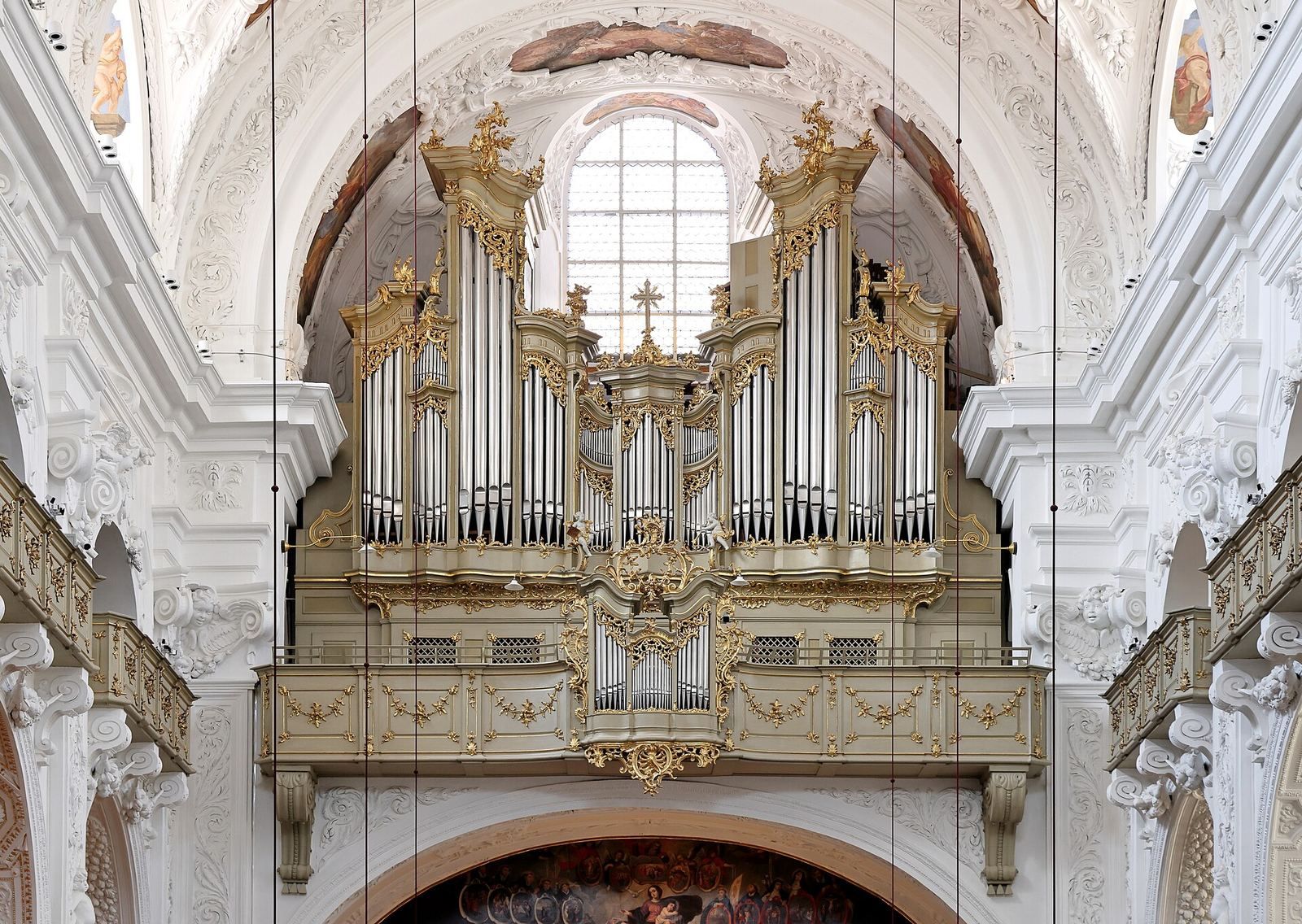
The gallery balustrade has a gilded, inward-and-outward-curving form characteristic of the transition from Baroque to Rococo. Beneath the organ gallery hangs an anonymous painting dated 1642. It depicts the glorification of the Rosary and the intercession of St. Dominic.
Main organ
The main organ’s case survives from an instrument built around 1750 by an unknown maker, probably with two hand keyboards. Rieger installed new organ works in 1895-96, initially with 36 stops, or sets of pipes, across three hand keyboards and a foot keyboard. The historical case was enlarged, and the case of an earlier small gallery-rail organ also survives. Schuke of Berlin thoroughly restored the instrument in 1991, reconstructed its façade, returned later alterations to the earlier stop arrangement, and reinstalled the gallery-rail organ. The main instrument now has 50 stops, three hand keyboards, and a foot keyboard, with mechanical controls. Several stops producing pitches related to, but different from, the basic note are housed in a small supplementary chest.
Choir organ
Schuke built a separate choir organ in 1992. It has 19 stops, two hand keyboards, and a foot keyboard, with mechanical controls.
Bells
The church’s two towers hold the large bell Rosa in the left tower and two smaller bells in the right. Rosa is still rung by hand, though only rarely because it is cumbersome for the monks to ring. It swings on special toothed-ring bearings.
Stonework and burial
Master stonemason Hieronymus Bregno of Kaisersteinbruch carried out stonework at the church. Hard Kaiserstein, a building stone associated with Kaisersteinbruch, was used for steps in the monastery wing leading to the church gallery and for a tower staircase.
Claudia Felicitas of Austria, the second wife of Emperor Leopold I, is buried in the crypt beneath the transept chapel of St. Dominic. She died on 2 September 1676, aged 22.