Nine Stones Close: A Prehistoric Stone Circle in Derbyshire
Site at a Glance
- Popularity
- Very High
- Country
- United Kingdom
- Primary era
- Stone Age
- Eras represented
- Stone Age, Bronze Age, Modern
- Civilizations
- British
- Site type
- Civic
- Remains
- Megalithic Monument
On this page8 sections
History
Nine Stones Close is a prehistoric stone circle on Harthill Moor in Derbyshire, United Kingdom. Its construction date is unknown, although the size of its stones has prompted the suggestion that it may be Neolithic. The circle belongs to a wider tradition of stone-circle building across Britain, Ireland, and Brittany, spanning roughly 3300 to 900 BCE, from the Late Neolithic into the Early Bronze Age. Its original purpose is uncertain.
Antiquarian records, excavations, and repair
In 1782, Hayman Rooke described Nine Stones Close as a Druid temple. Thomas Bateman later called it a small Druidical circle. These labels reflected a popular antiquarian theory that Druids, ritual specialists associated with Iron Age societies in western Europe, had built prehistoric monuments.
Bateman excavated the circle in 1847. In 1877, William Greenwell and Llewellyn Jewitt dug trenches beside the second-highest stone and in the centre. A further excavation in 1939 produced Bronze Age flints and pottery. Bateman’s 1847 work also recovered pottery fragments and flint, including flint in natural and burnt states.
After a circle stone fell in 1936, the Derbyshire Archaeological Society arranged for it and another stone, thought to have lain largely on its side for centuries, to be raised. The society sought advice from Alexander Keiller, an archaeologist known for his work at Avebury. Both stones were reset on concrete bases in the late 1930s.
Names and folklore
Nine Stones Close is also called the Grey Ladies. Stories say that the stones dance at midday or midnight. In 1947, J. P. Heathcote proposed that the tale might have begun with early guidebook writers rather than with local oral tradition. The circle’s original stone count is uncertain; one explanation connects the number in its name with noon, when fairies were said to gather and dance.
A separate 19th-century tale tells of a farm labourer who found a clay pipe among the stones. After smoking it, he could see through the ground into a land inhabited by fairies.
Remains
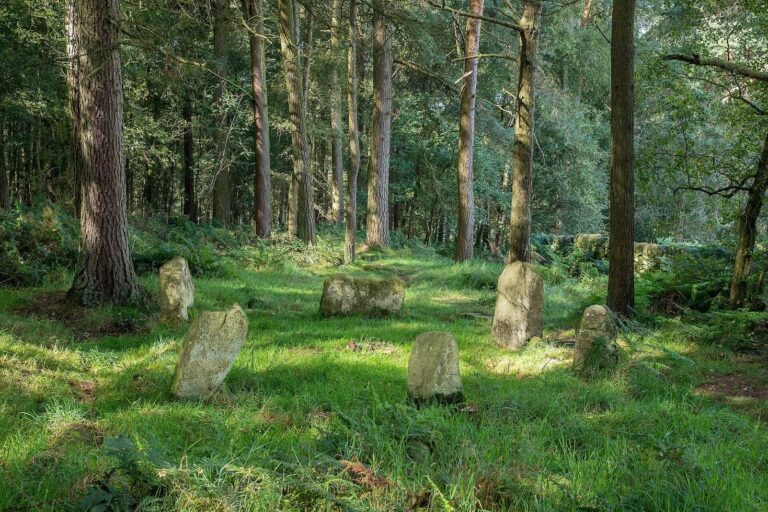
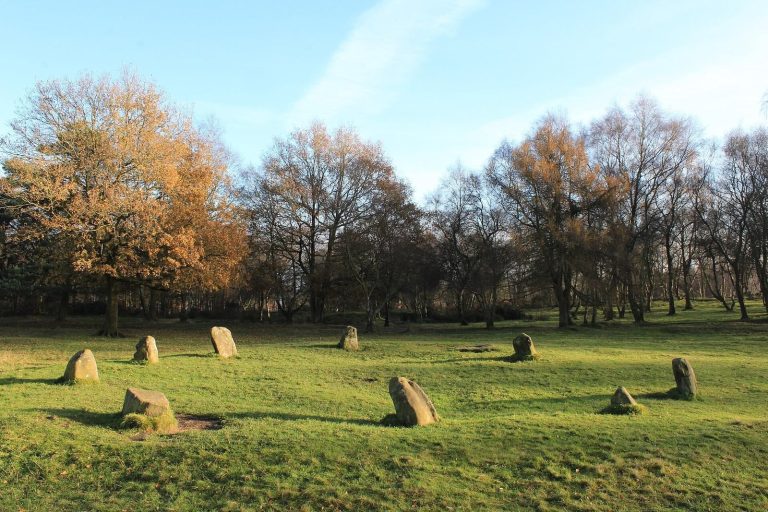
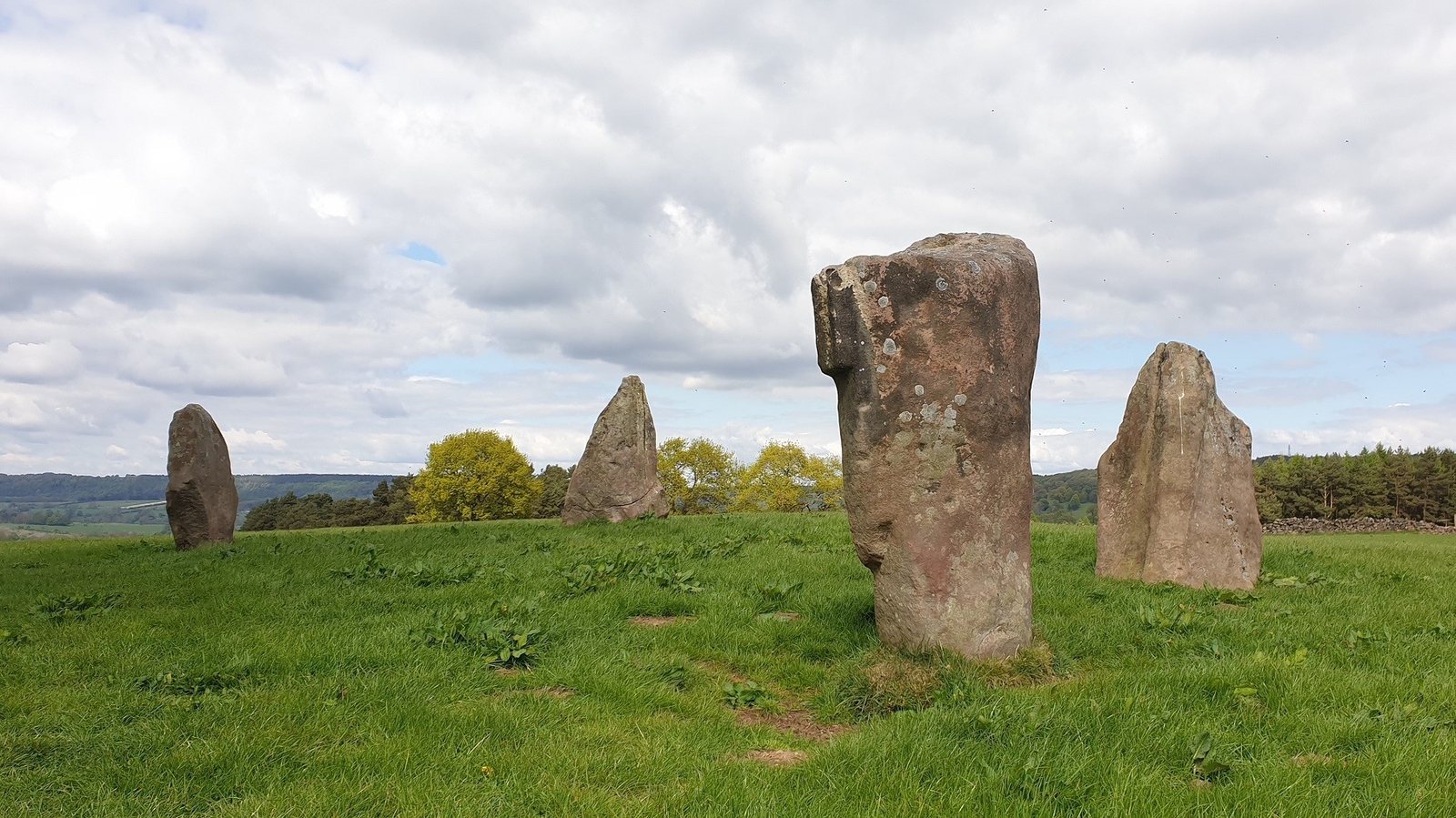
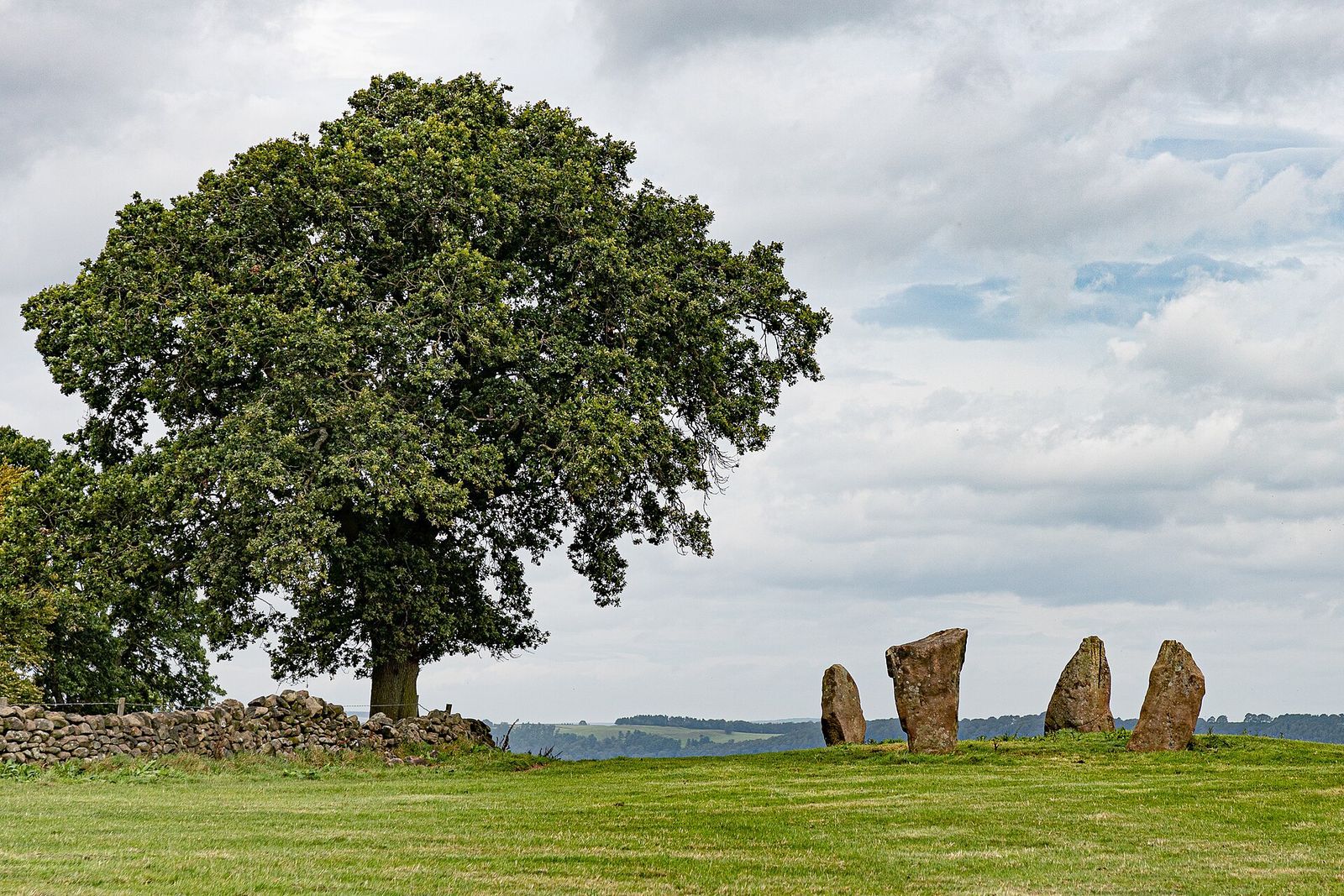
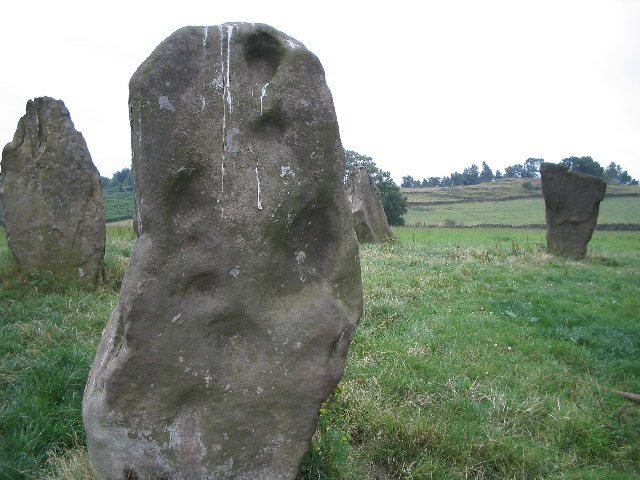
The circle originally measured 13.7 metres in diameter. Four stones survived into the early 21st century, arranged as the remains of a ring on Harthill Moor. The stones range from 1.2 to 2.1 metres high, and the tallest stands on the southern side.
Stone circle and surrounding landscape
The stone ring
Recorded counts changed over time: Rooke noted six stones in 1782, Bateman counted seven in 1847, and J. Ward described six upright stones in 1905. Four remained by the early 21st century. The circle’s stones are among the largest found in Derbyshire stone circles. Two of the surviving stones rest on concrete bases.
Two stones have fluted tops, shaped by prolonged weathering, though it is uncertain whether this took place before they were set in the circle. The southernmost upright stone has two weathered cup marks, small carved hollows, on its south face. Their carving may predate or postdate the stone’s placement in the ring. A slight rise at the centre, noted in the mid-19th century, led Bateman to suggest that a low burial mound might once have stood there.
Displaced and nearby stones
A stone removed in the 18th century now serves as an unusually large field gatepost nearby. Another long stone lies fallen in a field 230 metres northwest of the circle, while a further stone may form part of a dry-stone wall south of it. Bateman also noted two upright single stones about 80 yards south of the ring.
Rock art and other remains on the moor
Robin Hood’s Stride, a natural crag of coarse-grained sandstone, lies less than 400 metres south-southwest of the circle. The circle may have been positioned so that, at midsummer, the Moon at the southernmost setting point of a major lunar standstill would appear to set between the crag’s two rocks. The crag’s distinctive shape may also have been altered by people.
A sandstone boulder 130 metres north-northeast of the circle bears three cup marks, one partly surrounded by a circular groove. This cup-and-ring carving is generally dated to the Neolithic or Early Bronze Age, though its meaning is unclear. Other prehistoric remains on Harthill Moor include Bronze Age burial mounds and settlement enclosures; traces of some earthen mounds were still visible in the early 21st century. Chance finds from the moor include food vessels, stone axes, a macehead, an axe-hammer combining axe and hammer forms, and a bronze flat axe with a flat blade.