Doll Tor: A Bronze Age Stone Circle near Matlock
Site at a Glance
- Popularity
- Medium
- Country
- United Kingdom
- Primary era
- Bronze Age
- Eras represented
- Bronze Age
- Civilizations
- Unclassified
- Site type
- Religious
- Remains
- Sanctuary
On this page11 sections
History
Doll Tor is a Bronze Age stone circle near Matlock in the United Kingdom. The Bronze Age was a prehistoric period marked by the use of bronze that followed the Neolithic in Britain. The circle’s construction date is unknown, but its building appears to have taken place in stages: the ring came first, and a cairn, or mound of stones, beside it may have been added later. Late Bronze Age pottery from cremation burials suggests that funerary use followed the circle’s construction. Archaeologist Aubrey Burl interpreted these burials as a later use of a place that had previously served as a sanctuary.
Antiquarian discovery and archaeological investigation
On 10 April 1852, English antiquarian Thomas Bateman found pottery fragments and cremated bones exposed by rabbits. He excavated the circle’s centre, uncovering remains from three or four urns and objects he identified as incense cups. Bateman’s 1861 book gave Doll Tor its first written account.
J. P. and J. C. Heathcote excavated the monument between 1931 and 1933, investigating the circle and uncovering the eastern cairn and further cremation burials. During this work, unknown people broke three of the circle stones. The Heathcotes repaired them with cement and spread sand and loose stones over the monument, without restoring its earlier buried appearance.
Disturbance and protection
In spring 1993, unknown people rearranged the stones, making the six upright stones appear to number fourteen. They removed the circle’s kerb and much of the eastern cairn, and used stones to create new features. English Heritage and the Peak National Park Authority restored the monument in 1994, aiming to recover its earlier arrangement as closely as possible.
Modern Pagans have used Doll Tor for rituals, leaving offerings such as flowers and fir cones. Offerings attached to nearby trees were noted in 2018. Further damage, including moved stones and fires, was found in early June 2020; Historic England described the act as a heritage crime. Doll Tor is a Scheduled Monument, a site protected by law in England, under the Ancient Monuments and Archaeological Areas Act 1979.
Remains
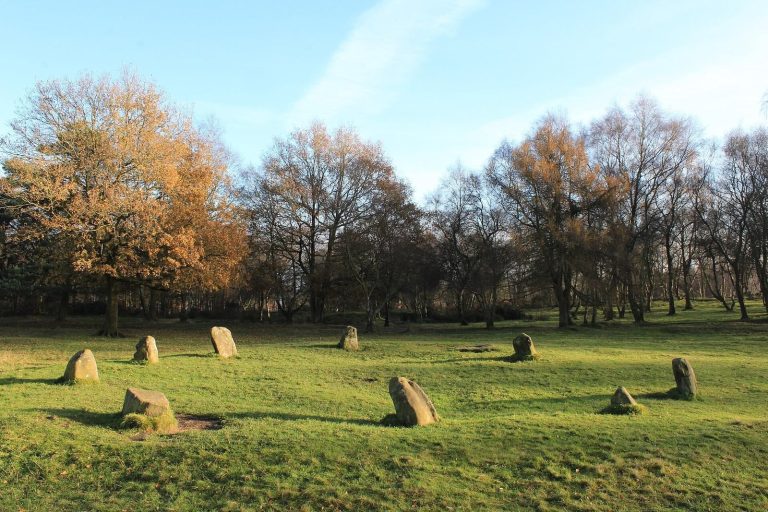
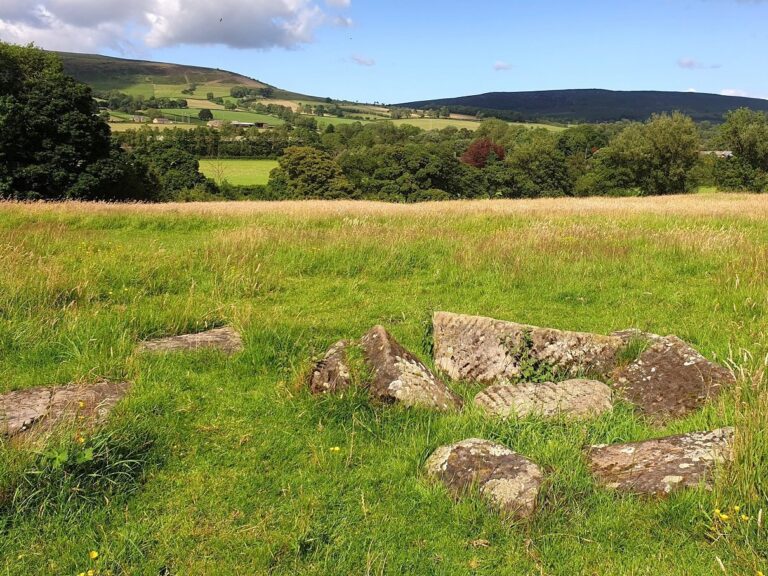
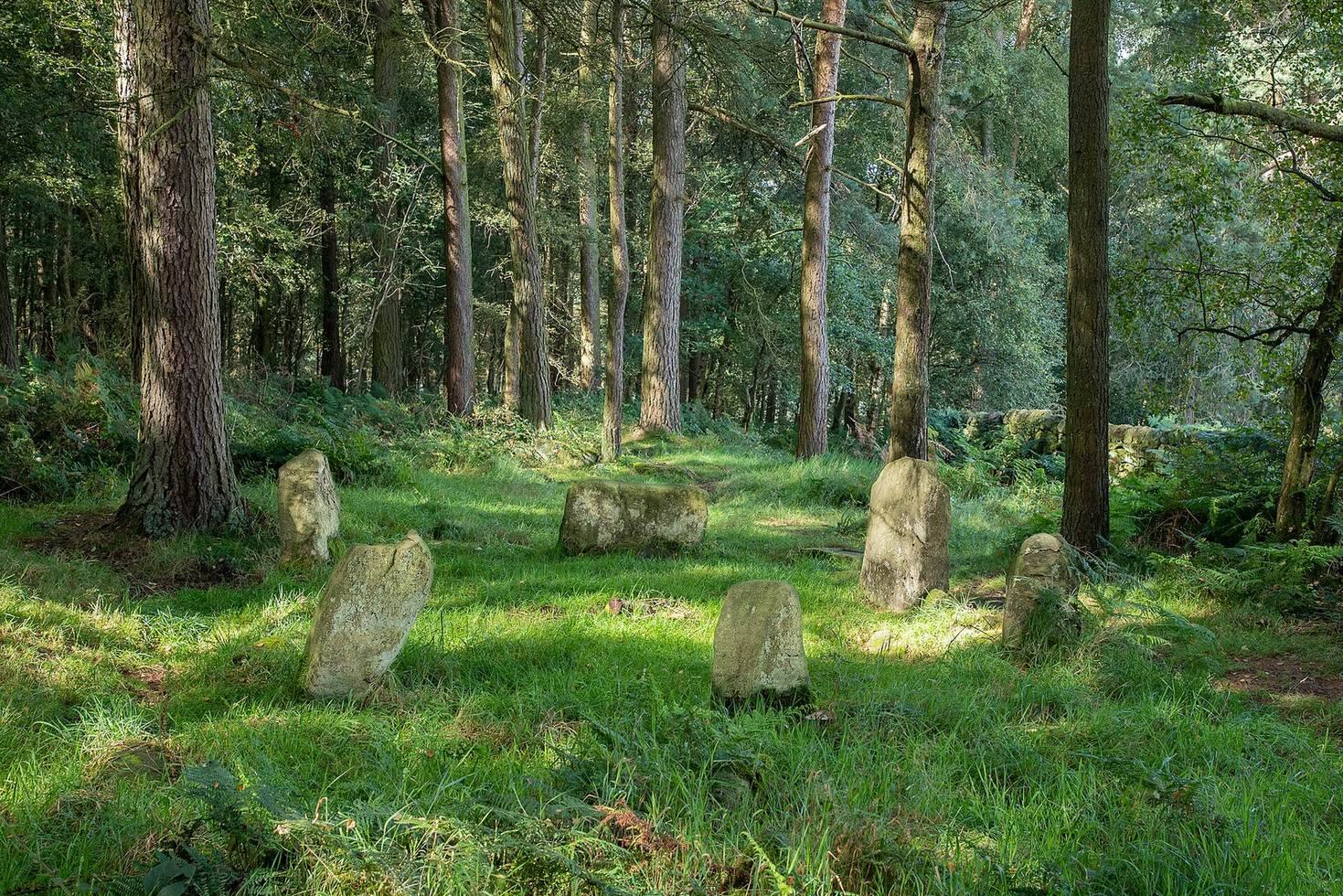
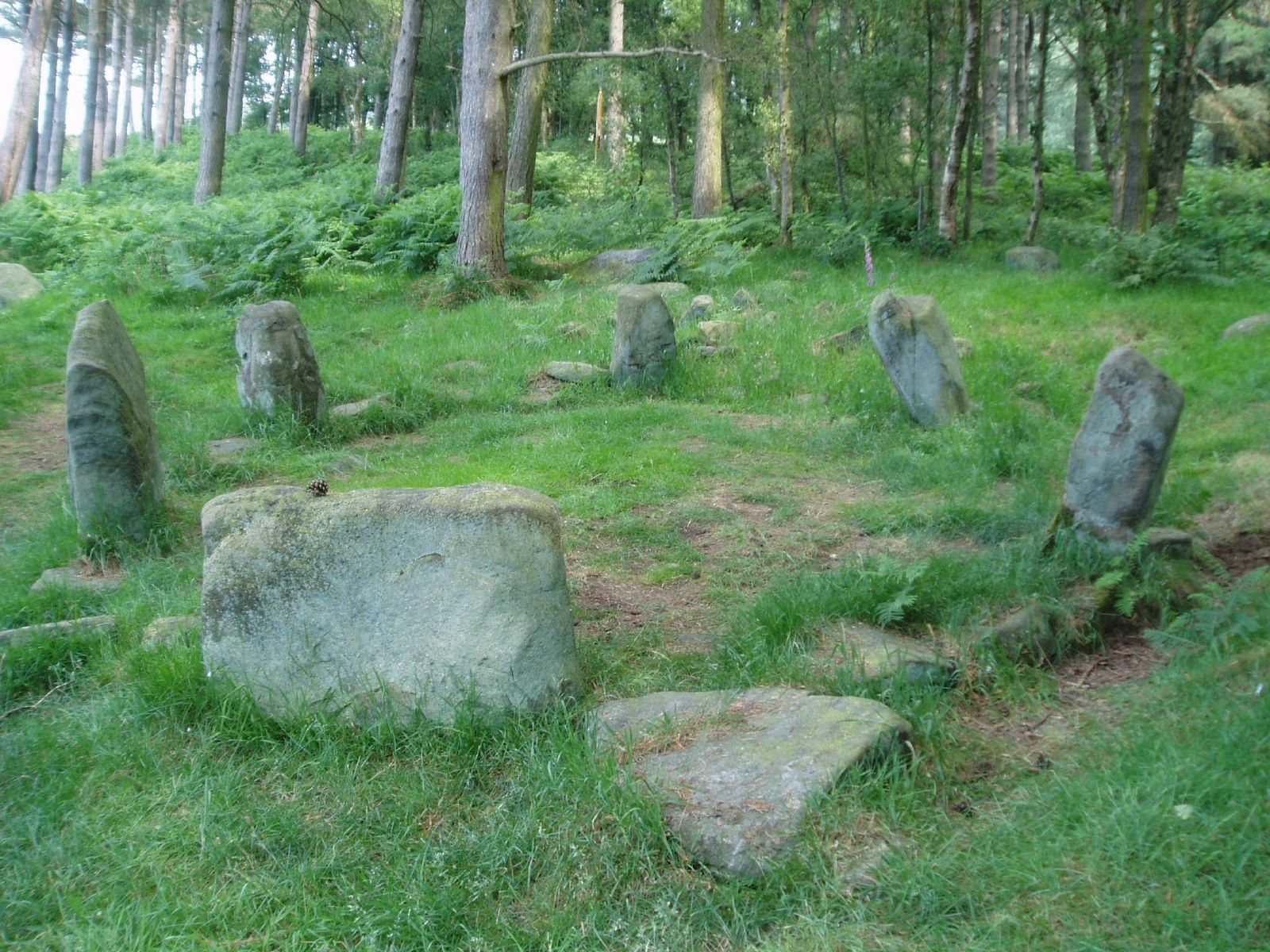
The remains centre on a small stone circle with a sub-rectangular cairn directly to its east. One of the circle stones stands within the cairn. The circle is set on a stony platform, and low stonework links its standing stones.
Setting and layout
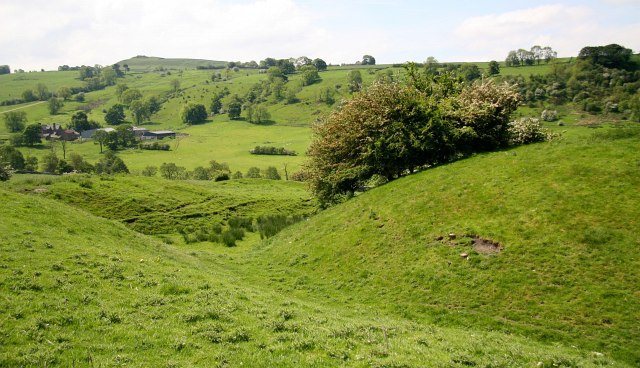
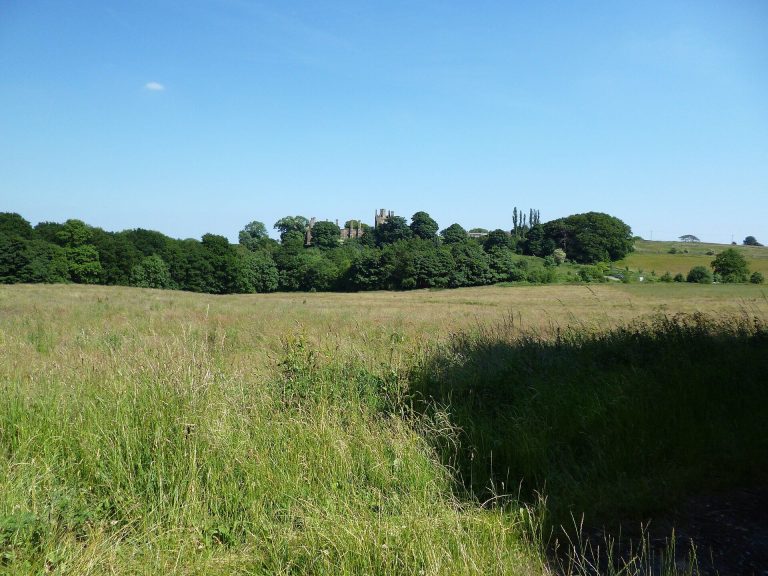
Doll Tor occupies the western flank of Stanton Moor, about half a mile north of Birchover. It lies 230 metres southwest of the Andle Stone and overlooks Harthill Moor Stone Circle. It is one of four megalithic sites identified at Stanton Moor.
The stone circle
The circle is 7 metres across, with six upright stones reaching up to 1 metre high. The stones on its western side are taller and heavier than those elsewhere in the ring. The stony platform may have been made to level the ground; excavation in 1994 identified part of it as an intact, constructed prehistoric layer. Low dry-stone walling, made mostly of flat stones fitted without mortar, was added between the standing stones at an unknown date.
During restoration, excavators located the holes where two western stones had stood, allowing them to be raised again. Two other stones, already fallen from their original positions by at least the mid-nineteenth century, were also re-erected. The positions of stones from the kerb and cairn could not be determined precisely, so their arrangement was reconstructed approximately.
The eastern cairn
The sub-rectangular cairn lies directly beside the circle. Excavation revealed a rectangular stone-lined pit at its centre and burials around the inner edge. A large flat stone at the eastern end may have served as a burial cover, while another slab lay over cremated remains near the centre. At the cairn’s northeast, a further flat stone covered child remains and fragments of a large urn.
Burials and finds
Finds from the circle
Bateman recovered fragments from three or four Pennine-type collared urns, prehistoric pottery vessels with a distinct collar around the opening, as well as objects he identified as incense cups. Several urn fragments were later reassembled at Weston Park Museum in Sheffield. Heathcote’s finds were kept at his home in Birchover in the late 1930s and were in the museum’s care by the early twenty-first century.
The 1931–33 excavations uncovered a burnt flint knife at the centre of the circle. At its southeastern edge, excavators found fragments of a thick, plain urn; nearby were charcoal, decorated pottery and child bones. Charcoal near the southwestern upright stone was interpreted as the remains of a cremation in which the bones had been completely incinerated. At the base of the western stone lay a roughly made urn 8.3 centimetres high, accompanied by very few bones.
Burials in the cairn
Excavation identified at least six burials around the cairn. At its centre, cremated adult remains, interpreted at the time as those of a woman, were accompanied by a segmented faience bead, a glazed, glass-like material, with a dark-red base. A southern burial deposit held an inverted urn 8.9 centimetres high, small bronze pieces, three unburnt flint scrapers and very few bones.
At the southeast were another flint scraper and two urns lying on their sides, measuring 8.3 and 13.3 centimetres high, with the remains of a child. A pit to the north contained adult remains considered probably male and a red faience star bead once thought to have come from Egypt. The child remains and large urn fragments at the cairn’s northeast lay beneath a flat stone.
Remains east of the circle
Further cremated remains were found east of the circle. Analysis of the bones suggested they belonged to an adult male.