Church of Saint Stephen in Vilnius: A Roman Catholic Parish Church
Site at a Glance
- Popularity
- Medium
- Country
- Lithuania
- Primary era
- Early Modern
- Eras represented
- Early Modern
- Civilizations
- Grand Duchy of Lithuania, Polish–Lithuanian Commonwealth
- Site type
- Religious
- Remains
- Church
On this page13 sections
History
Church of Saint Stephen in Vilnius is a Roman Catholic parish church in Naujamiestis, in the southeastern part of Lithuania’s capital. Built in 1600 in the Rudnicki suburb, it is a late Renaissance church with forms moving toward the early Baroque. Jesuit priest Szymon Wysocki began the project and gathered money from townspeople. Dedicated to Saint Stephen, traditionally regarded as the first Christian martyr, it was among the first masonry churches in Vilnius’s suburbs and belonged to the Diocese of Vilnius, the local Catholic jurisdiction led by a bishop.
Parish, hospital, and annual celebrations
The church initially served the nearby wooden Hospital of Saint Lazarus, named for a saint traditionally associated with care for the sick, and a school also operated there. In 1604, the church held elaborate celebrations for the canonization of Saint Casimir, the Catholic Church’s formal recognition of a person as a saint. Casimir was a Jagiellonian prince from the ruling Polish-Lithuanian dynasty. The celebrations became annual, with a procession from Vilnius Cathedral through the Old Town to the church, carrying a copy of the papal standard associated with the ceremony.
In 1612, townspeople funded a stone hospital to replace the wooden building. Fire during the war of 1655 damaged the church and destroyed the hospital, which was rebuilt in 1673.
Brotherhood and Sisters of Life of Mary
In 1715, Bishop Konstanty Kazimierz Brzostowski gave the church to a monastery of the Brotherhood of Saint Roch, a Catholic men’s congregation devoted to caring for the sick. Brzostowski had founded the brotherhood, and its senior member, Father Karol Lutkiewicz, became rector of the church. Renovations followed in 1717, when the hospital was enlarged and a chapel dedicated to Saint Roch, traditionally associated with protection from plague, was added for the monks.
With Pope Clement XII’s permission, a convent of the Sisters of Life of Mary, a Catholic women’s congregation also known as the Mariavites, was established on the hospital grounds in 1737. Its founder and benefactor was the church rector, Józef Stefan Turczynowicz. Bishop Michał Jan Zienkowicz approved the congregation’s rules in 1739, and Pope Benedict XIV confirmed them in 1752 in a papal brief, a formal document issued by a pope. That year, the church passed to the sisters. During their first 30 years in Vilnius, they brought more than 400 people to Christianity, chiefly girls from Jewish families, and ran a school for girls from poor households.
Convent revival and reconstruction
After the sisters moved to Belarus, the convent stood empty and was dissolved. In 1770, one sister and three companions received permission in Rome to revive it. Bishop Ignacy Jakub Massalski confirmed their rules, and the convent was re-established in 1788.
During the 1794 uprising, Russian artillery and fire badly damaged the church and convent, leaving the convent in ruins. The sisters undertook restoration, and Emperor Paul I contributed to the church’s repair during a visit to Vilnius. Two single-storey convent wings and buildings for orphans were erected in 1798. The church was reconstructed between 1801 and 1806, with further repairs after the war of 1812 and again in 1820.
Parish changes and secular use
By the middle of the nineteenth century, the church belonged to All Saints parish, which included nearby villages such as Panary, Burbiszki, Biała Waka, Porubanek, and Czarny Bór. An imperial decree suppressed the convent in 1864, and the sisters were transferred to the Benedictine convent at Saint Catherine’s Church. The former convent buildings became a prison, while the church was assigned to All Saints. Because the church’s main entrance was within the prison grounds, it was walled up. The cemetery closed in 1865.
Industrial buildings rose beside the church in the early twentieth century. Construction of a new prison enclosure in 1914 badly damaged the Chapel of Saint Roch. In 1926, the former convent buildings housed a stonecutting workshop and storage, while a prison remained in the complex. During the years between the world wars, the closed cemetery was used to store building materials.
War, closure, and later use
The church was damaged during the Second World War and repaired in 1946. It had closed in 1945, and Soviet authorities prohibited worship there after the war. A nearby brickmaking workshop began operating in 1948, and the church was used as a warehouse.
Repairs to the facades took place in 1975 and 1976. The disused building later came under the management of the Youth Theatre and was used to store theatrical props, while restoration work was underway. The church is listed in Lithuania’s Register of Cultural Property as a site of national significance, under code 1042.
Remains
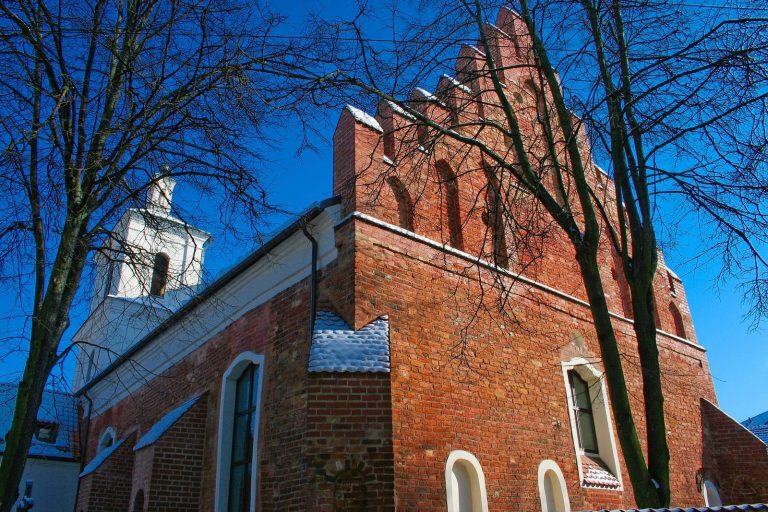
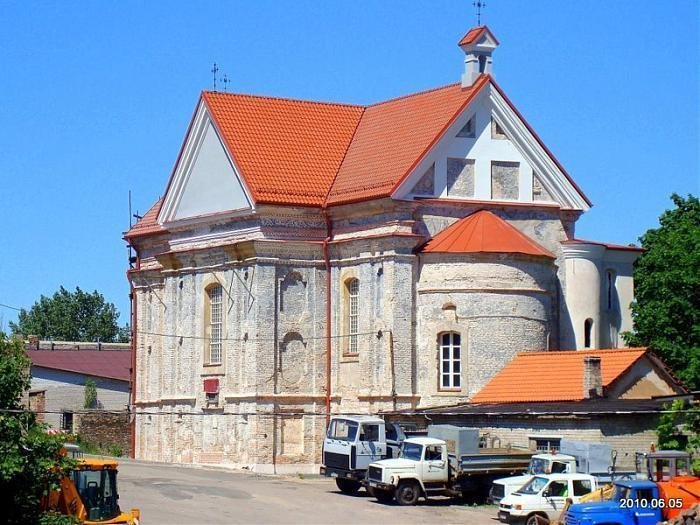
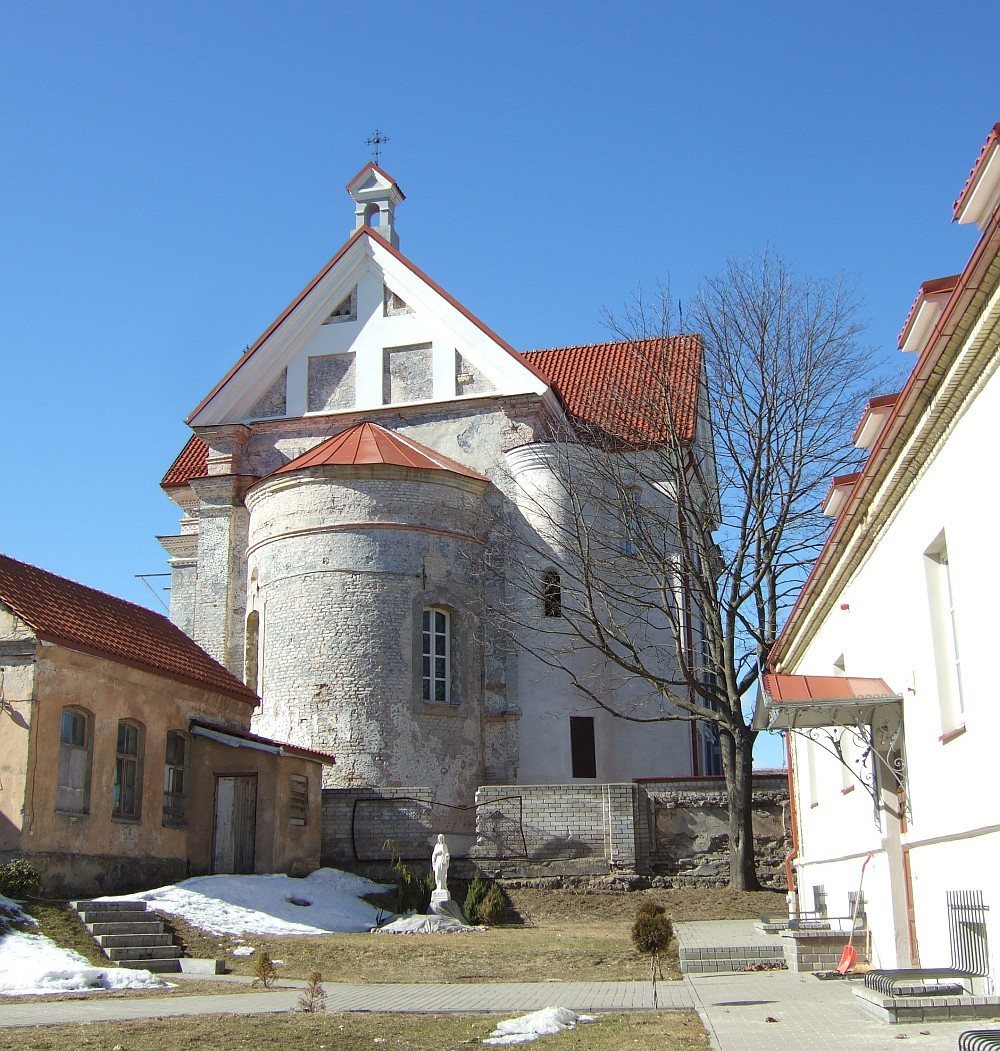
Near Vilnius’s railway station, the church is laid out on a cross-shaped plan and built of brick masonry, with plastered exterior walls and a tiled roof. Its main nave has a narrower side nave to the south, and rounded or polygonal apses, the projecting ends of a church, close the main nave at both ends.
Church exterior and plan
Cylindrical turrets mark the corners of the building. The facade combines Mannerist decoration, a late Renaissance approach favoring complex forms, with motifs drawn from Gothic defensive architecture, a medieval European building tradition. Elsewhere, the exterior is plain, with a molded cornice, niches between shallow wall projections called pilasters, and paired pilasters on the outer walls. Its sgraffito plasterwork, made by cutting through a surface layer to reveal a contrasting layer beneath, makes it the only Renaissance church in Vilnius with this decoration. The main entrance door is covered in patterned wrought-iron sheet. Oak frames surround the windows, except for two behind the main altar, which have iron frames and stained glass. One depicts Saint Stephen; the other shows the Sacred Heart, a Catholic devotion to Jesus represented by his heart.
Interior and furnishings
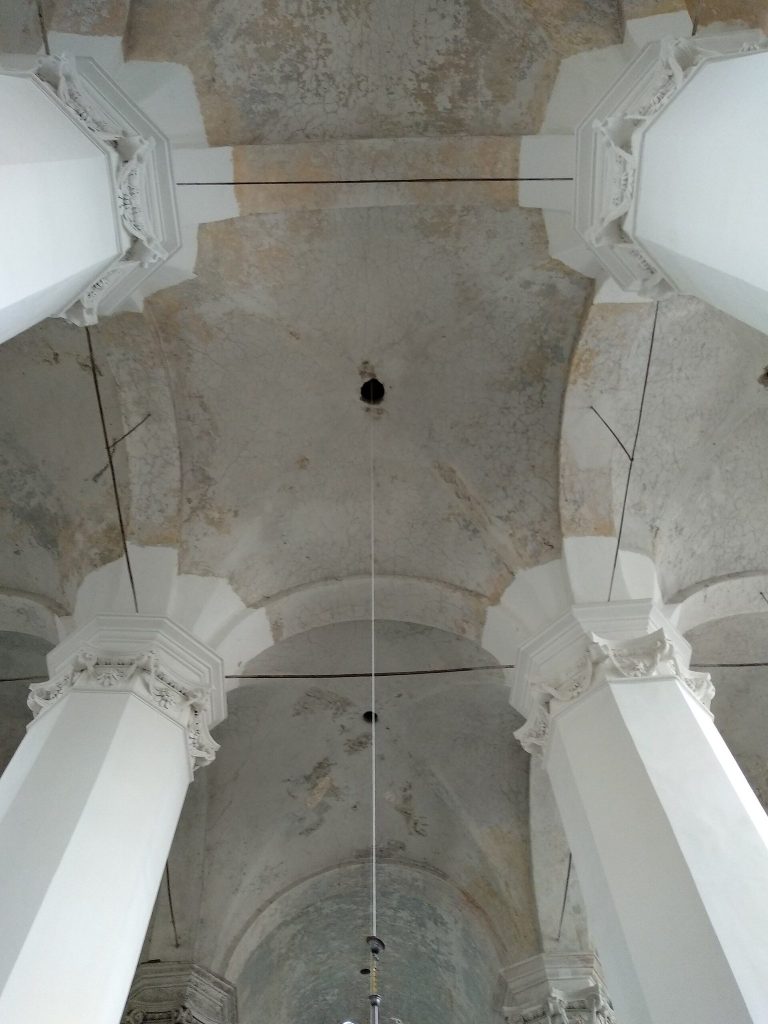
The interior is now simple and without ornament. Its eighteenth-century furnishings included organ lofts, raised galleries for an organ and sometimes a choir, and six Baroque altars, all lost in 1794. In the early nineteenth century, images of Saint Stephen and Saint Joseph, regarded in Christianity as Mary’s husband and Jesus’ foster father, adorned the main altar; both are attributed to Szymon Czechowicz. An altar in one chapel held an image of the Immaculate Conception, the Catholic teaching that Mary was preserved from original sin from the moment of her conception. The painting is attributed either to Franciszek Smuglewicz or to one of his pupils. A tombstone for Bishop Alexander Piotr Toczyłowski, who died in 1808, was inside the church.
Hospital and convent buildings
The stone hospital associated with the church could accommodate 24 patients and had three chapels. The former convent complex included two single-storey wings and separate buildings for orphans. The Chapel of Saint Roch contained a life-size statue of the saint and suffered severe damage when the prison enclosure was constructed in 1914.
Bell tower and cemetery
A separate bell tower stood beside the gate to the adjoining cemetery. Among those buried in the cemetery were architect Laurynas Stuoka-Gucevičius (1753–1798), a leading architect of Vilnius Classicism; suffragan bishop David Pilchowski (1735–1800), who served under the diocesan bishop; and medicine professor Mikołaj Regnier (1746–1800). Other burials included priest and Vilnius University professor Anioł Dowgird (1776–1835), philosopher Józef Władysław Bychowiec (1778–1845), the first translator of Immanuel Kant’s works into Polish, and Józef Rogowski, a veteran of Vilnius theatre who died in 1847. Royal chamberlain Jan Chodźko, a relative of writer Ignacy Chodźko and father of writer Dominik Chodźko, was buried there with his wife.
Stuoka-Gucevičius memorial
A wooden marker with a barely legible inscription marks Stuoka-Gucevičius’s grave near the church’s south facade. Before the Second World War, a plain plaque bearing a Polish inscription was set into a nearby wall. In 1998, a memorial plaque with his portrait in bas-relief and a Lithuanian inscription was installed there. Sculptor Jonas Noras Naruševičius made the relief, and architect Vytautas Zaranka designed the plaque.
Depictions of the church
The church appears in an etching by Jerzy Hoppen dated 1927 and in a tempera painting by Bronisław Jamont made in 1921–1922.