Church of St Bartholomew in Tong: A Medieval Collegiate and Parish Church
Site at a Glance
- Popularity
- Medium
- Country
- United Kingdom
- Primary era
- Medieval
- Eras represented
- Medieval, Early Modern, Modern
- Civilizations
- British, English
- Site type
- Religious
- Remains
- Church
On this page22 sections
History
The Church of St Bartholomew is a medieval collegiate parish church at Tong in the United Kingdom. Its present building was erected between 1409 and 1430 as the home of a college, a community of clergy living under a shared rule, founded to provide regular prayers and Masses for the dead.
Early church and disputed patronage
Tong had a parish church by the late eleventh century. Roger de Montgomery, Earl of Shrewsbury, granted its advowson, the right to nominate a parish priest, and an annual payment of half a mark to Shrewsbury Abbey, a Benedictine monastery. The grant indicates that the church was built between 1087 and Roger’s death in 1094. Richard de Belmeis I later arranged for Tong’s churches to return to the abbey after his death in 1127.
Control of the appointment of priests remained contested. Between 1188 and 1194, William la Zouche removed Ernulf, a priest presented by the abbey and installed by Bishop Hugh Nonant. Ernulf later died holding the church. After his death in 1220, Roger la Zouche disputed the abbey’s right to appoint a successor, but the abbey prevailed. The la Zouche family maintained closer ties with Lilleshall Abbey, an Augustinian house, than with Shrewsbury Abbey. A new church at Tong appears to have been built around 1260. In 1271, Orabil and her husband, Henry de Penbrigg, received permission to hold a weekly market and an annual fair around the feast of St Bartholomew, to whom the church was dedicated.
Foundation and resources of the college
The present church was built on the site of the earlier parish church. Its collegiate foundation began with Isabel Lingen, widow of Sir Fulk Pembridge, who died in 1409. Isabel secured the advowson from Shrewsbury Abbey and, with Walter Swan and William Mosse, obtained a royal licence from Henry IV on 25 November 1410 to establish a permanent college dedicated to St Bartholomew the Apostle. Its prayers were also intended to commemorate the king.
The foundation’s endowment included property at Tong, the advowson of St Mary’s Church at Orlingbury, land at Sharnford and the future right to the manor of Gilmorton. The college was planned for five chaplains under a warden and was also to support thirteen poor residents, seven of them seriously ill or disabled. Isabel established almshouses for these residents at the church’s west end. The first warden took office in March 1411, when Bishop John Burghill approved the college’s statutes. These set rules for the chaplains’ shared life and gave the warden responsibility for both college and parish affairs. They also provided for a deputy warden, two assistant clerics, a teacher for local children and care for the almshouse residents. The college’s central purpose was to secure regular Masses, the central Eucharistic service in Catholic worship, for Isabel’s husbands, relatives, benefactors and other dead.
In 1415, Henry V granted Lapley Priory to the college. Lapley was an alien priory, a religious house in England dependent on a mother house abroad, in this case the Abbey of Saint-Remi at Reims. The grant brought the priory and its lands, the right to appoint the priest at Lapley parish church, its tithes and estates at Hamstall Ridware, Meaford, Marston in Church Eaton and Silvington. About 25 years later, the Lapley estates supplied roughly half the college’s income. Revised statutes followed in 1423, though the higher payments they prescribed were not made.
The college and Sir Richard Vernon received royal privileges in 1448 that gave them substantial local legal independence, including rights over unclaimed property and some judicial matters. Most college estates were leased, while the institution retained farmland at Lapley and Wheaton Aston for its own use. Around 1440, five workers cultivated this land to supply food. In 1438, its livestock included 92 sheep, eleven oxen and six horses, and the college also sold wool. By the eve of dissolution, the listed stock had fallen to two oxen, two cows, 36 sheep, eleven pigs and poultry; barns held grain, hay and other produce.
Gifts and bequests added to the college’s income and supported services for the dead. In 1451, William FitzHerbert provided for funeral candles and a year of Masses for his soul. In 1454, Fulk Eyton requested burial in the Lady Chapel and left property and goods in return for commemorative services. John Mytton’s 1499 bequest specifically helped pay for church construction. In the early sixteenth century, Sir Henry Vernon established a separate chantry, an endowment for priests to celebrate Masses for named people, including the dead. His 1515 will directed that his wife, Anne Talbot, be reburied beside him and provided money for a priest and chapel dedicated to the Salutation of Our Lady, another name for the Annunciation. This chantry had separate finances and held land in Staffordshire and near Tong.
By 1535, the college also held a fifth of Weston-under-Lizard and land at Wellington. Its recorded annual income from property was £33 16s. 6d., of which £22 15s. 10d. came from Lapley.
Dissolution and parish use
In 1546, commissioners seized Tong College under the legislation by which Henry VIII’s government dissolved colleges and chantries. The college, Vernon’s Chantry and a separate chantry at Bakewell were later granted to Richard Manners. In 1547, Manners agreed to pay £486 4s. 2d. for the three properties. Their stated annual values were £53 13s. 5¼d. for the college, £6 9s. 2d. for Vernon’s Chantry and £7 5s. 1d. for the Bakewell chantry. Manners soon sold the Tong college buildings and site, the church’s advowson and other property to James and Alice Woolrich.
The church continued as Tong’s parish church after the college closed. The Woolrich family held the right to appoint its priest for about a century. In 1648, William Pierrepont acquired the former college property, bringing the advowson back together with the manor. The Pierreponts and their successors supported the church and its clergy. The church later served as a perpetual curacy; it had no vicarage building until 1725, and its curate sometimes lived at Tong Castle.
Civil War and later history
During the English Civil War, the conflict between Royalist supporters of the king and Parliamentarian forces, Tong Castle changed hands repeatedly. The church stood on the route between Newport and Wolverhampton and was caught up in local fighting. Royalist soldier Richard Symonds noted extensive broken glass. Around 1644, the college buildings were burned as Parliamentarian forces were driven from Tong, and later archaeological work found evidence of the fire. One church bell was taken to be cast into artillery, while roof lead was stripped for ammunition.
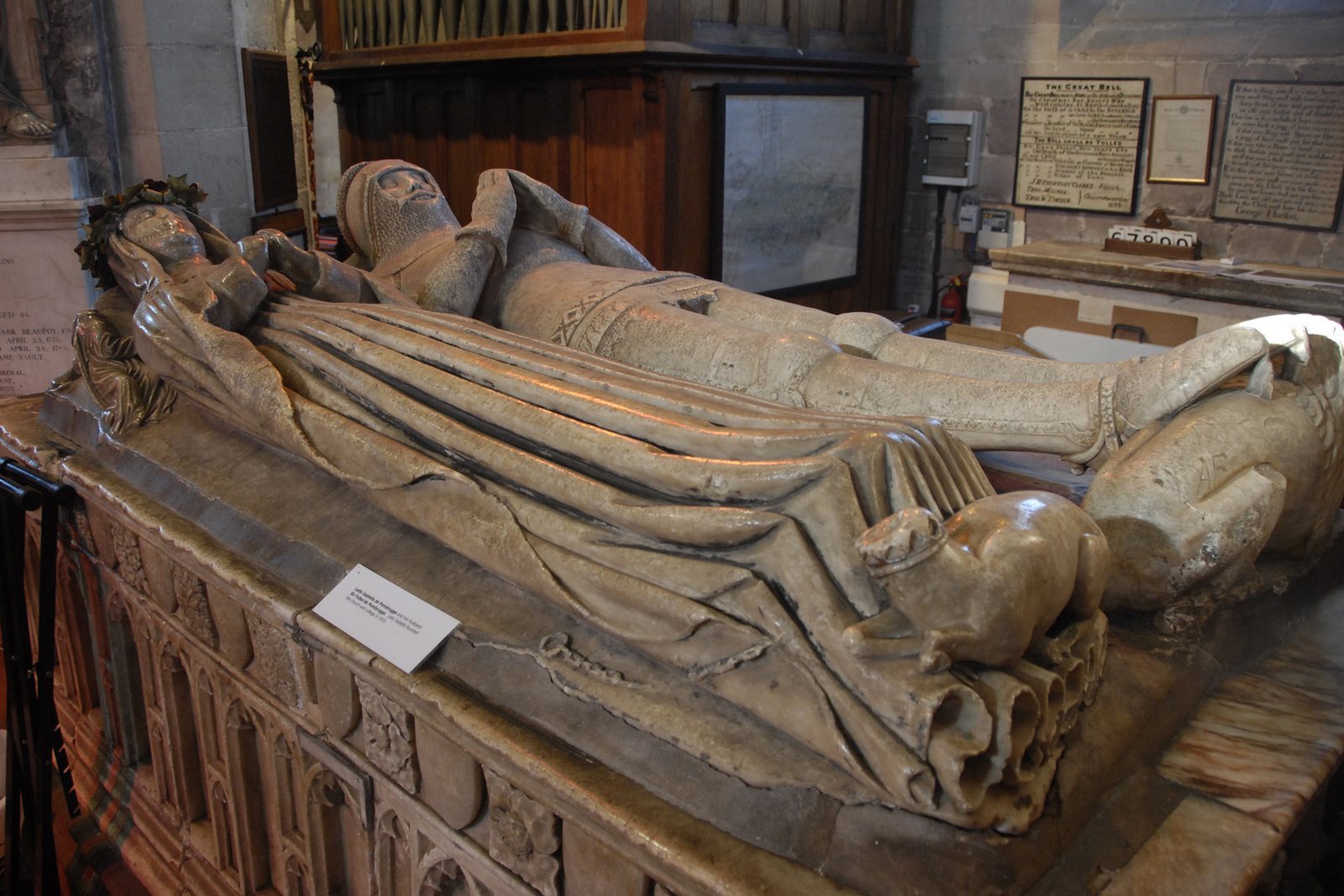
A midsummer rose-garland custom was later linked to Isabel de Pembrugge’s tomb, though its continuity is uncertain. An earlier grant from Roger la Zouche, dated between 1237 and 1247, required the Hugford family to provide him or his heirs with a chaplet of roses each year. If they were away from Tong, the chaplet was to be placed on an image of the Virgin Mary in the church. Later writers connected this obligation with the church’s garlanding custom.
The church’s north door bears the Royal Arms of George III, commemorating the 1814 Peace of Paris and Napoleon’s exile to Elba after the Napoleonic Wars. George Jellicoe presented the arms. In 1892, a major restoration directed by Ewan Christian was completed. Repeated thefts of lead from the roof between 2010 and 2015 led to its replacement with terne-coated stainless steel in 2017.
Tong is also associated with Little Nell, the fictional character in Charles Dickens’s The Old Curiosity Shop. Around 1910, verger George Bowden fabricated a parish-register entry and grave for Nell Gwyn, and the grave was later moved within the churchyard as other burials took place. The association with Dickens’s character partly reflects the fact that his grandmother worked at Tong Castle. Dickens reportedly confirmed the connection to clergy after the novel appeared. The church remains a Church of England parish church and was designated a Grade I listed building in 1955.
Remains
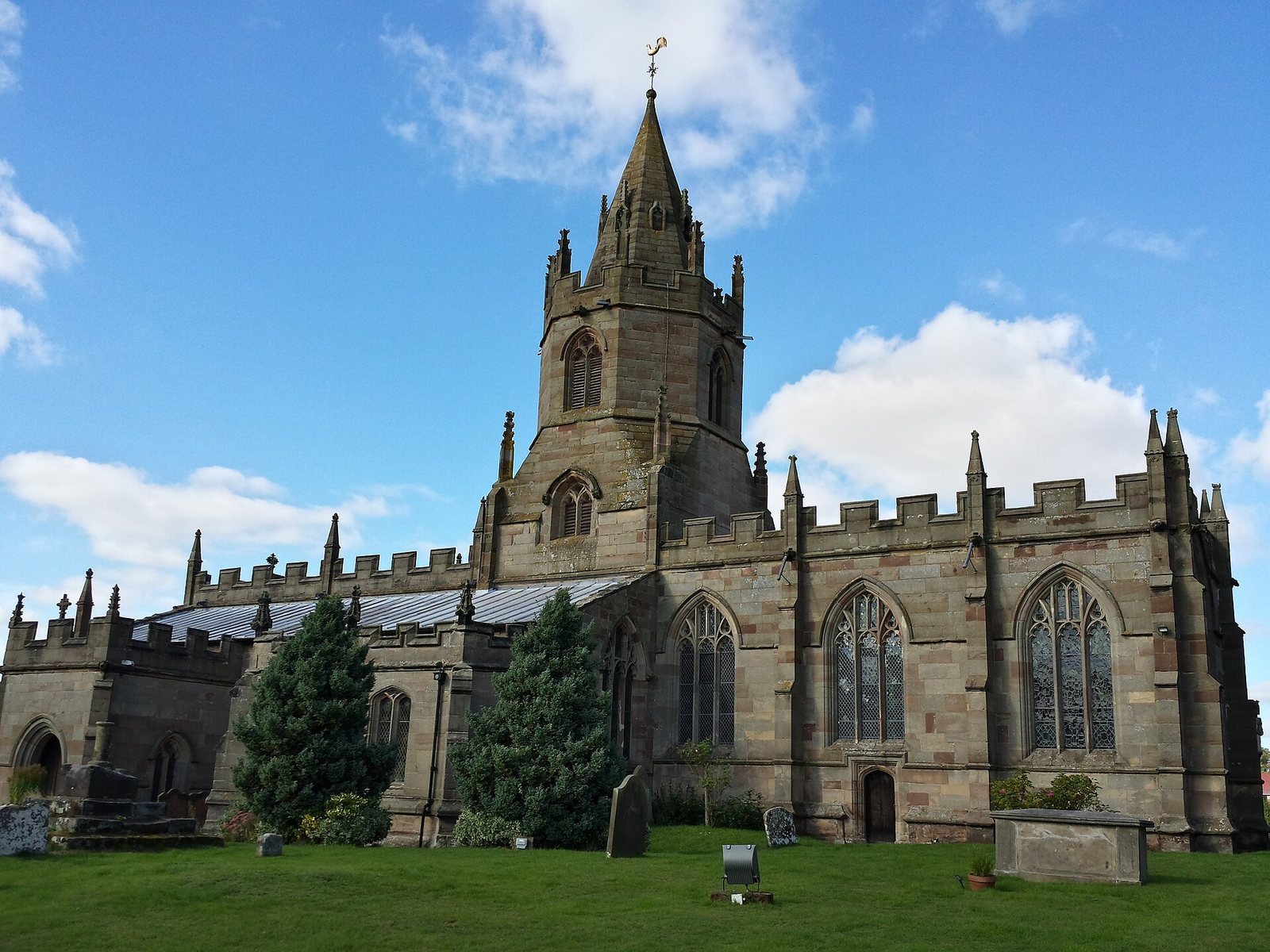
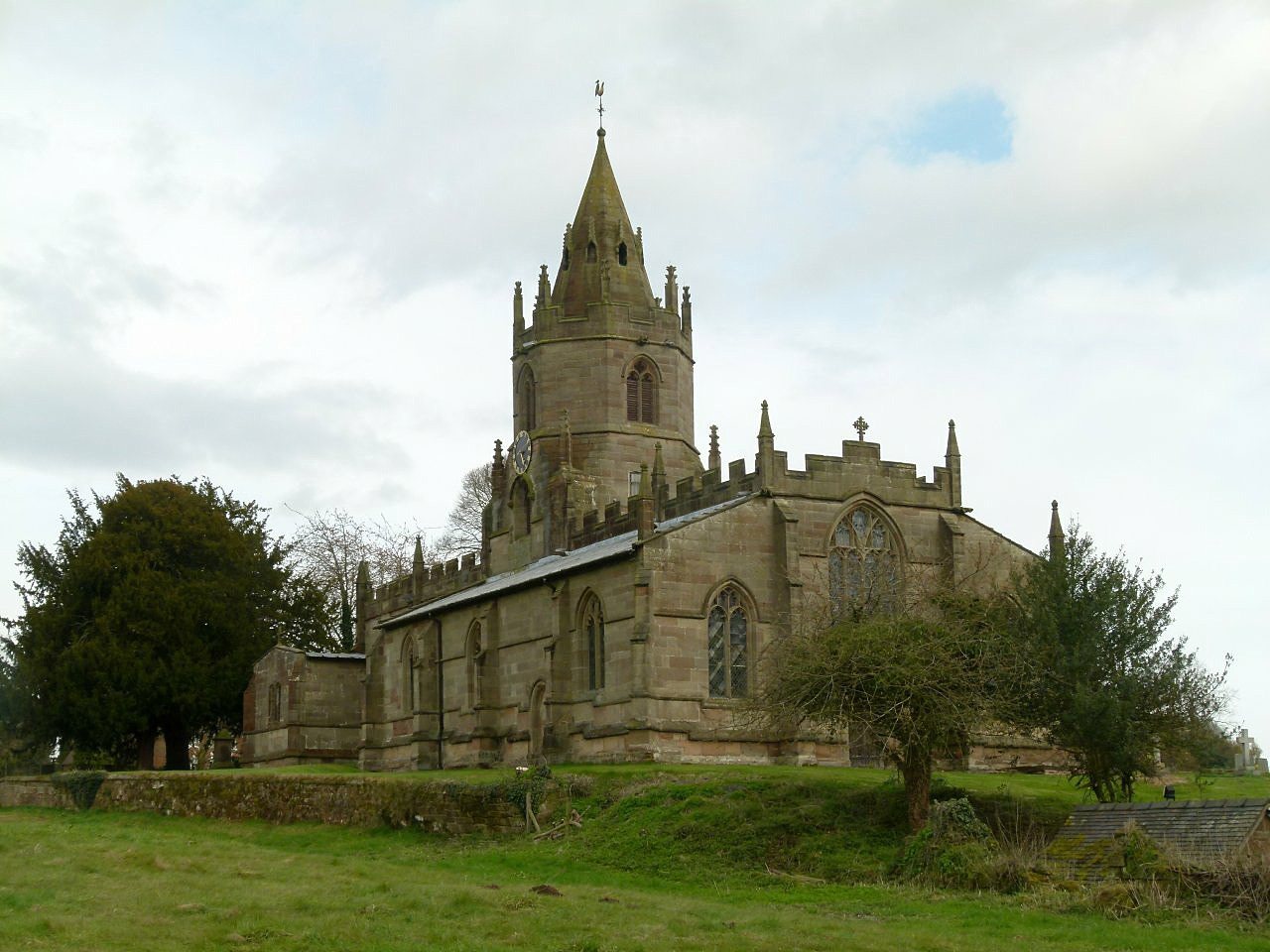
The church is built of local New Red Sandstone dressed into regular blocks. It measures 103 feet 10 inches (31.65 m) long and 25 feet 9 inches (7.85 m) high. The ground slopes down from east to west; one suggestion is that this helped water drain through the west door, though the reason for the slope is uncertain.
Exterior and overall form
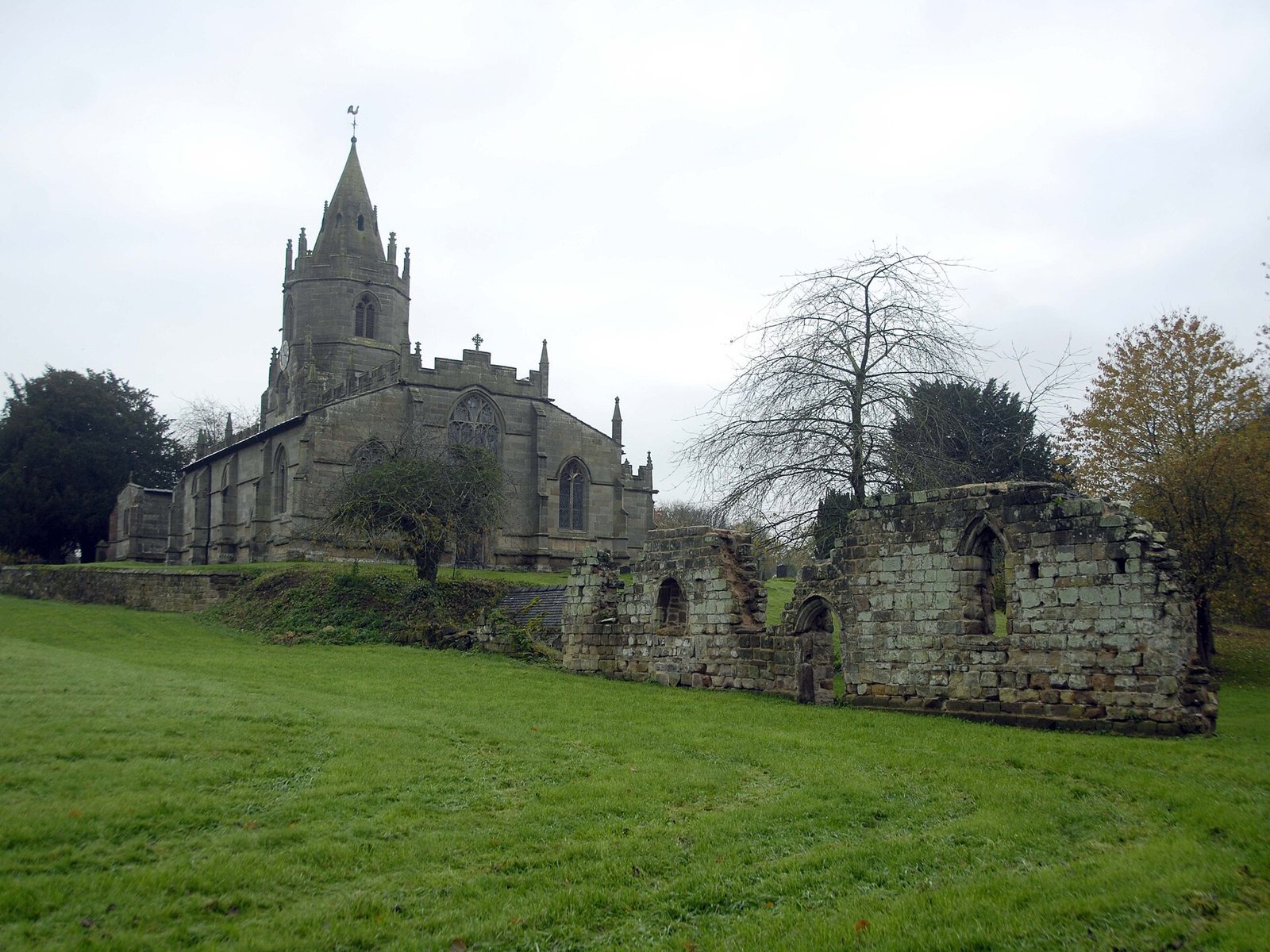
The church has a low-pitched roof with battlements, pinnacles and gargoyles. Its north wall bears numerous musket-ball marks and at least one hole attributed to a cannon shot during the Civil War. A carved statue of St Bartholomew by Pat Austin stands in a niche in the east wall. Around 16 feet (5 m) south of the South Chapel is the sandstone base of a fifteenth-century cross. Its cross-head has been lost, and a sundial was placed on the base in 1776.
Nave, tower and furnishings
Nave and crossing tower
The church’s principal body dates to the early fifteenth century. Four pillars along the south side of the nave survive from the earlier church and date to the late thirteenth century. At the crossing, the tower has a rectangular lower stage containing the belfry, an octagonal upper stage and a short spire. A doorway in the north-east pillar leads to the rood loft, a gallery associated with the cross above the church screen. The pulpit once hung from this pillar.
Pulpit and choir stalls
The hexagonal pulpit, in the Jacobean style associated with the reign of James I, dates to 1622 and was given by Lady Harries. It now stands just west of the pillar, and its inscription records the gift and date. The choir stalls have carved misericords from about 1480. These are small ledges beneath hinged seats, often decorated with carvings. One, associated with the warden’s seat, bears a Lily Crucifix. It is described as the only wooden example displayed in England, among roughly a dozen surviving examples of the motif. The panelling around the stalls dates from the nineteenth century and came from Oberammergau.
Windows
Charles Kempe designed the east window during Christian’s restoration. It has five sections divided by a horizontal bar. Kempe also salvaged fifteenth-century glass for the west window above the west door, which was unblocked during the restoration.
Chapels and memorials
Vernon Chapel
The Vernon Chapel, also called the Golden Chapel, was added in the early sixteenth century and completed around 1519–1520. An arched doorway with a double-curved profile separates it from the south aisle. Its fan-shaped stone vaulting forms the setting for a Nottingham alabaster monument to Sir Henry Vernon. A bust on a corbel commemorates his son Arthur, who died in 1517. Arthur holds a book in his right hand, while his left hand is damaged. The small fan-shaped vault above the bust echoes the chapel ceiling. Brasswork set into the floor also commemorates Arthur.
Stanley monument
The Stanley monument stands in the south transept after being moved there from the north side of the altar in the eighteenth century. Its upper level has figures of Sir Thomas Stanley and Margaret Vernon, while their son Edward is represented below. Two stone epitaphs are traditionally attributed to William Shakespeare and were reportedly composed at Sir Edward Stanley’s request for his parents. Figures that once decorated the monument are now damaged and have been placed on the upper part of the richly decorated Gothic arch known as the Burgundian arch.
Pembrugge and Vernon tombs
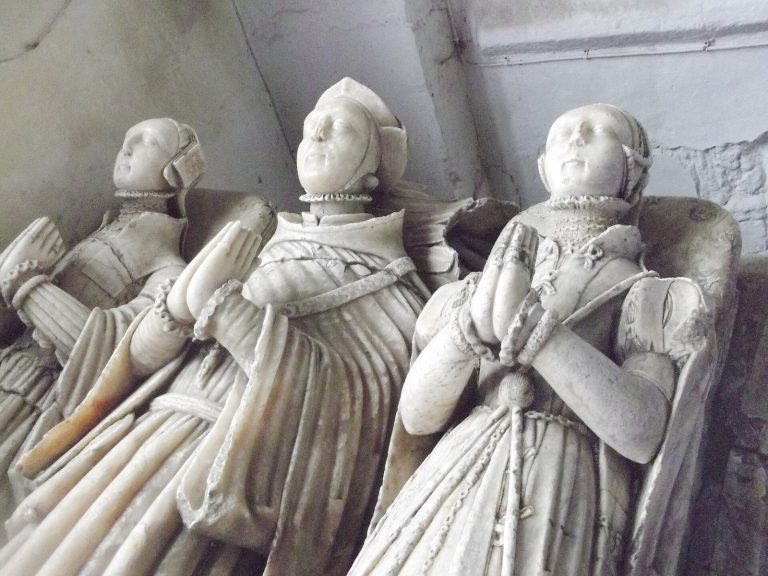
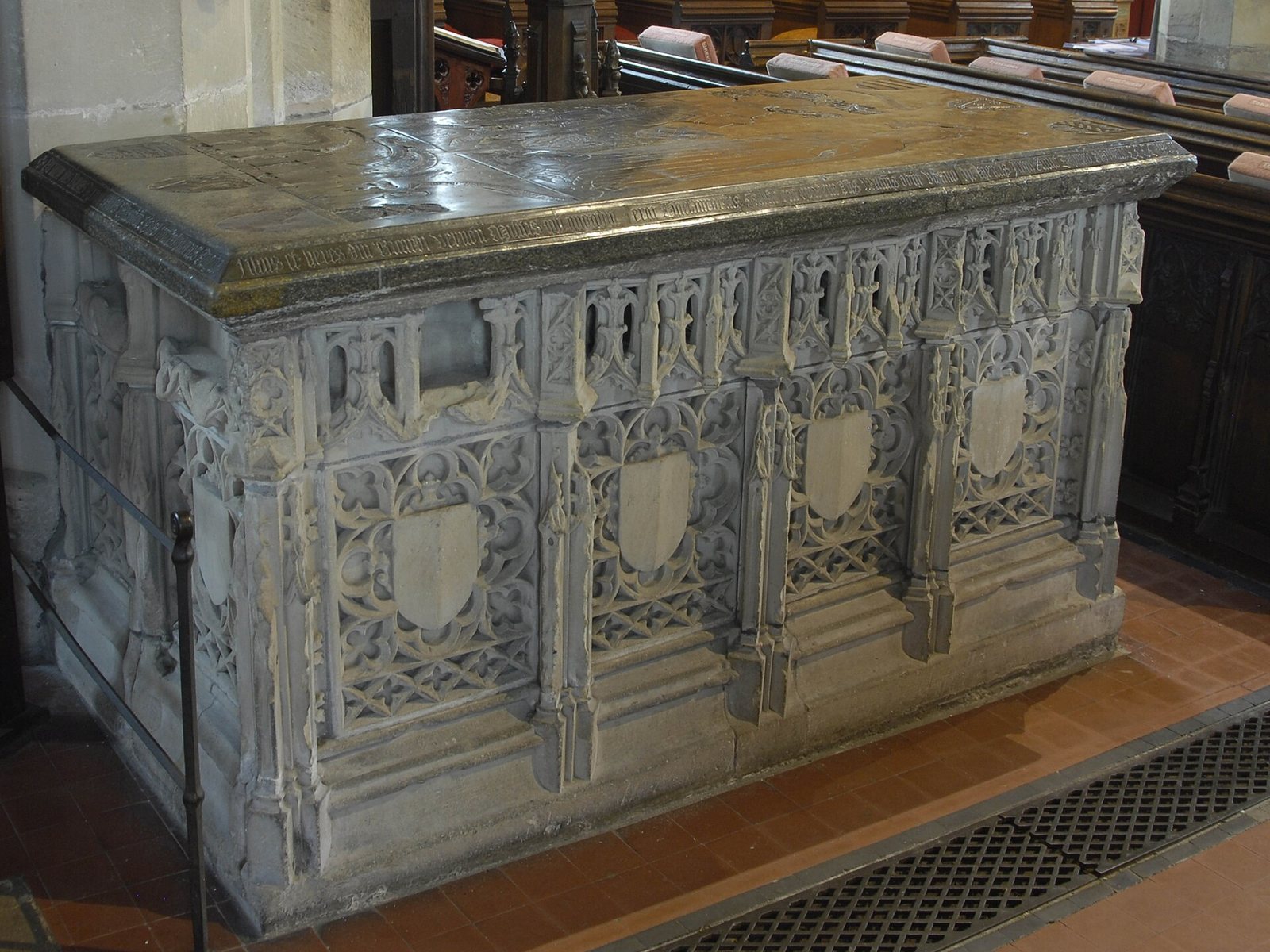
Near the north side of the tower, an alabaster tomb bears the figures of Sir Fulke and Dame Isabel de Pembrugge. The monument is damaged, but some black paint remains on Isabel’s widow’s dress. Opposite it, another tomb commemorates Sir Richard Vernon and Benedicta de Ludlow; its alabaster may have come from Chellaston in Derbyshire. A nearby Purbeck marble tomb has brass figures of Sir William Vernon and Margaret Swynfen. Other Vernon family tombs commemorate Richard Vernon and Margaret Dymoke beside the pulpit, and Henry Vernon and Anne Talbot beneath the arch between the Vernon Chapel and the south side of the nave.
Bells
The crossing tower contains six bells. Robert I Newcombe of Leicester cast the third in 1593; Henry II Oldfield of Nottingham cast the fourth in 1605; William Clibury of Wellington cast the fifth in 1623 and the second in 1636; Abraham II Rudhall of Gloucester cast the treble in 1719; and Thomas II Mears recast the tenor in 1810. A service bell, also called a Sanctus bell, was cast by a member of the Newcombe family around 1600.
The Great Bell of Tong, the largest bell, weighs 2 long tons, 6 hundredweight and 1 quarter (5,180 lb; 2.35 tonnes). It cracked during the Civil War and was recast in 1720. After cracking again during an Ascension Day service in 1848, it was recast in 1892. Sir Henry Vernon had left money for a bell in 1518. Concern about the tower’s ability to withstand regular ringing means the Great Bell is rung only on selected days and occasions.
North entrance and churchyard
North door
The stonework above the north door carries the Royal Arms of George III, made from Coade stone, a moulded ceramic material developed in eighteenth-century England. The north door was also known as the Door of Excommunication.
Cross and burial ground
Between the north side of the nave and the vestry, a small Maltese cross marks a burial area traditionally used for unbaptised babies. Lines by Lord Byron, Walter Scott and Sir Thomas More were carved on the cross, but most have worn away. The churchyard also contains a grave identified by a plate as the reputed grave of Little Nell.
Former college and almshouses
College buildings once occupied land south of the church, while the almshouses stood at its west end. A 1739 map shows the college buildings covering a large area, and in 1757 they were described as a well-maintained square building with a thatched roof. Later, parts were demolished and other sections used as a stable and accommodation. Only a short stretch of almshouse wall remains; the former college site lies beneath the A41 bypass.
Tong Cup
The church owns the Tong Cup, a silver-gilt vessel for consecrated Eucharistic bread, 11 inches (280 mm) high and set with a central crystal barrel. Parish records describe it as a communion cup of gold and crystal, but its date remains disputed. Nikolaus Pevsner placed it around 1540–1550, while later research proposed a date nearly a century later. After incumbent John E. Auden attempted to sell it, a nobleman lent the cup for 30 years. It was subsequently transferred to the treasury of Lichfield Cathedral while remaining parish property.
War memorials
Three twentieth-century war memorials are inside the church. Separate tablets on the chancel arch commemorate parish dead of the First and Second World Wars. The First World War tablet is brass in a marble surround, with crossed swords above a shield. Another plaque remembers Humphrey Herbert Orlando Bridgeman, who went missing in action at Roeux, France, on 11 May 1917.