White Ladies Priory: An Augustinian Priory and Royalist Refuge in England


Site at a Glance
- Rating
- 4.2
- Popularity
- Low
- Country
- United Kingdom
- Primary era
- Medieval
- External website
- Open
- Eras represented
- Medieval
- Civilizations
- English
- Site type
- Religious
- Remains
- Church
On this page11 sections
History
White Ladies Priory is a medieval Augustinian priory in the United Kingdom, established during the latter part of the twelfth century and associated with Romanesque architecture. Formally known as St Leonard’s Priory at Brewood, it housed canonesses regular dedicated to Leonard of Noblac, a French saint traditionally associated with the liberation of prisoners. The name White Ladies refers to the white habits worn by its religious community, distinguishing it from the black-clad Benedictine nuns of nearby Black Ladies Priory.
Foundation and medieval growth
The precise foundation date and identity of the founder are unknown, although the priory’s establishment in the late twelfth century is generally accepted. Documentary evidence exists from 1186 or earlier. The priory stood in an extra-parochial area near Brewood, which was the nearest substantial settlement but lay in Staffordshire rather than Shropshire. White Ladies was never within Brewood parish. The Lacy and FitzAlan families, particularly William FitzAlan, Lord of Oswestry, have been suggested as possible influences because of their nearby estates and connections with Augustinian foundations, but no founder has been established.
Early in its history, White Ladies acquired the church and some tithes at Montford. It also held ecclesiastical interests at Tibshelf in Derbyshire and Bold in southern Shropshire, including rights to revenues and, in some cases, the legal right to appoint a parish priest. Its estates grew through gifts of land, rents, mills, woodland, pasture rights, and other property at settlements across Shropshire and the West Midlands.
Royal grants added to these resources. A charter issued by King John in 1212 confirmed the dedication to St Leonard at Brewood and removed secular obligations from twelve bovates of land at Calverton in Nottinghamshire. In 1232 Henry III allowed the priory to clear, enclose, and cultivate an acre and a half of woodland there, followed in 1241 by permission to cultivate a further three acres containing dead oak trees. John visited the area at least three times and may also have granted fishing rights connected with Withlakeswere, a weir on the River Severn near Bridgnorth. The priory later leased part of these rights to Henry FitzRobert.
Parish rights and estate management
White Ladies obtained the advowson of Tibshelf early in its history. In 1315 Edward II licensed the priory to appropriate the church, allowing it to receive the tithes and appoint a vicar. An ordinance of 1319 defined the vicar’s landholding and annual payment of 40 shillings. The rectory was valued at £8 in 1291, while its income was £5 6s. 8d. by 1536. The priory also paid an annual pension of 20 shillings to the vicars of Lichfield Cathedral.
In 1309 Richard and Burga de Harley transferred the advowson of Bold church to White Ladies, together with a messuage and half a virgate of land. Edward II granted the required mortmain licence, the royal permission needed for land to pass to a permanent religious corporation. The transfer probably helped provide a dowry for Alice de Harley, who later became prioress. As the population of Bold declined, the church produced too little income to support a priest, and in 1481 Bishop Thomas Mylling united it with neighbouring Aston Botterell. By 1536 its income was only 6s. 8d.
The priory also defended its customary pasture rights. In 1292 it successfully challenged an attempt by William de Rugg to enclose land at Rudge, and in 1305 it asserted those rights again against William Wycher, who was associated with enclosure at nearby Blymhill. The Belmeis family made substantial grants during the thirteenth and fourteenth centuries. John de Belmeis received permission in 1304 to grant ten acres of land and ten acres of woodland at Donington, while Edward II licensed Hugh de Belmeis to grant a further thirty acres of woodland in 1315.
Community and episcopal oversight
The priory normally supported a prioress and five canonesses regular, along with lay and clerical servants. A prioress was the female head of the community, while a seneschal managed the estate or household. In 1535 the principal officers included the seneschal Thomas Giffard, who received 16s. 8d., and a chaplain paid £5.
Although White Ladies was administratively autonomous, the Bishop of Coventry and Lichfield inspected the community and confirmed its appointments. Bishop Roger Northburgh intervened in 1326 after Elizabeth la Zouche and Alkice de Kallerhale left the priory, ordering them to return within ten days or face excommunication. In 1332 he cancelled the irregular election of Alice de Harley and appointed her prioress himself.
A visitation probably held in 1338 criticised Alice for extravagant clothing, keeping hunting dogs, excessive spending, and lax discipline. She was ordered not to admit more canonesses than the priory could support. Alice died in 1349, shortly after the Black Death reached Shropshire, and Northburgh appointed Beatrice de Dene as her successor. Other known prioresses included Aldith, Cecily, Agnes, Sarah, Joan, Joan de Hugford, Margaret Corbet, Joan Fillilode, Isabel Creghton, Joan Shirley, Elizabeth Horde or Whorde, Alice Wood, Margaret Cowper, and Margaret Sandford, who led the community until the dissolution.
Economic decline and dissolution
Economic pressures intensified after the agrarian crisis of 1315–22 and the Black Death of 1349. Population decline encouraged the leasing of demesne land, and by the sixteenth century much of the priory’s property was held on long leases at fixed rents. Inflation then reduced the value of its income and left too little money for repairs. When Alice Wood resigned in 1498, she received the income from Tibshelf as a pension, although she had to pay for her own food if she stayed at White Ladies.
In 1521 the priory was not in debt, but Margaret Sandford appears to have struggled with the accounts, and two canonesses claimed that their monthly allowances had not been paid. The dormitory was in poor repair in 1524. Annual revenue amounted to only £31 1s. 4d. in 1535, against expenses of £13 10s. 8d., with similar figures recorded the following year. This placed White Ladies below the £200 threshold set by the Suppression of Religious Houses Act 1535.
White Ladies was dissolved in 1536. Four canonesses still lived there early in 1538, but the process was complete by May. In July that year Margaret Sandford received a pension of £5. The site was granted to William Skeffington of Wolverhampton, while several smaller estates were leased. In 1540 the reversion of the property was sold to William Whorwood and his wife, Margaret. Skeffington retained a long lease of the site and demesne at an annual rent of £10 9s. 6d., while the Whorwoods acquired the reversion of the priory site and several former White Ladies estates.
Post-dissolution estate and the royal escape
Skeffington probably built a house on the former priory site, incorporating part of the prioress’s residence. After his death in 1550, the property passed through his widow Joan, who later married Edward Giffard, into the Giffard family estates. Around 1630 John Giffard extended older farm buildings north of the priory to create Boscobel House, about one mile from White Ladies.
The Giffards were Catholic recusants, meaning Catholics who refused to conform to the established Church of England, and they supported the royalist cause during the English Civil War. On 3 September 1651, the royalists were defeated at the Battle of Worcester. Early the next day Charles Giffard escorted Charles II to White Ladies, where George Penderell, a servant, admitted the king and summoned his brothers Richard and William. After an unsuccessful attempt to cross the River Severn, Charles returned to the estate on 6 September and hid during the day in the grounds of Boscobel House, in the Royal Oak.
Frances Cotton died shortly after these events. White Ladies and Boscobel passed through her daughter Jane Cotton, the wife of Basil Fitzherbert, to the Fitzherbert family of Norbury Hall in Derbyshire. Part of the post-dissolution house still stood in 1791. The estate and Boscobel were sold to Walter Evans in 1812, although the Fitzherberts retained the White Ladies site. The head of the Fitzherbert family became Lord Stafford in 1884. In 1938 Edward Fitzherbert, 13th Baron Stafford, placed White Ladies in the care of the Office of Works. The surviving remains are now under the care of English Heritage. The former priory graveyard continued in Catholic use until 1844, when St Mary’s Church at Brewood was consecrated.
Remains
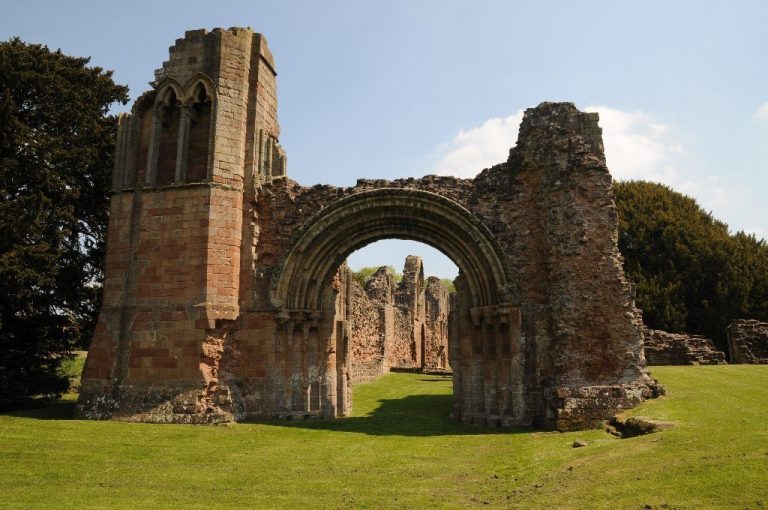
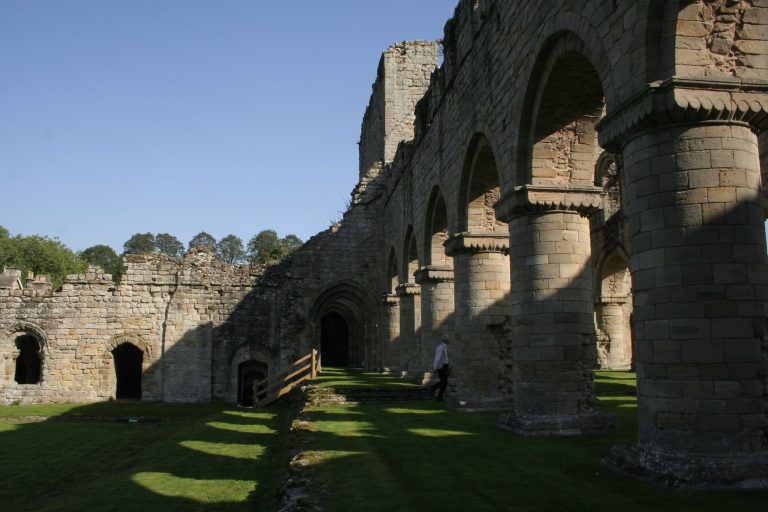
The surviving site is centred on the substantial medieval ruins of the priory church, a simple cruciform sandstone building. Its ground plan can still be followed, with the nave, chancel, transepts, and the position of the former monastic buildings indicating the original arrangement.
Priory church
The church had a five-bay nave, a three-bay chancel, and small transepts without chapels. The north wall of the nave and chancel is comparatively well preserved, and its windows make the bays of both sections identifiable. The south wall appears to have followed a similar window arrangement. A finely formed, round-headed Romanesque arch leads into the north transept. This opening formed the passage used by the residents to reach the cloister and the other priory buildings.
Locally obtained sandstone was used throughout the church. A fishpond appears to have been made from a quarry scoop, suggesting that stone may have been extracted immediately beside the site. The transepts survive only in limited form, while the church walls provide the clearest indication of the medieval plan.
Conventual and post-dissolution buildings
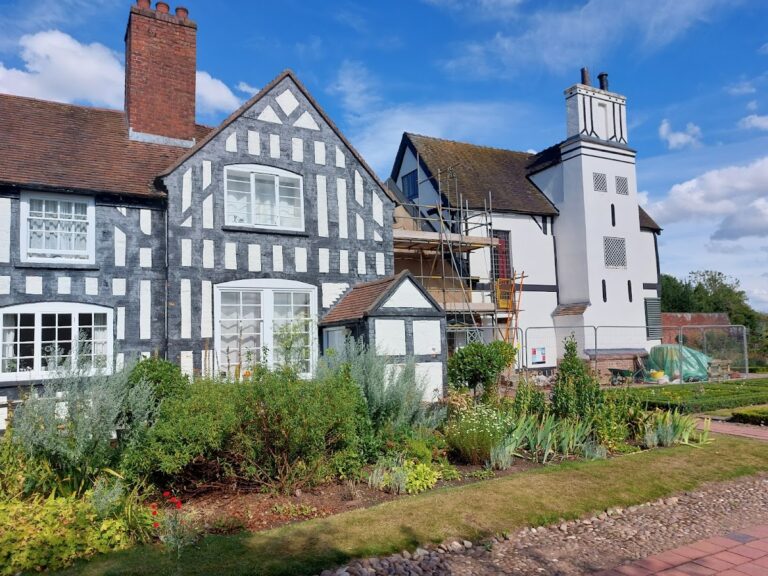
The conventual buildings were probably timber-framed and stood along the north wall of the church. A later house occupied part of the former priory site. A painting commissioned by Charles II around 1670 depicts this later house and may incorporate surviving parts of the prioress’s residence, which probably stood west of the principal priory buildings and cloister.
Boscobel House
Boscobel House was formed around 1630 when older farm buildings north of the priory site were extended. It stood approximately one mile from White Ladies and belonged to the same estate during the seventeenth century. Its physical relationship with the former priory estate is preserved in the surviving account of Charles II’s concealment in the Royal Oak grounds after his return from the failed attempt to cross the River Severn.
Graveyard
The site includes the former graveyard associated first with the priory and later with Catholic families. A nineteenth-century boundary wall survives around the small burial ground.