Zinna Abbey: A Cistercian Monastery in Germany
Site at a Glance
- Popularity
- High
- Country
- Germany
- Primary era
- Medieval
- Eras represented
- Medieval, Early Modern, Modern
- Civilizations
- Holy Roman Empire
- Site type
- Religious
- Remains
- Monastery
On this page16 sections
History
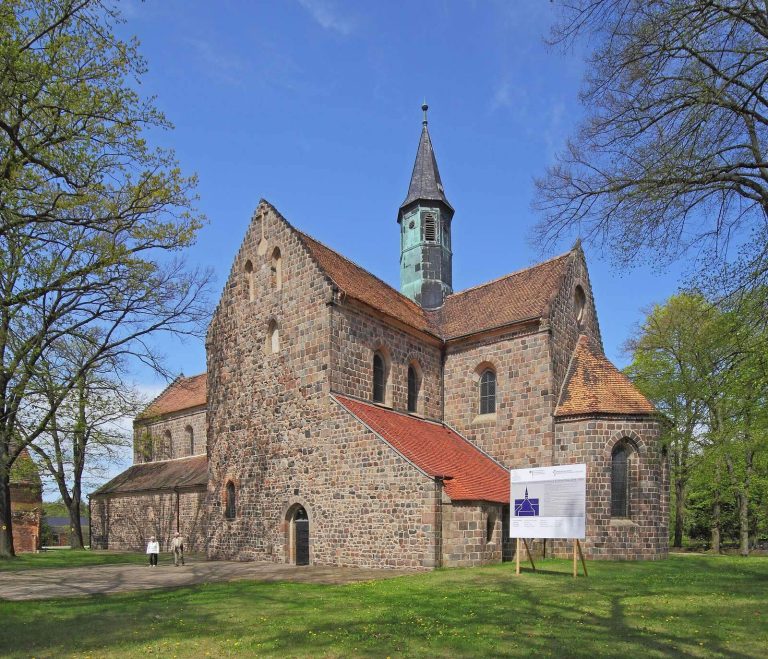
Zinna Abbey is a former Cistercian monastery at Kloster Zinna, now part of Jüterbog in Germany, founded in 1170 by Wichmann von Seeburg, archbishop of Magdeburg. Its church combines late Romanesque and early Gothic forms, and the monastery grew into an important regional landowner and economic center.
Foundation and early development
The foundation occupied territory Wichmann had recently brought under his control. Albert the Bear, a leading Ascanian ruler, had granted him the land in 1157 in return for help against Jaxa of Köpenick, a Slavic ruler involved in the struggle over Brandenburg. The abbey may also have been intended to restrain the southward expansion of the neighboring Ascanian dynasty.
Zinna belonged to the Cistercian order, a Catholic monastic network of parent and daughter houses. Altenberg was its mother abbey, the house from which Zinna’s first community was established; the monks came from Altenberg, though they may instead have come from its affiliated house of Mariental. Morimond, one of the order’s principal houses in France, was Zinna’s primary abbey. The monks settled in marshland along the Nuthe River, drained the wetlands, and made the land productive.
An attack in 1179 interrupted the monastery’s construction. Afterward, the monks sought alms in Jüterbog, and signs of renewed activity appear from around 1215. Construction of the abbey church probably began about then. It was consecrated in 1226, possibly before it was complete, and its mixture of architectural styles indicates that work continued after 1230. A papal privilege for the monastery dates to 1221. In 1229, the Cistercian order’s general chapter instructed the abbot, the head of the monastery, at Altenberg to inspect Zinna and look for another site on the Barnim. The proposed relocation did not happen.
Regional landholding and economic life
Zinna expanded its estates and influence over the following centuries. In 1285 it bought Luckenwalde and eleven nearby villages, and by 1307 its territory covered nearly 300 square kilometres. By the late fifteenth century, it held 39 villages, 14 mills, a salt well with four salt pans, a pitch works, and a brickworks. It also held patronage rights over dozens of churches.
The abbey’s Barnim lands extended east to the Stobber-Löcknitz watercourse, which marked the boundary with the territory of the Bishop of Lebus. They included nearly all of what is now Grünheide through Kienbaum, together with surrounding lakes and fisheries. Zinna first administered these holdings from a farm at Kagel, then moved their administration to Rüdersdorf in the fifteenth century. The abbey founded Rüdersdorf around 1235, partly because of the local limestone quarry. In 1247, Brandenburg’s jointly ruling Ascanian margraves, John I and Otto III, transferred holdings around Liebenberg to Zinna.
Urban properties in Berlin, Wittenberg, Jüterbog, and other towns supported the abbey’s trading activity. Zinna became the margraves’ largest creditor, while its water-management works, including mills on streams and lake outlets, contributed to settlement and development in the region. Abbot Nikolaus II acquired a printing press for the monastery. In the 1490s, it produced the Marian Psalter, a devotional collection of psalms associated with the Virgin Mary. The book is regarded as the oldest printed in Brandenburg and is now held by a library in Potsdam. In 1449, an agreement between Magdeburg Archbishop Frederick of Beichlingen and Brandenburg Margrave Frederick the Iron was concluded at Zinna.
Reformation and monastic closure
The Reformation, a sixteenth-century movement that led to the establishment of Protestant churches, contributed to the abbey’s decline. Abbots Greve and Kagel were removed because of their closeness to Lutheran teaching, and attempts by the archbishop of Magdeburg to reform monastic life failed. In the 1530s, Jüterbog and its surrounding area became Protestant.
Cistercian monastic life at Zinna ended in 1553, when the last abbot departed. Monks from the abbey found refuge at Henryków, a Cistercian monastery in Silesia. Zinna’s properties passed to the estate of the archbishop of Magdeburg. Its Barnim lands became the Brandenburg jurisdiction of Rüdersdorf, while its Jüterbog lands remained within Magdeburg territory.
Reuse and the settlement of Kloster Zinna
After the monks left, the former abbot’s residence became a home for administrators of the Magdeburg archbishopric. In 1591, the sister of administrator Joachim Frederick died there, and a meeting was held to arrange guardianship for the minor son of Christian I of Saxony. In 1606, members of the Magdeburg cathedral chapter took refuge at Zinna to escape plague in the city. Christian William, the deposed Protestant administrator of the archbishopric, later lived at the former monastery and died there in 1665. In 1667, Brandenburg and Saxony concluded the Treaty of Zinna on coinage there, agreeing to standardize their thalers, large silver coins.
In 1680, Magdeburg’s territories were transferred from church to secular control and incorporated into Brandenburg-Prussia. The former monastic lands became a state-administered estate and jurisdiction. Its authority included Luckenwalde, Zinna, Grüna, and other nearby villages at least until 1755. A tax register for the estate survives from 1702; the political jurisdiction is mentioned in 1805 and was no longer operating by 1861, while the separate domain office was dissolved in 1874.
In 1764, Frederick II of Prussia established a settlement for weavers brought from Upper Lusatia in an effort to revive the local economy. Planned around a rectangular layout and an octagonal central square, it was built beside the former abbey using material from buildings being demolished. The economic recovery was more limited than intended. The settlement took the name Kloster Zinna in 1902 and became part of Jüterbog in 1992. A substantial portion of the monastic buildings had already been demolished in the eighteenth century, and a brewery in former cloister buildings burned in 1872.
Remains
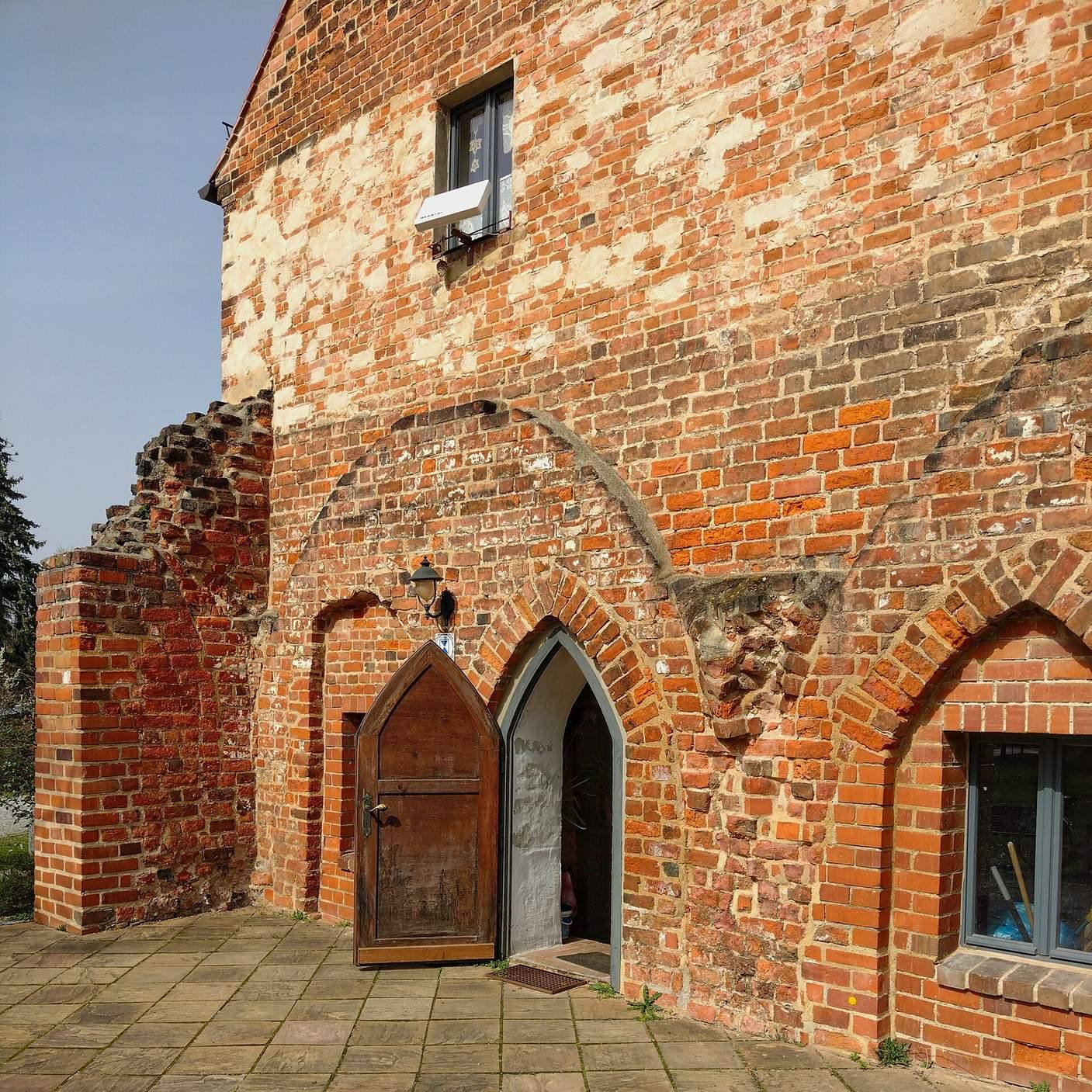
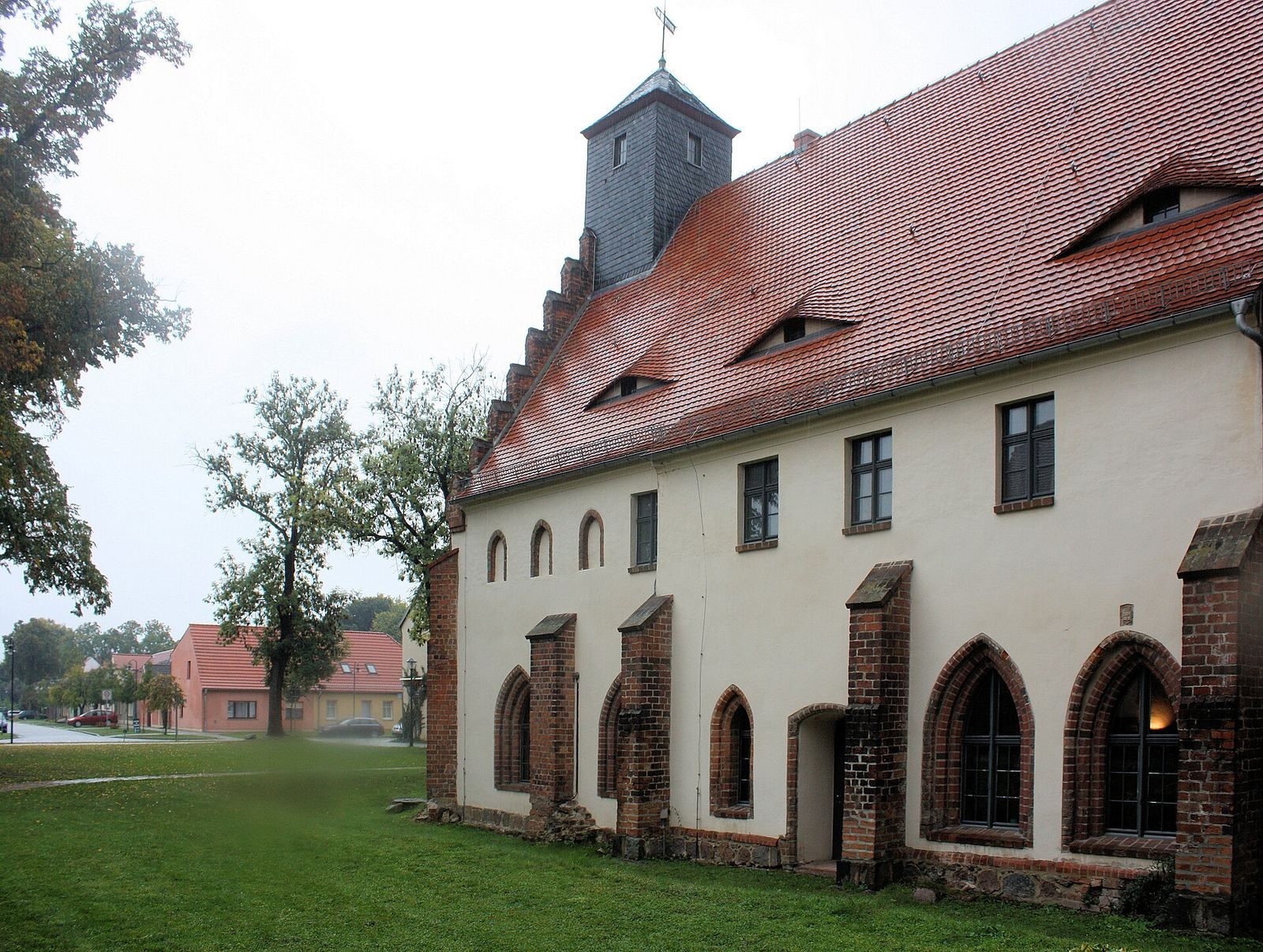
The surviving complex includes the abbey church, fragments of the cloister, and a group of residential and service buildings. The cloister stood south of the church, while the former abbot’s residence, infirmary, guesthouse, customs house, and brewhouse preserve other parts of the abbey’s built history. The church is constructed of granite and fieldstone; brick is used in the surviving infirmary and the New Abbey.
Church and cloister
Abbey church
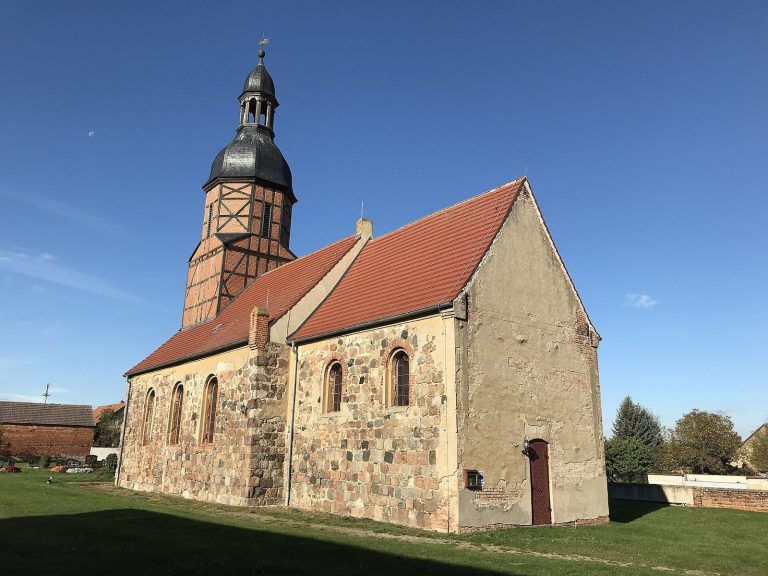
The plain church has a cross-shaped plan, with a central nave, side aisles, and a transverse arm. Its eastern choir ends in a polygonal apse, a projecting sanctuary end, and four smaller polygonal apses extend from the transept. The building is dedicated to the Virgin Mary and combines late Romanesque and early Gothic forms. Vaults were added over the side aisles, subsidiary choirs, and transept in the late Gothic period. The church is now a Protestant parish church belonging to the Evangelical Church of Berlin-Brandenburg-Silesian Upper Lusatia.
Before the altar, the floor includes a thirteenth- or fourteenth-century inscription of Ave Maria, the traditional Latin prayer honoring the Virgin Mary. Its Gothic uppercase letters are raised impressions on separate, unglazed red-brown terracotta tiles, each measuring 14 by 14 centimetres. The technique is considered an early precursor of movable-type printing. The church also has an early Romantic organ made by Wilhelm Baer in 1850–51. It underwent extensive renovation in 2016–17.
Cloister
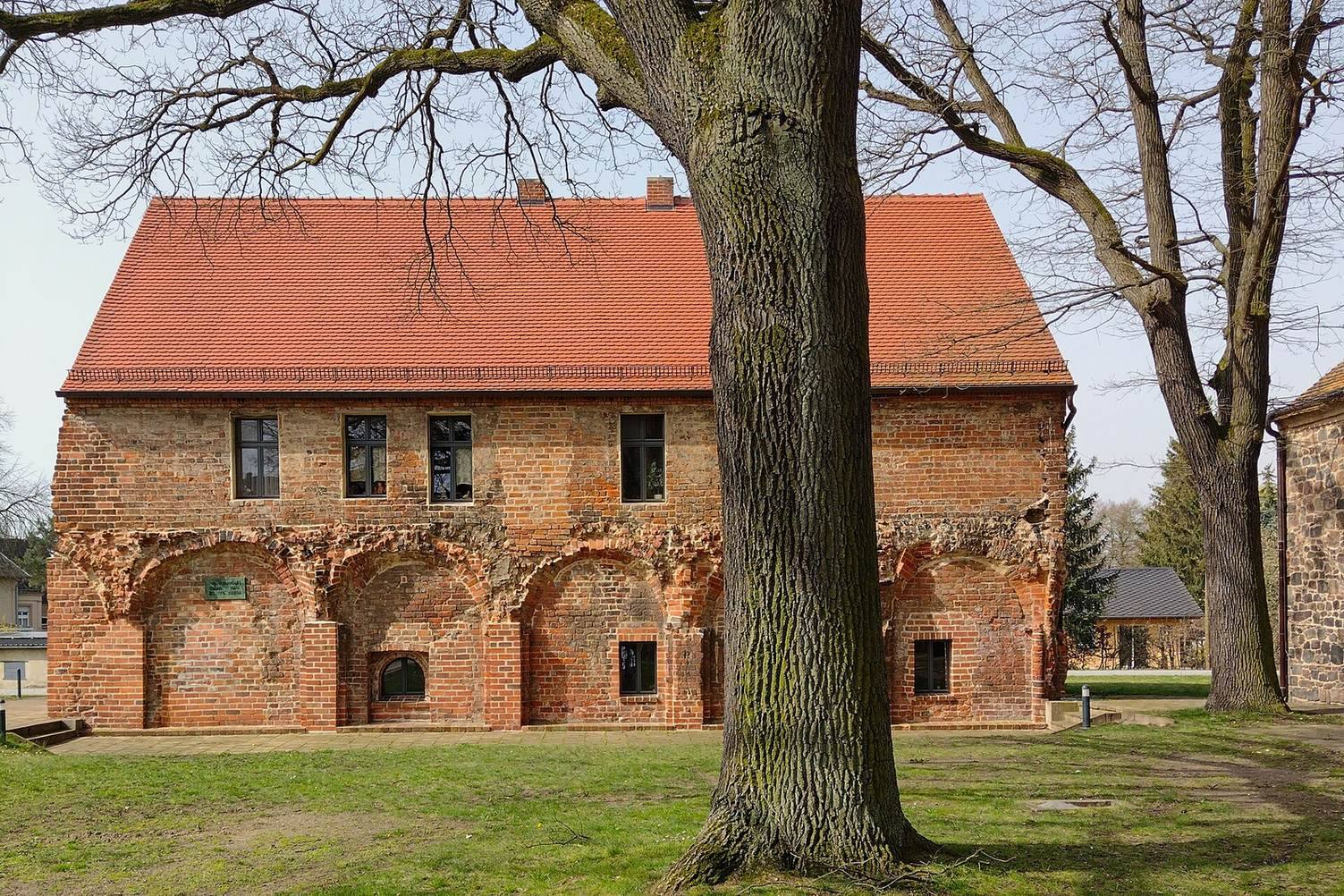
The cloister passage enclosed a courtyard south of the church. A projecting well stood opposite the refectory, the monks’ communal dining room, on the southern side. The eastern range held the sacristy, where liturgical objects were stored, the chapter house, where monks met, and a parlour for conversation, with the monks’ dormitory above. The southern range included a heating room, refectory, and kitchen. The western range contained a brewery, a dining room and cellar for the lay brothers, members of the community who generally performed manual work, and their dormitory above. Fragments of the cloister buildings survive, including part of the western range, which dates to the first half of the thirteenth century, and a portion of the former refectory.
Residential and service buildings
Old Abbey and infirmary
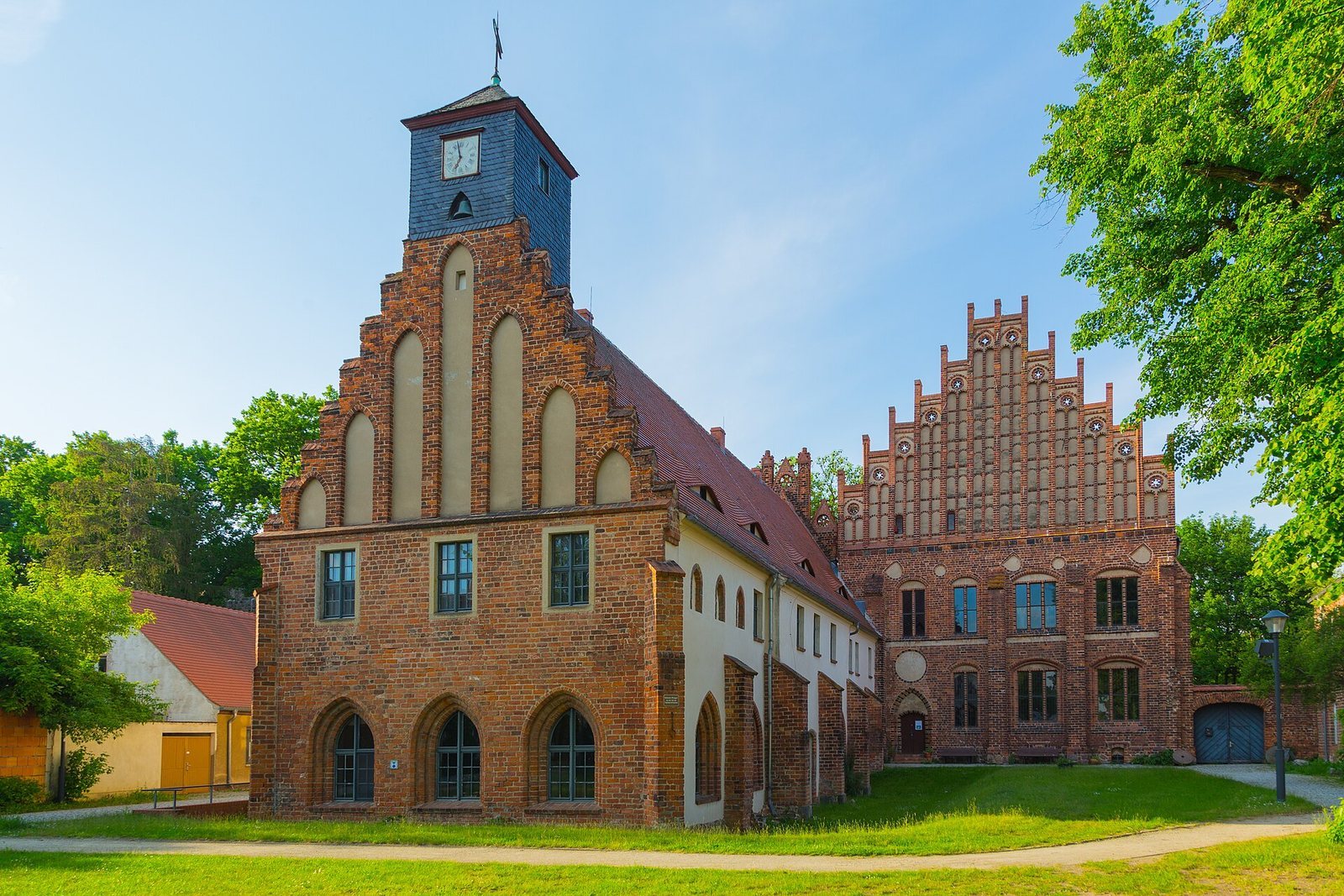
The fourteenth-century building known as the Old Abbey stands east of the main complex. Its interiors include cross-rib vaults, ceilings supported by intersecting ribs, and its exterior has stepped Gothic gables. Heating and running water served the building, which housed the infirmary among other functions. A separate surviving infirmary, also known as the Siechenhaus, is a rectangular Gothic brick building. The infirmary and former abbot’s residence underwent repair and modernization from 2017 to 2024, following earlier conservation work in the 1960s. The work also reorganized parts of the infirmary for administration, events, and temporary exhibitions.
New Abbey
The late Gothic New Abbey is a brick building that formerly served as the abbot’s residence. It stood apart from the main complex and was linked to it by a long connecting building. The residence includes a chapel with surviving frescoes, large rooms with cross-rib vaults warmed by circulating air, and a kitchen in the basement. Another building opens south from the connector, parallel to the monks’ refectory; its original function is uncertain. The former residence became a museum in 1956. Its displays include medieval frescoes, a model of the abbey as it appeared in 1170, and material on the monastery’s history to about 1550 and the development of the weavers’ settlement.
Guesthouse and service buildings
A guesthouse dating to the sixteenth century stands beside the New Abbey. The customs house and brewhouse also survive. The customs house presents traditional weaving techniques, while herbal liqueur continues to be made in the brewhouse.
Associated features
Golmberg cross
A cross on the summit of nearby Golmberg is the surviving physical marker of a former pilgrimage site associated with the abbey.
Frederick II monument
A monument to Frederick II stands in the settlement’s market square. Its inscription identifies him as the founder of the settlement in 1764. Erected for the centenary of the settlement’s establishment in 1864, the monument was destroyed in 1949 and re-erected in 1994 with a replacement figure donated by M. Starke and F. Woike.