Nicolaaskerk: A Gothic Church in Onstwedde, Netherlands
Site at a Glance
- Rating
- 4.7
- Popularity
- Very Low
- Country
- Netherlands
- Primary era
- Early Modern
- Eras represented
- Medieval, Early Modern
- Civilizations
- Dutch, Holy Roman Empire
- Site type
- Religious
- Remains
- Church
On this page14 sections
History
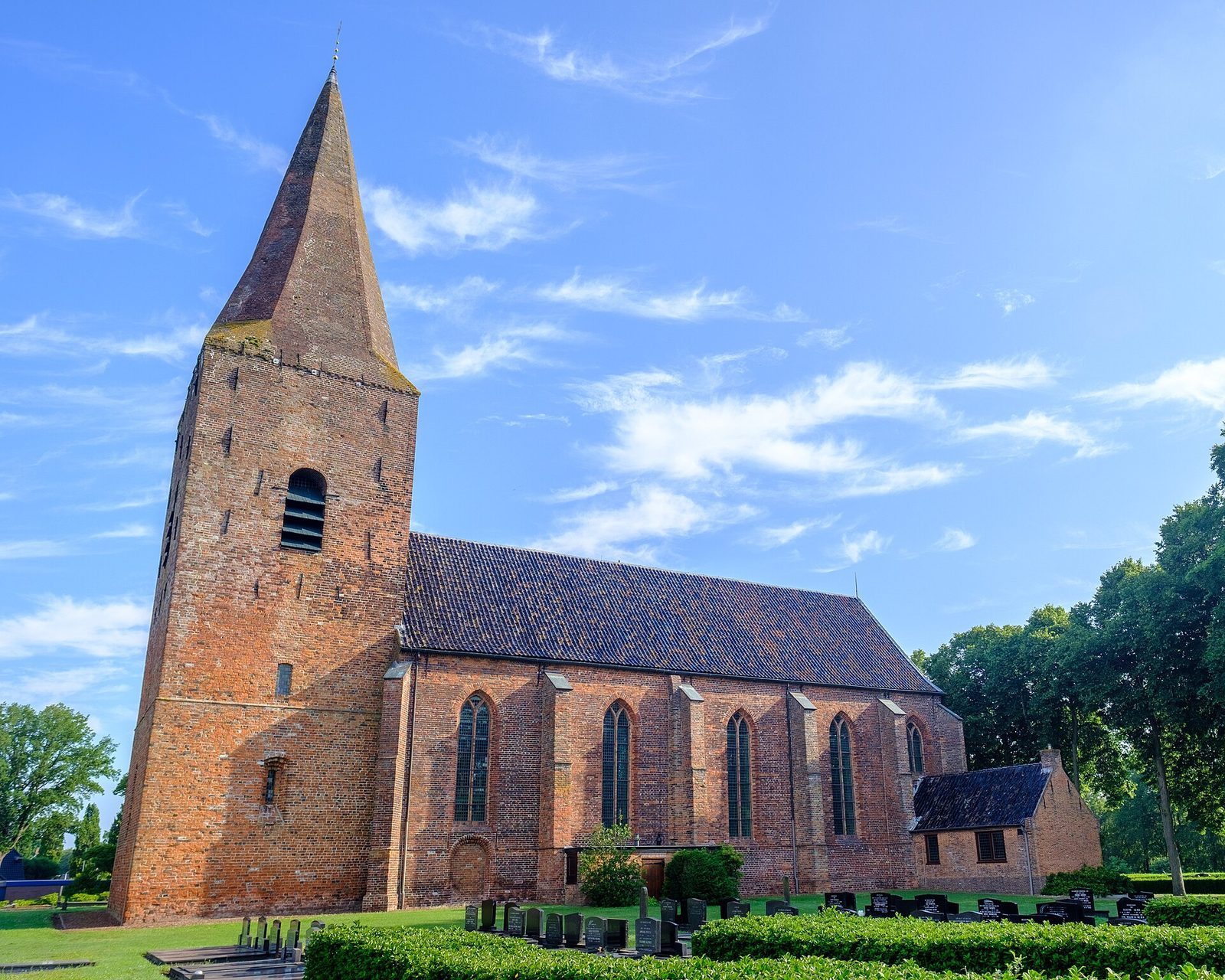
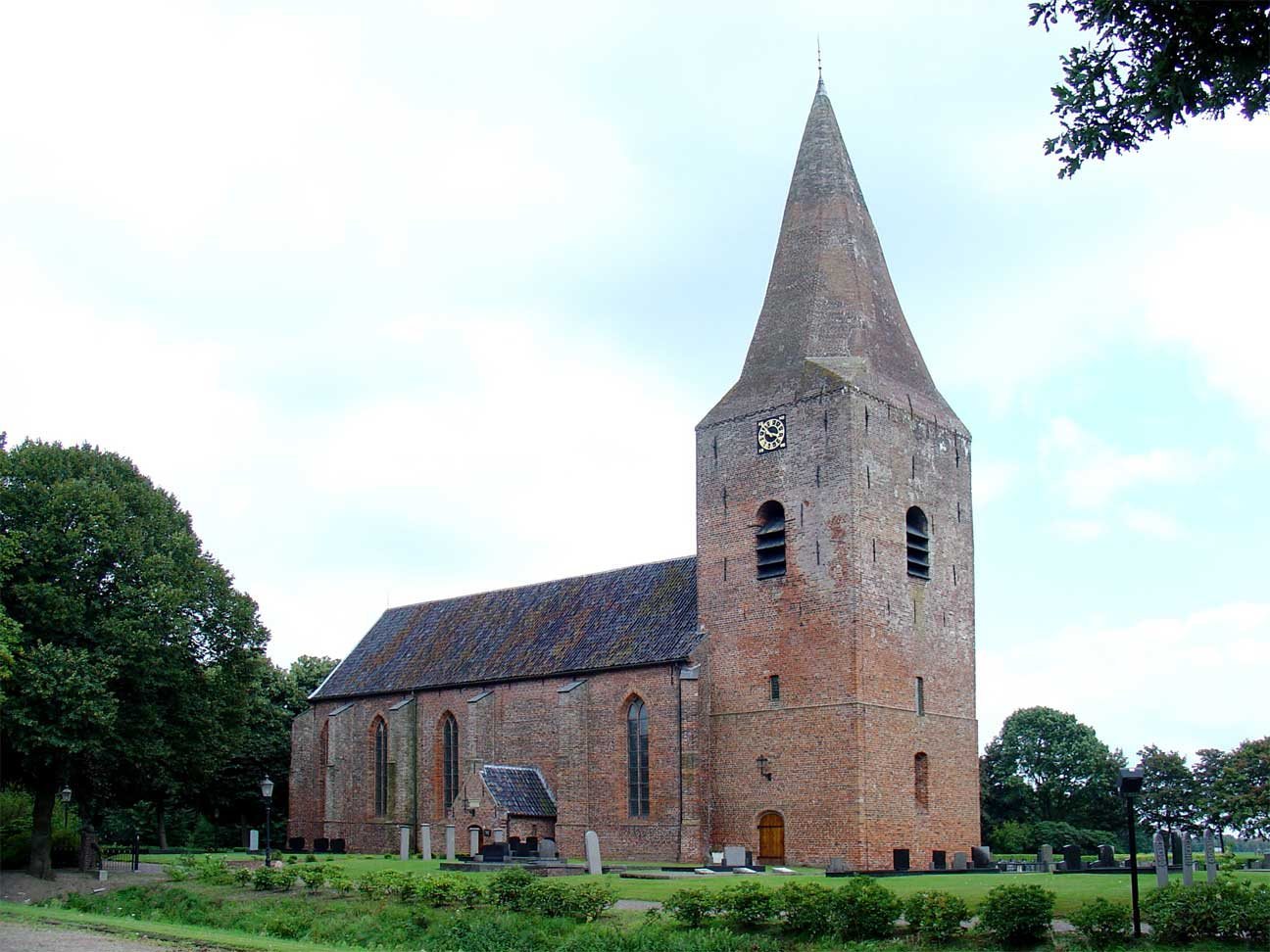
The Nicolaaskerk is a Gothic church in Onstwedde, Netherlands, whose present building dates to around 1500. By about 1150, a church here was the only one in Westerwolde and served as the center of a seend district, an area overseen by an ecclesiastical court, within the archdeaconry of Friesland, a church administrative district that also covered much of the Emsland. The church may have had earlier predecessors dating to the 10th or 11th century.
Medieval church and authority
Ecclesiastically, Onstwedde belonged to the diocese of Osnabrück until 1568. Westerwolde’s secular authority lay with the prince-bishop of Münster, an office that joined church leadership with territorial rule. The abbot, or head, of the Benedictine abbey of Corvey had the right to appoint the pastor, though he generally left the choice to the parishioners.
In 1466, Pastor Gerardus Bol identified himself as parish priest of Onstwedde and dean of Friesland. His seal showed Saint Peter, an apostle and leading figure in early Christianity. The following year, his vicar, a deputy pastor, Herman served in his place and used the deanery’s seal. Several pastors’ seals show James the Greater, one of the Twelve Apostles, and he is identified as the church’s dedicatee. A single reference from 1475 or 1476 names Saint Nicholas, an early Christian bishop venerated as a saint, as patron; it may instead refer to Vlagtwedde. Since the Onstwedde church probably already existed when devotion to Nicholas arose in the 12th century, an original dedication to him is considered unlikely.
Pastoral conflict in the 15th century
Onstwedde’s pastors frequently clashed with the Addinga family, which governed Westerwolde on behalf of the prince-bishop of Münster and the abbot of Corvey. In 1474, Haye Addinga ordered the killing of a newly chosen pastor and his deputy. The pastor was dragged behind a horse until he died; the deputy was killed shortly before setting out for Rome to seek assistance, and his house was destroyed. The family’s conduct eventually contributed to Westerwolde passing under the control of the city of Groningen.
Reformation and Protestant life
The shift from Catholicism to Protestantism in 1594 was relatively peaceful in Onstwedde. The pastors had probably leaned toward Lutheranism from the mid-16th century. Albert Colters, pastor from about 1541 to about 1578, also served as the Duke of Aremberg’s commissioner and led ecclesiastical judicial affairs in Westerwolde.
Berent tho Unsde followed Colters as pastor. In 1589, the jurist Johannes Mensynck took the position; he joined the Reformed Church around 1597 and continued serving the congregation until his death in 1606. He may have been the former pastor Johannes Mensing of Meppen, who resigned in 1577 after a dispute with the town government and was also a canon, or member of a cathedral or collegiate clergy, in Münster.
Many residents continued to tolerate Catholic furnishings, to the disapproval of stricter Calvinists, a movement within the Reformed tradition. Mid-17th-century complaints prompted pastors to promise they would oppose these remnants. The altar had been removed by 1682. Some prominent residents also argued for the return of the solemn funeral sermons formerly held in the church.
Onstwedde came relatively late under the influence of Pietism, a Protestant movement emphasizing personal devotion and inward religious life. The minister Everwinus Molanus, who died in 1768, opposed it, while the appointment of Hermannus Beekhuis in 1769 marked a change. Around 1800, farmers in the area read devotional works such as The Inner Christianity by the Dutch Reformed minister Wilhelmus Schortinghuis.
Pastors in later centuries often came from the German borderlands. Adamus Oomkes, whose ministry lasted from 1800 to 1842, was the first in some time to come from the Groningen region; he was the son of the minister at Blijham. Around 1832, dissatisfaction with a pastor accused of unorthodoxy led to the formation of a Christian Reformed congregation. After Henricus Eskelhoff Gravemeijer arrived from Midwolda in 1865, Onstwedde became a stronghold of Dutch Reformed orthodoxy. The congregation later joined the Gereformeerde Bond, an orthodox Reformed association within the Protestant Church in the Netherlands. The Nicolaaskerk is a Dutch national monument.
Remains
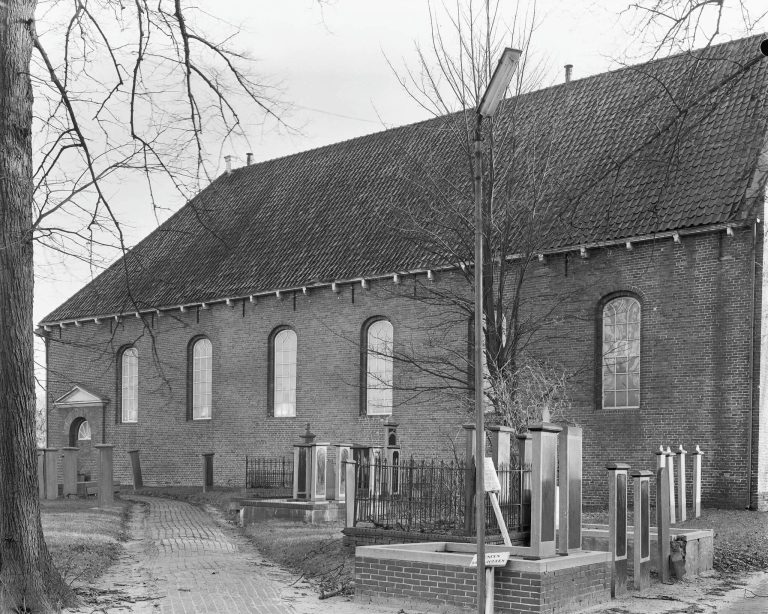
The site brings together a Gothic church and an older tower that originally stood apart, with the later church built against it. The tower, the north-side entrance and the surviving stone furnishings are among the physical features that show the building’s development and use.
Tower and enclosure
The Juffertoren
The Juffertoren dates to the middle of the 14th century and rises 41.2 metres. Its walls are about two metres thick in places, and its masonry spire has an octagonal form with a twisted upper section. The twist can make the tower appear to lean, but the apparent tilt is an optical effect. The tower’s slender, tapering shape is thought to have given rise to the name Juffertoren, by comparison with a long, pointed pine trunk.
Local traditions offer other explanations for the tower and church. One tells of three wealthy sisters who, after turning away from a life of feasting, built identical towers at Onstwedde, Schildwolde and Holwierde in honor of God. Another says that the church’s building stones came from a kiln on Tichelberg near Veenhuizen, about two and a half kilometres away, and were passed to the site hand to hand. A separate story attributes the tower’s twist to a construction overseer who sought revenge after a disagreement with the woman who commissioned it.
Former moat and drawbridge
A moat and drawbridge once enclosed the church and tower. Their presence, together with the tower’s heavy walls, has been interpreted as evidence of possible defensive use, perhaps providing refuge for residents under threat.
Bells
The tower had three bells until 1697, when its large bell was sold to the Reformed church at Bellingwolde and recast. From 1812, the tower had only one bell. German forces seized it during the Second World War and melted it down. A replacement was installed in 1947, bearing an inscription that says the enemy took the old bell and that the new one had come to ring again for humanity’s salvation and God’s honor.
Church and furnishings
North portal
The north portal belongs to the 1713 restoration of the church and tower. Two sandstone memorial stones sit above the doorway. The upper inscription means “The sanctuary of the Lord”; the lower records the restoration, gives the date as 14 July, and names Pastor Ernestus Molanus, foreman Timen Bertels and maker Jan Jacob.
Baptismal font
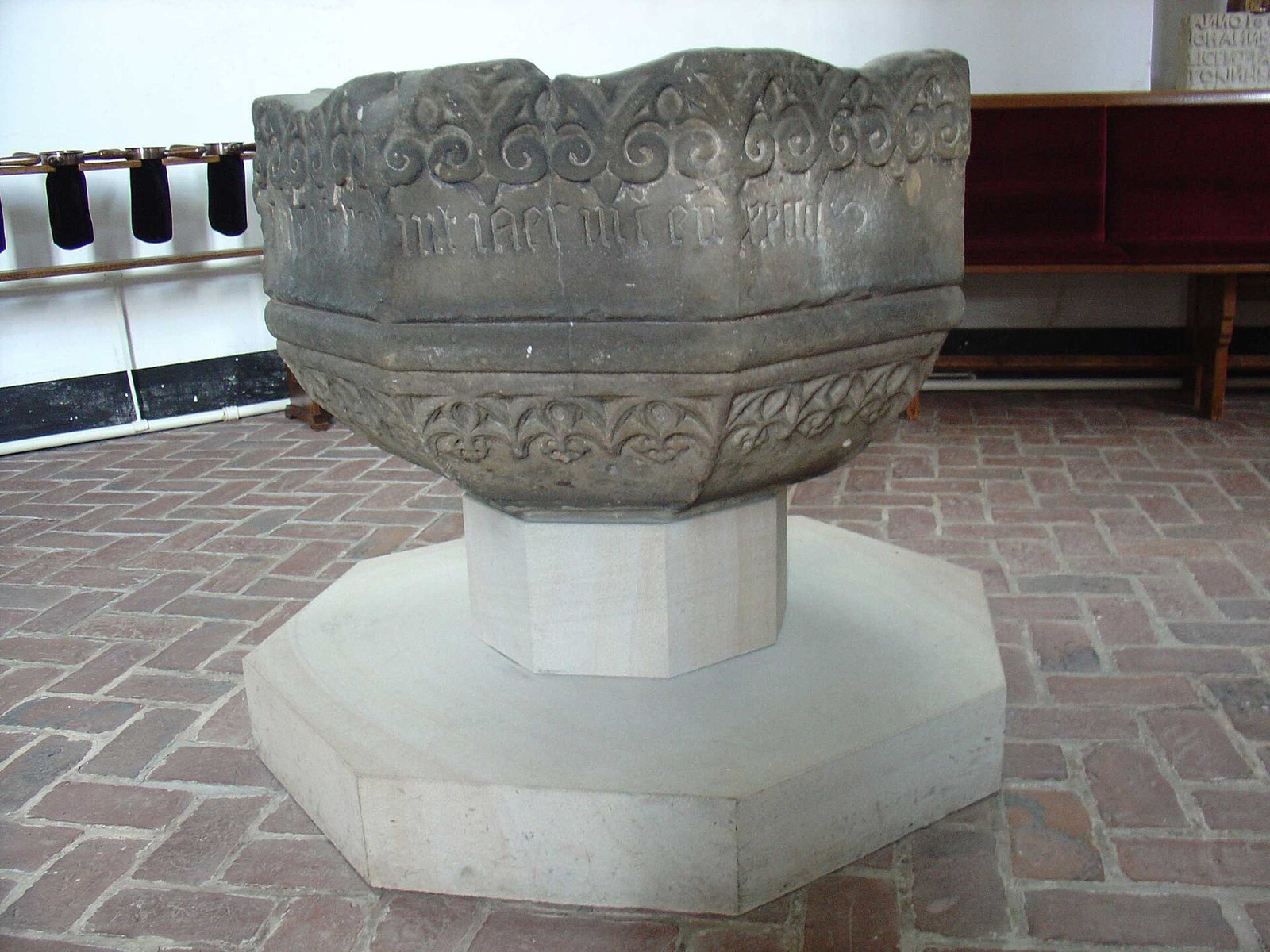
The church’s Gothic baptismal font is made of Bentheim sandstone and is tentatively dated to 1524. Its Gothic design and use of the vernacular have been regarded as difficult to reconcile with that proposed date. After removal from the church, it was taken to Veenhuizen, southwest of Onstwedde, where it served for centuries as a cattle trough and probably also as a knife-sharpening stone.
In 1950, the font’s owner offered to return it, but withdrew the offer after the church council proposed placing it only in the tower. An agreement for its return was reached in 1989. By 1991 it was being used for baptisms again, and three children were baptized from it that year.
Altar stone and former furnishings
An altar stone removed from the church lies outside the building. The church’s former Catholic furnishings also included a sacrament house, a structure for reserving the consecrated Eucharist, an altar, a mass chalice and supports for statues of saints.
Organ
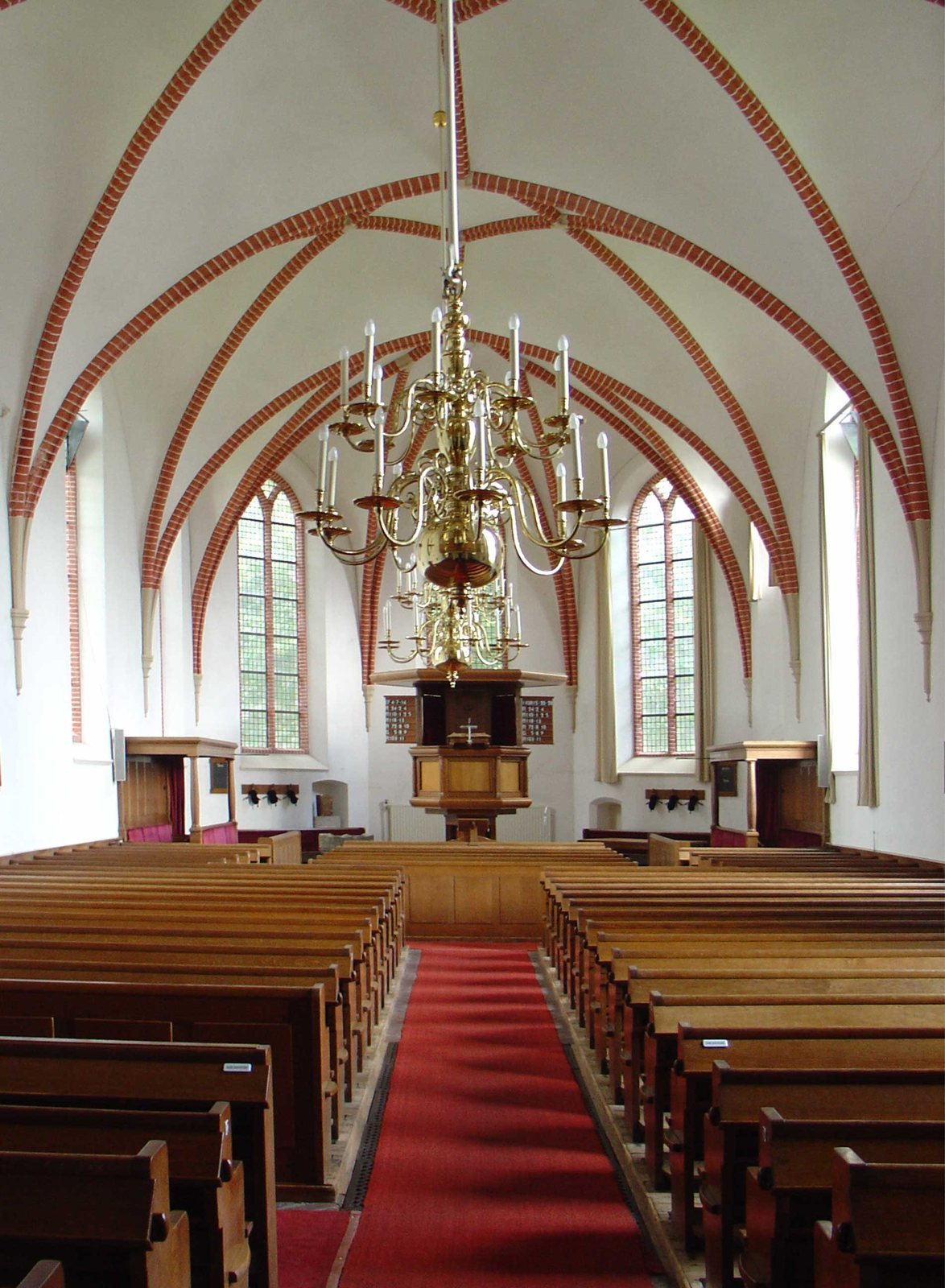
S. F. Blank built the church organ in 1984.