San Trovaso: A Renaissance Parish Church in Venice
Site at a Glance
- Popularity
- Medium
- Country
- Italy
- Primary era
- Early Modern
- Eras represented
- Classical, Medieval, Early Modern, Modern
- Civilizations
- Italian, Venetian
- Site type
- Religious
- Remains
- Church
On this page25 sections
History
San Trovaso is a Roman Catholic parish church in Venice’s Dorsoduro district, Italy, dedicated to Saints Gervasius and Protasius, Christian martyrs. Its present Renaissance rebuilding began in 1584, after the nave collapsed, and the church was consecrated in 1637. It belongs to the Latin Church, the Western Catholic tradition, and the Patriarchate of Venice. San Trovaso is a Venetian shortening of the names Gervasius and Protasius.
Early church and medieval rebuilding
The church’s beginnings are uncertain. Tradition associates an earlier church with Venice’s fifth-century foundation, while the site’s church has also been tentatively dated to the eighth century. By the ninth century, the building was dedicated to Gervasius, Protasius, and Chrysogonus. Their relics were venerated until they disappeared after the building disaster of 1583.
In its early years, the church’s ecclesiastical jurisdiction was shared by the patriarch of Grado and the bishop of Castello. Their dispute was settled in 1041, although the date when San Trovaso became a parish remains uncertain and is generally placed around the middle of the eleventh century. The Barbarigo and Caravella families rebuilt the church in 1028. A fire destroyed it in 1105; it was rebuilt in the thirteenth century and had fallen into disrepair by the fifteenth.
Reconstruction and parish life
On 11 September 1583, the nave collapsed. The old church was demolished the following year, and rebuilding began, probably to a design by Francesco Smeraldi, a Venetian architect and pupil of Andrea Palladio. The completion date is uncertain, but the church was consecrated in 1637.
Tradition links the church’s two entrances with Venice’s rival Castellani and Nicolotti factions. Each group was said to use a separate door to avoid confrontation, including during the saints’ commemorations, while couples from the rival groups could marry at the church.
Napoleonic-era reforms from 1807 to 1810 reduced Venice’s more than 70 parishes to 30, but San Trovaso retained its parish status. It took in part of the territory and congregation of San Basilio, suppressed in 1807, and part of San Raffaele Arcangelo. Interior decoration began in the early seventeenth century and continued over later centuries. The collection grew in 1810 with works from suppressed churches. In 1857, nearly all the altars were renovated and several pictures were replaced by works now in the church. A restoration in 1987 focused mainly on the roof. San Trovaso remains an active parish.
Remains
Exterior and plan
Facades
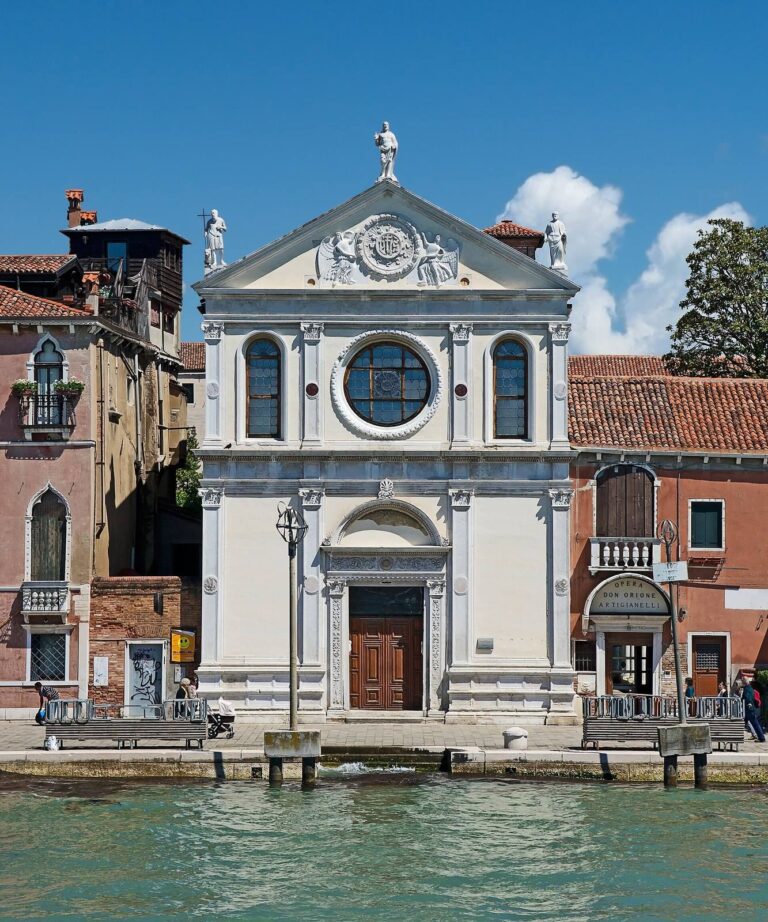
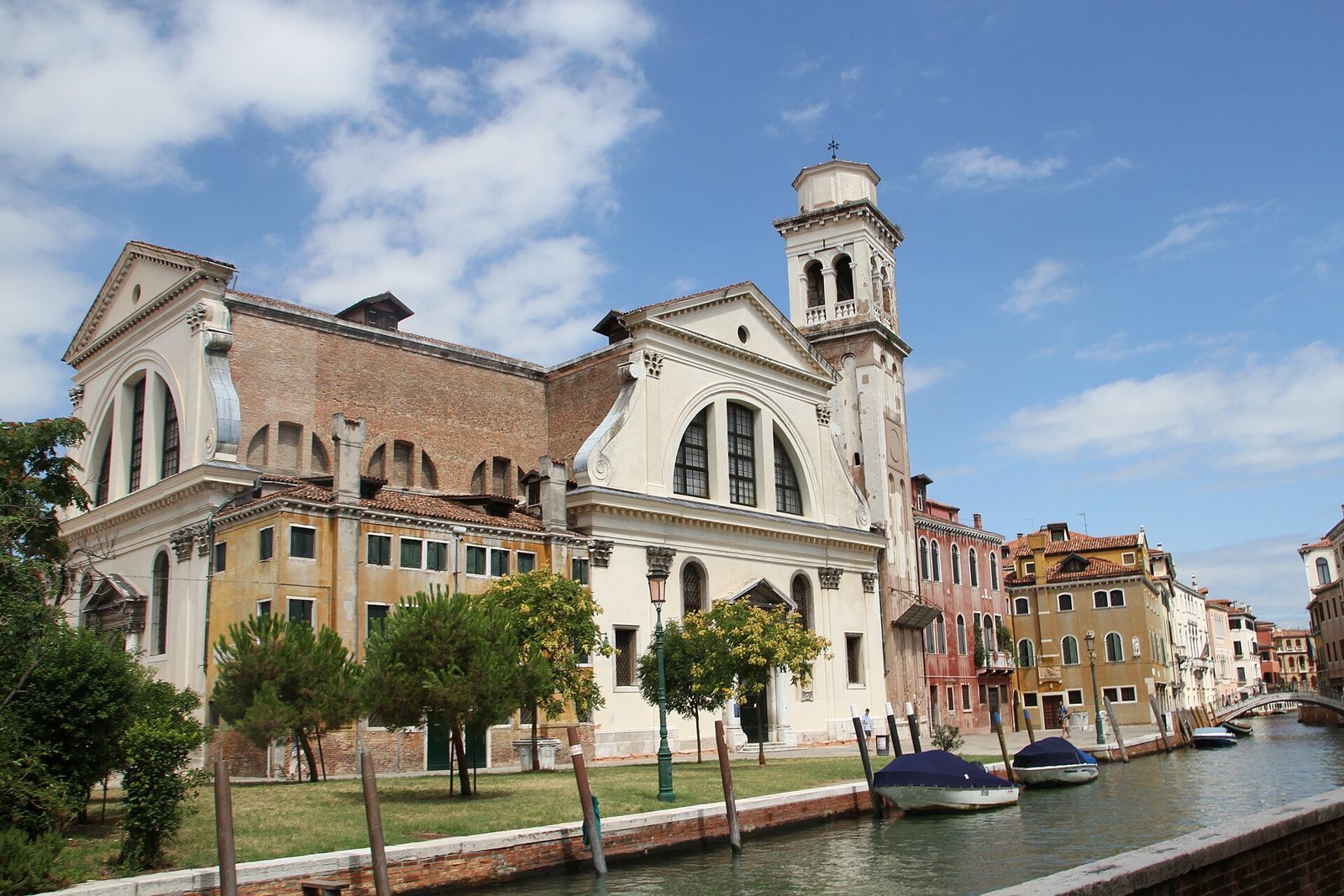
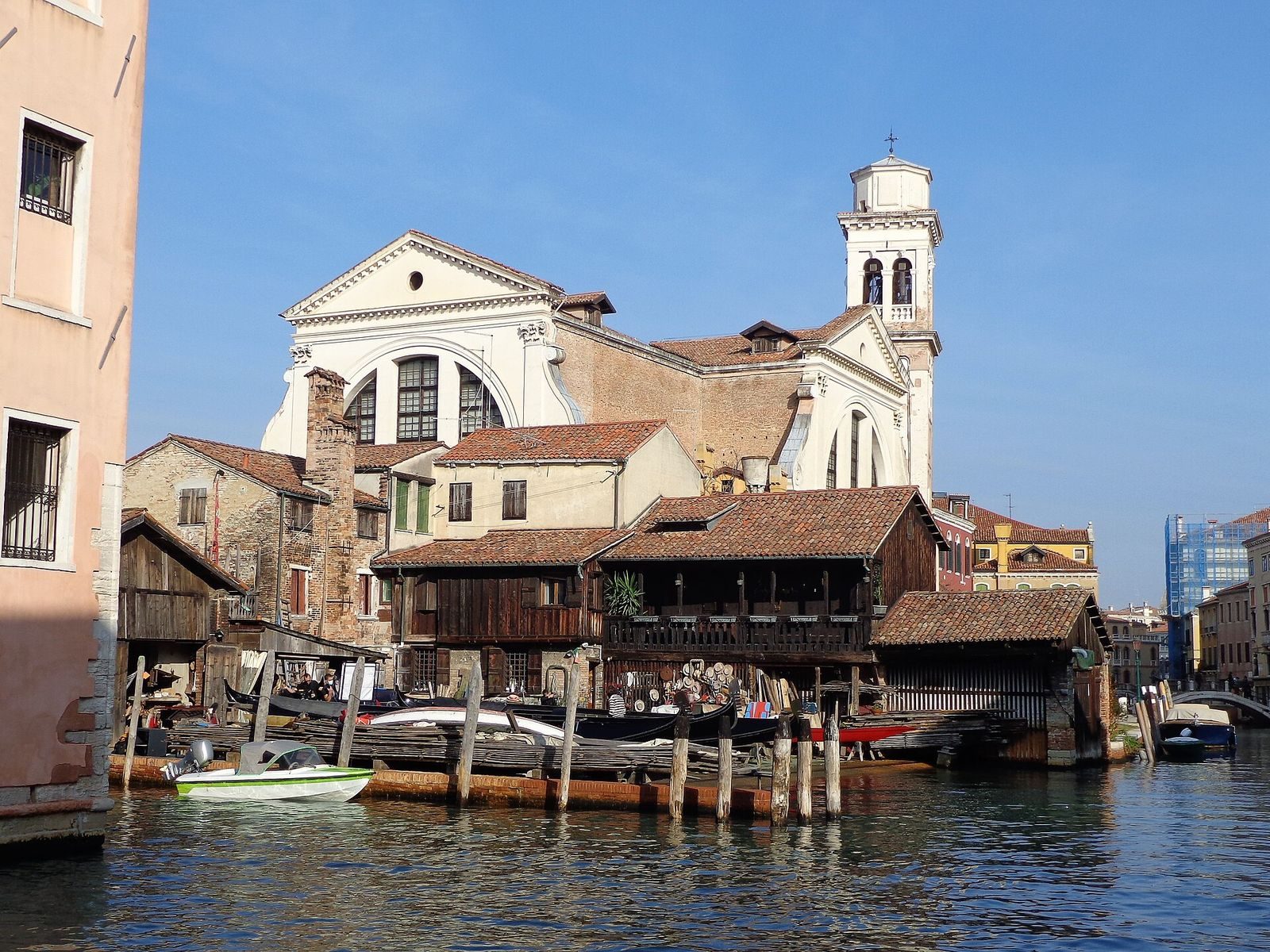
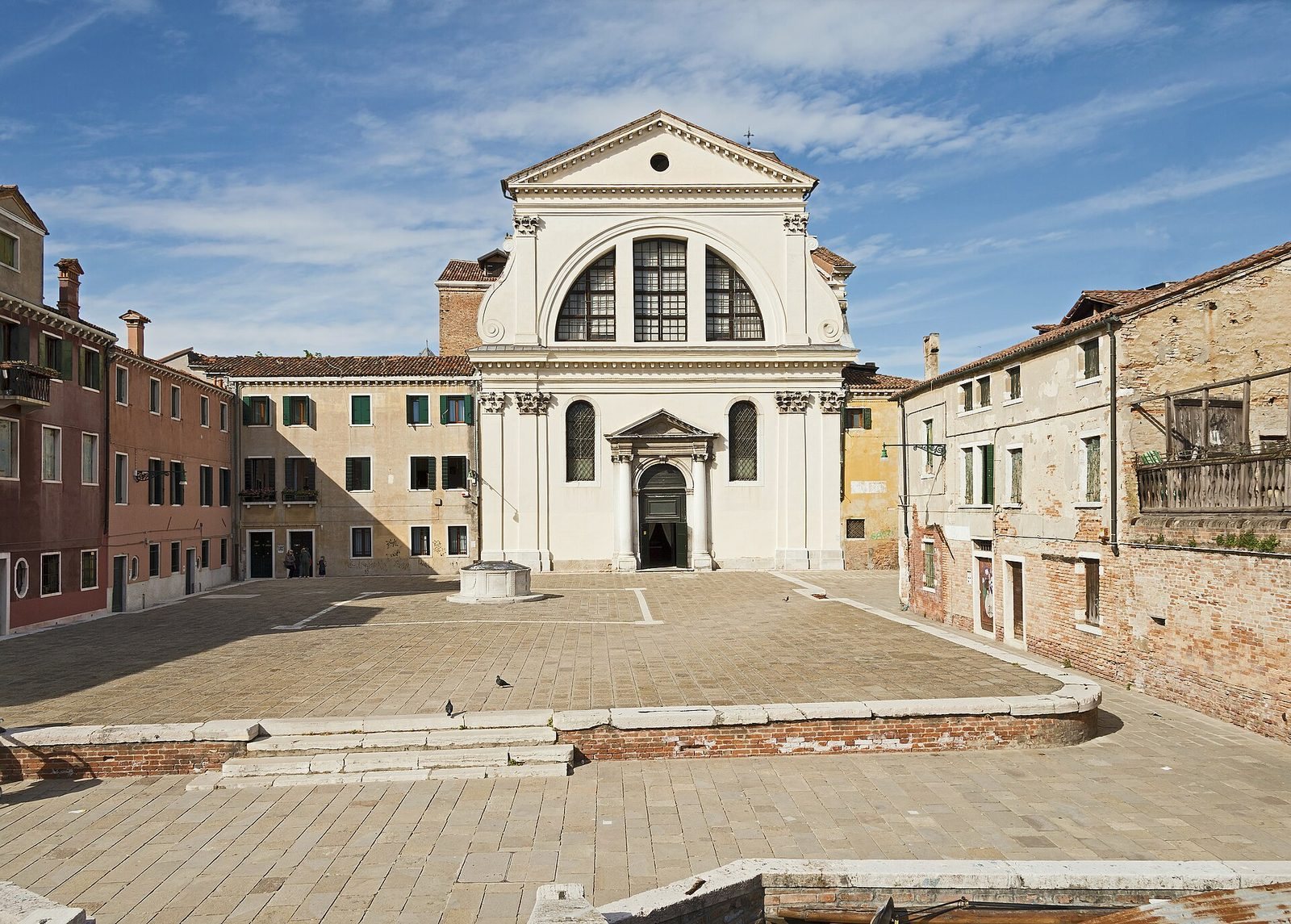
Built of brick, the church has two nearly matching facades, one facing Campo San Trovaso and the other Rio di San Trovaso. The principal facade has two storeys. Flat, column-like supports with ornate Corinthian-style tops mark its narrow side sections. At ground level, a portal is flanked by arched windows; above it, scroll-shaped forms frame a central semicircular window, and a triangular pediment crowns the facade. The canal-facing facade follows a similar design and forms the right arm of the transept, the part of the church that crosses the main hall. The western entrance faces the campo and was associated with the Nicolotti; the southern entrance faces the canal and was associated with the Castellani.
Bell tower
The 53-metre bell tower stands in line with the canal-facing facade. Its large bell chamber has paired openings, a prominent cornice, and an octagonal drum. The tower’s construction date is unknown. It appears on a map from 1635 without the drum. Its bells are rung by hand, and a grotesque face decorates the doorway.
Interior layout
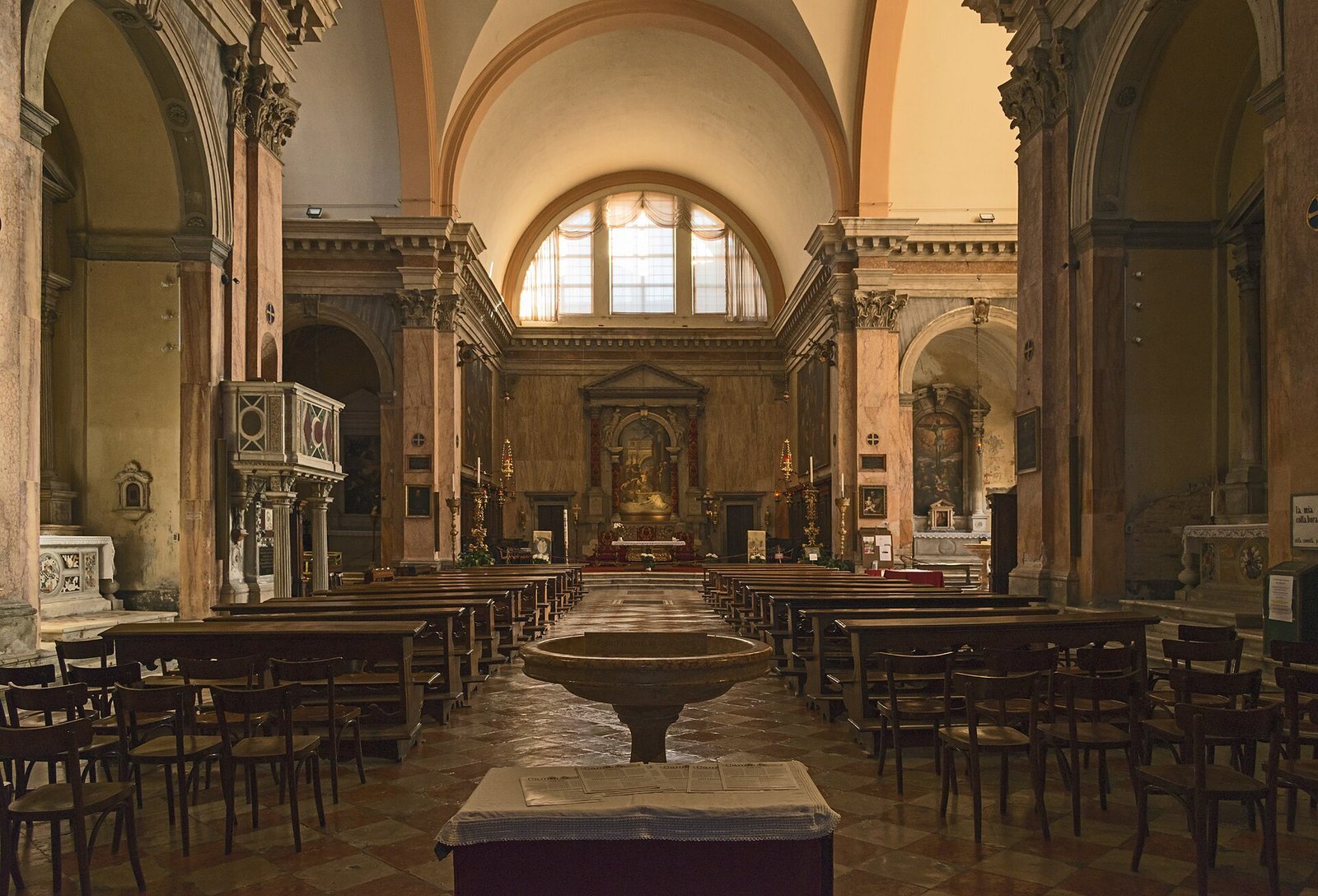
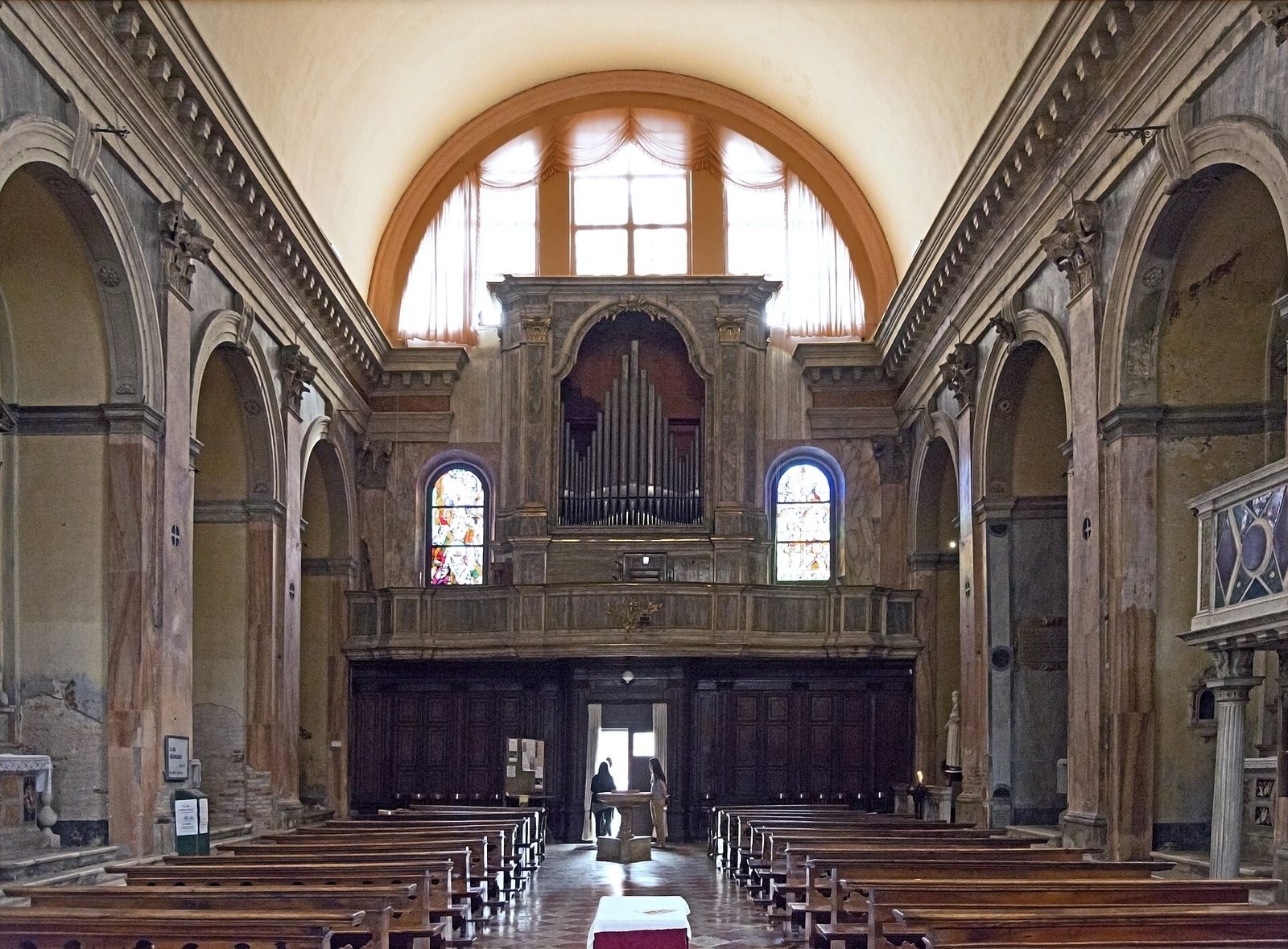
The interior follows a cross-shaped plan, with a single main hall, a crosswise arm, and six side chapels, three on each side of the hall. The side chapels have vaulted ceilings and are divided by sections of continuous wall. A long, tunnel-shaped ceiling covers the main hall. The earlier church is believed to have stood where the present crosswise arm lies.
Chapels, altars, and paintings
Main altar and other paintings
The main altar holds a 1910 painting of the Martyrdom of Saints Gervasius and Protasius. It replaced Gregorio Lazzarini’s earlier painting of the same subject, which burned in 1908 after a candle ignited it. Two eighteenth-century candlesticks attributed to Andrea Brustolon stand beside the sanctuary. Elsewhere in the church are Domenico Tintoretto’s Adoration of the Magi and Expulsion of Joachim from the Temple, both from 1587 and brought from the suppressed church of Santa Maria Maggiore in 1847.
Molin Chapel
Completed in 1599, the Molin Chapel contains Domenico Tintoretto’s 1589 painting Crucifixion with the Marys.
Clary Chapel
The Clary Chapel, completed in 1620 in the right arm of the transept, has an altar painting of the Annunciation from about 1621 to 1628, associated with the circle of Palma il Giovane. Its altar-front relief, attributed to the unidentified sculptor known as the Master of San Trovaso, dates to 1470 and shows angels carrying the instruments of the Passion beside musicians. Above a side entrance is Andrea Vicentino’s Wedding at Cana, made before 1594 and brought from the suppressed church of Ognissanti. The baptismal font includes an anonymous sculptor’s statue of Saint John the Baptist dated to 1700.
Chapel of Saint Francis
The Chapel of Saint Francis contains an altarpiece of Saint Francis of Paola with its donor, Alvise dal Friso. The painting dates from 1591 to 1609.
Chapel of Saint Constantius of Ancona
This chapel holds relics of Saint Constantius of Ancona and Gaspare Diziani’s painting Saint Constantius at Prayer, from about 1755. Both came from the suppressed church of San Basegio.
Chapel of the Squeraroli
Formerly associated with the Squeraroli, a craft organization of boatyard workers, this chapel has J. Barasciutti’s 1954 painting Saint Pius X in Glory. Below it, the altar front carries an anonymous artist’s Visitation, dated to 1626–1628.
Milledonne Chapel
Dedicated to Saint Anthony the Abbot, the Milledonne Chapel was built through the generosity of Antonio Milledonne, secretary of the Council of Consuls. He was buried at the foot of its altar. Jacopo Tintoretto’s Temptation of Saint Anthony the Abbot, commissioned by Milledonne, dates to about 1577. On the chapel’s right wall is Michele Giambono’s Saint Chrysogonus on Horseback, from about 1444. It is the only Venetian depiction of this saint in that form. The painting was restored in 1974 and again in 2015–2016.
Chapel in the left arm of the transept
This chapel contains a sixteenth-century Venetian-school painting of the Blessing Saviour. Its walls carry Saint Mary Magdalene and Saint John the Evangelist, attributed to Leonardo Corona, and a sixteenth-century Venetian-school Madonna and Child. A date of 1556 on a pilaster may mark the completion of restoration work. The sculptural furnishings include a sixteenth-century shrine for the Sacrament in the style of Alessandro Vittoria, an anonymous eighteenth-century relief of the Communion of the Apostles, and Francesco Polazzo’s Christ and the Centurion, from about 1743, in a semicircular wall space. Eighteenth-century statues of David and Melchizedek flank the altar; both are in the style of Giovanni Marchiori, and David’s statue dates to 1700–1725.
Tintoretto paintings in the left transept chapel
Jacopo Tintoretto’s mid-sixteenth-century Last Supper, an oil painting on canvas measuring 221 by 413 centimetres, is paired with Christ Washing the Feet of the Disciples. The original of the latter, an oil painting on canvas measuring 201 by 408 centimetres and dating to about 1556, is now in London’s National Gallery. A copy took its place in the church in 1720.
Chapel of the Nativity
Palma il Giovane’s Birth of Mary hangs above an altar front with a round image of the Nativity.
Lion Chapel
Senator Domenico Lion commissioned this chapel, which was completed in 1600 and dedicated to Saints Francis of Assisi and Dominic de Guzmán. Its altar painting, by Palma il Giovane and dated to 1621–1628, shows the Madonna and Child with Saints John, Mark, Lucy, Francis, and Dominic.
Barbarigo Chapel
Built in 1600 and dedicated to Saint Liberalis, the Barbarigo Chapel has Pietro Malombra’s 1618 altarpiece Coronation of Mary and the Saints.
Sacristy and other interior works
Sacristy
The sacristy walls carry canvases by sixteenth-century Venetian-school painters, including a Crucifixion and Saint Peter and the Virgin Adoring. Portraits of parish priests from the nineteenth and twentieth centuries are also displayed there.
Sculpture
The church also contains a work by Jacobello del Fiore and a low-relief carving by Pietro Lombardo depicting relics of the Passion.
Organ
Gaetano Callido built the organ in 1765. It stands on a wooden choir loft and has 25 tin pipes arranged in a triangle, two hand-played keyboards, and a pedalboard played with the feet. The Confraternity of the Blessed Sacrament paid for its construction and for the organist and conservator; other religious associations paid to use it. In 1856, the Bazzani firm proposed adding registers, which control groups of pipes, to the pedalboard and the main keyboard. In 1901, the firm proposed repairs after dust and mice had damaged the instrument. From the 1960s, the heritage authority oversaw its conservation. Organ builder Alfredo Piccinelli modernized it in 1990–1992, retaining most of Bazzani’s additions while changing some registers.