Church of St Mary and All Saints, Chesterfield: A Medieval Parish Church
Site at a Glance
- Popularity
- Very High
- Country
- United Kingdom
- Primary era
- Medieval
- Eras represented
- Medieval, Early Modern, Modern
- Civilizations
- British, English
- Site type
- Religious
- Remains
- Church
On this page16 sections
History
The Church of St Mary and All Saints is an active Church of England parish church in Chesterfield, United Kingdom. Construction of the present church began in 1234 and continued through the medieval period, especially during the 14th century. Its architecture combines Early English, Decorated and Perpendicular Gothic styles. It is the largest parish church in the Diocese of Derby and the largest church in Derbyshire.
Early church and medieval construction
Christian worship at the site predates the present building. A reference from the 11th century, during the reign of Edward the Confessor, records a church in Chesterfield. A Norman church, from the period following the Norman Conquest of 1066, is also considered likely to have stood there.
Work on the present church began in 1234 and extended across several medieval building phases. The spire was added around 1362. The resulting church reflects successive English Gothic styles and became the focus of worship for the local parish.
Reformation and nineteenth-century change
During the English Reformation under Henry VIII, when England broke with papal authority, the church lost much of its medieval decoration and parts of the building were damaged. Restoration and rebuilding followed. Eighteenth-century work included the north transept, completed in 1769.
In the early 19th century, Chesterfield housed soldiers held on parole during the Napoleonic Wars, a series of European conflicts involving France under Napoleon Bonaparte from 1803 to 1815. The soldiers could travel within two miles of their barracks but had to return when the curfew bell rang. Ten bells were installed in the church steeple in 1810. An inspection in 1817 found rotting timber and supports pushing the spire southwards, and warned that it might collapse. Although dismantling was proposed, the decision was to repair it.
After the tower clock failed, Chesterfield’s reformed Town Council agreed in 1836 to fund a replacement through a church-rate charge on liable property. Made by Mr Payne of Bloomsbury, the clock was completed in October at a cost of £352. In the 1840s, George Gilbert Scott restored and embellished the church, giving it much of its present appearance. It reopened on 9 May 1843 after nine months of closure.
Lightning struck the spire on 11 March 1861. The strike damaged gas-lighting pipes in the steeple and ignited a beam beside the chancel’s wooden roof. The fire smouldered for three and a half hours before the sexton discovered it during his nightly round. A further restoration began in 1896 under Temple Lushington Moore.
Twentieth-century events and recognition
By 1911, the annual Shrove Tuesday ringing of an old Angelus bell at 10:45 a.m. was described as a pancake-bell custom. In 1929, a new clock replaced the 1836 mechanism. The church was designated a Grade I listed building on 15 July 1971.
A fire engulfed the north side of the church on 22 December 1961. It destroyed the roof and choir room and most of the 1756 John Snetzler organ. A replacement organ was installed in 1963. In 1984, new stained-glass windows were installed for the church’s 750th anniversary, and older glass was conserved and restored between 2007 and 2012.
In 1994, the church became the United Kingdom’s sole representative in the Association of the Twisted Spires of Europe. Among the association’s 72 churches, it is regarded as having the greatest lean and twist. An assessment in 2000 considered that movement in the spire might have accelerated over the preceding two decades, but judged it no threat to the structure.
Remains
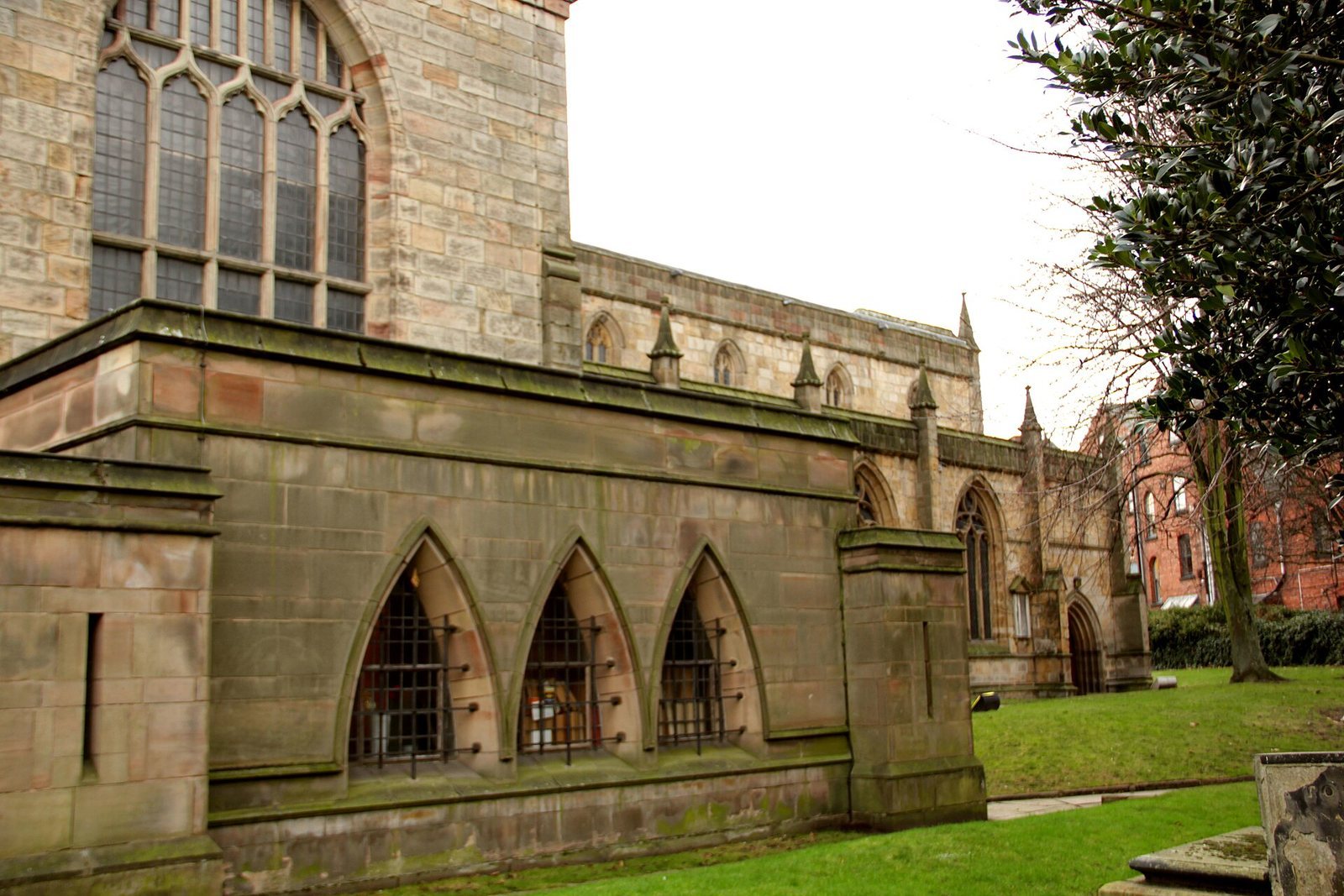
The church has a Latin-cross plan, with the nave and transepts forming a cross, arranged in a basilica layout: a long central space flanked by aisles. The chancel is surrounded by four guild chapels. The medieval building is constructed of ashlar, finely cut stone laid in regular courses, and combines Early English, Decorated and Perpendicular Gothic forms.
The spire and bell space
The twisted spire
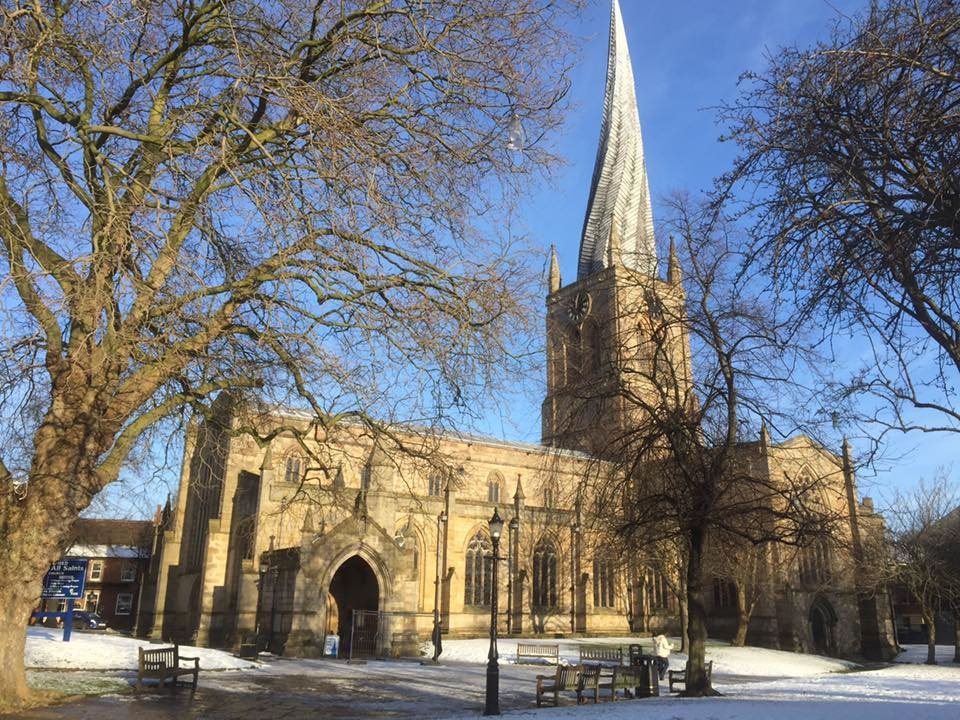
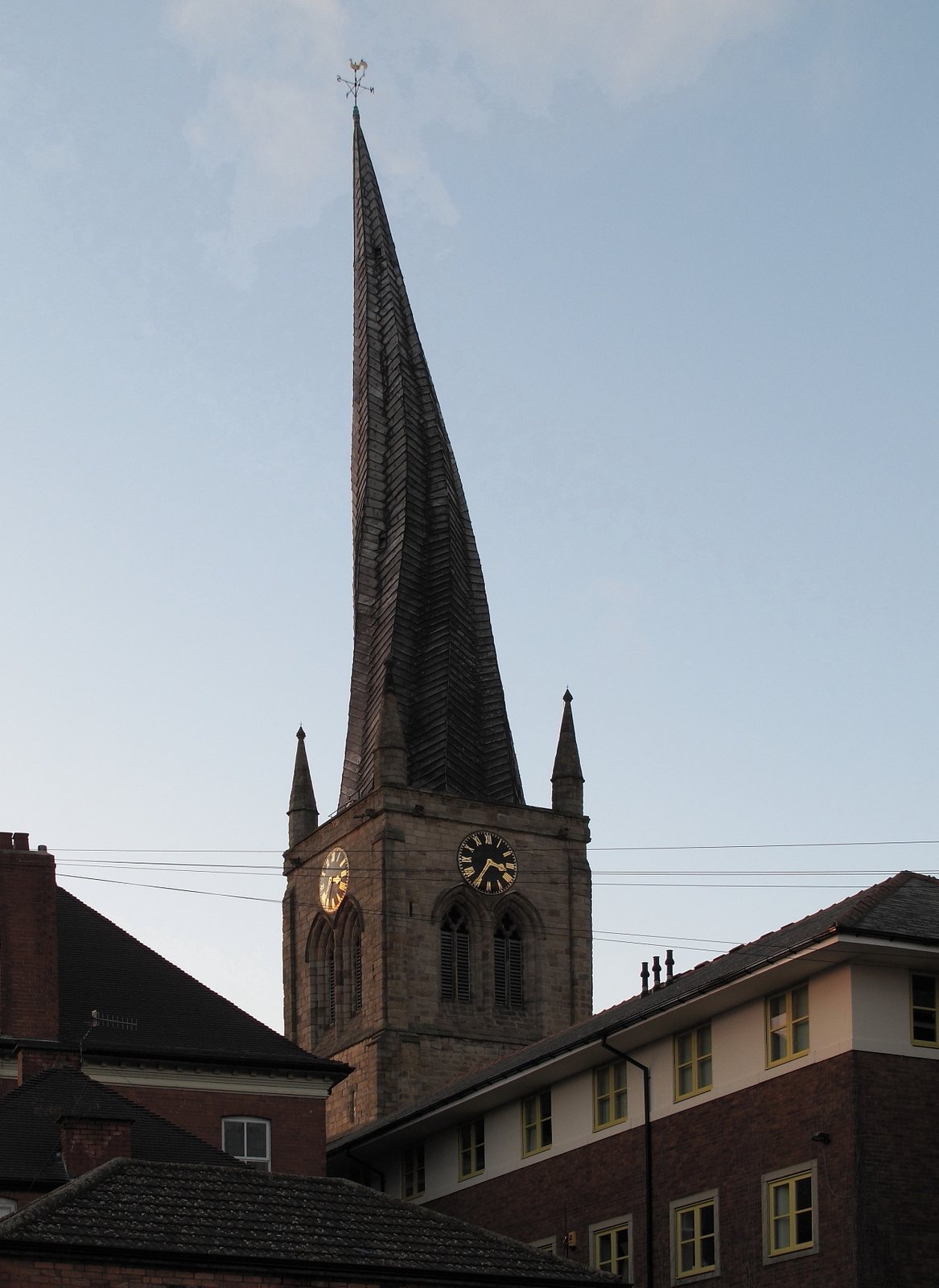
A tower rises above the crossing, where the nave and transepts meet, and carries the spire. Its top stands about 69 metres above ground. The spire twists by about 45 degrees and leans north, with its tip roughly 2.9 metres off centre. Its lead sheeting weighs about 33 tons, and a golden cockerel weather vane bearing the names of former vicars stands at its summit.
The reason for the distortion remains uncertain. Suggested factors include a shortage of skilled workers during the Black Death, the plague pandemic that swept through Europe in the mid-14th century, as well as inadequate cross-bracing, unseasoned timber and poor carpentry. Another explanation proposes that 17th-century lead sheeting added about 33 tons to 14th-century bracing not designed for that load. A further theory links greater sunlight on the south side with hotter lead and unequal expansion. More than one factor may have contributed.
Bells and windlass
The steeple beneath the spire holds ten bells tuned to D and an eleventh known as the Shriving or Curfew Bell. The present set was cast in 1947 by the Whitechapel Bell Foundry in London; the heaviest bell weighs 1,270 kilograms. The old Angelus bell is also known as the Prentice bell. An Angelus bell traditionally marked a time for prayer, while a curfew bell signalled a required time to return or stop activity.
The bell space formerly contained a builders’ windlass, a hand-operated lifting device. It is now displayed at Chesterfield Museum and Art Gallery. The windlass is one of the few known medieval cranes and the only one from a parish church.
Interior architecture and furnishings
Nave and chancel
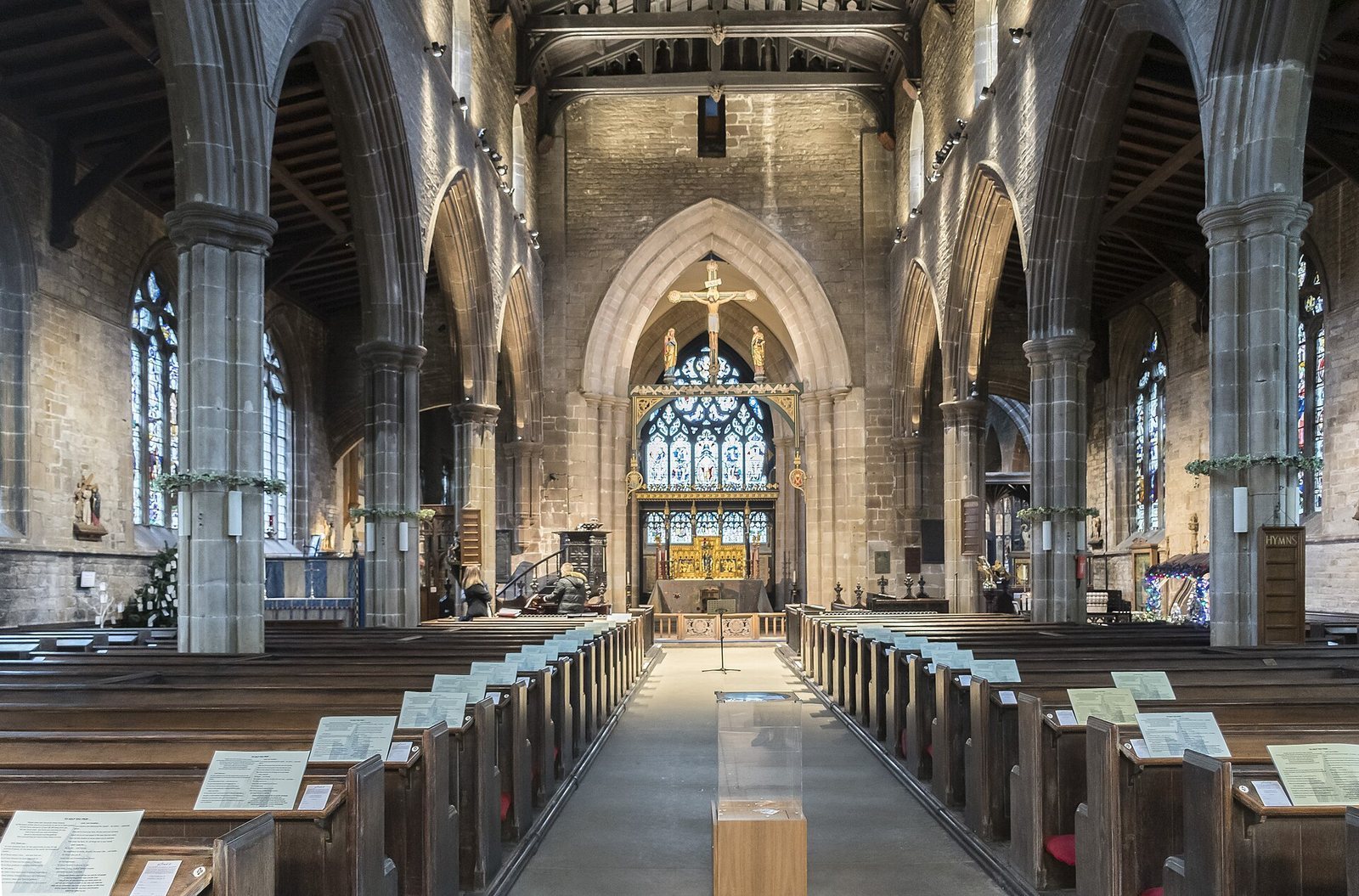
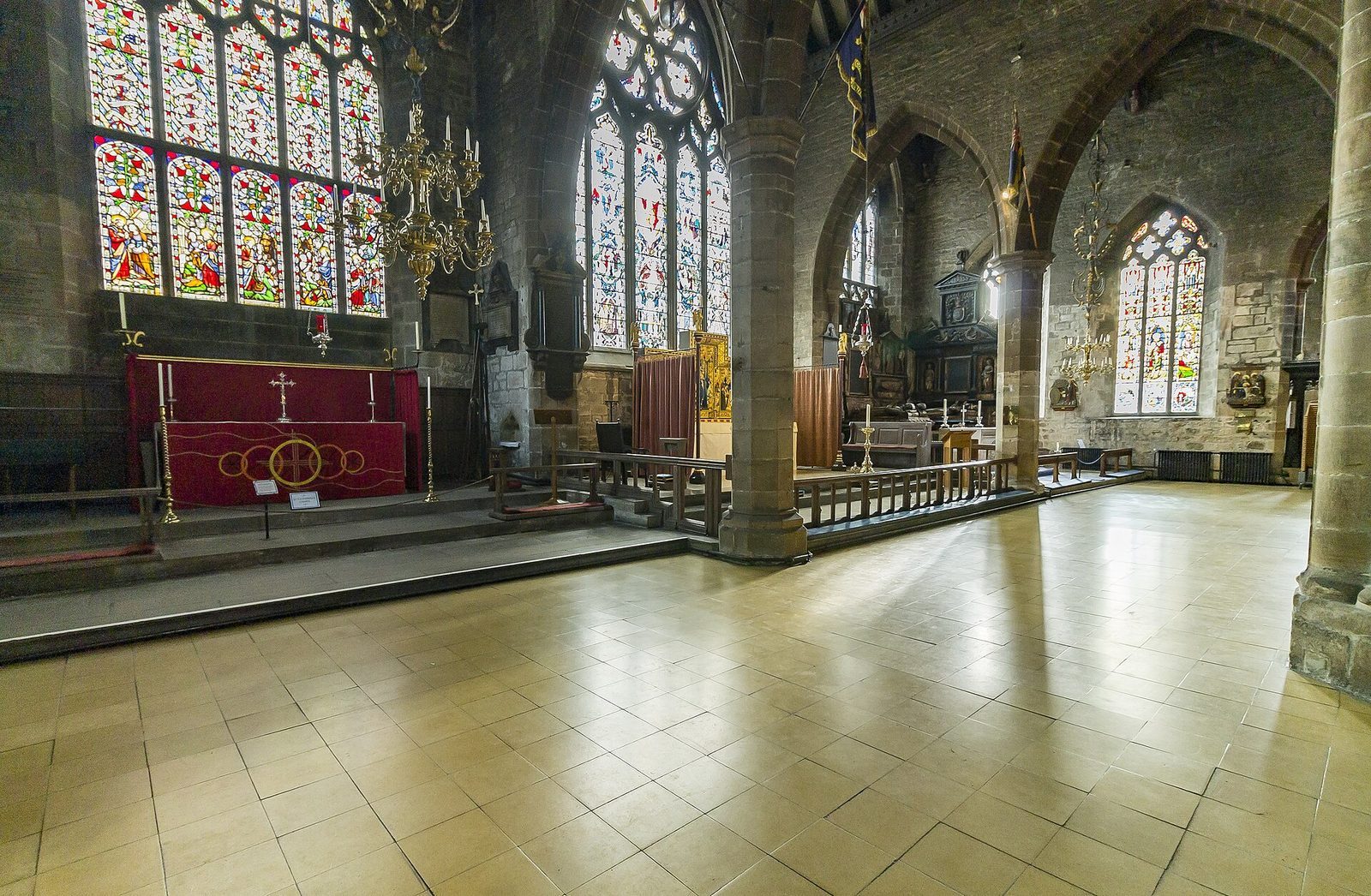
A small Gothic portal lies below a high west window. The three-aisled nave has open roof trusses, and a new ceiling formed part of Scott’s 1840s restoration. Before the altar, a pointed arch carries a rood cross, a large crucifix commonly placed at the division between nave and chancel. A Decorated-style window marks the end of the chancel.
Font, screen and pulpit
The font in the south transept is thought to date from between 890 and 1050 and may be Anglo-Saxon, a term for England’s early medieval period before the Norman Conquest. It was among the features saved in the 1961 fire. The south transept screen dates to about 1500 and also survived the fire. A Jacobean pulpit, from the period of James I’s reign between 1603 and 1625, was saved as well.
Altar furnishings and memorials
The church has a small late-Gothic altar reredos, a decorative structure behind an altar. Moore designed a separate reredos for the High Altar, installed in 1898. Two double cenotaphs, memorials that do not contain the persons’ remains, commemorate members of the Foljambe family and date from the 16th century.
Windows, clocks and organ
Stained glass
The east window contains stained glass made by William Wailes of Newcastle as part of Scott’s 1840s work. Windows installed in the south aisle in 1984 depict the town’s history from the 11th century onward and were given by the people of Chesterfield. Glass in the north window melted in the 1961 fire.
Clocks
The 1836 clock had dials 9 feet in diameter. Its minute hand measured 4 feet 10 inches and its hour hand 2 feet 6 inches; the striking hammer weighed 50 pounds. A 14-foot pendulum ended in a 150-pound ball. Installed in 1929, a clock made by Potts of Leeds had new copper dials with gilt numerals and five bells that chimed the Cambridge quarter-hour pattern and struck the hour.
Organ
The 1756 pipe organ by John Snetzler was largely destroyed in the 1961 fire. The instrument installed in 1963 was made by T. C. Lewis and brought from Glasgow City Hall. It had four manuals, or keyboards, and 65 stops, controls for selecting pipe sounds. The instrument incorporated what remained of the Snetzler organ, with two later additions to its tonal range.