Kloster Urspring: A Benedictine Nunnery in Germany
Site at a Glance
- Popularity
- Medium
- Country
- Germany
- Primary era
- Early Modern
- Eras represented
- Medieval, Early Modern
- Civilizations
- Habsburg, Habsburg Austria, Holy Roman Empire
- Site type
- Religious
- Remains
- Monastery
On this page15 sections
History
Settlement and foundation
Kloster Urspring is a former Benedictine nunnery near Schelklingen in Germany, founded after 1127 and established by 1179. Benedictines belong to a Catholic monastic order whose communities follow the Rule of Saint Benedict. Urspring was a dependent priory, or religious house governed under a larger monastery, of St. Georgen in the Black Forest.
A settlement around the spring and its stream probably existed by the tenth century. It lay within the Swerzenhuntare, a medieval territorial unit, and took its name from the spring. In 1127, Rüdiger, Adalbert, and Walther gave Urspring and its church to St. Georgen, represented by Abbot Werner I and the monastic community. Count Diepold II of Berg received the lay bailiwick, a secular protective and administrative jurisdiction. The women’s house was founded afterward. Tradition holds that its first nuns came from Amtenhausen, a daughter nunnery of St. Georgen.
A papal privilege confirmed Urspring’s dependent status in 1179. A monk from St. Georgen probably served the nuns as prior, parish priest, spiritual adviser, and confessor. During the convent’s first century, it appears to have been small and poor, under the leadership of a female superior. Its first recorded grant of property came in 1237. Thirteenth-century holdings included Urspring, Hausen, Schmiechen, Sotzenhausen, Muschelwang, and Oberschelklingen.
Conflict, growth, and reform
Fighting in 1246–1247 between King Conrad IV and supporters of the papal party destroyed the monastery. Urspring recovered, and a papal bull issued by Alexander IV on 8 March 1258 attests to its renewed standing. As its property and prestige grew among local noble families, the convent became a suitable place for their daughters. It also gained some practical independence from St. Georgen: it had its own seal by 1258/1275, and the abbey’s role in property transactions and oversight was limited. A document of 14 April 1328 nevertheless set out St. Georgen’s rights, and Urspring remained subordinate to it.
In 1343, the convent’s lay bailiwick passed to Further Austria, a group of Habsburg lands outside the Austrian heartlands, along with the lordships of Berg and Schelklingen. St. Georgen had only an indirect part in the 1475 Bursfeld reform at Urspring, a movement to renew Benedictine monastic life; St. Georgen itself had not adopted the reform.
Reformation and secularization
The Reformation was associated with Urspring in 1536 and 1566, but the convent remained subordinate to St. Georgen. From 1566, its direction rested with St. Georgen’s Catholic abbot, who lived in Villingen.
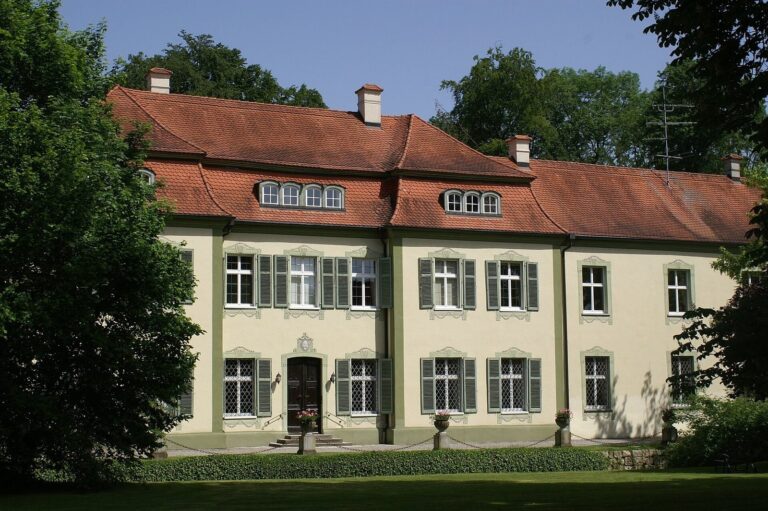
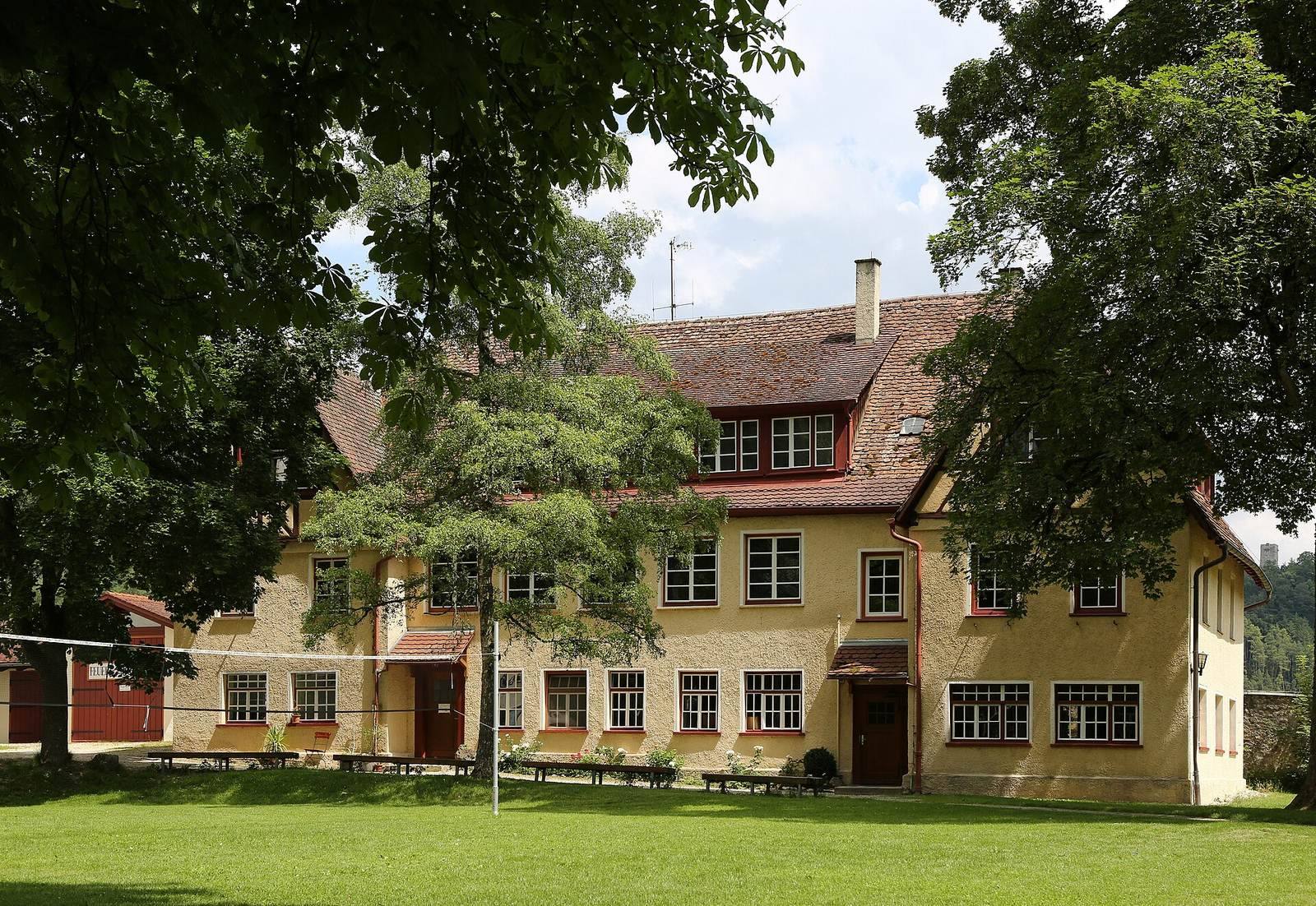
After Maria Abundantia von Barille was elected abbess in 1797, disputes within the convent led St. Georgen to relinquish its rights over Urspring in 1802. Urspring then became a priory of Wiblingen from 1802 to 1804. Following the Peace of Pressburg in 1805, Austria ceded Further Austria. Urspring passed to the Kingdom of Württemberg in 1806 and was secularized, transferring the religious institution out of ecclesiastical control. The former monastery buildings are protected and appear in Schelklingen’s register of architectural monuments. The site now houses Urspringschule boarding school.
Remains
Church and devotional features
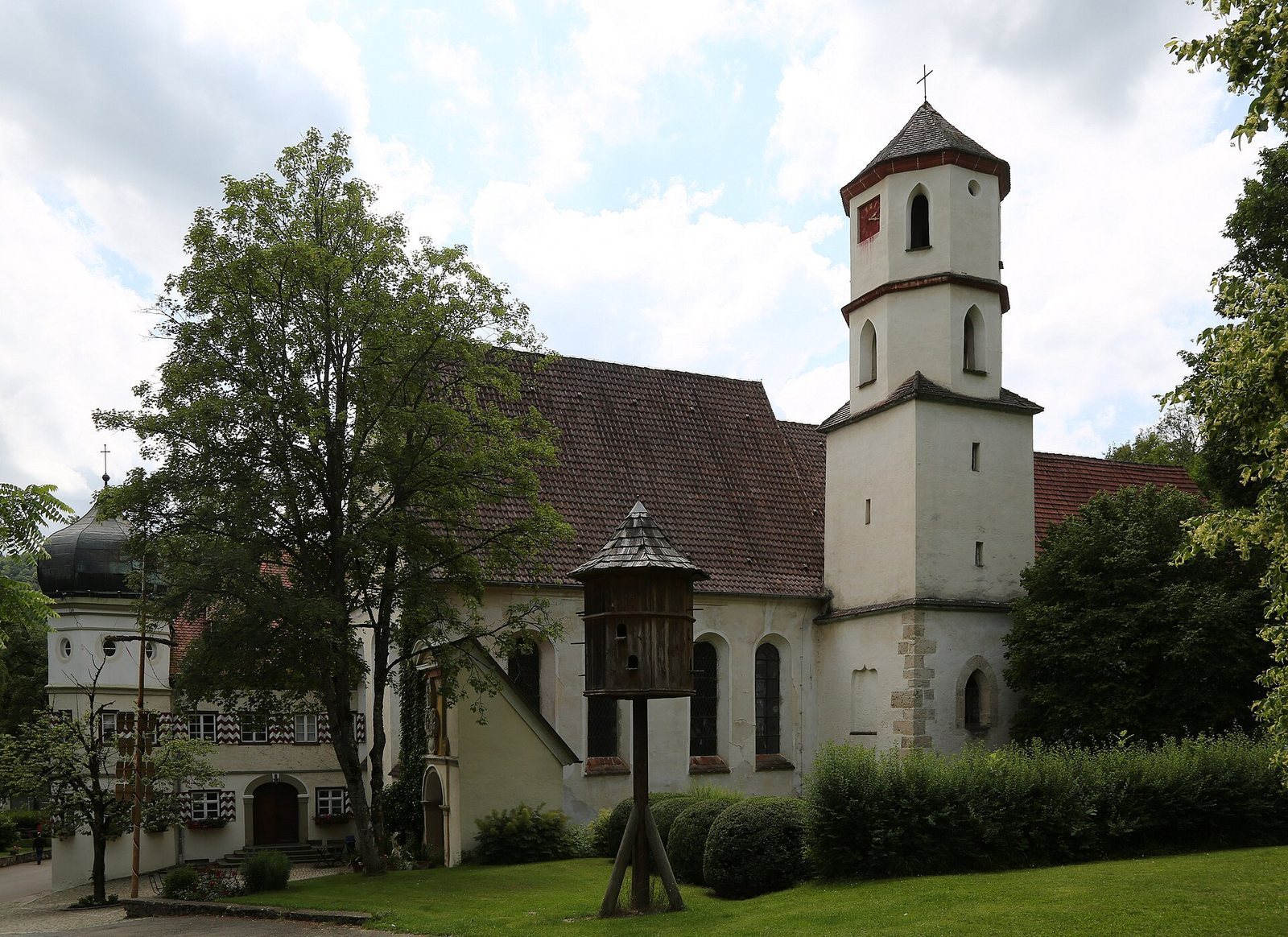
Monastery church
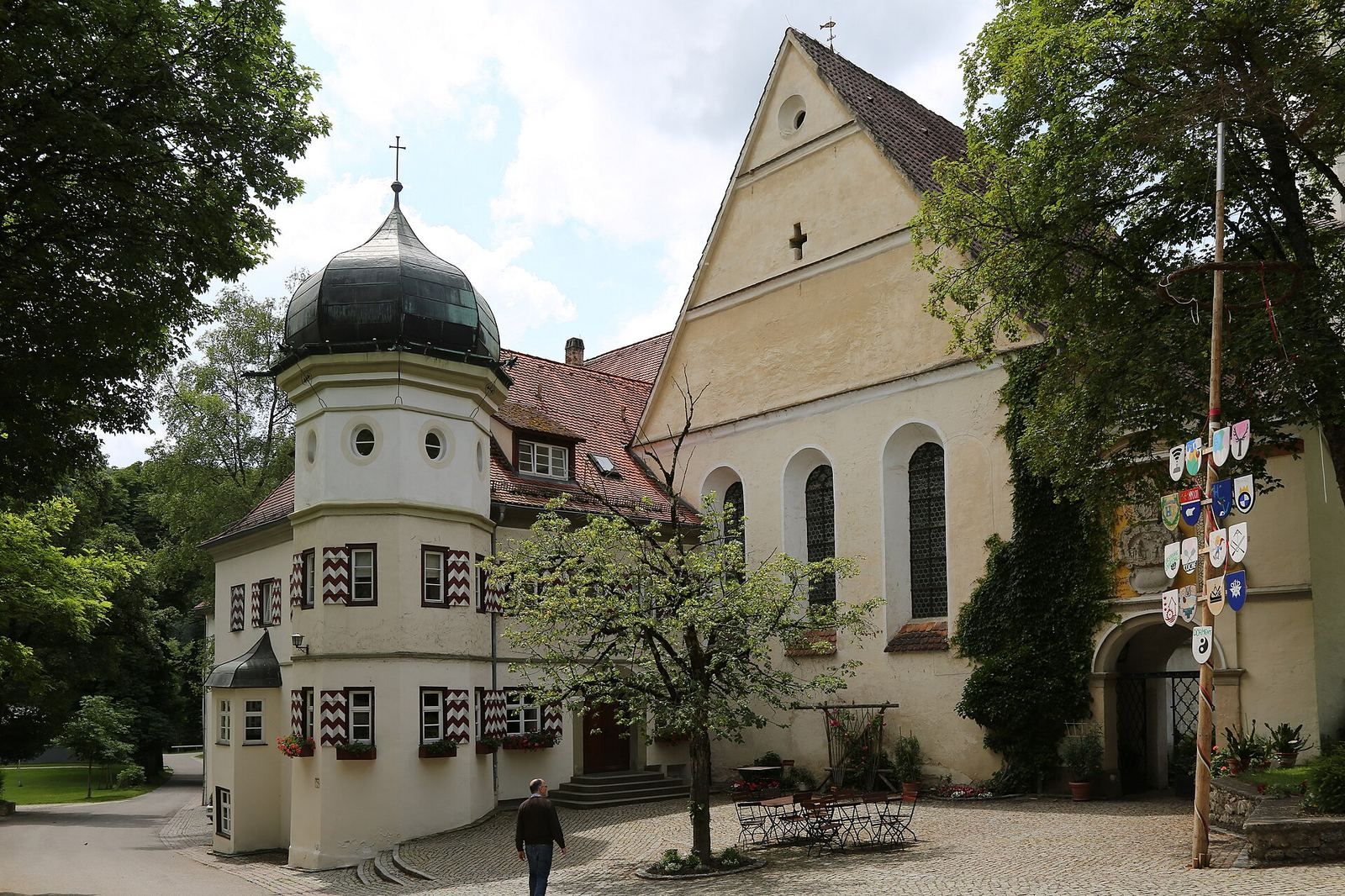
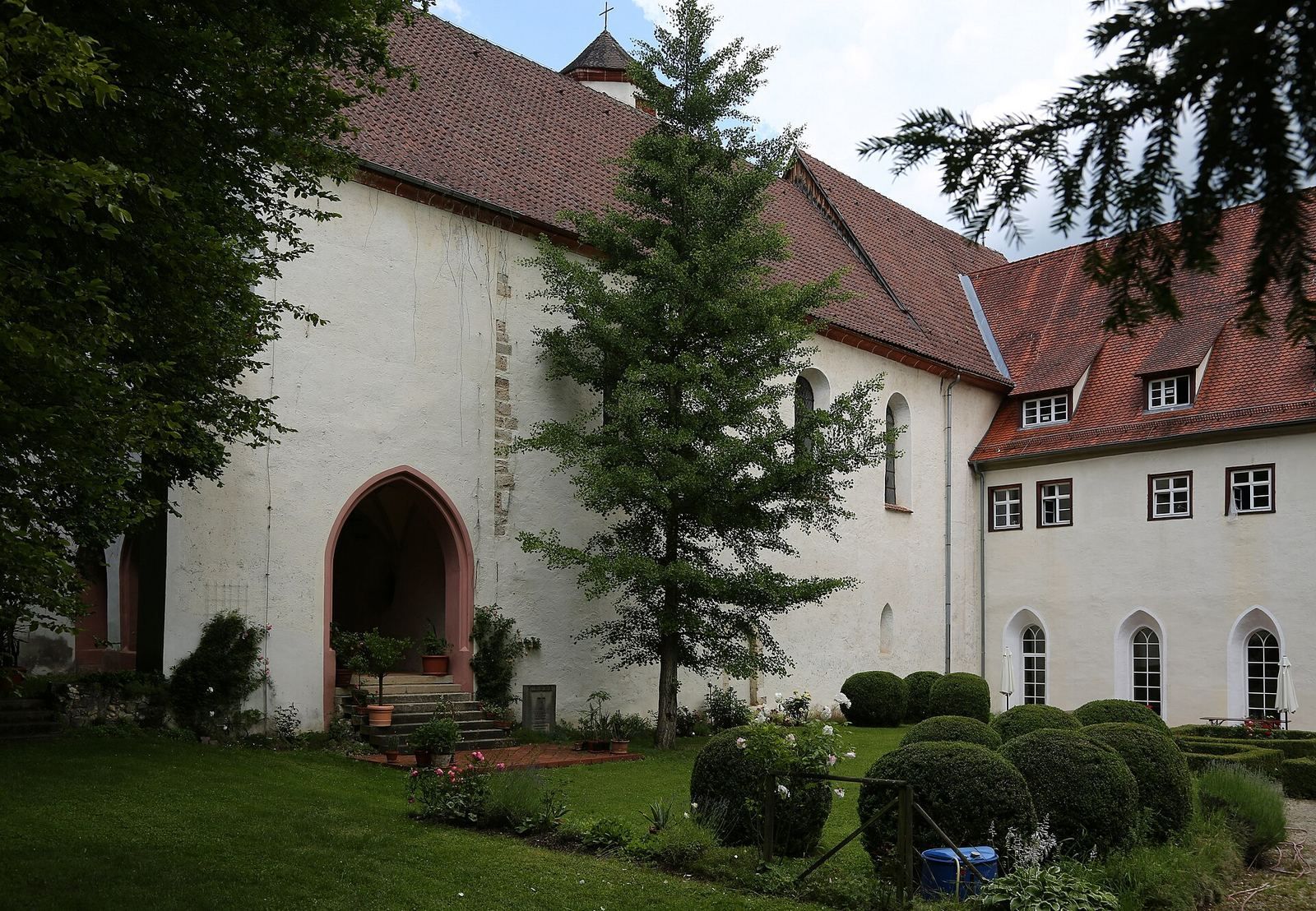
The monastery church is dedicated to Saint Ulrich, a tenth-century bishop of Augsburg venerated as a saint. After a fire in the seventeenth century, the church was rebuilt. Its tower retains lower storeys from the late Middle Ages. An onion dome remained above them until the end of 1832, when manufacturer Georg Reichenbach removed it to sell its copper. The tower now has a plain octagonal shed roof, intended to replace the dome.
Chapel, graves, and stone cross
The Sacred Heart Chapel was built in 1708–1709. The Sacred Heart is a Catholic devotion in which Jesus’s heart represents divine love. Medieval grave slabs remain inside the monastery church. A stone cross associated with a shoemaker stands in the gate building that leads to the church.
Cloister and convent buildings
East wing and church entrance
Substantial portions of the east cloister wing’s ground and first floors date to the late fifteenth century. Its ground-floor cloister, a covered walkway around a courtyard, belongs to the same period. The church’s west entrance vestibule, known as the “Paradise,” also dates to the late fifteenth century.
Guesthouses and abbey building
The Upper Guesthouse, intended for lay guests, was built in 1495, while the Lower Guesthouse, for clerical guests, followed in 1520. The former abbey building served as the residence of the monastery’s female superior and is first mentioned in 1622.
Administrative buildings and precinct
Offices and residence
An administrative office building, later also used as a forestry office, was built in 1691 during the abbacy of Gertrud Schenk von Castell. An inscription above its entrance records the date. The former senior administrative officer’s residence probably dates to the eighteenth century, after the monastery steward’s residence moved from Schelklingen to Urspring. It later served as a state forestry office.
Garden, gates, and enclosing walls
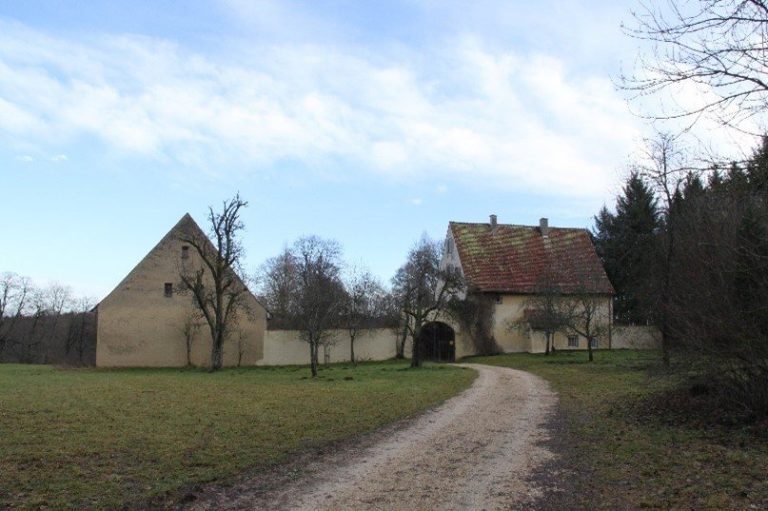
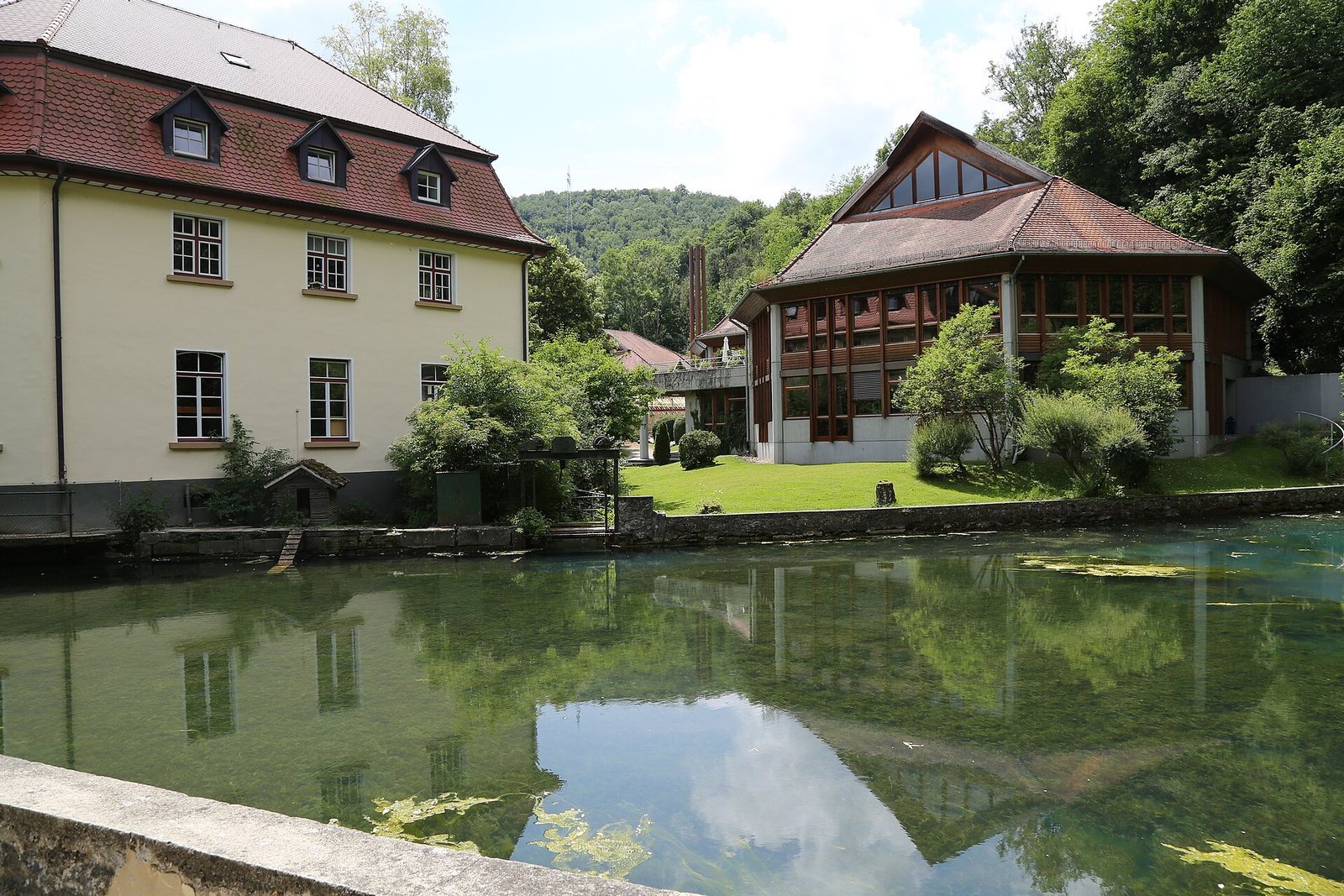
A walled former monastery garden lies in front of the former Upper Gate. Walls also enclose the spring basin and its outlet channels. The monastery precinct had its own enclosing walls, with a round tower at the center of the eastern wall.
Artworks and reused objects
Two wings of a triptych, a three-part artwork, show the Adoration of the Magi and the donors Burkhart the Tall and his brother Ital of Ellerbach. The panels are held in the Württemberg State Museum. Although attributed to Erbach, they most likely originated at Urspring. Sixteenth-century stained-glass panels from the former communal dining hall are now privately owned at Friedrichshafen Castle and Lichtenstein Castle. A stone Madonna and Child from around 1490, once used as a fountain column at Urspring, now stands in an exterior niche on the east side of the parish church of St. Vitus in Schmiechen.