Red Cloister: An Augustinian Priory in Belgium
Site at a Glance
- Rating
- 4.5
- Popularity
- Medium
- Country
- Belgium
- Primary era
- Early Modern
- Eras represented
- Medieval, Early Modern
- Civilizations
- Duchy of Brabant, Habsburg, Habsburg Austria, Holy Roman Empire
- Site type
- Religious
- Remains
- Monastery
On this page17 sections
History
Foundation and growth
The Red Cloister, known as Rouge-Cloître and formally as Saint-Paul en Soignes, was a religious community at the edge of the Sonian Forest in Auderghem, Belgium. It began as a hermitage in 1366 and became an Augustinian priory, a religious house governed by a prior, in 1374. The hermit Gilles Olivier and layman Walter van der Molen established the community; the priest Guillaume Daneels, who sometimes celebrated Mass there, later joined them.
Duchess Joanna of Brabant authorized the community to settle in the area in 1367 and subsequently granted it land for a priory. Between 1367 and 1369 the hermits adopted the Rule of Saint Augustine, a set of rules for communal religious life. Their chapel was consecrated in 1369 and dedicated to Saint Paul. The community could hold religious services there but was not yet permitted to administer the sacraments. Its way of life and liturgical rules received approval in 1372, and Daneels became the first prior when the house affiliated with the Canons Regular of Saint Augustine in 1374. These were clergy who lived under a shared religious rule while carrying out priestly duties.
The community joined a congregation of Brabant priories led by Groenendael in 1402; that network entered the Windesheim Congregation in 1412. The Windesheim houses were associated with the Modern Devotion, a movement that emphasized personal religious practice and disciplined communal life. In 1438 the canons adopted strict enclosure, limiting movement between the priory and the outside world. Their early observance centred on poverty, prayer, meditation, and contemplation.
During the fifteenth century the priory grew in wealth and reputation. It became known for historical and theological scholarship, and its library held manuscripts and old books with valuable bindings. A catalogue made in 1487 gives evidence of the collection’s scale. The priory also had a workshop for copying and illuminating manuscripts, supplemented by work from the Carthusian monastery at Herne. Subprior Jean Gielemans, the prior’s deputy, wrote lives of saints. The painter Hugo van der Goes joined the community as a lay brother, a member who was not ordained as a priest, and continued painting there. He died at the priory in 1482 or 1483.
Royal connections and conflict
In 1488, an uprising against Maximilian of Austria forced the canons to leave. The priory was also caught up in the sixteenth-century Dutch Revolt, a rebellion against Spanish Habsburg rule in the Low Countries. Episodes of plundering led the community to flee, and in the late sixteenth century its members took refuge in Brussels until the unrest subsided. They returned in 1607, but the priory was attacked again in 1635.
Despite these disruptions, the house was among the most prestigious monasteries in the Spanish Netherlands, the Habsburg territories in the Low Countries governed by Spain. Its closeness to Brussels helped draw prominent visitors. Charles V, Holy Roman Emperor and ruler of the Habsburg Netherlands, stayed there frequently. Archduke Albert VII of Austria and Isabella Clara Eugenia, who governed the Spanish Netherlands with him, also visited.
An internal dispute resulted in the prior’s removal between 1679 and 1683. A fire in 1693 damaged part of the priory, though the library survived.
Suppression and later uses
Emperor Joseph II suppressed the monastery by an edict of 17 March 1783. The measure aimed to improve public finances and targeted convents that relied on tithes while living a purely contemplative life. Valuables were removed in April 1784. Many books later went to Vienna’s Imperial Library, while others were sold privately or stolen. After the Brabant Revolution, an uprising against Habsburg rule in the Austrian Netherlands, the canons bought the priory back from the States of Brabant, the provincial assembly, in July 1789 for 58,000 florins. They returned the following year.
French revolutionary troops occupied and plundered the priory in 1792, after the Battle of Jemappes. Following France’s annexation of the Southern Netherlands in 1795, the French Directory, the republican executive government, abolished the monasteries in 1796. This ended the priory; its buildings were sold as national property in 1798.
After the sale, the estate’s buildings served varied purposes, including as a cotton mill, dye works, munitions factory, stonemason’s workshop, hotel, restaurants, and cafés. Urban development and road construction later reduced the estate’s boundaries. Romain Govaert acquired the estate, fields, and ponds in 1872. The Belgian state took ownership in 1910, and the Brussels-Capital Region in 1992.
The estate received protected-site status in 1959. Archaeological investigations began in 1999, and the grounds were landscaped between 1997 and 2007. Restoration work has aimed to recover elements of the priory’s historic water system and gardens. Part of the estate, both within and beyond the former enclosure, is a nature reserve and part of Natura 2000, the European Union network for conserving important habitats and species. The surviving priory buildings now house the Rouge-Cloître Art Centre.
Remains
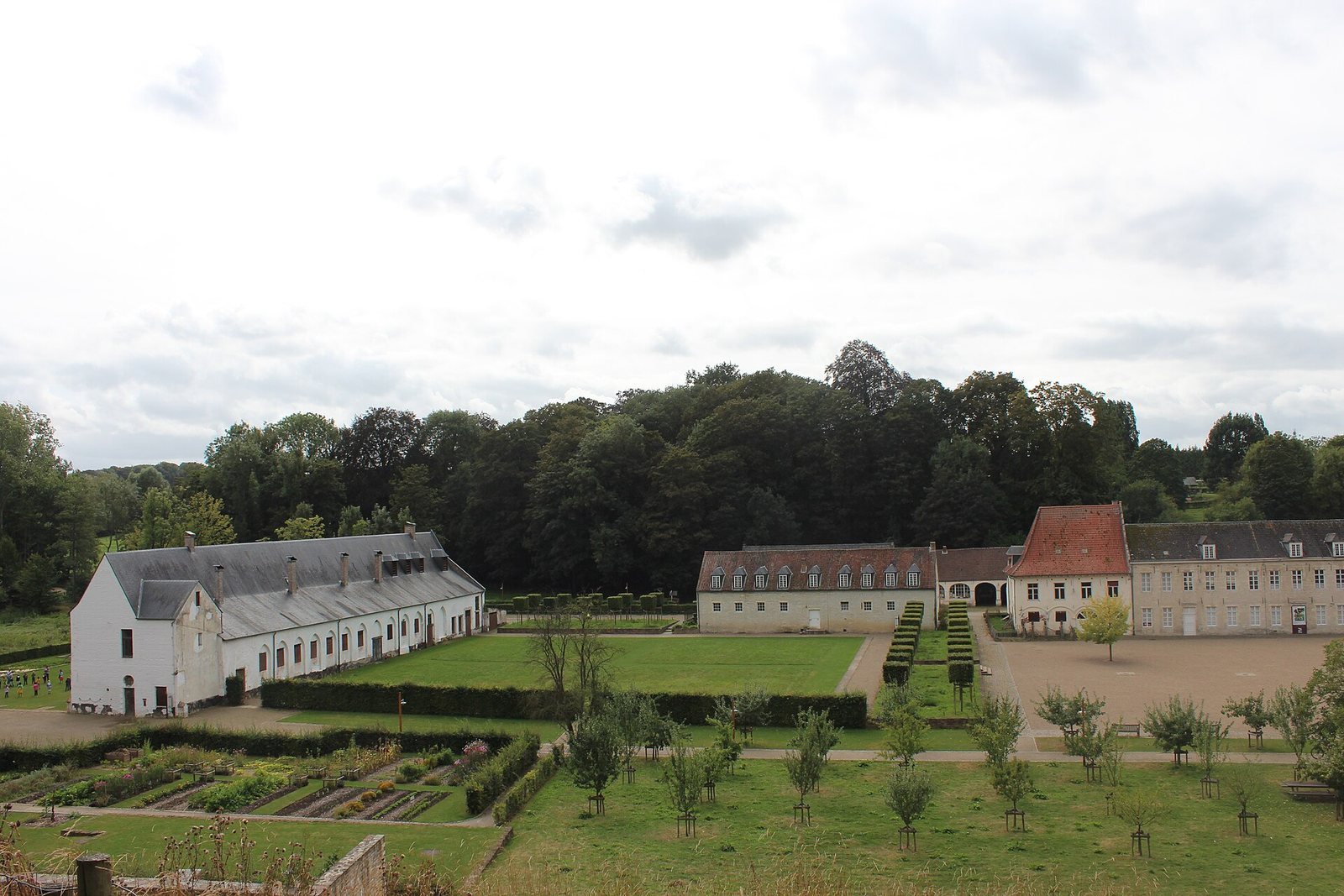
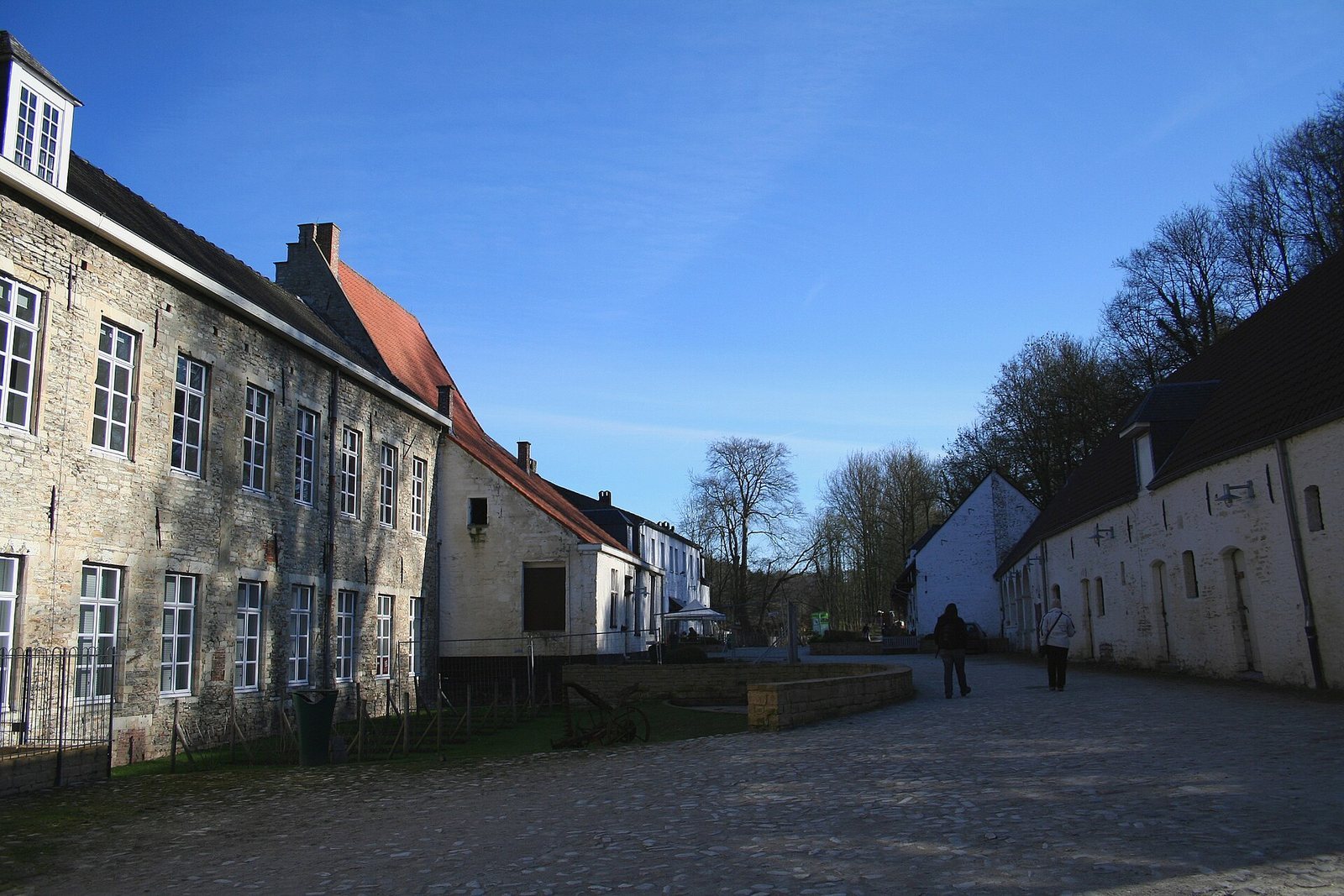
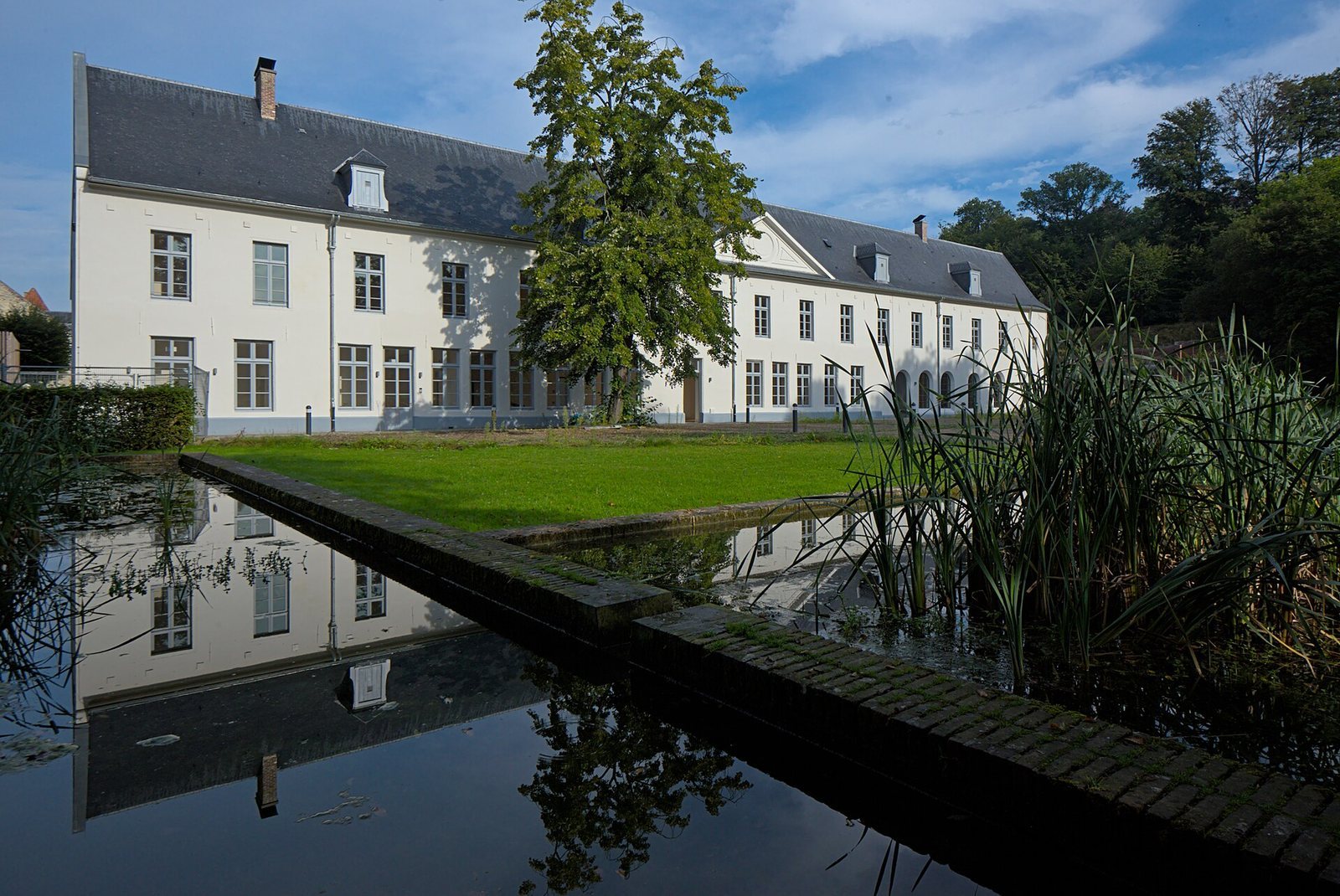
The surviving estate brings together priory buildings, sections of the former enclosure, archaeological remains, ponds, and woodland. Its buildings represent different periods of the community’s development and later reuse; the surviving structures provide only a limited sense of the former priory’s full scale.
Grounds and enclosure
Enclosure and water system
An enclosure wall was built around the estate around 1400, and a section survives. The outer wall of the former brewery follows the line of that boundary. Ponds, springs, and a stream crossing the grounds form part of the historic landscape. The medieval ponds were made on marshland. The stream powered a watermill that ground grain and pressed oil, while the ponds supplied fish. Woodland was cleared for cattle pasture and also provided timber for furniture and heating; local sandstone was used in construction.
Woodland and wildlife
The grounds include oak-hornbeam woodland with extensive bluebells and locally occurring wild daffodils. Other plants include wood anemone, Solomon’s seal, dog’s mercury, white and black rampion, heather, black bryony, fingered and sea-green sedge, deadly nightshade, nettle-leaved bellflower, sanicle, one-berry, common twayblade, wild privet, field maple, and European spindle. Recorded amphibians include common toads and frogs, Alpine, smooth, and palmate newts, and the rare fire salamander. Bats include whiskered bats, Leisler’s bats, Nathusius’s pipistrelles, and brown long-eared bats. Waterbirds include great crested grebes, tufted ducks, pochards, teals, grey herons, cormorants, and kingfishers.
Priory buildings
Buildings and former uses
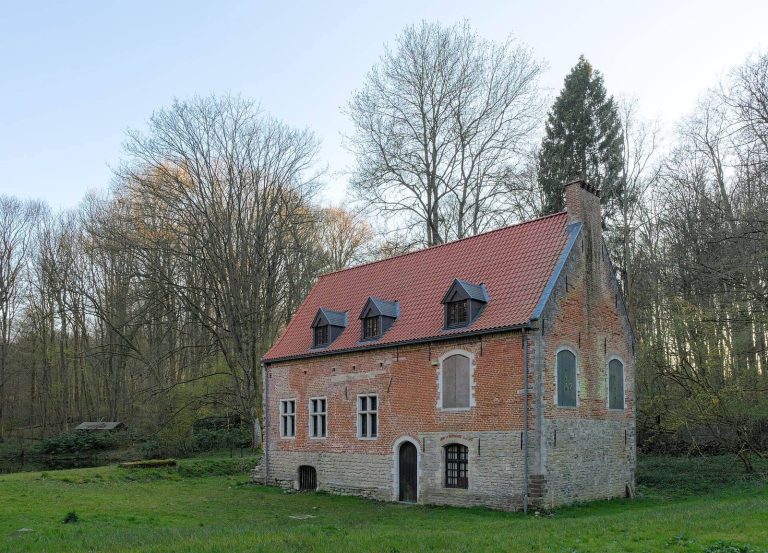
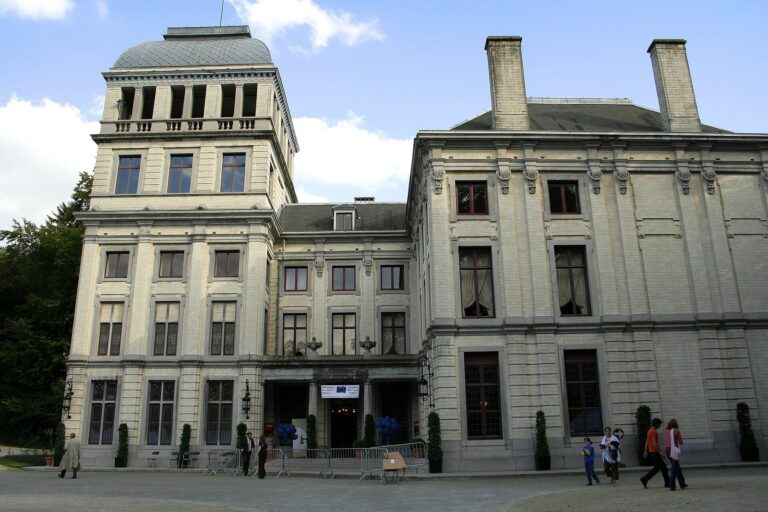
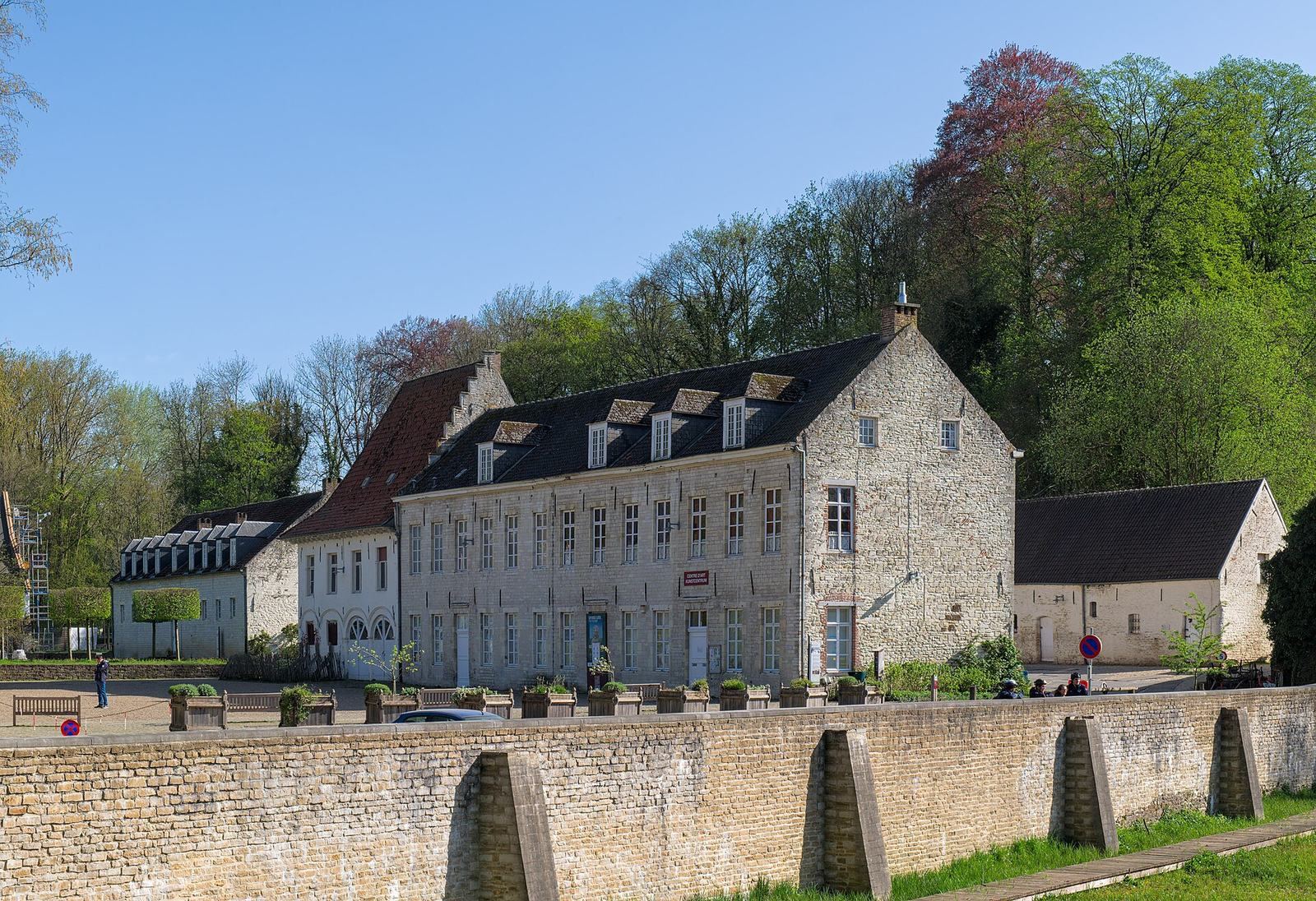
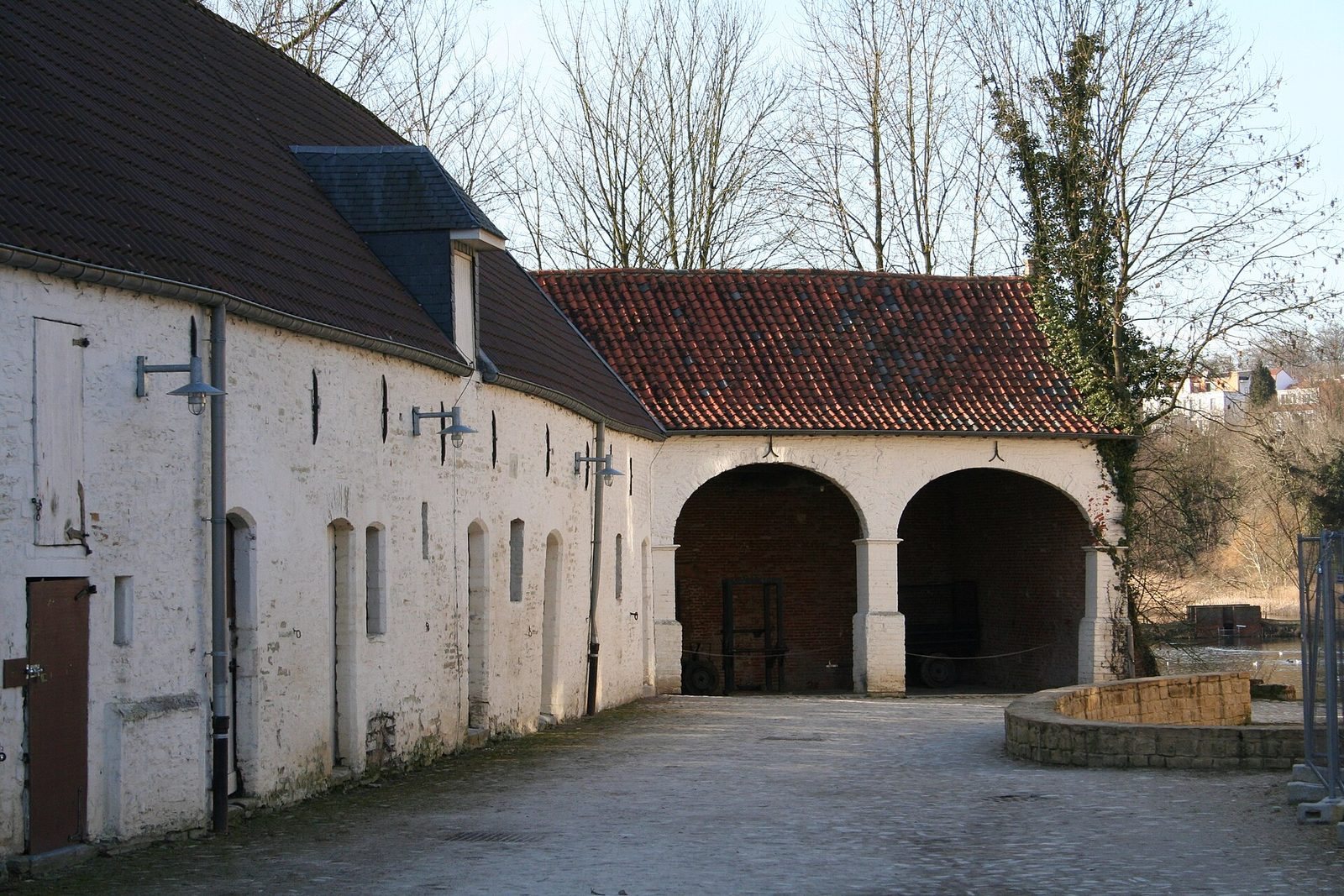
The complex includes an eighteenth-century priory, dormitories, and the former priory farm, a square, two-storey building. Former service buildings include a riding hall and stables. The grounds also contain the miller’s house, known as Maison de Bastien, and the porter’s house. The largest building, once a dormitory, later became a restaurant.
Maison de Savoie
Built in 1535 as a refectory, or communal dining hall, and accommodation for guests, the former Maison de Savoie later became a restaurant and café.
Cloister
A cloister is a covered walk around a courtyard. Of the priory’s four wings, one is well preserved and another was extensively altered to provide artists’ studios. The other two were levelled around 1800.
Church and archaeological features
Priory church
Construction of the church began in 1381, and the court architect Adam Gherijs built it between 1381 and 1384. It was made of white sandstone, and its choir, the area used for liturgical singing, was substantially rebuilt in 1511. Paintings from Peter Paul Rubens’s workshop decorated the church. A marble altar made between 1635 and 1638 was later transferred to the Church of Our Lady of the Pool in Tienen. The priory church was destroyed by fire during the nineteenth century, and its former site was investigated in 2003.
Infirmary
Excavations in 2001 and 2002 exposed the priory infirmary, one of the buildings serving the religious community.
Brewery
The former brewery retains floors in place and ovens that can help explain traditional beer-making processes. Excavations in 2001 and 2002 exposed parts of the building, and later investigations in 2003 also focused on it.
Mill
The estate’s mill survives in remains. Excavations in 2001 and 2002 recovered its mechanism, while investigations in 2003 included the mill site.