Romsey Abbey: A Benedictine Nunnery and Parish Church in the United Kingdom
Site at a Glance
- Rating
- 4.8
- Popularity
- High
- Country
- United Kingdom
- Primary era
- Medieval
- Eras represented
- Medieval, Early Modern, Modern
- Civilizations
- Anglo-Saxon, British, English
- Site type
- Religious
- Remains
- Church
On this page21 sections
History
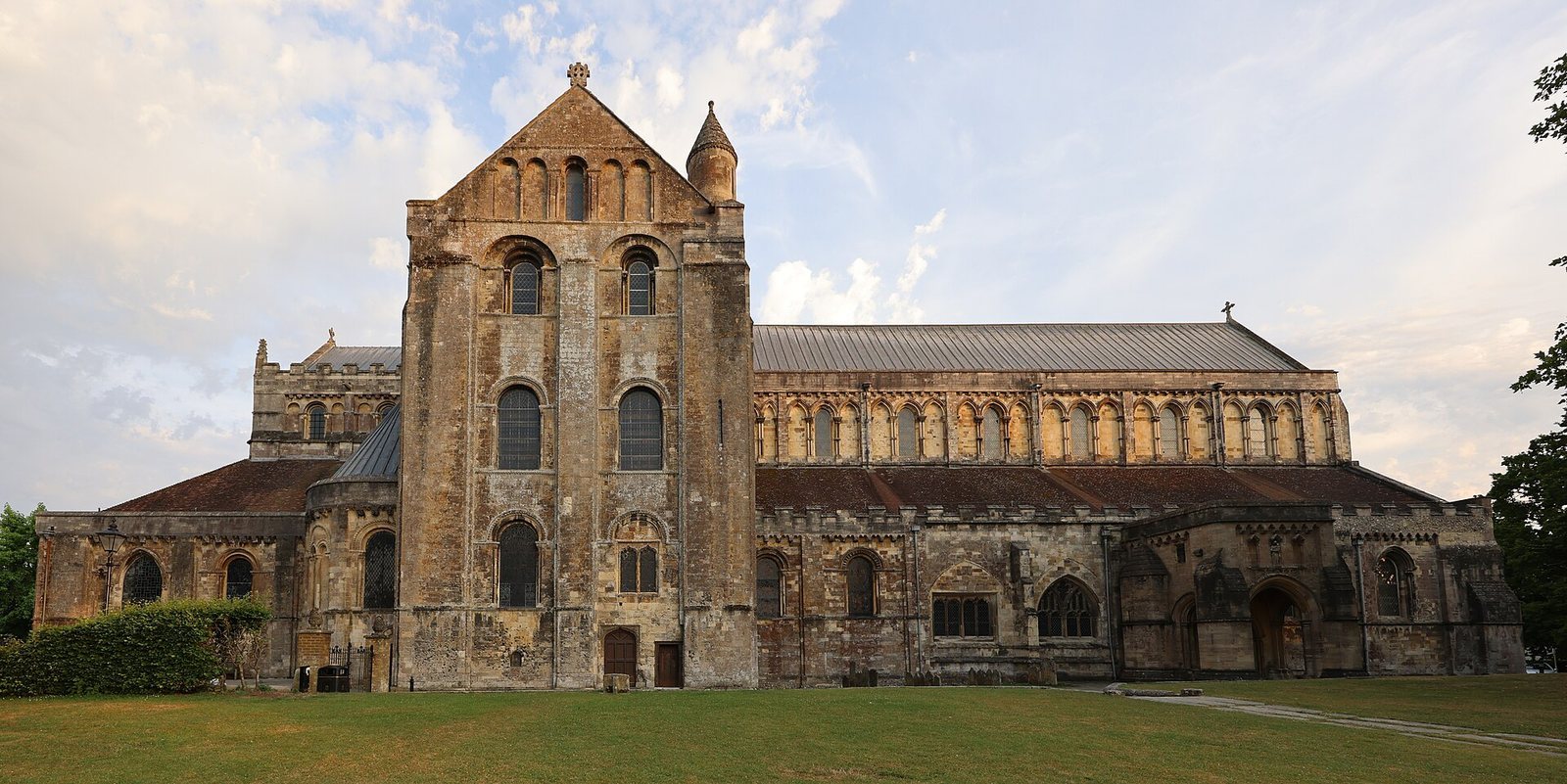
Romsey Abbey is a former Benedictine nunnery, whose community followed the Rule of St Benedict for monastic life, and is now a Church of England parish church in Romsey, United Kingdom. Traditionally founded in 907, it became a centre of learning, especially for children of the nobility. Its surviving medieval church is largely Romanesque, a medieval architectural style, with an early Gothic, or succeeding medieval, extension to the nave.
Foundation and early community
Tradition credits Edward the Elder, king of Wessex, with founding the women’s religious house. After Viking devastation, Edgar, a later king of England, and Æthelwold, bishop of Winchester, re-established the nunnery around 967. It received land and was rededicated in 968, while a village grew nearby to supply the community’s needs.
In 993, Viking raiders sacked the village and burned the original church. A stone church replaced it around 1000. The nunnery and its community then flourished under Benedictine rule.
Royal connections and medieval growth
After the Norman Conquest of 1066, the abbey’s position near Southampton and its port for voyages to Normandy brought it travellers waiting for favorable winds. This setting also helped the nuns maintain connections with ruling families. Matilda, daughter of Malcolm III and Margaret of Scotland, and her sister stayed at the abbey under the care of their aunt Christina, the abbess, or female head of the community. Matilda later married Henry I in 1100. Henry visited Romsey in 1105, and seven charters of donation added to the abbey’s wealth.
A substantial new stone abbey church was probably begun around 1130–1140, during the reigns of Henry I and his successor Stephen. Its principal builder was Henry of Blois, bishop of Winchester and abbot of Glastonbury, who was Stephen’s younger brother. Building work continued through much of the twelfth century. By 1240, the community numbered more than 100 nuns.
In 1159, Abbess Mary inherited the County of Boulogne. The following year she was taken from the abbey and married to Matthew of Alsace. The marriage shocked contemporaries and drew condemnation from the Church.
Plague and late medieval community
The Black Death, a devastating plague epidemic that spread across Europe, reached Romsey in 1348–1349. The town, then home to about 1,000 people, may have lost as much as half its population. Seventy-two nuns died, including Abbess Johanna. The community contracted by more than 80 percent, falling to 19 women, and never again exceeded 26.
During Abbess Elizabeth Broke’s tenure from 1472 to 1502, allegations were made about poor standards of dress, nuns visiting town taverns, irregular bookkeeping, and inappropriate relationships with chaplains.
Dissolution and survival of the church
Henry VIII’s suppression of religious houses, known as the Dissolution of the Monasteries, closed the abbey in April 1539 and forced the nuns to leave. The buildings escaped wholesale demolition in part because a substantial section of the church, dedicated to St Lawrence, an early Christian martyr, had served the townspeople. The town bought the abbey buildings from the Crown for £100 in 1544. Demolition then began on the St Lawrence section, whose earlier use by the town had helped preserve the church.
Parish church and later history
In 1643, Parliamentarian troops damaged the church and destroyed its organ. In the nineteenth century, the incumbent Edward Lyon Berthon carried out restoration work that helped preserve the building. The church’s long musical tradition is associated with the nuns’ singing, and male choristers were added in 1867.
Romsey Abbey is now an Anglican parish church in the Diocese of Winchester and the Province of Canterbury. It received Grade I listed status in 1951, a designation recognizing buildings of exceptional historic interest.
Remains
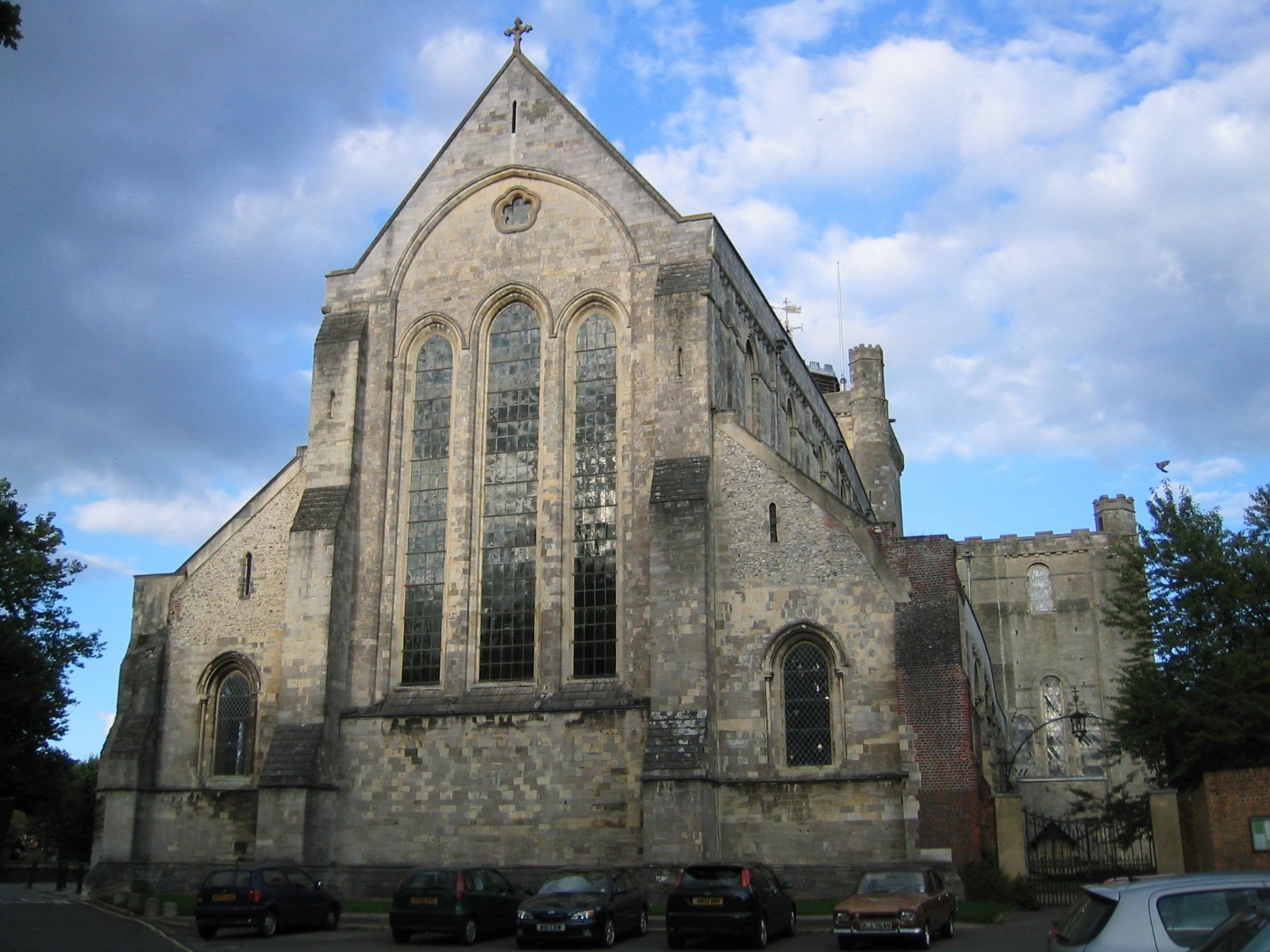
The surviving church has a long plan, with a choir at the east end and a nave extending west. It is built mainly of Chilmark limestone from Wiltshire and measures 78 metres in overall length. The design is simple in outline, with a flat eastern end and a three-level interior elevation.
Early archaeological remains
Excavations in the 1900s and between 1973 and 1991 found burials dating to the early ninth century on the site and around the present church. They also revealed an early tenth-century church at the centre of the present building’s footprint. It was cross-shaped, with equal arms measuring about 28 metres in length and width, and had a large rounded sanctuary end to the east. Residential buildings stood to its south.
Church plan and interior
Choir, nave, and elevations
Construction of the surviving church began at the east end. The choir has three bays, or structural sections, and the nave has seven; about four-fifths of the building is Romanesque, while the nave includes a later extension in the early Gothic style. Its flat east end is a notable feature of its English plan.
Nave and wall passage
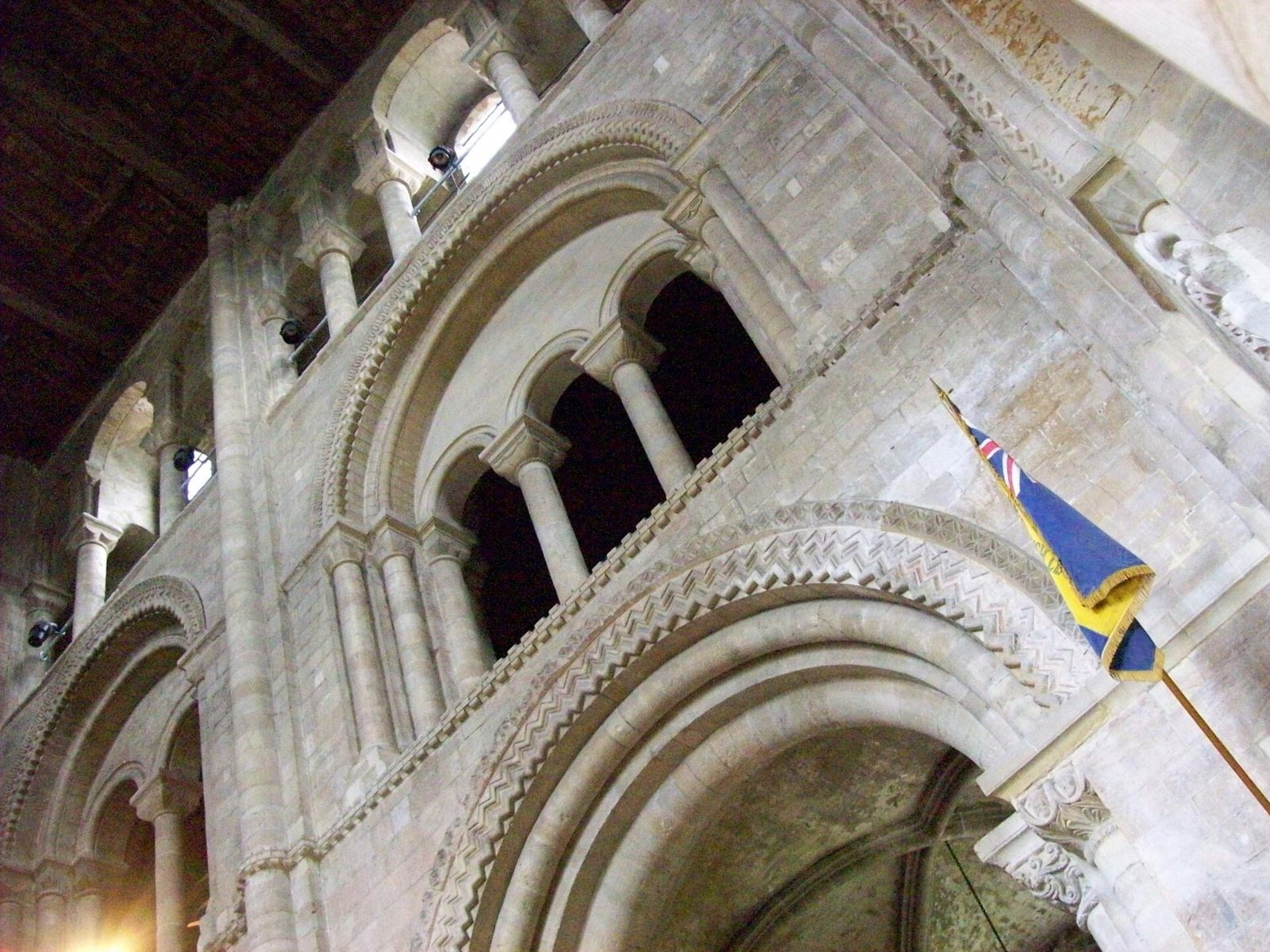
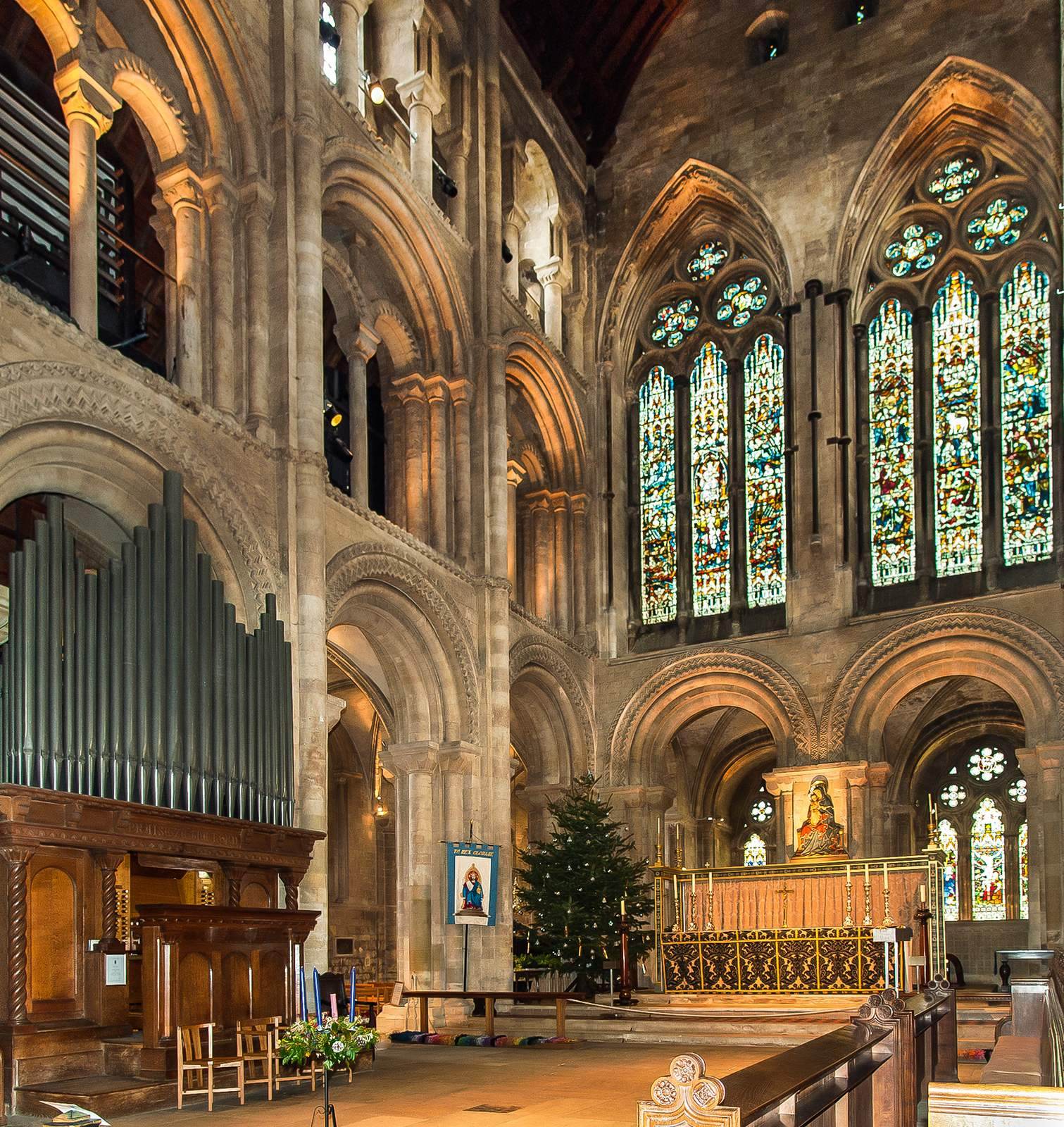
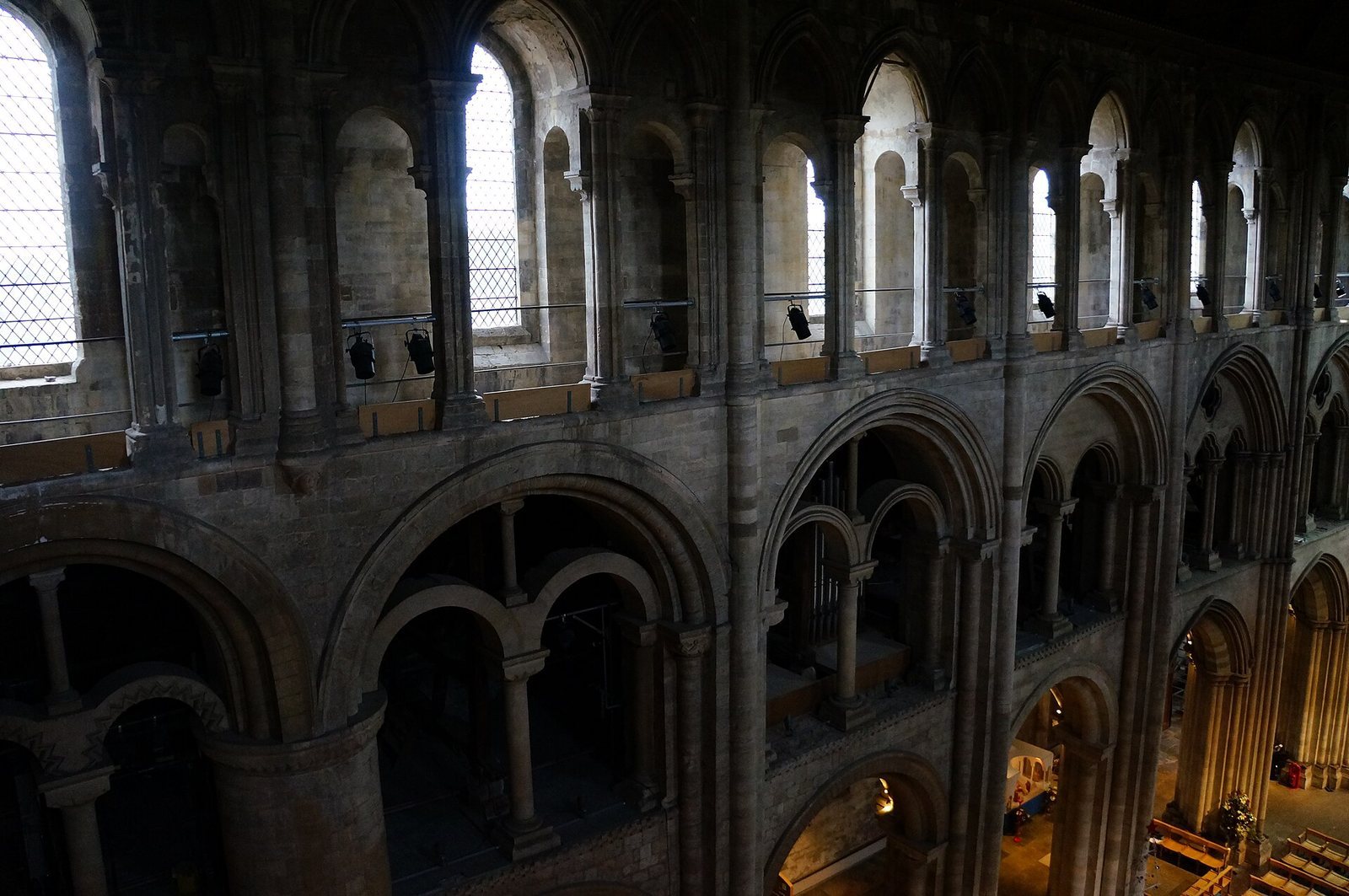
The first Romanesque portion of the nave was completed around 1180–1190. Three early Gothic bays were added in the early thirteenth century, retaining a three-level arrangement. At each bay, vertically aligned arches frame the lower arcades and openings at the triforium, the gallery-like level above the main arcade. A passage within the wall runs at the level of the high windows, including through the Gothic part of the nave, an arrangement described as unique in England. A rounded pier near the crossing, where the church’s main arms intersect, rises to the top of the triforium.
Ceilings and vaults
The nave and the small tower above the crossing have ceilings. The crossing tower does not provide light to the church. The nave aisles and choir have rib vaults, ceilings supported by intersecting ribs.
Carved capitals and exterior supports
Carved capitals, the tops of columns and piers, vary across the church. Those in the nave include scalloped shapes, interlacing patterns, foliage, and acanthus leaves, with some resembling carvings at Canterbury Cathedral. Choir capitals show a wider range of designs, including figures. One in the south aisle bears the inscription "Robert made me" and depicts a king at its centre, with a seated man and an angel to his left, and a man holding a scroll and a mask to his right. Rows of carved and plain corbels, projecting supports beneath a cornice, run along the exterior.
Sculpture and eastern chapels
Christ sculpture in the south transept
A large sculpture projects from the west wall of the south transept. Christ stands with his head raised, while the hand of God appears above him. Its imagery recalls continental models, while its style is English; the hand of God has been identified as a distinctively Anglo-Saxon element. Some date the work to around 1000–1025. It may once have belonged to an interior ensemble before the choir, perhaps positioned between the Virgin Mary and St John.
Crucifixion relief in the choir chapel
A shallow-carved Crucifixion in the south aisle chapel of the choir shows Christ on the cross, watched by angels and accompanied by the Virgin Mary and St John. Roman warriors threaten the figures with spears. The carving is probably the crucifix that Edgar the Peaceful gave to the abbey around 960.
Eastern chapels
Excavations at the church’s eastern end revealed two chapels, probably dedicated jointly to the Virgin Mary and St Ethelflaeda, a tenth-century abbess of Romsey. Their windows are in the late Decorated Gothic style, an ornamental phase of English Gothic architecture, and date stylistically from the mid-thirteenth to the mid-fourteenth century. Floor tiles may date to the late thirteenth or early fourteenth century. A well-preserved man’s tomb was found in the north chapel, and four other burials lay in the south chapel.
Burials, memorials, and church fittings
Burials and memorials
Burials in the church include William Petty (1623–1687), an economist, scientist, philosopher, and politician, and John Latham (1740–1837), a physician and naturalist who examined birds found in Australia. John and Grissell St Barbe, who died in 1658, are also buried here; their family acquired the abbey estate soon after the Dissolution and held it until 1723. Prince Edmund Atheling, son of Edgar the Peaceful, died in infancy around 966–970 and is reportedly buried in the old abbey. Earl Mountbatten of Burma, who lived locally at Broadlands House and received the title Baron Romsey in 1947, was killed in 1979 when a bomb exploded aboard his fishing boat in Ireland. After a ceremonial funeral at Westminster Abbey, he was buried at Romsey. His grave runs north–south so that he faces the sea where his wife Edwina’s ashes were scattered. Major General Sir Richard Harman Luce (1867–1952), a surgeon, army officer, politician, and former mayor of Romsey, is buried in the churchyard.
A chapel plaque commemorates Arthur (Bob) Ward, an engineering officer on the Titanic, the British passenger liner that sank on its maiden voyage in 1912.
Organs
The church has two organs. J. W. Walker & Sons built the main instrument in 1858, replacing an earlier organ by Henry Coster. It was rebuilt in its present position and enlarged in 1888. Restoration in 1995–1996 renewed its mechanical actions and overhauled its pipes. A new nave organ followed in 1999, with pipes in the south triforium; it can be played from a movable console in the nave or from the main console.
Bells
The bells were once housed in a detached bell tower, demolished in 1625. Its six bells were transferred to a wooden belfry on top of the central tower and replaced in 1791 by eight new bells. The largest, or tenor, bell originally weighed about 1,320 kilograms. Three bells were recast in 1932. The bells and their eighteenth-century frame were restored in 2007, when removing the tenor’s crown reduced its weight to about 1,120 kilograms.