Amesbury Abbey: A Benedictine Nunnery Refounded as a Priory
Site at a Glance
- Popularity
- Medium
- Country
- United Kingdom
- Primary era
- Unclassified
- Eras represented
- Unclassified
- Civilizations
- Unclassified
- Site type
- Religious
- Remains
- Monastery
On this page8 sections
History
Amesbury Abbey was a Benedictine nunnery founded by Queen Ælfthryth around 979 in Amesbury, United Kingdom. Henry II refounded it as a priory in 1177, and royal patronage shaped much of its medieval history before its dissolution in 1539.
Foundation and early holdings
Amesbury had sacred associations before Christianity. Later legends placed a monastery there before the Danish invasions, and devotion to St Melor, a boy martyr venerated in Brittany, may have influenced Ælfthryth’s choice of site. A later tradition said some of Melor’s relics were brought to Amesbury and sold to the abbess. A twelfth-century Life of St Melor places the convent’s foundation before the relics arrived. Ælfthryth’s foundation was once understood as penance for the murder of her stepson, Edward the Martyr, but she is not considered personally responsible for his death. She also established a religious house at Wherwell in Hampshire around this time.
In 1086, Amesbury held the Wiltshire manors of Bulford, Boscombe, Allington, Coulston and Maddington, as it had under Edward the Confessor, as well as Rabson in Winterbourne Bassett. Its Berkshire holdings included Ceveslane in Challow, Fawley and Kintbury, along with the church at Letcombe Regis. The community was probably not especially influential for much of its history. Its income was £54 15s, and powerful neighbours exposed it to harassment, livestock theft and other intrusions, while taxation also burdened the house.
Fontevraud refoundation
On 15 September 1176, Pope Alexander III issued a bull approving a reorganization of the convent. He instructed the Archbishop of Canterbury and the bishops of London, Exeter and Worcester to explain the change to the nuns and supervise it. Those who chose not to join the new order were to be transferred to other convents and treated well.
In 1177, Henry II dissolved Ælfthryth’s foundation and established a house of the Order of Fontevraud. During an inspection that year, the abbess was deposed and dismissed with a pension. Although some nuns were first offered the chance to remain, about 30 were ultimately dismissed. Henry summoned 21 or 24 nuns from Fontevraud, led by a former subprioress, and further nuns came from Westwood Priory in Worcestershire. The new community was installed on 22 May in the king’s presence by the Archbishop of Canterbury and other bishops.
The Order of Fontevraud was centred on its mother house in France and governed its priories under the authority of an abbess. Amesbury initially had separate communities of women and men under a shared authority. The refoundation has also been associated with Henry’s penance after supporters killed Thomas Becket, Archbishop of Canterbury. Gerald of Wales described Amesbury as one of three foundations Henry had promised the pope in return for release from his crusading vows.
Royal patronage and medieval decline
The priory first prospered through grants from the Crown and gifts from lay and church patrons. Henry III confirmed and increased his father’s grants, supported building work and visited the house. In 1268 he gave the manor of Melksham for the souls of Eleanor of Brittany and her brother Arthur, and ordered their commemoration alongside former English kings and queens. Eleanor, a princess held captive for much of her life because of her presumed claim to the throne, was buried at Amesbury. Her brother Arthur was widely believed to have been murdered by King John.
Eleanor of Provence, Henry III’s queen, supported the priory and encouraged her granddaughter Mary, a daughter of Edward I, to join the community in 1285. Eleanor of Provence also entered the house. She died there on 24 or 25 June 1291 and was buried in the priory church on 11 September. Another granddaughter, Eleanor, daughter of John II, Duke of Brittany, became a nun at Amesbury and later an abbess of Fontevraud. After Edward I’s death, his youngest daughter Eleanor was placed in Mary’s care and died at Amesbury in 1311. Mary remained at the priory until her own death in 1332.
More than 100 nuns lived at Amesbury in the early fourteenth century, but the community later contracted, with about 30 recorded in 1381. The priory’s income and standing also declined during the later fourteenth and fifteenth centuries. Isabel of Lancaster was prioress from about 1343 until her death before February 1349. Richard II confirmed Sybil Montagu’s election as prioress in 1391. She appears to have ended the system of male priors, prompting upheaval and intervention by Henry IV after he displaced Richard II. Sybil remained prioress until her death in 1420.
French-English conflicts weakened Amesbury’s ties to Fontevraud from the late thirteenth century. The male community had apparently disappeared by the early fifteenth century, leaving a house that seems to have been exclusively female, with a small group of chaplains outside the order. Amesbury probably joined the Benedictine order during the fifteenth century. In 1501, Catherine of Aragon stayed there while travelling to marry Arthur, Prince of Wales.
Dissolution and later history
Henry VIII dissolved the priory in 1539, and its estate passed to the Crown. Edward Seymour, Earl of Hertford and son of Edward Seymour, Duke of Somerset, acquired it in 1540. Monastic buildings were cleared over time, with the last demolished in the nineteenth century. A nearby country house later came to share the name Amesbury Abbey, though it is distinct from the medieval priory. The parish church is Grade I listed; the house is also Grade I, and its park and pleasure grounds are designated Grade II*.
Arthurian legend gives Amesbury a separate place in its stories, identifying it as a refuge where Queen Guinevere went after Arthur’s death and where she later died.
Remains
Medieval precinct and church
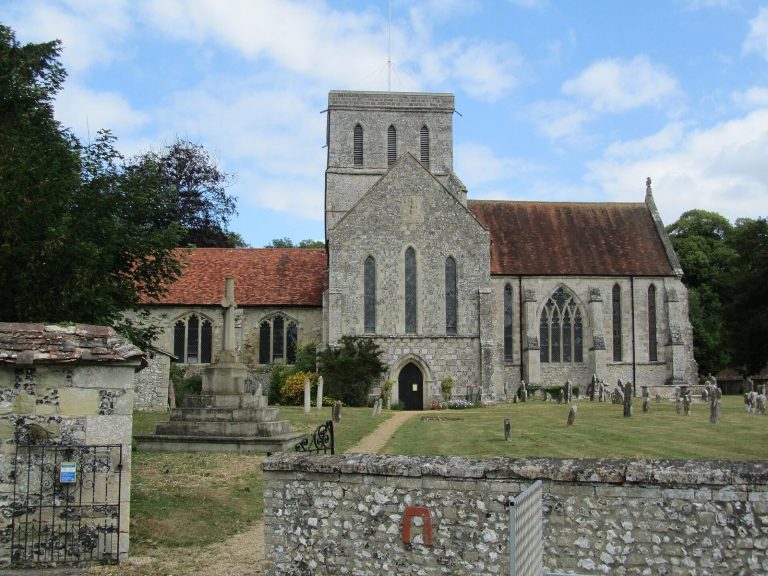
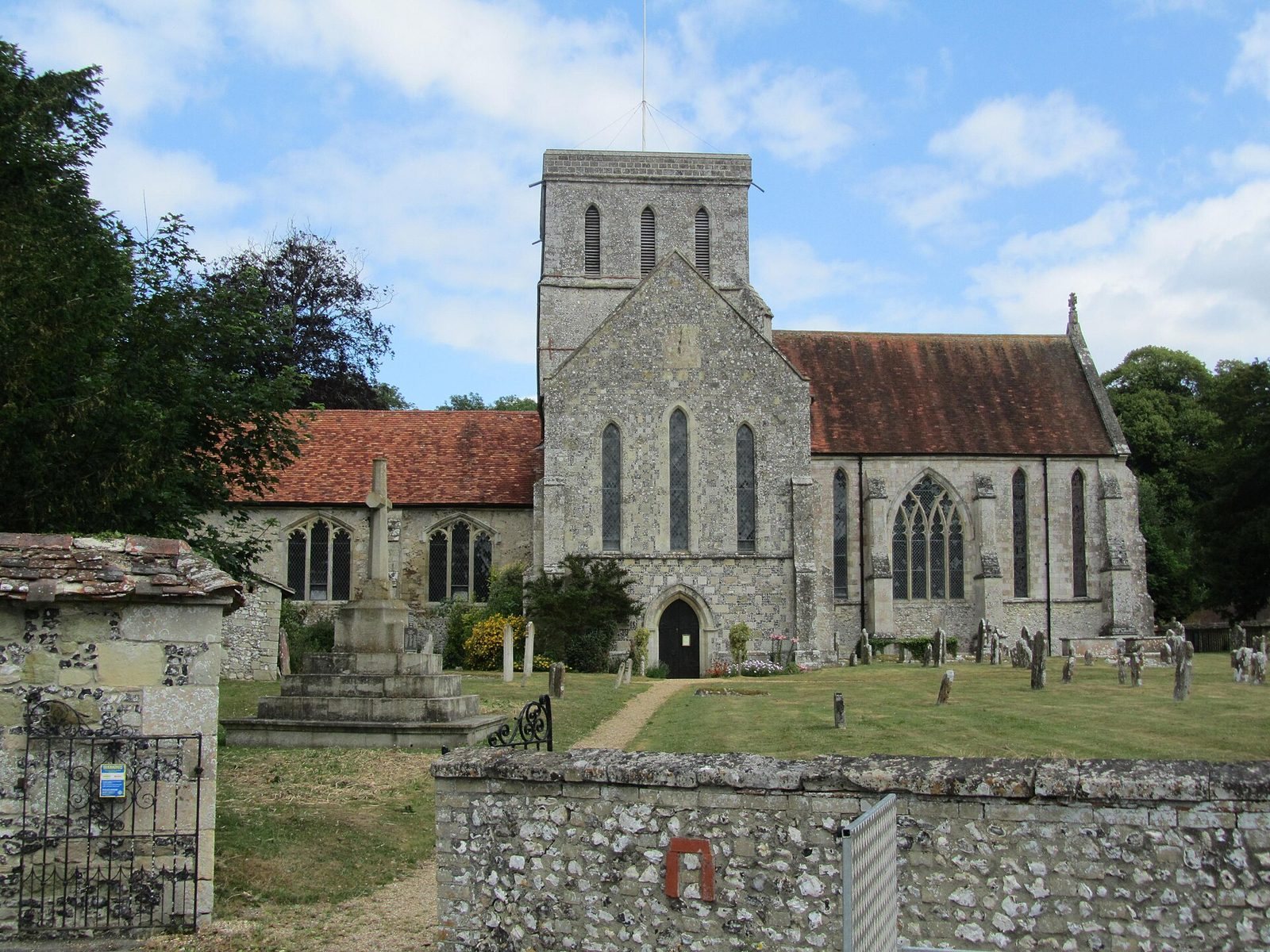
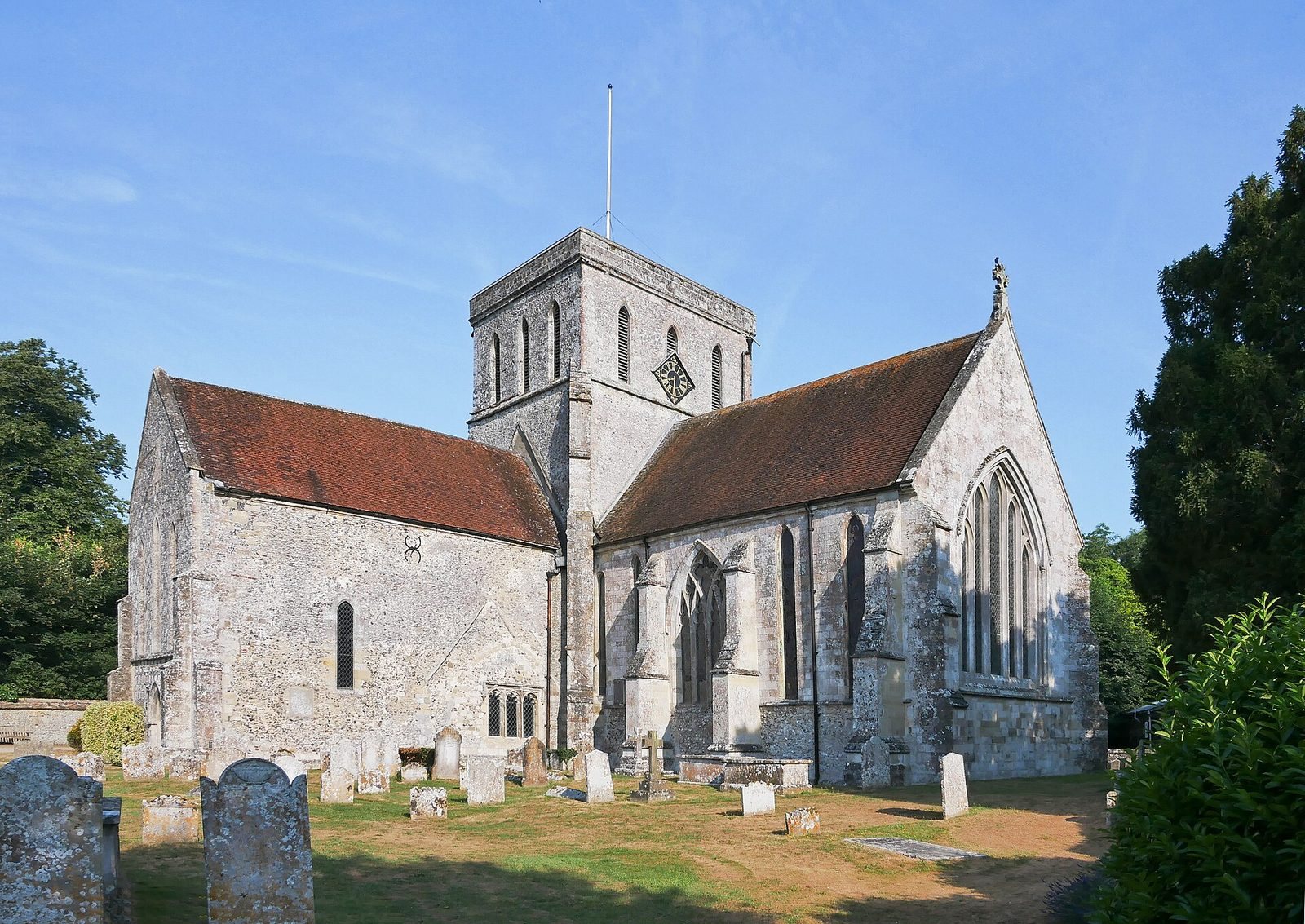
The former monastic precinct covered about five hectares and contained a church along with numerous residential and service buildings. The Church of St Mary and St Melor, now an Anglican parish church, may be the former priory church. Its dedication preserves the association with the veneration of St Melor.
The country house
The nearby country house called Amesbury Abbey was built for Sir Edmund Antrobus between 1834 and 1840, replacing an earlier house erected around 1660–61 for William Seymour, Duke of Somerset. It has three storeys and attics. Its principal south front is nine bays, or façade sections, with five set behind a portico, a roofed entrance supported by six composite columns combining Ionic and Corinthian forms. The house stands within parkland and pleasure grounds covering about 56 hectares.