Montluc Fort: A Nineteenth-Century Defensive Fortification in Lyon
Site at a Glance
- Popularity
- Medium
- Country
- France
- Primary era
- Modern
- Eras represented
- Modern
- Civilizations
- French
- Site type
- Military
- Remains
- Fort
On this page10 sections
History
Construction and military decline
Montluc Fort, originally called Fort de Villeurbanne, is a nineteenth-century defensive fortification in Lyon, France. French authorities built it from 1831 to 1835 as part of the city’s first defensive ring, one of successive fortification systems around Lyon. Construction took place under Louis-Philippe I, king of the French from 1830 to 1848, and was directed by General and military engineer Rohault de Fleury.
The fort later became barracks for Lyon’s garrison. In 1887, it was renamed for Blaise de Montluc, a sixteenth-century French soldier and military writer who held the rank of Marshal of France. By the 1870s, the fort’s defenses were considered outdated, and a second defensive ring was built around Lyon. During the 1870s and 1880s, curtain walls, the stretches connecting defensive works, and bastions, projecting parts of a fortification, were demolished. The glacis, sloping cleared ground outside a fortification, and the ditches were leveled. The cleared area was used for military drills and later held buildings including a military court. By the end of the nineteenth century, the regional military administration occupied the glacis.
Military prison and wartime occupation
A separate military prison was built on the fort’s southern glacis in 1921. It closed in 1932, then reopened at the beginning of the Second World War. From early 1943, German occupying forces used it, especially the Gestapo, Nazi Germany’s secret state police. Up to 10,000 people passed through the prison during this period. Most were deported to German concentration camps, while many others were executed in the Lyon area. The prison continued operating after the war and became a memorial in 2009.
Police use
On 10 July 1949, Republican Security Company No. 141 moved to the fort from Albigny-sur-Saône. The Republican Security Companies, known as the CRS, are France’s mobile national police force. After a reorganization, the unit became CRS No. 45 on 1 January 1964 and stayed at the fort until moving to Chassieu on 1 February 1982. The fort passed to the French Ministry of the Interior in 1969. Between 2005 and 2007, it was converted into the headquarters of the French National Police in Lyon. Since 2007, it has served as the second police headquarters in the Lyon urban area.
Remains
Fort layout and surviving structures
Trapezoidal enclosure
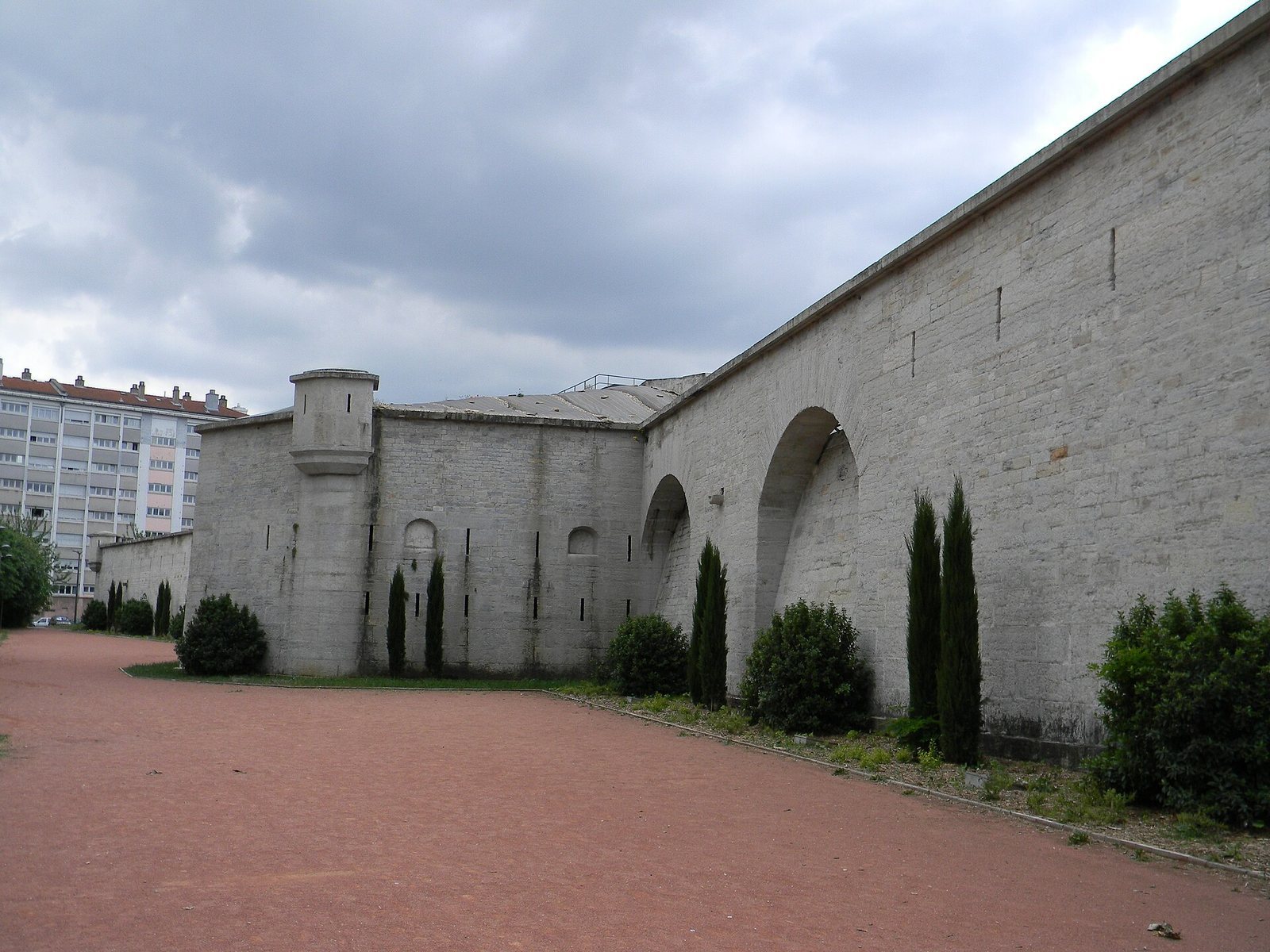
The fort had a trapezoidal plan, with a shorter eastern side facing the anticipated enemy and protecting the suburb of Guillotière. A bastion stood at each corner of this side. The longer western side faced the city and had a bastion at either end. Water surrounded the fort, and a wooden bridge provided access.
Western entrance tower
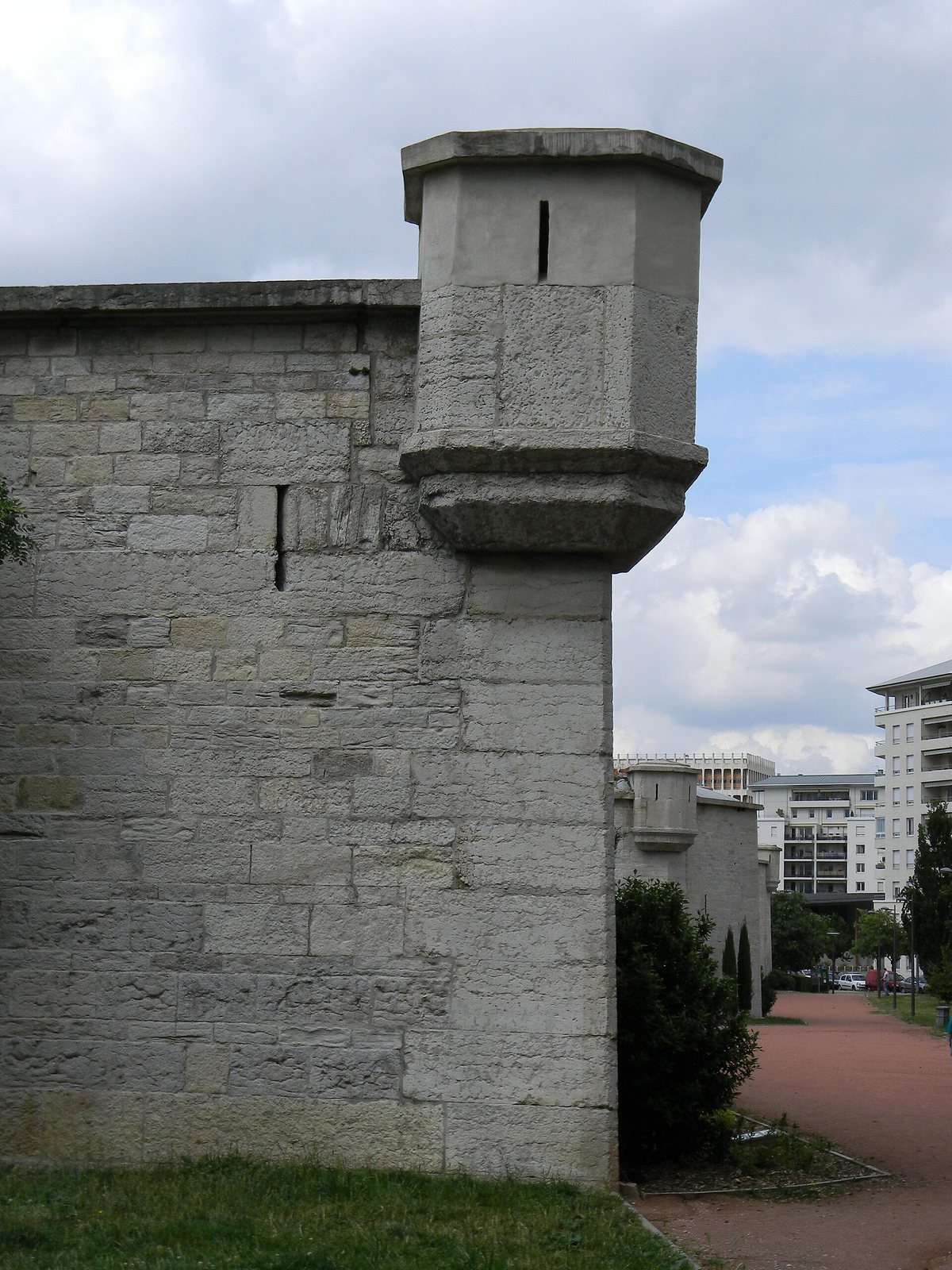
The western entrance gate was protected by a nearly cubic outer watchtower with four small sentry turrets. The watchtower survives as an original part of the fortification.
Cavalier and barracks
A large, two-storey cavalier, a raised artillery platform within the fort, stood at its center and could accommodate up to 600 men and 67 guns. A barracks building with another tower stood to its west. During the 2005–2007 conversion, new buildings were constructed inside the fort while its exterior fortress appearance was preserved.
Site setting and southern glacis
The fort occupies the left bank of the Rhône in Lyon’s 3rd arrondissement. Rue du Général Mouton-Duvernet forms its western boundary, with the Collonges-Fontaines–Lyon-Guillotière railway line beyond; Rue Jeanne Hachette bounds it to the east and south. The former Montluc military prison stands immediately south of the fort on the southern glacis. The fort’s former glacis, once used for military facilities, is now the site of a garden square.