Elmley Castle: A Medieval Stronghold and Beauchamp Family Seat
Site at a Glance
- Popularity
- Medium
- Country
- United Kingdom
- Primary era
- Medieval
- Eras represented
- Medieval
- Civilizations
- Norman
- Site type
- Military
- Remains
- Castle
On this page8 sections
History
Elmley Castle is a late 11th-century stronghold on the flanks of Bredon Hill in the United Kingdom, about 0.5 mile south of Elmley Castle village and 12 miles southeast of Worcester.
Possible Iron Age use and castle foundation
The hill may have been used as an Iron Age camp. Two other sites of that period, Kemerton Camp and Conderton Camp, lay nearby on Bredon Hill.
The timber-and-earthwork castle was probably commissioned by Robert le Despenser d’Abetot, steward to King William II. A steward managed the ruler’s household and estates. Robert died without children around 1098, and his brother Urse d’Abetot became his sole heir. The castle later entered the Beauchamp family through the marriage of Urse’s daughter Emmeline to Walter de Beauchamp.
Beauchamp seat and Earls of Warwick
Elmley Castle remained the Beauchamp family seat until 1268. That year, William de Beauchamp, a high-ranking noble and 9th Earl of Warwick, inherited the title and Warwick Castle from his maternal uncle, William Maudit, 8th Earl of Warwick. Elmley then became a secondary possession of the Earls of Warwick.
Crown ownership and decline
The castle was surrendered to the Crown in 1487. It apparently remained habitable in 1528, when Walter Walshe was appointed its constable and keeper. A survey in 1544, before the manor and castle were granted to Sir William Herbert and Christopher Savage, found the buildings wholly uncovered and decaying. The site is a Scheduled Monument, a legally protected archaeological or historic site in England.
Remains
Castle earthworks and associated landscape
Castle remains
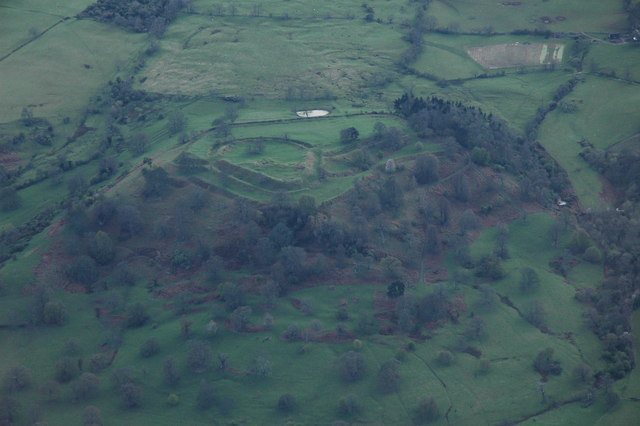
Elmley Castle was a motte-and-bailey structure, combining a raised earth mound with an enclosed courtyard. Its timber buildings and defenses were set within earthworks, with stone additions dating to the 12th century and possibly the 13th. Only earthworks survive today. In the 16th century, John Leland, an English antiquary, described a partly ruined tower on the summit of a wooded hill, with a small town nearby.
Medieval deer park
The outline of the medieval deer park surrounding the castle also survives. Such a park was an enclosed area managed to keep deer and other game.