Palazzo Saporiti: A Neoclassical Palace in Milan
Site at a Glance
- Popularity
- Medium
- Country
- Italy
- Primary era
- Modern
- Eras represented
- Modern
- Civilizations
- Unclassified
- Site type
- Domestic
- Remains
- Elite Residence
On this page6 sections
History
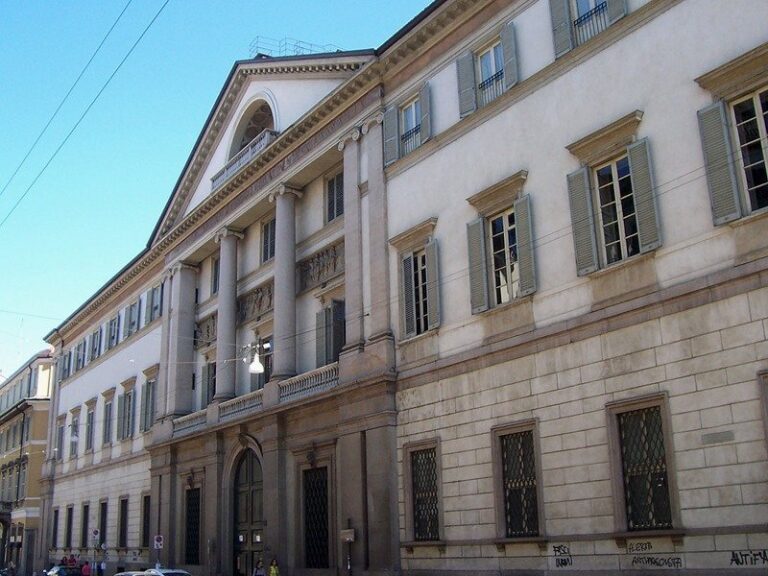
Palazzo Saporiti, also known as Palazzo Rocca-Saporiti, is a Neoclassical palace in Milan, Italy. Commissioned in 1800 and completed in 1812, it was built during redevelopment around Porta Orientale, Milan’s historic Eastern Gate. Its design combines Neoclassicism, a revival of ancient Greek and Roman forms, with Palladian influence, an adaptation of classical architecture associated with the Italian architect Andrea Palladio.
Land and construction
The land had belonged to the Capuchin Friars, a branch of the Franciscan religious order, before the Austrian administration suppressed monastic orders. A plaque opposite the palace recalls a convent that once stood there. The convent also appears in The Betrothed, the nineteenth-century novel by Alessandro Manzoni.
Gaetano Belloni commissioned the palace as part of the area’s redevelopment. Although the project bears architect Innocenzo Giusti’s signature, Giovanni Perego carried out the work. Perego was a noted stage designer at La Scala, Milan’s opera house, but was not a professional architect and could not sign the project.
Change of ownership
Belloni had made his fortune managing gambling at La Scala. After Napoleonic rule ended, gambling was prohibited, leaving him deeply in debt and prompting him to sell the residence to the Rocca-Saporiti marquises of Genoa. The palace now houses a Swiss bank.
Remains
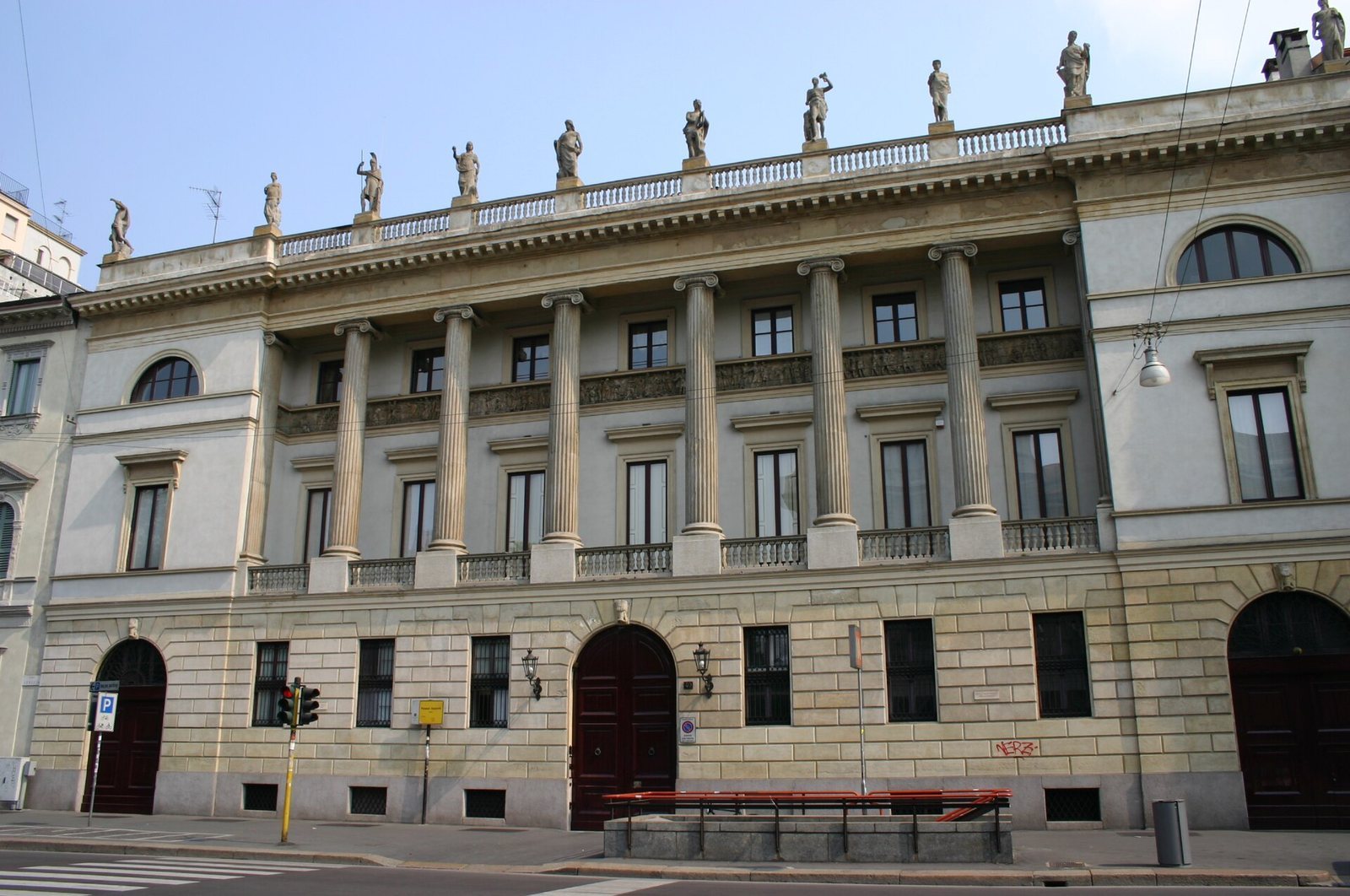
At Corso Venezia 40 in central Milan, Palazzo Saporiti has a Neoclassical design influenced by Palladian architecture. Its street-facing façade is centered on a large colonnade, while the ballroom occupies the front of the principal floor above ground level.
Exterior
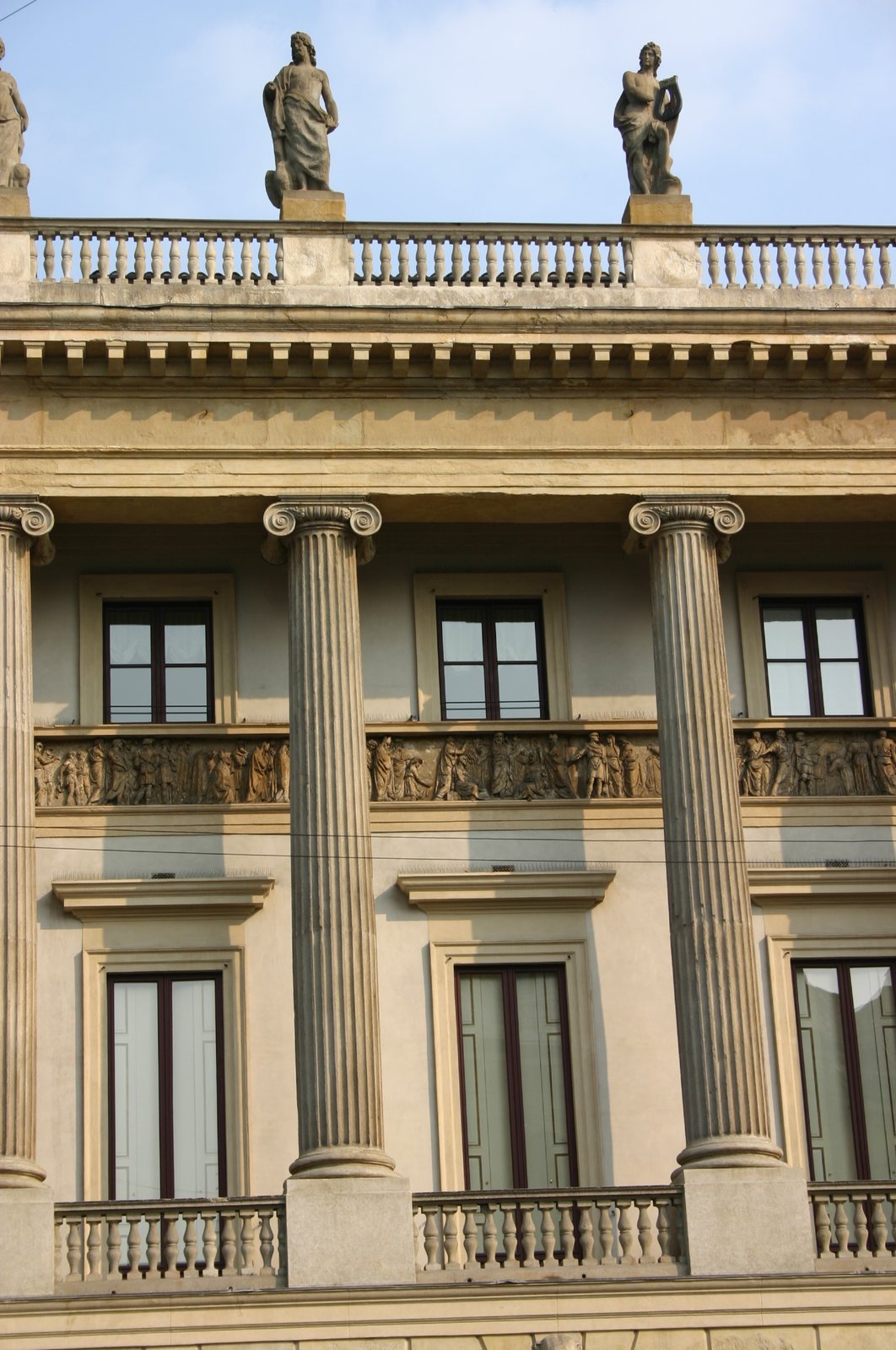
A broad colonnade of Ionic columns, with their characteristic scroll-shaped capitals, forms an open-sided gallery from which processions in the street below could be watched. At ground level, subtle joints articulate the smooth masonry, and a heraldic elephant stands above the central entrance. A horizontal band of shallow relief sculpture between the first and second floors depicts episodes from Milan’s history. A balustrade crowns the gallery and supports statues of the Dii Consentes, the twelve major deities of Roman religion, sculpted by Pompeo Marchesi and Grazioso Rusca.
Interior
The ballroom fills the front of the principal floor, known as the piano nobile. Its decoration includes stucco and frescoes.