Visconti Castle of Cassino Scanasio: A Medieval Defensive Complex
Site at a Glance
- Popularity
- Medium
- Country
- Italy
- Primary era
- Medieval
- Eras represented
- Medieval, Early Modern
- Civilizations
- Duchy of Milan
- Site type
- Military
- Remains
- Castle
On this page7 sections
History
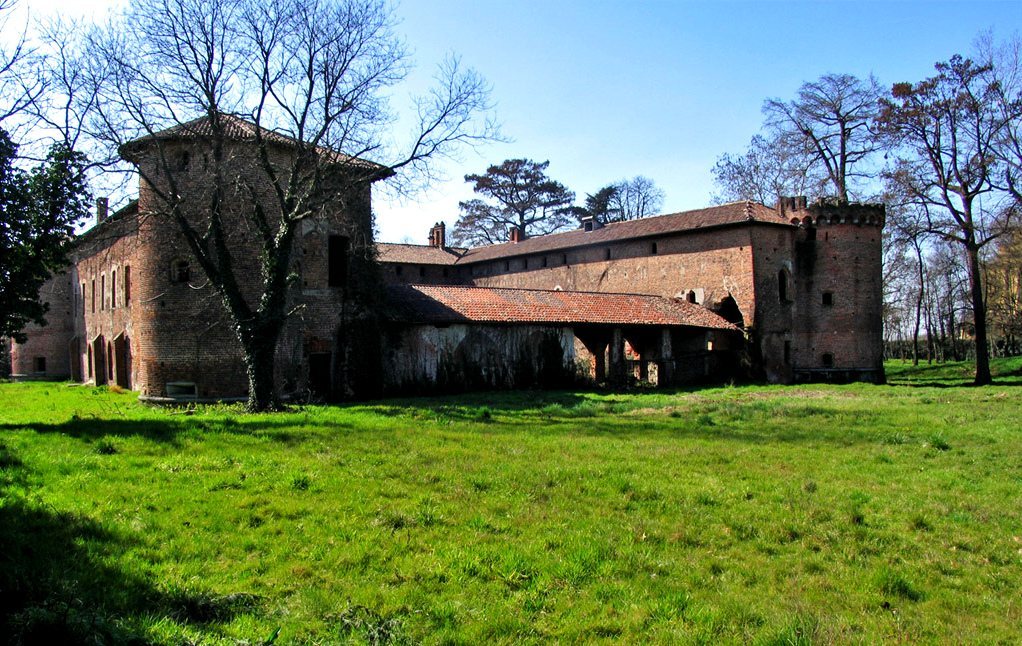
The Visconti Castle of Cassino Scanasio is a medieval defensive complex in Rozzano, Lombardy, Italy. Its visible structures are generally dated to the 14th century, within a broader construction phase assigned to the 14th and 15th centuries. The castle defended Rozzano and occupied a position useful for controlling access to Milan and the surrounding countryside. Milan was the center of the Duchy of Milan, a duchy in northern Italy. Cassino Scanasio is a hamlet of Rozzano, and the castle is also known as the Castle of Rozzano.
Origins and medieval defense
The castle’s beginnings are tentatively linked to an 11th-century fortified rural holding and its associated lands. It is also connected with fighting between Milanese forces and Frederick I, known as Barbarossa, the Holy Roman Emperor. The date associated with this conflict, 1239, is inconsistent with Barbarossa’s death in 1190.
Country residence and later ownership
In the early 16th century, the Milanese Trivulzio family acquired the castle and converted it from a fortification into a country residence, adding cylindrical towers. Its strategic military role ended in the 17th century. By 1638 it belonged to the Pirovano family, and it later passed to the Della Croce family.
In 1836, the Visconti di Modrone family, a branch of the Visconti, acquired the castle and turned it into an agricultural enterprise.
Remains
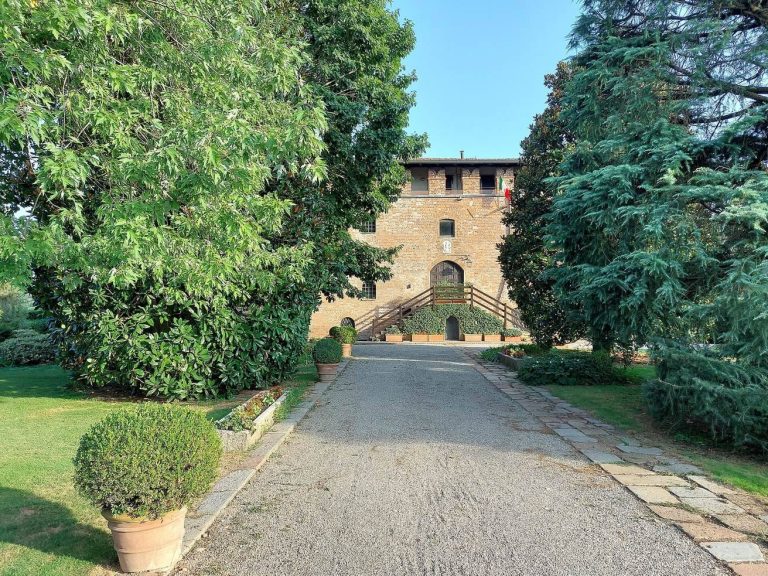
The complex has a quadrangular plan and is built of brick, stone, and wood. Its condition is described as good.
Moat and towers
A water-filled moat once encircled the castle but has since been filled in. Its infill conceals the tower bases, making the towers appear unusually squat. The cylindrical towers were built later than the walls.
Entrance defenses
A brick ravelin, an outer defensive work in front of a fortification’s entrance, provides access to the complex and replaced what was probably a wooden drawbridge. A masonry bridge leads to the main entrance. The arch bears the Visconti serpent, an emblem of the family, on its keystone, the central stone at the arch’s crown.
Facade and windows
The facade has Gothic-style windows with pointed arches, each formed as a single opening.