Hallyards Palace: A Bishops’ Residence and Reformation-Era Country House
Site at a Glance
- Popularity
- Medium
- Country
- United Kingdom
- Primary era
- Unclassified
- Eras represented
- Unclassified
- Civilizations
- Unclassified
- Site type
- Domestic
- Remains
- Elite Residence
On this page5 sections
History
Hallyards Palace, also known as Hallyards Castle, is a ruined country house on farmland northwest of Auchtertool in the United Kingdom. Tradition identifies it as a hunting seat of Malcolm Canmore, or Malcolm III, king of Scots in the eleventh century. The name Hallyards is glossed as “the yards at the hall.”
Episcopal residence and early owners
After the Roman Catholic Church became established in the district, Hallyards served as the residence of the Bishops of Dunkeld, the bishops of the Scottish diocese centered on Dunkeld. They remained there until 1539, when a lay proprietor took possession for the first time.
During the ownership of James Kirkcaldy of Grange, James V visited Hallyards shortly before his death. John Knox wrote that the murder of Cardinal David Beaton may have been discussed during the visit.
Reformation conflict and royal visits
During the Scottish Reformation, French troops fought at Hallyards against the Lords of the Congregation, Protestant nobles who opposed Mary of Guise’s government and French intervention. William Kirkcaldy of Grange fought with the reformers and came close to betrayal at a place called Hawyairdeis. French troops blew up the house. John Knox recounted that Mary of Guise taunted him that her God was stronger than his, even in Fife. By February 1560, Hallyards had been destroyed down to its foundations. Kirkcaldy later took revenge on a Savoyard captain named Sebastian and his 50 French troops.
At Easter 1562, James Hamilton, 3rd Earl of Arran, escaped confinement at Kinneil House, where his father had held him, using a rope made from bedsheets. After crossing the Forth, he went to Hallyards before meeting Mary, Queen of Scots, at Falkland Palace.
During the Chaseabout Raid, a 1565 rebellion against Mary, she and her husband, Lord Darnley, ordered James Stewart, 1st Earl of Moray, and William Kirkcaldy of Grange to surrender Hallyards, Ballinbreich Castle, and the Abbot’s house at St Andrews to their officers. After Prince James was baptized at Stirling Castle in December 1566, Moray took the English ambassador, the Earl of Bedford, on a tour of Fife that included Hallyards.
In the Marian Civil War, the conflict between Mary’s supporters and those governing in the name of her son, William Kirkcaldy supported the queen and held Edinburgh Castle for her. On 4 February 1572, James Douglas, 4th Earl of Morton, sent soldiers to destroy Hallyards and the crops in its fields.
Later ownership and decline
Hallyards later passed through the hands of John Boswell of Balmuto, William Forbes of Craigievar, and members of the Skene family before coming to the Earls of Moray. Its name changed to Camilla Castle. Local tradition connects Camilla with a Countess of Moray, although no countess by that name is known; Camilla is the name more commonly used in Auchtertool today.
The Earls of Moray lived at a distance, and Hallyards fell into disuse. A member of the Skene family returned in 1819 and found the house dilapidated. The great house was largely demolished in 1847.
Remains
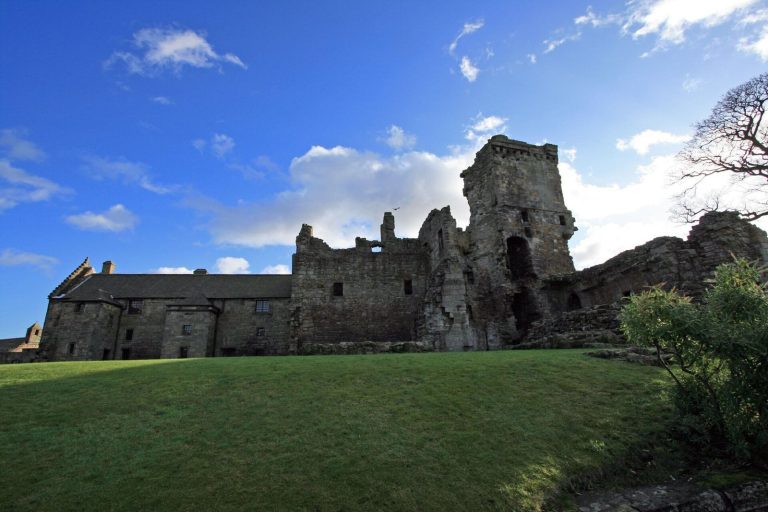
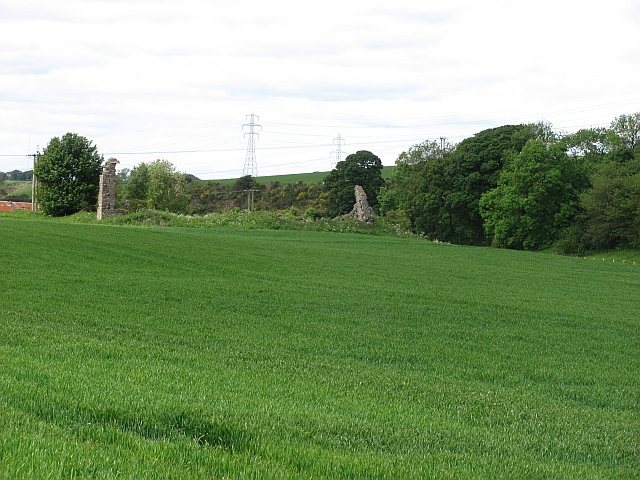
Hallyards survives as the ruin of a country house on farmland northwest of Auchtertool. A nearby water feature may have been called Camilla Loch.