Palazzo Ducezio: The Baroque Town Hall of Noto
Site at a Glance
- Popularity
- Medium
- Country
- Italy
- Primary era
- Early Modern
- Eras represented
- Early Modern, Modern
- Civilizations
- Italian, Kingdom of Sicily, Kingdom of the Two Sicilies
- Site type
- Civic
- Remains
- Town Hall
On this page8 sections
History
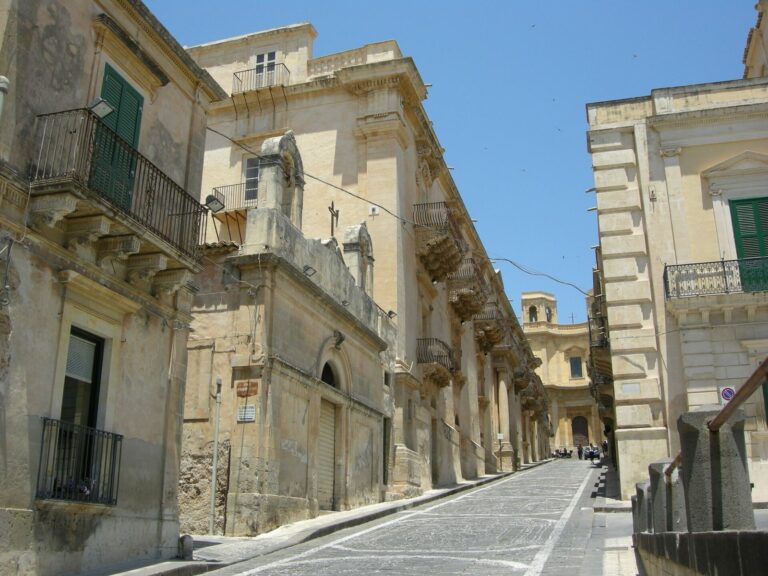
Palazzo Ducezio is the town hall of Noto, in Sicily, Italy. Developed during the rebuilding that followed the 1693 earthquake, it took shape from the 1740s to around 1760, with construction beginning in 1746. Its late Baroque and Rococo design draws on seventeenth-century French palaces; Rococo was a decorative style associated with eighteenth-century France. The palace is named for Ducezio, a fifth-century BCE leader of the Sicels, an ancient people of Sicily, who is credited with founding Noto’s original settlement.
Aristocratic residence and civic government
As Noto was rebuilt, local nobles sought homes near the reconstructed cathedral and the center of religious authority. Palazzo Ducezio was built opposite the cathedral as an urban residence. Its design followed French palace models, while the ground floor was completed during the nineteenth century. After Italian unification, when the country became a single state, the palace became Noto’s town hall. Its Hall of Mirrors served as a municipal reception room for heads of state and official delegations.
Twentieth-century changes
At the beginning of the 1930s, painter Gregorietti restored the Hall of Mirrors for the official visit of Umberto and Marie-José of Savoy, then Prince and Princess of Piedmont. A Neobaroque upper storey was added in 1949–1951. The Hall of Mirrors closed in the 1990s and reopened after restoration on 14 July 2001. The reopening coincided with a Hungarian government delegation’s visit, connected with Noto’s twinning with Hungary. The relationship was associated with Hungarian poet Sándor Petőfi and Giuseppe Cassone, Petőfi’s Italian translator.
Palazzo Ducezio is part of the UNESCO World Heritage property covering the Baroque towns and buildings of Val di Noto. World Heritage recognition is given to places considered to have outstanding universal cultural or natural value.
Remains
Facade and entrance
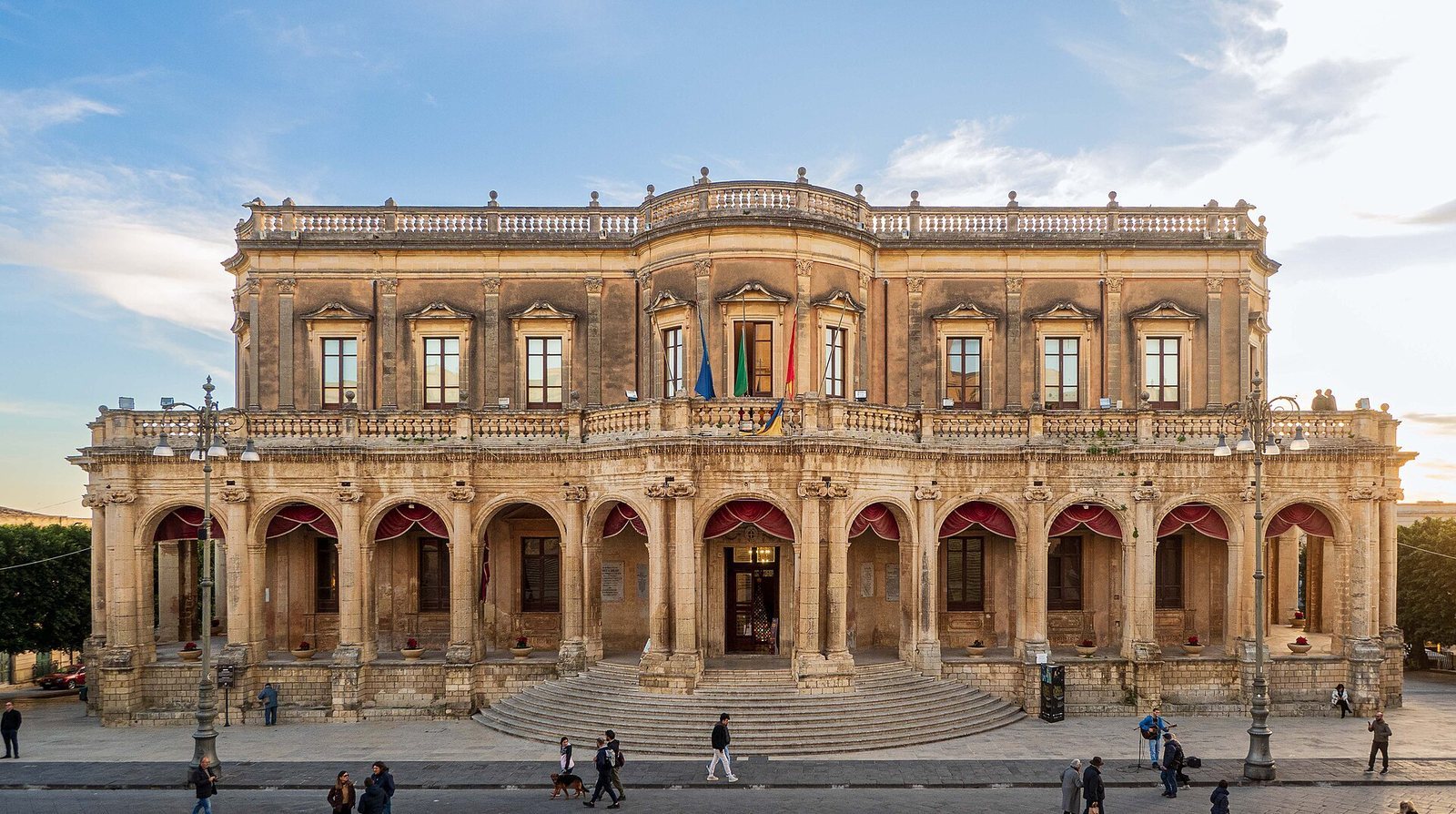
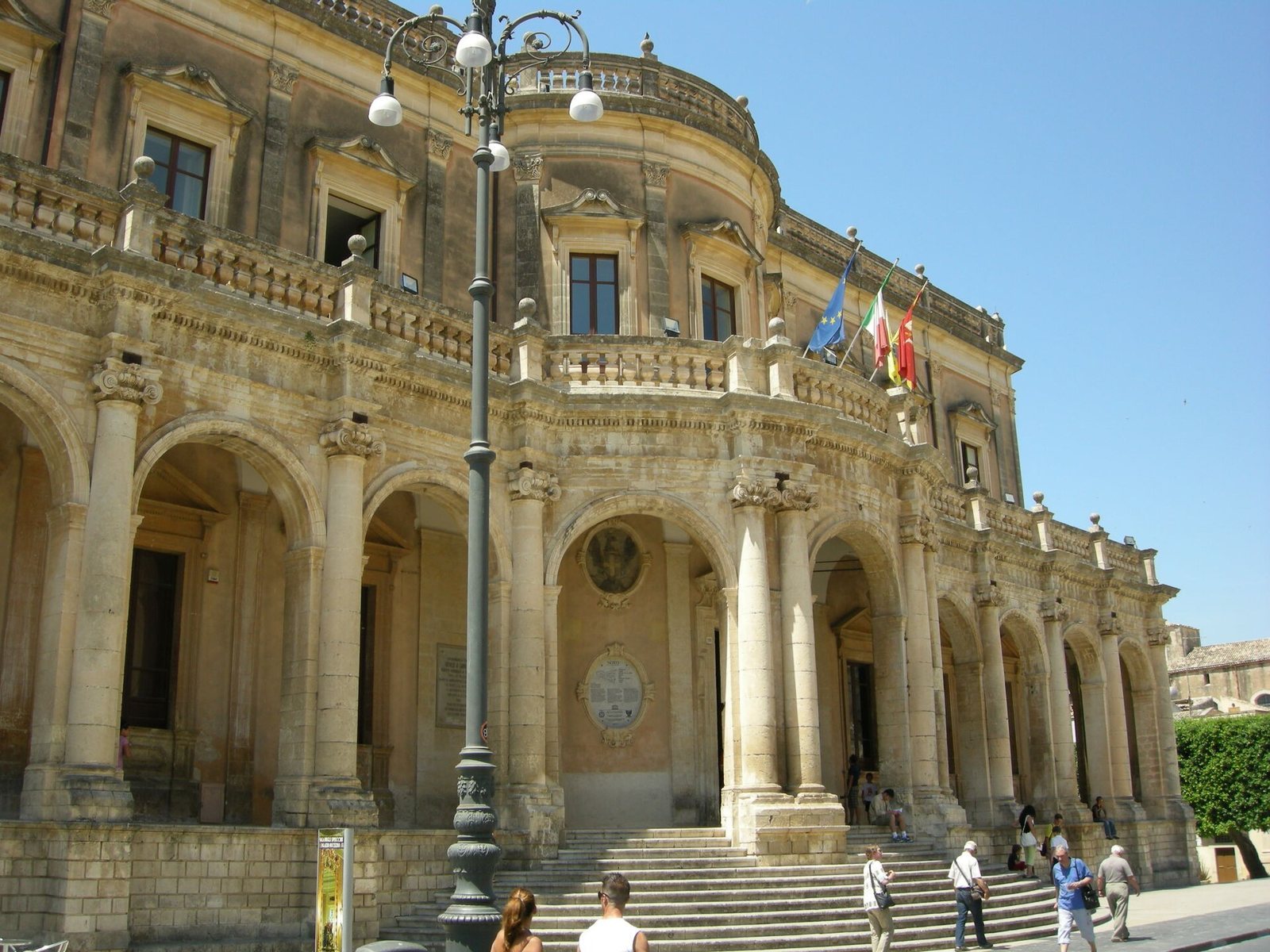
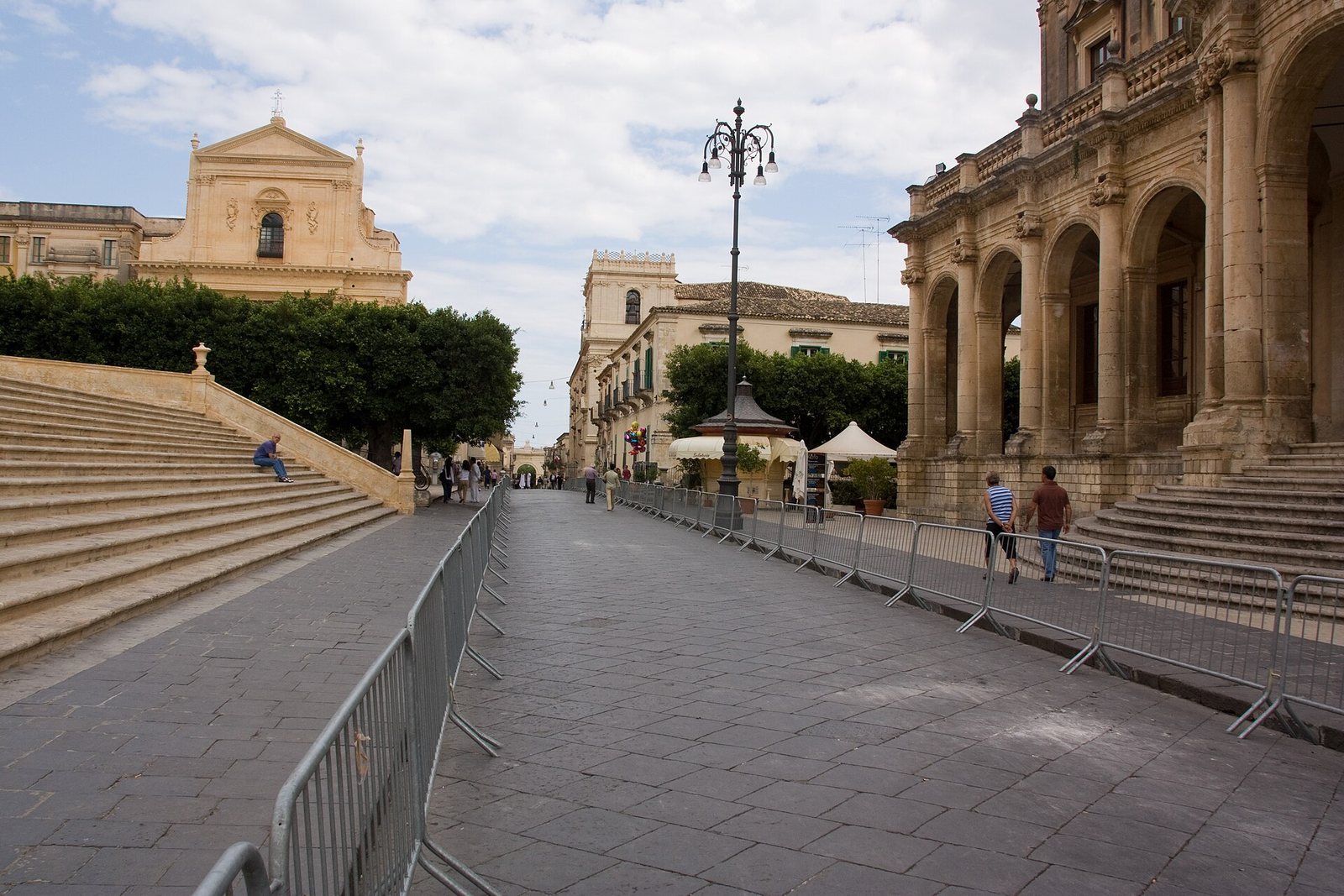
The palace has a convex façade that brings together its eighteenth-century ground floor and later Neobaroque upper storey. Twenty arches line the lower floor, supported by Ionic columns, a classical form distinguished by scroll-shaped capitals. Above them are thirteen rectangular windows. A marble bust donated by the Hungarian government stands at the town hall entrance.
Hall of Mirrors
Room and furnishings
The oval Hall of Mirrors dates to around 1830. In the late nineteenth century, it received stucco decoration, gilding, mirrors, and furnishings in the Louis XV style, a form of decorative art associated with eighteenth-century France. Master Dugo, a craftsman with the Franza Company, made the furnishings; Sebastiano Dugo, an artist from Avola, carved the large mirrors.
Ceiling painting and inscriptions
The ceiling painting on wet plaster, The Foundation of Neas, was made in 1826 and is attributed to Antonio Mazza. This neoclassical scene presents Ducezio, king of the Sicels, with an officer of the military engineering corps pointing to Neas on Mount Alveria. It associates Neas with the pre-Greek rebuilding of fortified Noto Antica as a defense against Greek attack. Inscriptions on the side panels refer to Noto’s achievements and draw on Diodorus Siculus, an ancient Greek historian, as well as Littara and Randazzo. A telegram sent in 1860 by Italian unification leader Giuseppe Garibaldi to Noto’s patriots is displayed on the left side of the hall.