Château de Bourdeau: A Medieval Fortified Manor House in France
Site at a Glance
- Popularity
- Medium
- Country
- France
- Primary era
- Medieval
- Eras represented
- Medieval, Early Modern, Modern
- Civilizations
- Duchy of Savoy, French, Holy Roman Empire
- Site type
- Domestic
- Remains
- Castle
On this page10 sections
History
A medieval stronghold and the Seyssels
The Château de Bourdeau is a fourteenth-century fortified manor house on the western shore of Lake Bourget in France. It became the seat of the lordship of Bourdeau, later elevated to a barony, a lordship held by a baron. The site may have been occupied as early as Roman times, and a structure called an astrium may have housed an official responsible for boats. A small fort was later destroyed by forces broadly called Saracens in medieval European usage, a term for Muslim peoples rather than a precise identification. The fort was rebuilt in the ninth or tenth century and restored in the twelfth.
The Seyssels, a noble family of Savoy, were the château’s first lords and retained it until 1570. In 1263, Humbert I de Seyssel, lord of Bourdeau and Aix-les-Bains, pledged fealty. His son Guy succeeded him. On 17 March 1316, Guy’s great-nephew Humbert III received from Amédée V, count of Savoy, seigneurial rights that included authority over cases at the highest, intermediate, and lowest levels. Humbert III’s son Aymard succeeded him, followed by Aymard’s sons Geoffroy, Jean, and Pierre.
The castle was established by 1330, when it successfully resisted an attempt by the Dauphins of Viennois, rulers of the medieval principality of Dauphiné, to seize it. In 1344, the Bourdeau family held it as a sub-fief under the Seyssels; that family’s line ended in the eighteenth century. Pierre de Seyssel, Viscount of Novalaise, was lord of Bourdeau in 1390.
From the Livrons to the Sallier de La Tours
A weapons manufactory operated at the château in the sixteenth century. The French writer Michel de Montaigne mentioned it in his travel journal covering 1580-81. After Claude de Seyssel died, his daughter Jeanne inherited the property and brought it as her dowry to Louis de Livron on 2 August 1570. It remained with the Livron family until another Louis bequeathed it to the Jesuit college of Chambéry, a school run by the Catholic religious order, on his death on 22 November 1671.
The Jesuits sold the château on 7 July 1688 to Antoine Sallier de La Tour de Cordon, president of the Chamber of Accounts, an institution responsible for financial oversight. Antoine left it to his younger son Philippe, a diplomat at The Hague who later became minister of war and was made baron of Bourdeau. Philippe’s son François succeeded him in 1707. Victor Amédée de Sallier de La Tour de Cordon held the property until he emigrated in 1793.
Revolution and later restoration
The keep was already in ruins before the French Revolution. An inventory from 1710 described the château’s walls and courtyard as ruinous and noted the great gate. During the Revolution, the fortifications were dismantled and the ditches filled. On 3 April 1800, the château was declared national property, placing it under state ownership for sale. It was bought by Jean-Baptiste Viviand of Chambéry, who sold its stones for the construction of a new parish church.
Viviand’s heirs exchanged the property in 1810 with Antoine Métral, a lawyer in Chambéry, who carried out restoration work. Métral’s heirs sold it on 2 October 1850 to Joseph-Louis-Thomas Girod, first president of the Imperial Court of Chambéry. George Sand stayed at the château in 1863 while writing Mademoiselle la Quintinie, which uses the building as a setting. Her description evokes the steep, jagged mountain face and the lake’s long, winding shape, clear blue water, and shifting reflections. The poet and statesman Alphonse de Lamartine also stayed there during the nineteenth century. A drawing by Chardin depicts the château in 1857.
In 1875, Girod undertook a major restoration with an architect, giving the château a renewed appearance. Alexis Gigot de Villefaigne, formerly a jeweler in Saint Petersburg, bought it in 1880. His descendants owned it until 2010, when it was sold to a Parisian family in a purchase associated with Jean-Luc Michaux. The building served as a restaurant until 1955, after which it returned to private use as a château.
Remains
The medieval defensive plan
Setting, enclosures, and residence
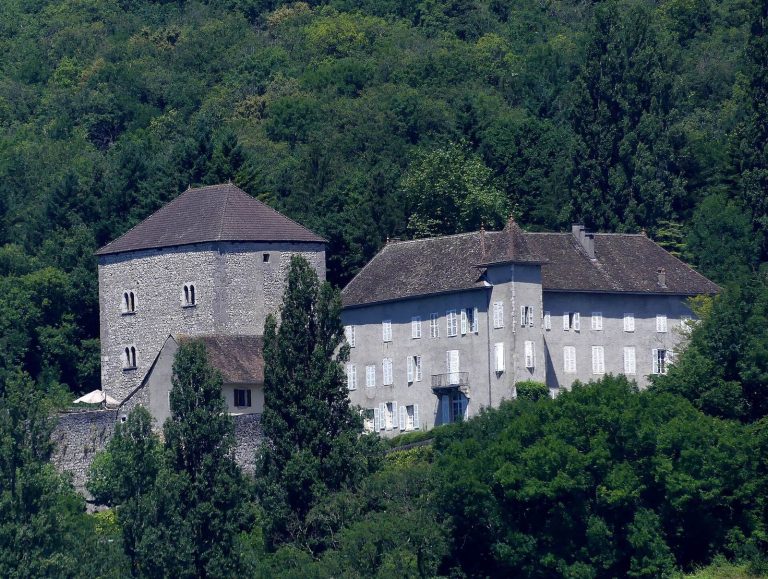
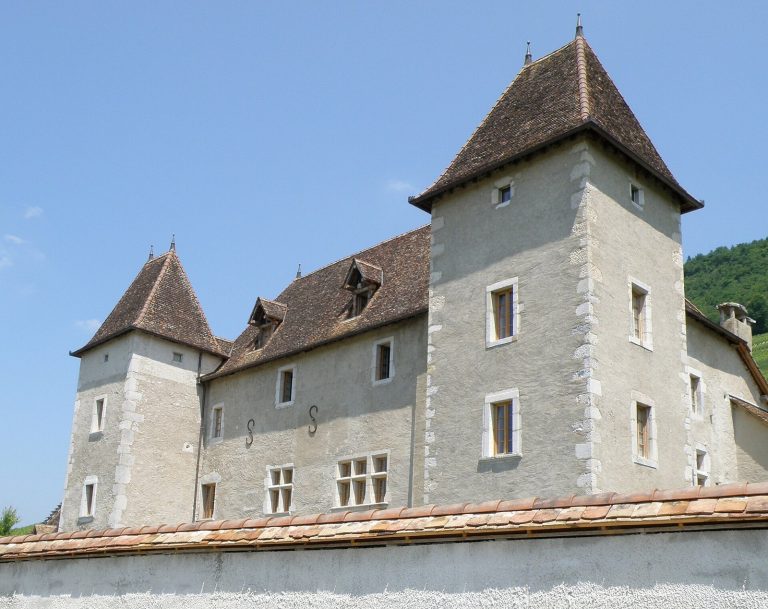
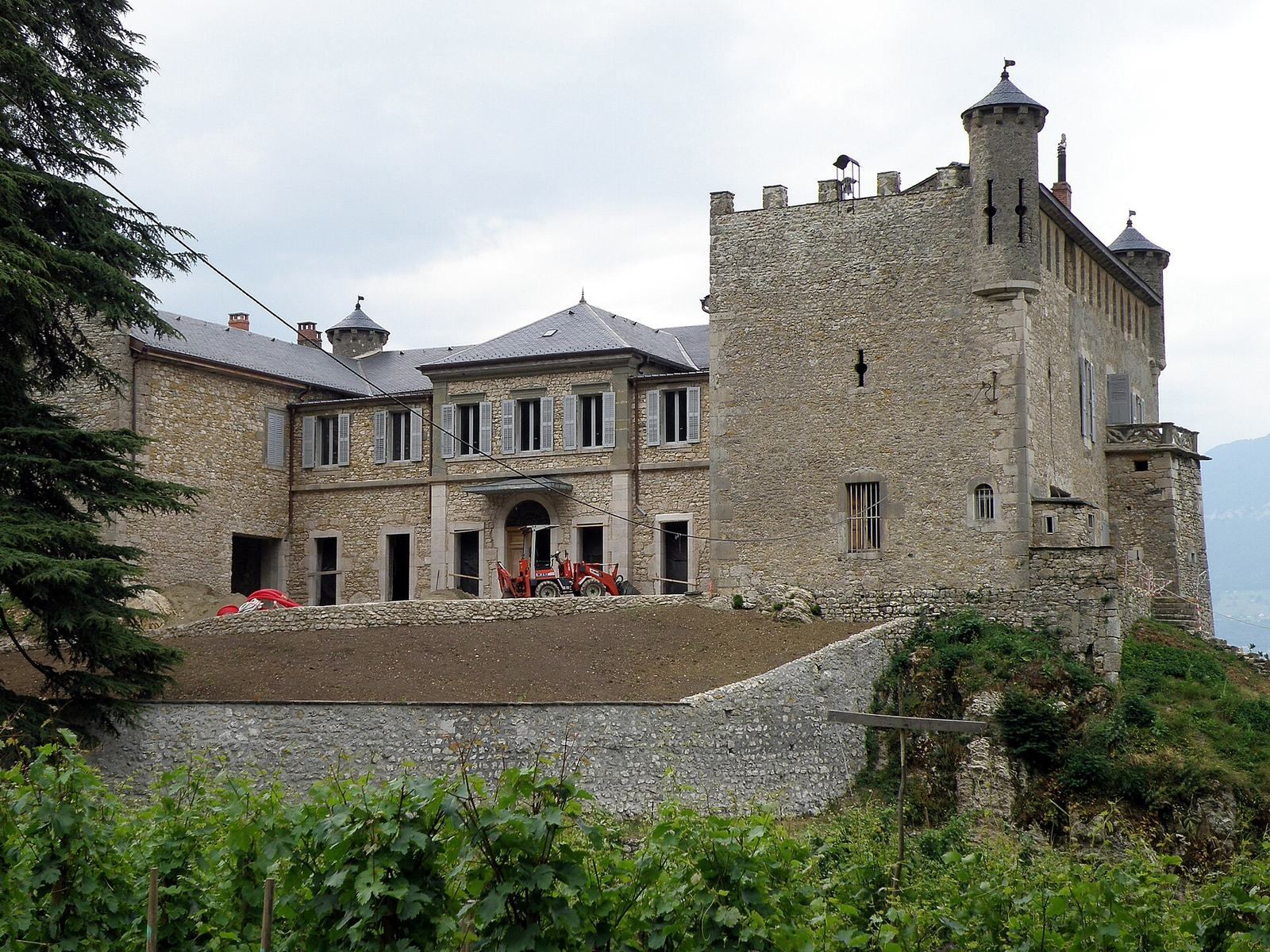
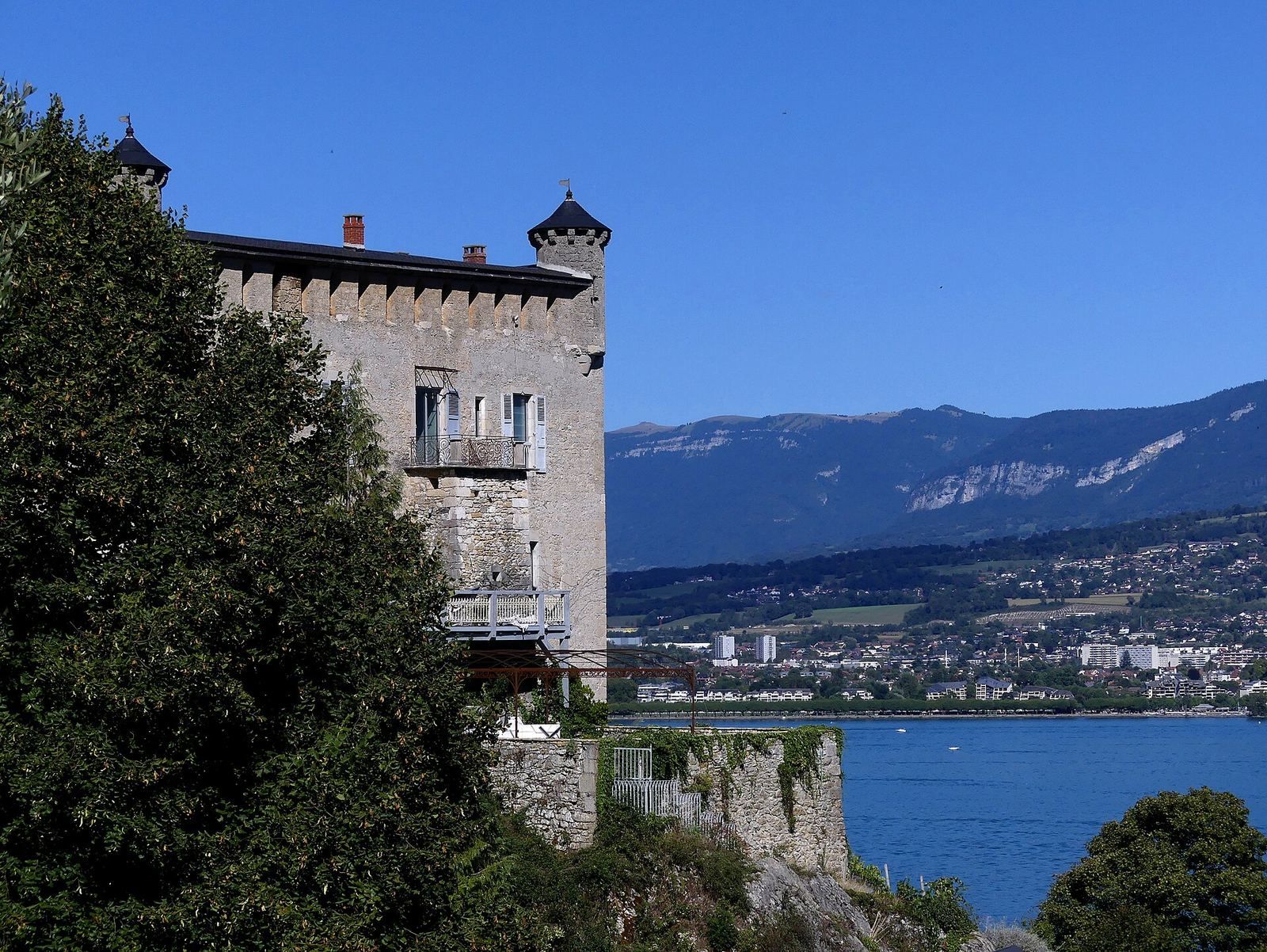
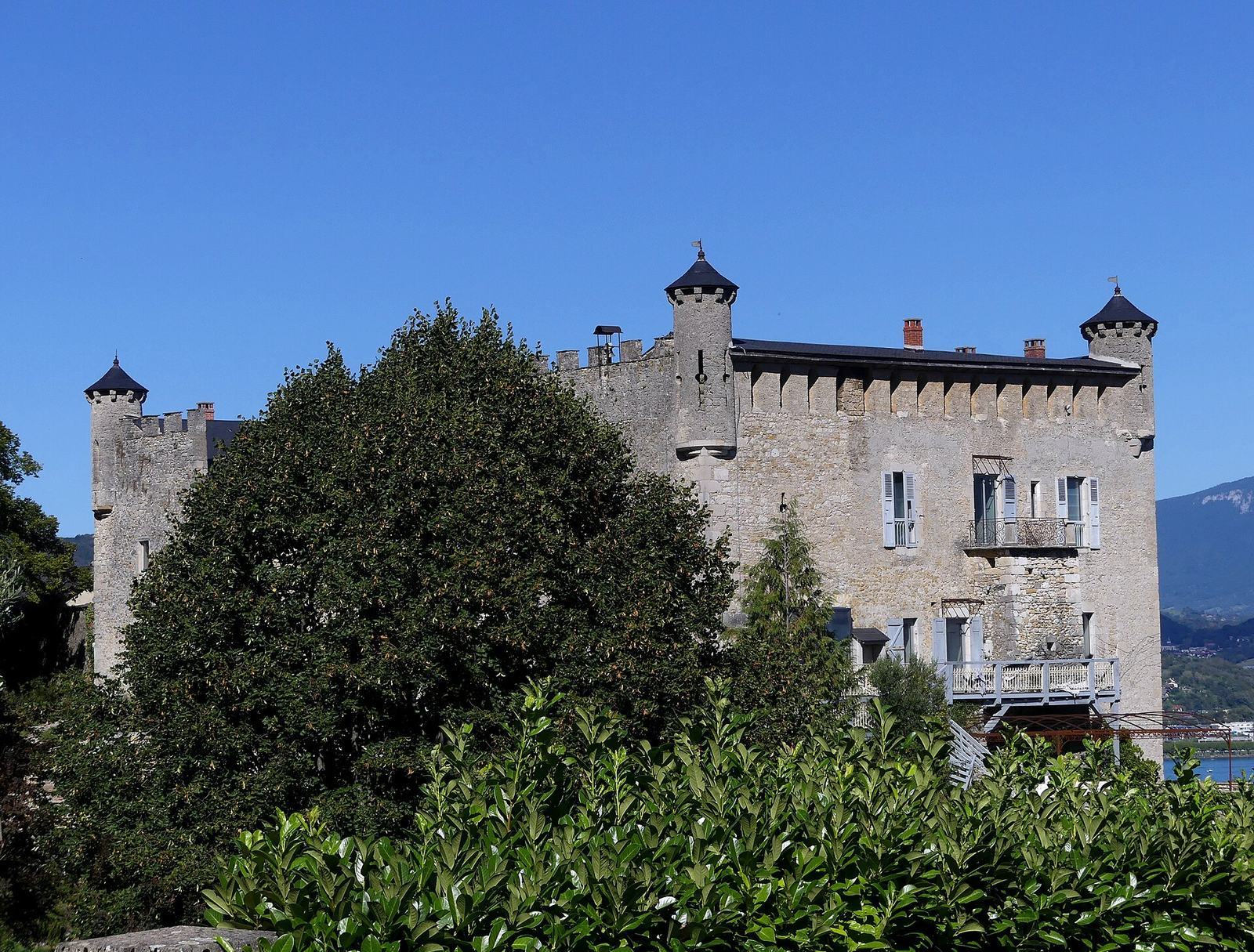
The château stands on a terrace at the foot of Mont du Chat, above Bourdeau Cove and about 80 metres above Lake Bourget. Its position overlooked the route from Chambéry, ancient Lemencum, to Yenne, ancient Etana, following the former Roman road. The original complex had two enclosures bordered by ditches, with narrow defensive openings in their walls and battlemented towers. Within them stood a four-sided residence built directly on rock. Its thick walls had few narrow openings.
Walls, towers, and entrances
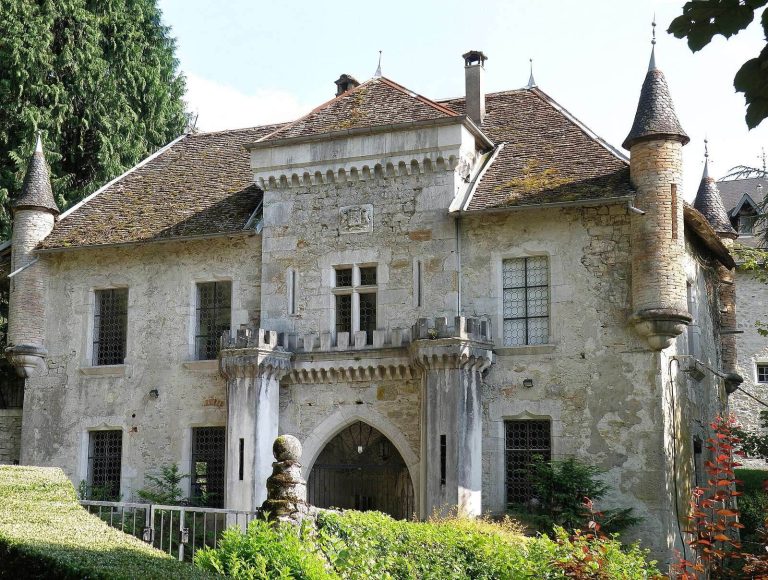
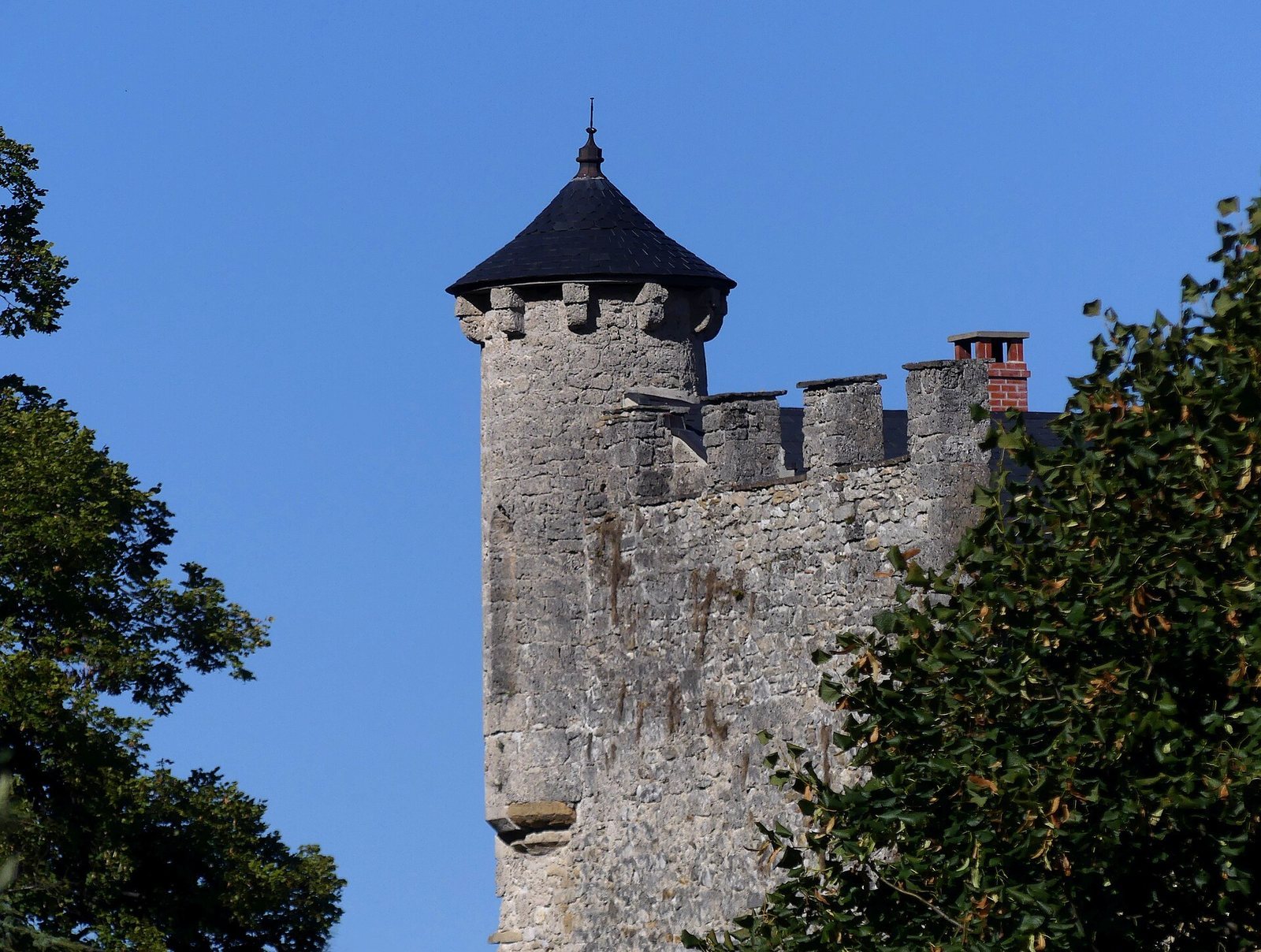
A passage ran along the tops of the walls, where projecting structures with openings allowed defenders to attack below. Small corner turrets rested on projecting supports, and a lookout tower rose above the complex. A staircase ran within the thickness of the residence’s walls. Two gates, each flanked by turrets, controlled access. Each had a vertically sliding gate operated from a guardhouse, and both were approached by movable bridges. The keep, the castle’s principal fortified tower, stood against the south façade near the residence’s southwest corner.
Service buildings and chapel
Service buildings and a small kitchen garden occupied the northern side of the complex, while a separate building housed the falconry. A castle chapel is known to have existed between 1493 and 1673.
The nineteenth-century appearance
The restoration gave the residence a Troubadour-style appearance, a nineteenth-century revival of medieval-inspired architecture. Small projecting corner turrets, known as pepper-pot turrets, rest on projecting stone supports. Battlements and structures with openings through which defenders could attack below crown the restored walls. An English garden was also created.