Schloß Pesch: A Historic Estate and Hunting Lodge in Meerbusch, Germany
Site at a Glance
- Popularity
- Medium
- Country
- Germany
- Primary era
- Modern
- Eras represented
- Early Modern, Modern
- Civilizations
- French, German, Kingdom of Prussia
- Site type
- Domestic
- Remains
- Castle
On this page16 sections
History
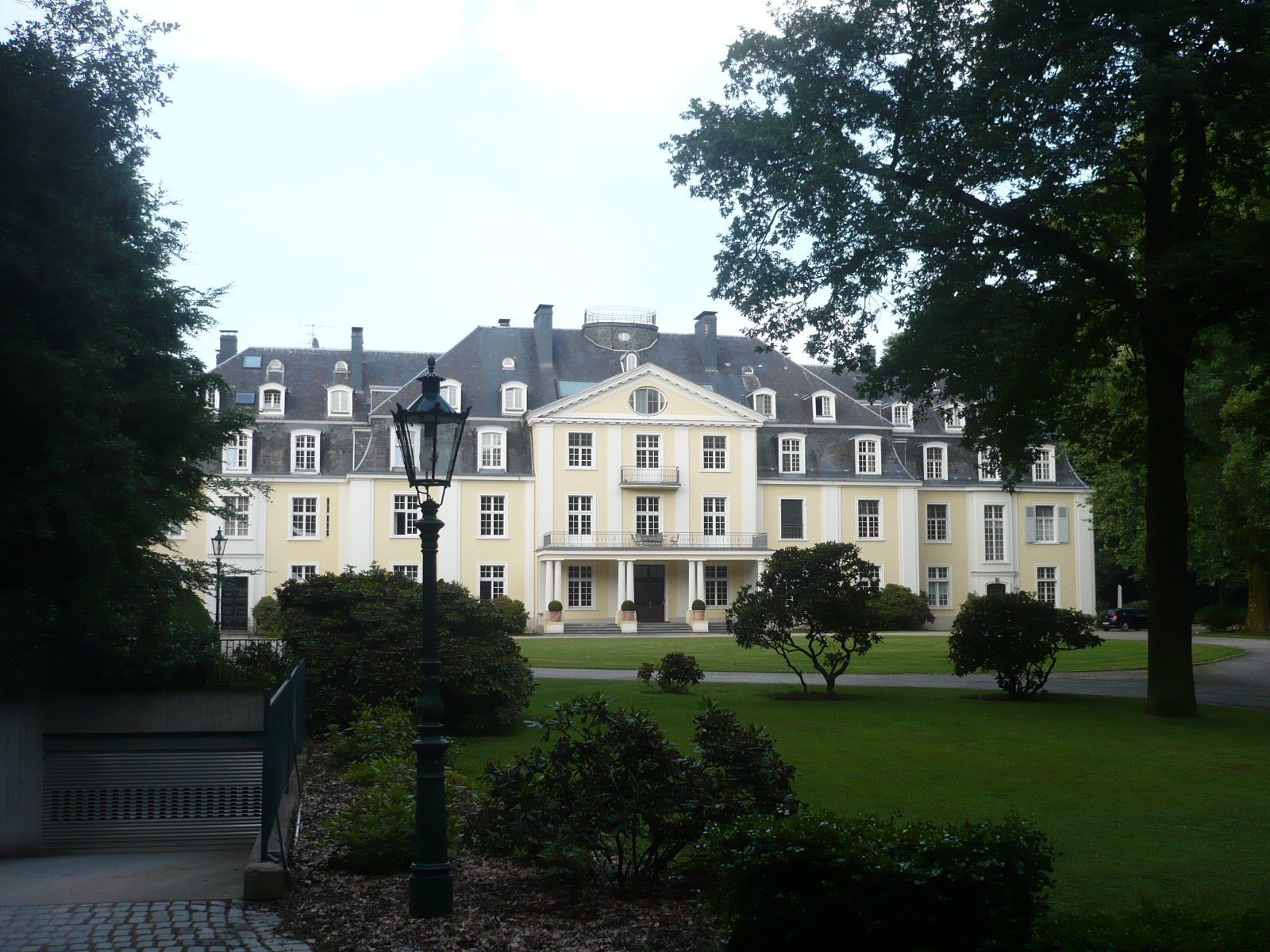
Schloß Pesch is a historic estate in Meerbusch, Germany, first mentioned as Peschhof in 1311 and reshaped into its present three-wing hunting-lodge form between 1906 and 1912. Repeated damage, rebuilding, changes of ownership, and later reuse shaped its long history.
Origins and estate ownership
A 1368 deed records the knight Godert Knop transferring Haus Pesch and other property belonging to his wife. The estate lay in territory once governed by the prince-archbishops of Cologne, who combined senior church office with territorial rule. Despite this location, Pesch remained independent and owed them no feudal obligations.
The old castle was plundered and burned in 1583 during the Truchsessian War, a conflict over control of the Electorate of Cologne. A manor house was then built farther west. Emmerich Hurth von Schöneck inherited it in 1595, along with properties in Ossum and Ilverich.
After 1605, probably around 1615, Emmerich and his wife Magdalena von Merode’s holdings in the district of Linn passed to Edmund von Metternich. Ownership of Haus Pesch and related properties was disputed from 1616 to 1669 by members of the Merode, Lützerode, Landschad, Uettingen, Wolfskeel, Greck, and Bawyr families, as well as Cologne citizens Thoer and Bengeraths. The dispute involved property valued at 6,000 goldgulden, or gold coins, and two Metternich daughters who had married into the Landschad and Galen families. It appears to have been resolved around 1704. A 1645 map of the Archbishopric of Cologne marks a place called Peschoff near the estate’s present location.
Warfare and eighteenth-century owners
In 1689, during the War of the Palatine Succession, a wider European conflict fought from 1688 to 1697, Prussian and French forces clashed near the estate. Prussian troops under Lieutenant Field Marshal Hans Adam von Schöning faced French forces led by General Sourdy. On March 13, fighting moved through Bösinghoven and Ossum, then Strümp and Büderich. About 300 French grenadiers were killed at Ossum. After Lieutenant General Hans Albrecht von Barfus captured the village, French troops were driven through Strümp and Büderich toward occupied Neuss, losing about 1,000 men and abandoning their position at Linn. Later, Prussian forces besieged French-held Kaiserswerth, which surrendered on June 27.
In 1758, about 47,000 French troops camped in and around Fischeln, northwest of Pesch, before taking part in the Battle of Krefeld on June 23 during the Seven Years’ War, a wider European conflict fought from 1756 to 1763. They withdrew toward Osterath after the battle. The estate then belonged to Baron Matthias Gerhard von Hoesch, whose ownership gave him a seat in the Landtag, a territorial representative assembly. He had also acquired the nearby Gerversgut in Ossum.
Hallberg ownership and the nineteenth century
Through the marriage of Heinrich Theodor von Hallberg, who died in 1792, to Henriette Helene von Hoesch, daughter of Matthias Gerhard, the estate passed from the Hoesch family to the Hallbergs. French revolutionary troops plundered it in 1794 and burned it in 1795. It subsequently belonged to the Counts of Hallberg and became the home of their Pesch branch. A castle-like rebuilding with an extensive garden is credited to Henrietta Baroness von Hoesch, wife of a Count of Hallberg. Although the work is assigned a date of 1840, 1804 is more likely because she died in 1808.
Mathias Constantin Capello, Imperial Count von Wickenburg, known as Stechinelli, was born at the estate in 1797. His mother was a Countess of Hallberg. He later founded the spa town of Bad Gleichenberg and served as Austria-Hungary’s minister for trade and economic affairs. In 1828, the property was classed as an estate rather than a castle and had 20 permanent residents.
The male line of the Hallberg family ended with Mathias Anselm in 1848. Haus Pesch passed to Matthea Agnes Lucia Henriette Maria Hubertina Walburgis, Imperial Baroness Geyr von Schweppenburg und Lathum. She brought it into her 1849 marriage to Felix Edmundt Carl Ghislain Baron von T’Serclaes, who became Count T’Serclaes-Hallberg in 1851.
Arenberg ownership and modern reuse
The Dukes of Arenberg acquired the estate in 1885. Johann von Arenberg commissioned a major extension and remodeling between 1906 and 1912, creating the castle’s present form as a hunting lodge. The adjoining Herrenbusch forest was used for hunting. Robert-Prosper, Prince and Duke of Arenberg, was born at the castle in 1895; Prince Franz von Arenberg died there in 1907, and Rose-Sophie, Princess of Arenberg, was born there in 1922.
The estate also served agricultural and residential purposes. A poultry farm operated there by 1928. After the First World War, the Amt Lank requisitioned some apartments in the ancillary buildings to house local residents. On March 1, 1945, during Operation Grenade, an Allied offensive in western Germany, the front line ran near the estate. The U.S. 2nd Armored Division faced the German Panzer-Lehr-Division, an armored training division, as Allied forces pursued the intact Rhine bridge at nearby Uerdingen. From 1946 to 1953, the Congregation of the Sisters of Saint Elizabeth ran a retirement home in the adjoining farmyard.
Hans Schäfer acquired the castle and park in 1970. Around 1977, artist Kurt Link, a close friend of Joseph Beuys, lived in part of the estate and kept a studio there; proposals for an artists’ colony and international academy at Ossum also emerged. After Schäfer’s death, his heirs sold the estate around 1980. Renovation in the early 1980s adapted it for private residences, and the former castle chapel was converted to residential use in 2000. The castle and park remain privately owned, and the ground floor houses an international consultancy.
Remains
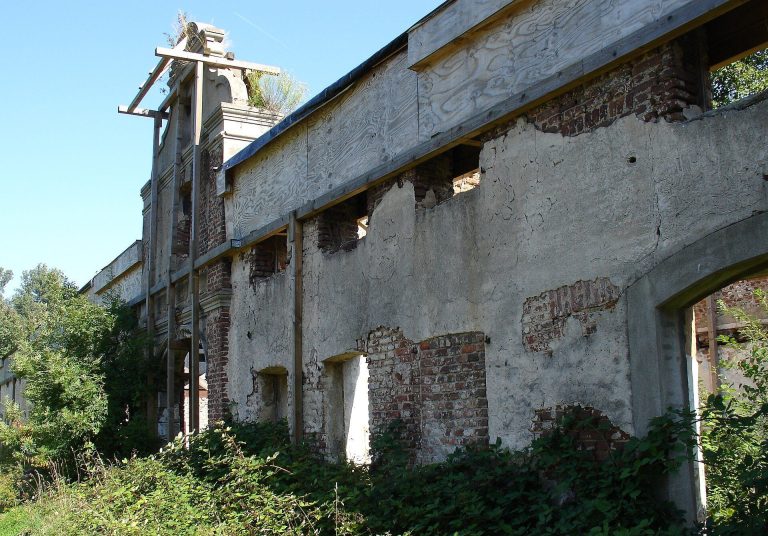
The surviving complex occupies an extensive park and is organized around a two-storey, plastered main house with three wings. Three ancillary buildings stand around it: a former estate office, a brick farmyard, and a chapel. Ruins of an earlier castle also remain in the park.
The estate buildings
Main house
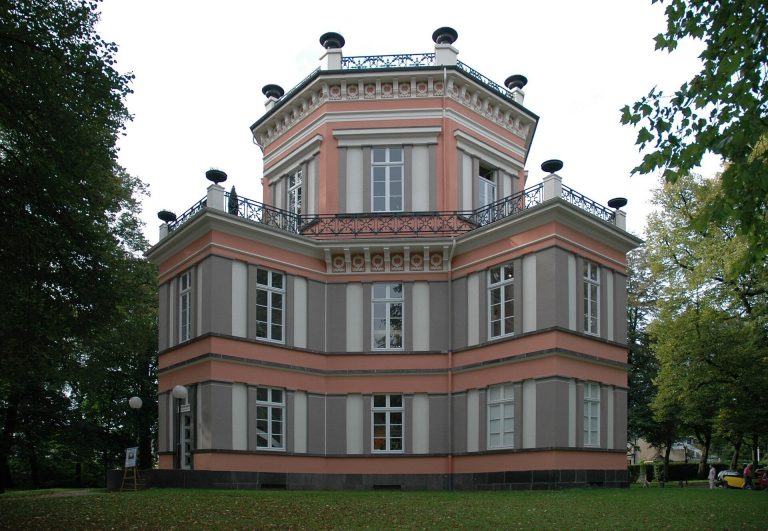
The main house is a plastered, two-storey building divided into 13 window bays, or vertical sections marked by windows. Its three wings form the central building of the estate complex.
Former estate office
The former estate office is a two-storey plastered building with seven window bays. A clock tower rises on its north side.
Farmyard
South of the main house, the farmyard is a three-wing structure built of brick and dating to 1795.
Castle chapel
The chapel stands northeast of the main house, between it and the former estate office.
Earlier castle
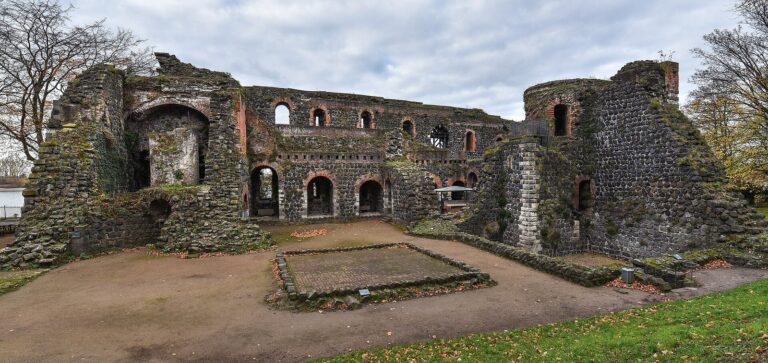
Ruins of the earlier castle survive in the park, separate from the later manor house built farther west.
Roman-period remains
Offering stones
Six stones dedicated to the Matronae, female deities revered in parts of the Roman Rhineland, and Mercury Arvernus, a regional form of the Roman god Mercury, were found in 1863 between the estate and Haus Gripswald. These offerings relate to traces of Roman-period settlement nearby. An earlier interpretation associated remains in the area with a Roman field chapel.
Roman military road
A Roman military road passed a short distance east of the estate, linking the Roman cities or legionary camps at Cologne, Neuss, Gellep-Stratum, and Xanten. Traces of its route could still be seen until the middle of the nineteenth century.
Landscape around the estate
In the nineteenth century, woodland between Strümp, Ossum, Linn, Bockum, Oppum, and Krefeld was cleared for farmland. Heathland extended from Bösinghoven toward Fischeln, Willich, Anrath, and Neersen. An old channel of the Rhine lay east of the estate, and during floods the river reached close to Herrenbusch, the forest beside Pesch.