Château de Rochecotte: An Eighteenth-Century Residence in France
Site at a Glance
- Popularity
- High
- Country
- France
- Primary era
- Early Modern
- Eras represented
- Early Modern, Modern
- Civilizations
- French
- Site type
- Domestic
- Remains
- Elite Residence
On this page12 sections
History
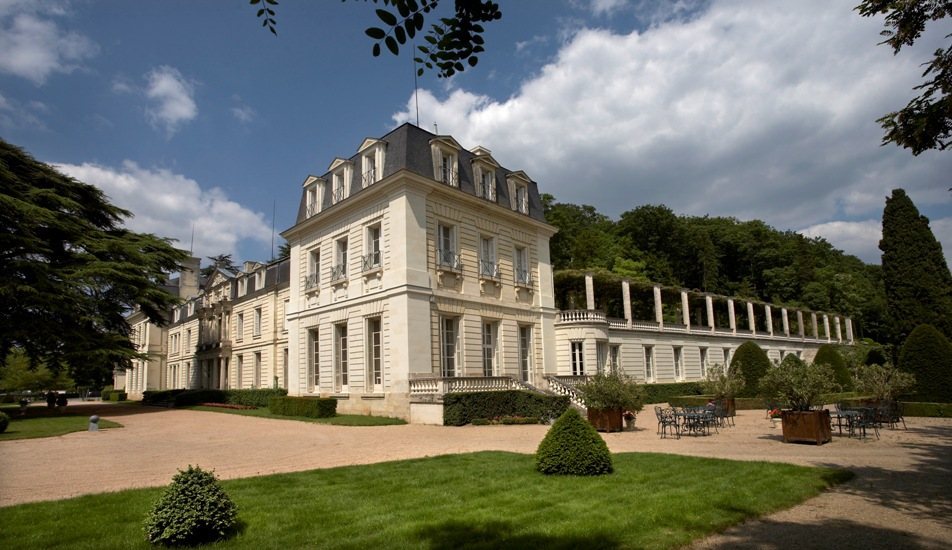
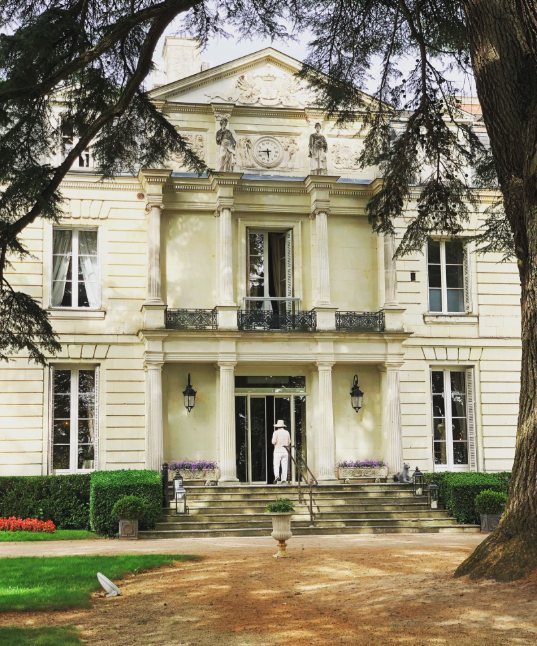
Château de Rochecotte is a late-eighteenth-century residence in Saint-Patrice, near Langeais, France, built in the Louis XVI style, a French design style of that period. It originally belonged to the Count of Rochecotte and later became the home of the Duchess of Dino and a political salon associated with Talleyrand.
Estate and marquisate
In 1540, Antoine de La Châteigneraie held the estate through his wife, Edmée de Coué. Gabriel le Bascle held it in 1607, followed by Balthazar le Bascle in 1671 and N. de Jaucourt in 1698. On 18 November 1700, it was adjudicated to Marie du Bellineau, wife of René Guillon, a treasurer of France, or royal financial official, in the Tours bureau of finances, which administered royal revenues in its district.
In January 1767, the lands of La Varenne, Saint-Patrice, and Milly were united as a marquisate, an estate associated with a marquis’s title, for Fortuné Guillon de Rochecot, a cavalry major. His son, Fortuné Guyon de Rochecotte, became a leader of the Second Chouannerie, a later phase of the royalist insurgency in western France during the French Revolution. The Directory, France’s republican government from 1795 to 1799, executed him at the Champ-de-Mars in Paris. In 1790, Fortuné Bouin de Noiré held the chapel benefice, an income-bearing ecclesiastical appointment. In Year XII of the French Republican calendar, the estate was valued at 600,000 livres.
The Duchess of Dino and Talleyrand
On 12 January 1824, Gatien de La Motte-Baracé, Marquis of Senonnes, and his wife, Augustine-Marie-Gabrielle de Goddes de Varennes, sold Rochecotte to René de Lasselle de Ligué for 280,000 livres. On 30 April 1828, the Chevalier René de La Selle de Ligné sold it to Dorothée de Courlande, Duchess of Dino, for 400,000 francs. The Duchess, a European aristocrat and Talleyrand’s niece by marriage and lover, made extensive alterations to the property. Talleyrand, the prominent French diplomat and statesman, stayed frequently and held a political and social salon there, welcoming leading figures from politics and the Church. He continued to visit until his death about a decade after her purchase.
A dinner at Rochecotte in late 1829 was credited with helping advance opposition to the Polignac ministry. Talleyrand reportedly discussed political ideas there with journalist Armand Carrel, historian and journalist François Mignet, and politician Adolphe Thiers. The newspaper Le National appeared soon afterward with a campaign against the government, and Charles X abdicated about six months later. Other meetings at Rochecotte involving Thiers and Victor, Duke of Broglie, a French statesman, also helped prepare the way for the paper’s foundation in 1830.
After Talleyrand’s death, the Duchess converted his apartment into a chapel. Abbé Dupanloup blessed it on 12 November 1841. On 17 August 1847, the Duchess gave Rochecotte to her daughter Pauline, wife of Henri de Castellane. Henri died that October, after which Pauline lived at the estate in seclusion.
The Castellanes and the Second World War
In 1871, Frederick Charles of Hohenzollern, a Prussian prince and military commander known as the Red Prince, stayed at Saint-Patrice for six weeks with his staff. He celebrated the proclamation of the German Empire at Rochecotte while Antoine de Castellane was confined in besieged Metz with Marshal Bazaine. Antoine’s son Boniface, known as Boni, had lived at Rochecotte until the age of twenty. In 1895, he held a three-day celebration at the château for his marriage to Anna Gould.
Stanislas de Castellane sold the château to his brother-in-law, Emilio Terry, on 24 June 1934. Terry, a Cuban architect and decorator, restored and redecorated it over the following 35 years. During the Second World War, the château held diplomatic archives from the French Foreign Ministry and provided refuge for diplomats and officials. Terry kept one wing for himself and displayed the Cuban flag to signal the property’s neutral status.
The original Treaty of Versailles, the 1919 peace agreement between Germany and the Allied powers, was also kept at Rochecotte. German forces seized it on 11 or 12 August 1940 and took it to Berlin. Its subsequent fate is uncertain: it may have been destroyed with the armistice railway carriage in June 1944, or recovered by Soviet forces in Czechoslovakia in 1944 or 1945. The original was not among the documents returned to France in 1993–94, and the treaty displayed at Rethondes is a reproduction. The 1919 Treaty of Saint-Germain-en-Laye, the peace treaty with Austria, was also stored at the château.
In August 1944, as Saint-Patrice was being liberated, local schoolteacher Jean Lenoble wrote that the château’s lady had organized an armed guard on the river levee while German soldiers occupied the opposite bank. He also described her children firing a submachine gun at porcelain ornaments along the orangery avenue, with bullets passing over the village below. Lenoble mentioned a young Austrian baron at the château whose identity and role remained unclear. In 1948, the register of historic monuments included the outbuildings, but not the main château or chapel.
Sale and conversion
On 16 January 1978, the last Castellane owner sold the château and its 446-hectare estate to the Société Marcel Joly. The estate was broken up, and its furnishings, library, and historical mementos were dispersed. A substantial group of Talleyrand and Castellane family archives and memorabilia from Rochecotte was auctioned at Château de Cheverny in 2017. The Pasquier family bought the empty, closed château in 1984, restored it, and converted it into a hotel and restaurant.
Remains
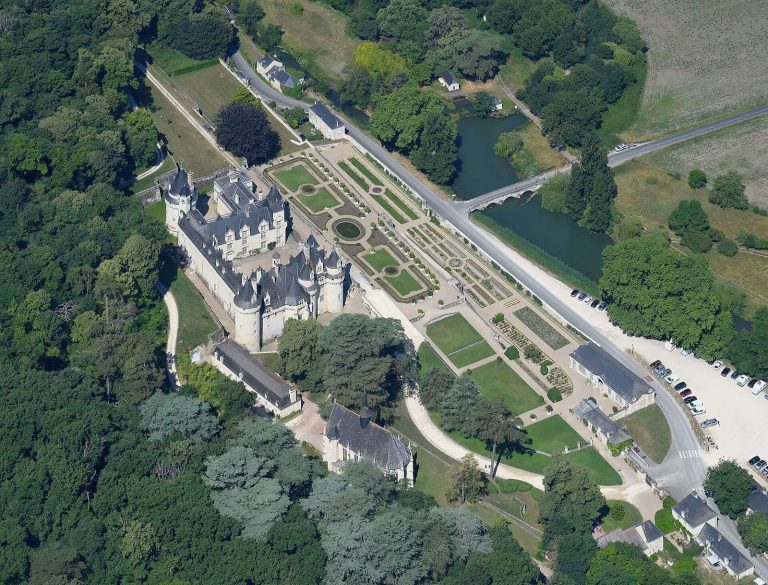
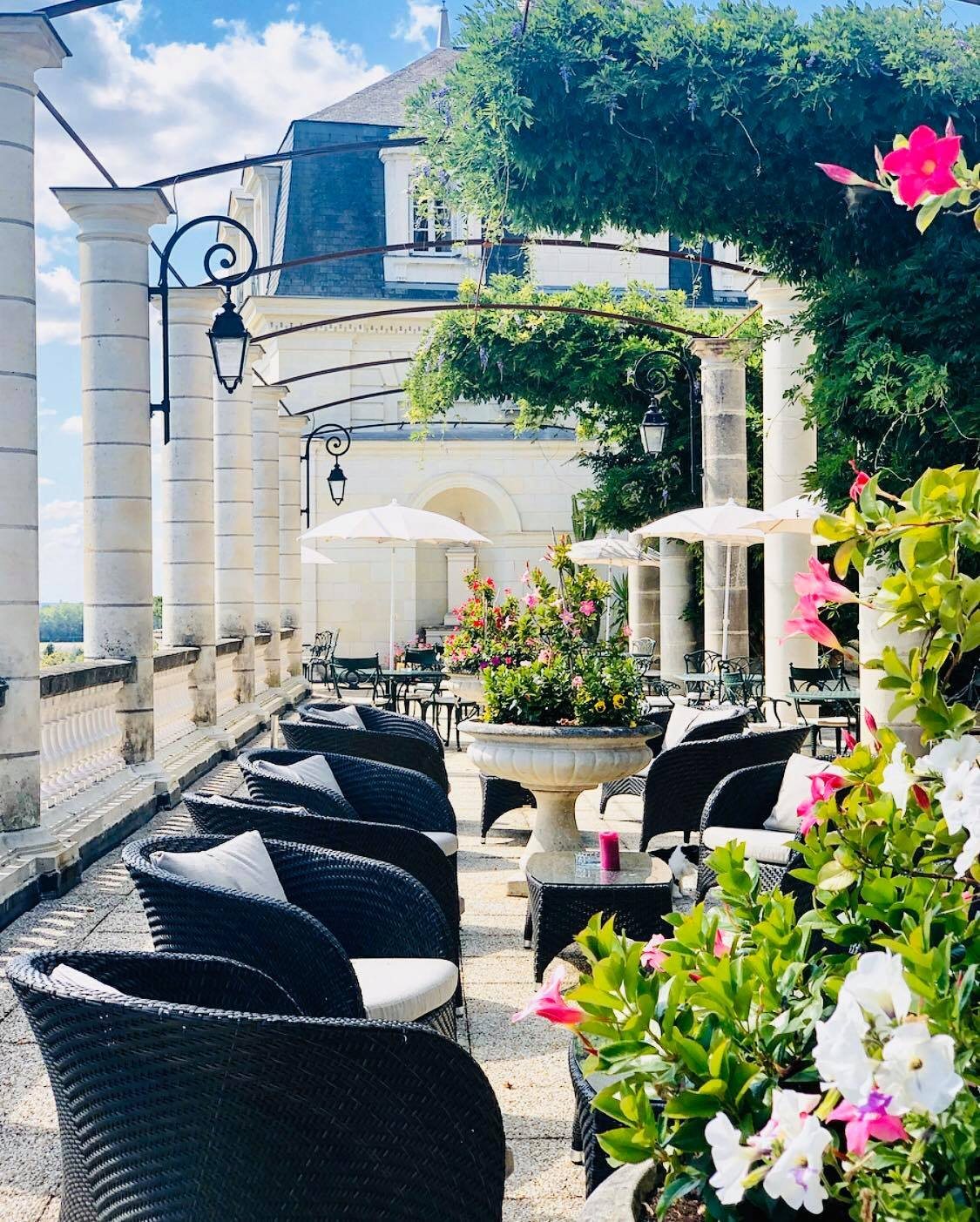
Set on a hillside overlooking the Loire Valley, the château forms the centre of a terraced estate. Its villa-like design was compared to an Italian villa, with terraces at successive levels and views extending toward the horizon. The grounds also included formal gardens, a park, a chapel, stables, and a mausoleum.
Château and terraces
Exterior and terraces
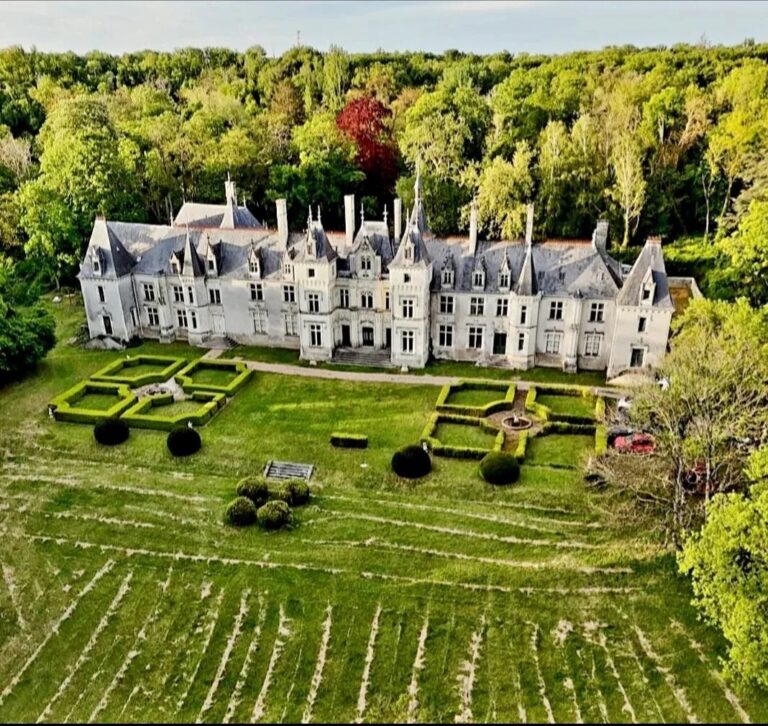
The Duchess of Dino enlarged the château and rebuilt its façade. The front displayed the arms of her in-laws and their motto, “Re que Diou,” meaning “Nothing but God.” A colonnaded terrace adjoined Talleyrand’s apartment. The tiered arrangement of the terraces linked the residence to its hillside setting.
Interior and fittings
The château had 14 bedrooms, heating systems, and double casement windows, as well as rugs, curtains, and draperies. The Duchess installed hydraulic rams, water-powered pumps for lifting water, said to be the first brought from England into France. Her furnishings included Chinese porcelain inherited from her father and commodes signed by Boulle. Art and antiquities were also assembled at the residence, along with jewels given to Talleyrand by European powers with which he had negotiated.
Chapel
The chapel occupied Talleyrand’s former apartment, with its altar placed where his bed had stood. Among its mementos was a statue of the Virgin Mary given to him by the King of Saxony.
Gardens and mausoleum
The gardens followed the French formal style. Long hornbeam avenues framed lawns and flower beds, and the estate also contained a park. A mausoleum was built for Antonia Terry, née Sánchez, Emilio Terry’s mother.
Stables
Antoine de Castellane had the stables built in 1890. Their façade bears the Castellane family monogram, formed by two interlaced Cs.