Briançon Castle: A Medieval Stronghold on the Isère
Site at a Glance
- Popularity
- Medium
- Country
- France
- Primary era
- Medieval
- Eras represented
- Medieval
- Civilizations
- Holy Roman Empire
- Site type
- Military
- Remains
- Castle
On this page8 sections
History
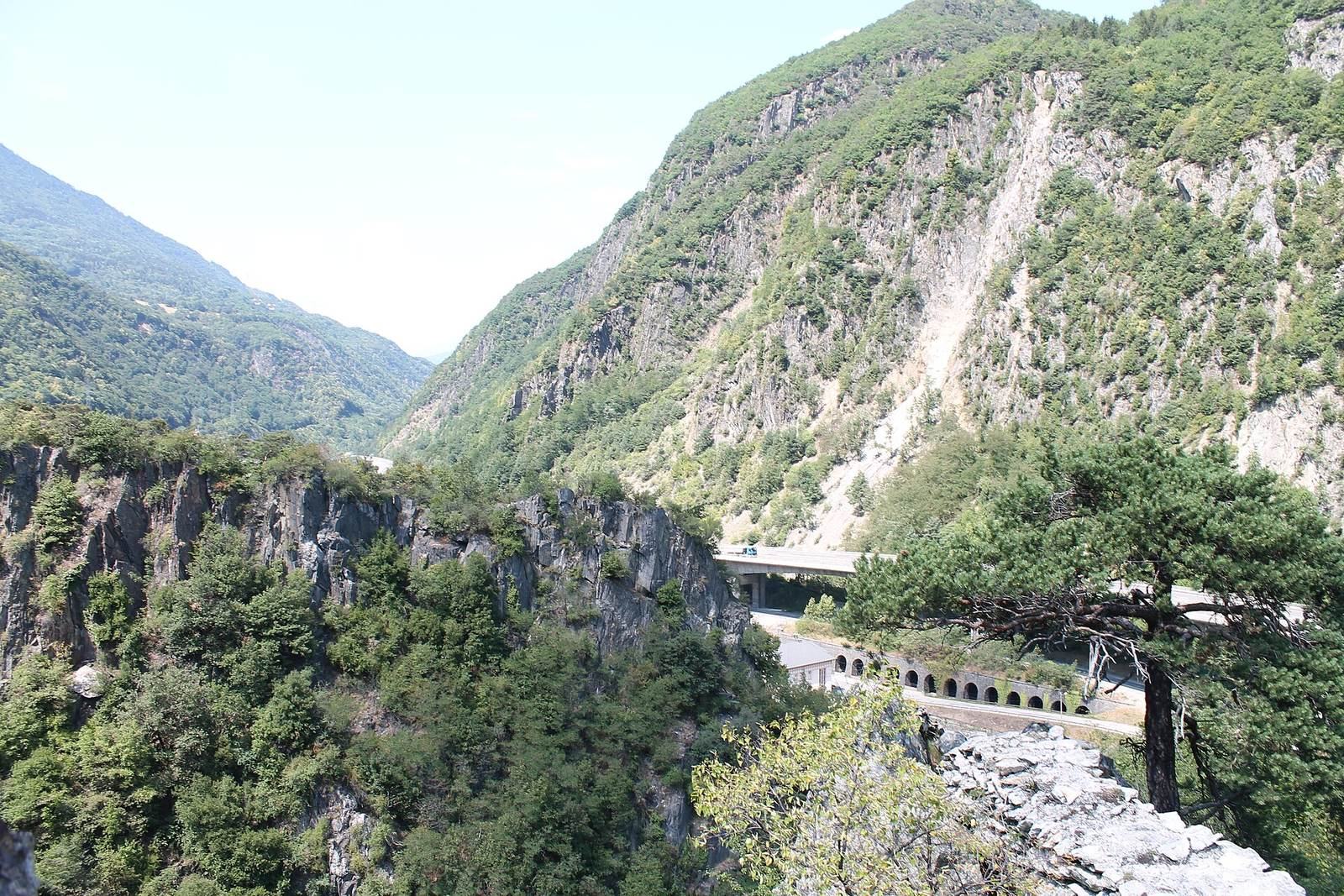
Briançon Castle is a medieval fortress at Notre-Dame-de-Briançon, in La Léchère, France. Its foundation is best placed no earlier than the twelfth century. The castle controlled the narrow Pas de Briançon and routes linking Tarentaise with the Combe de Savoie, including approaches toward the Great and Little Saint Bernard passes. It also guarded a toll collected at the bridge over the Isère and formed part of Savoy’s defenses in its upper valleys.
Origins and disputed traditions
An older tradition attributes the castle to the Briançon family in the ninth century, and a Roman fortified settlement has also been proposed as an earlier site. Archaeological assessment and later historical analysis instead favor a foundation in or after the twelfth century. The Briançon family held the rank of viscount in Tarentaise, though surviving evidence of that title appears only around 1100. The associated lordship is said to have become a viscounty during the eleventh century.
Two explanations have been offered for the family’s authority. The archbishop-count of Tarentaise, an archbishop with a count’s secular power, may have appointed the Briançons to administer part of his domain. Alternatively, Count Humbert, founder of the dynasty from which the House of Savoy developed, may have chosen them to control Upper Tarentaise and counter the archbishop’s influence. The Briançons repeatedly witnessed acts made by Humbertian rulers, suggesting that they also operated independently of the archbishop.
A purported record says that Archbishop Anizo I approved Richard of Briançon’s foundation of the Priory of Saint-Martin of Moûtiers, a religious house governed by a prior, around 900. The document was forged, probably in the twelfth century, and served the archbishops in their struggle with the Briançon family. Another disputed tradition claims that Aymon or Émeric, viscount of Briançon and lord of Aigueblanche, imposed a toll on the Isère bridge in 1082. It further alleges that Archbishop Héraclius appealed to Count Humbert II of Savoy in 1097, leading Humbert to besiege and raze the castle. The alleged abuses are undocumented, no Archbishop Héraclius is otherwise known, and the reported siege and Savoyard takeover of the valley belong about two centuries later.
Archiepiscopal and Savoyard claims
Papal bulls of 1172 and 1176 listing the possessions of the archbishops of Tarentaise do not name the castle. It may have been unfinished, or the Briançons’ right to hold it may have been disputed. Imperial documents issued in 1186 and 1196 do name the fortress, and granted Archbishop Aymon of Briançon investiture, the formal confirmation of a fief.
In 1255 and 1258, the lords of Briançon and Aigueblanche acknowledged that their castle and fief had previously belonged to the archbishops’ domain, before Archbishop-count Rodolphe Grossi sold his rights. After an inquiry into the Briançon lord’s revenues and rights, Count Philip I of Savoy took possession of the castle in 1276. Amid renewed tensions between the archbishops and the Briançon lords, a truce of 6 August 1284 recognized that the lords’ fiefs were held indirectly from the archbishop, except those of Aigueblanche and Briançon.
Montmayeur, Savoy, and French wars
Gaspard I of Montmayeur received the castle as a fief in 1392. After Jacques of Montmayeur, the last of his family, died, Duke Charles I of Savoy acquired it in 1486 through an agreement with Jacques’s nephews. Charles later ceded it to Béatrice of Portugal in 1528. Repairs and defensive works were undertaken against the troops of Francis I of France, but French forces captured the castle in the mid-1530s and held it until the late 1550s. It returned to Duke Emmanuel-Philibert of Savoy after the fighting at Saint-Quentin and the Treaty of Cateau-Cambrésis. On 20 March 1568, Emmanuel-Philibert sold it to the nobleman François Ramus.
During the Franco-Savoyard War, a conflict between France and Savoy, forces of King Henry IV of France captured and dismantled the castle in 1600. In 1630, Thomas of Savoy-Carignan established himself there against the troops of Louis XIII, then withdrew toward the Alpine frontier when Marshal Bassompierre threatened to outflank him. The lordship had been made a marquisate for the Caron de Saint-Thomas family on 2 May 1680. In 1690, Marshal Catinat’s assault left the stronghold almost completely destroyed.
Remains
Cliff-top fortifications and approaches
Enclosure and keep
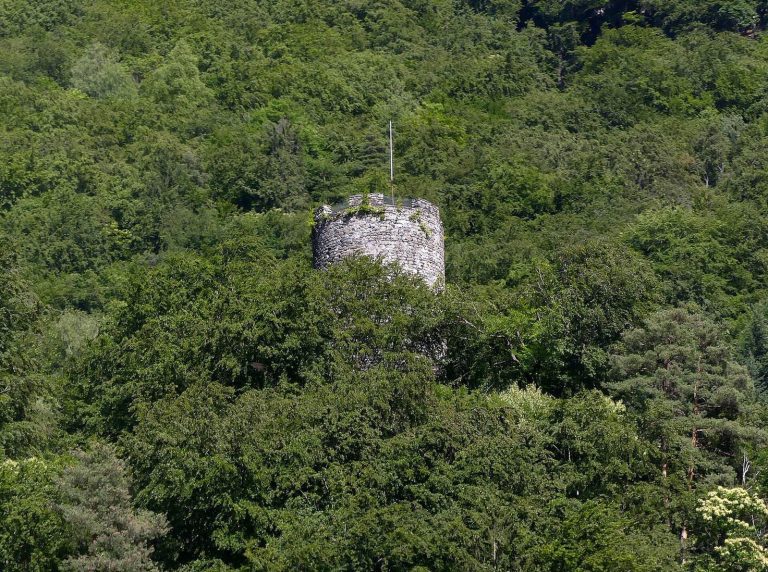
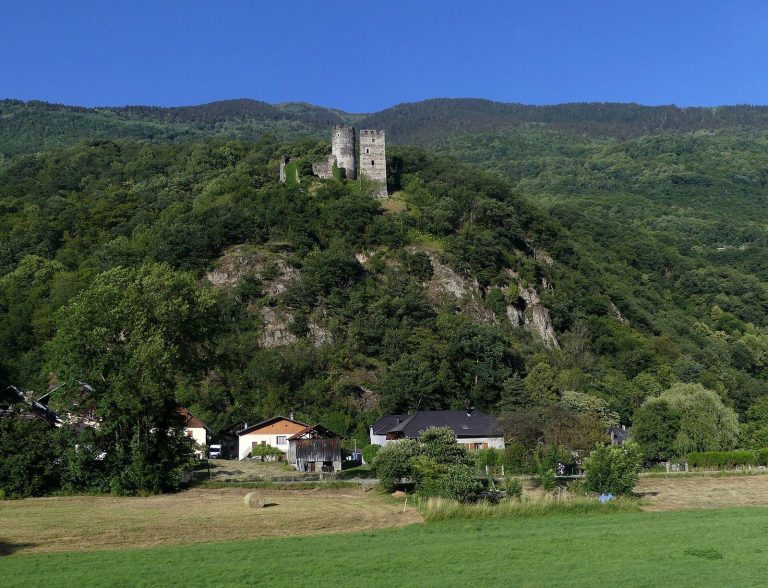
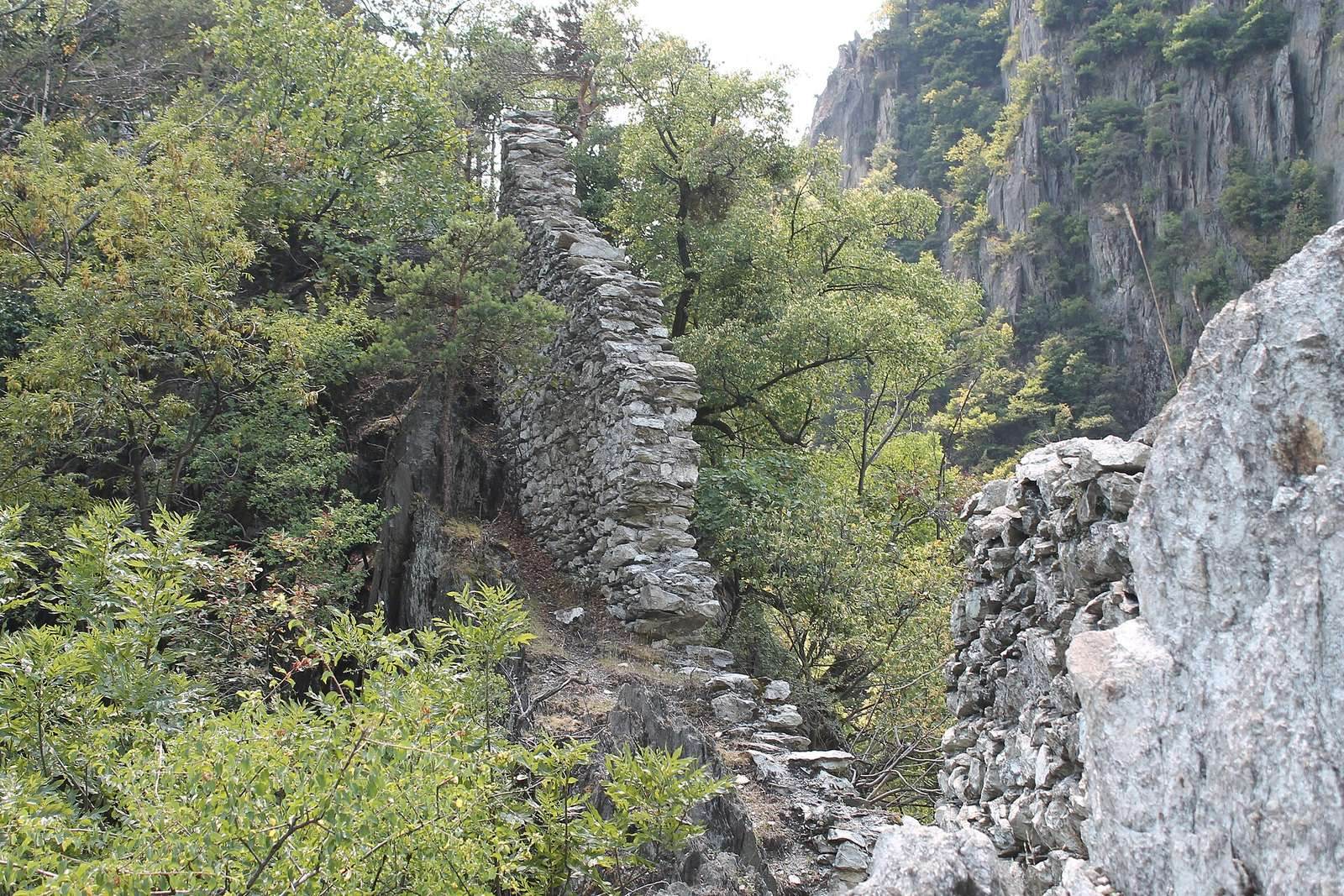
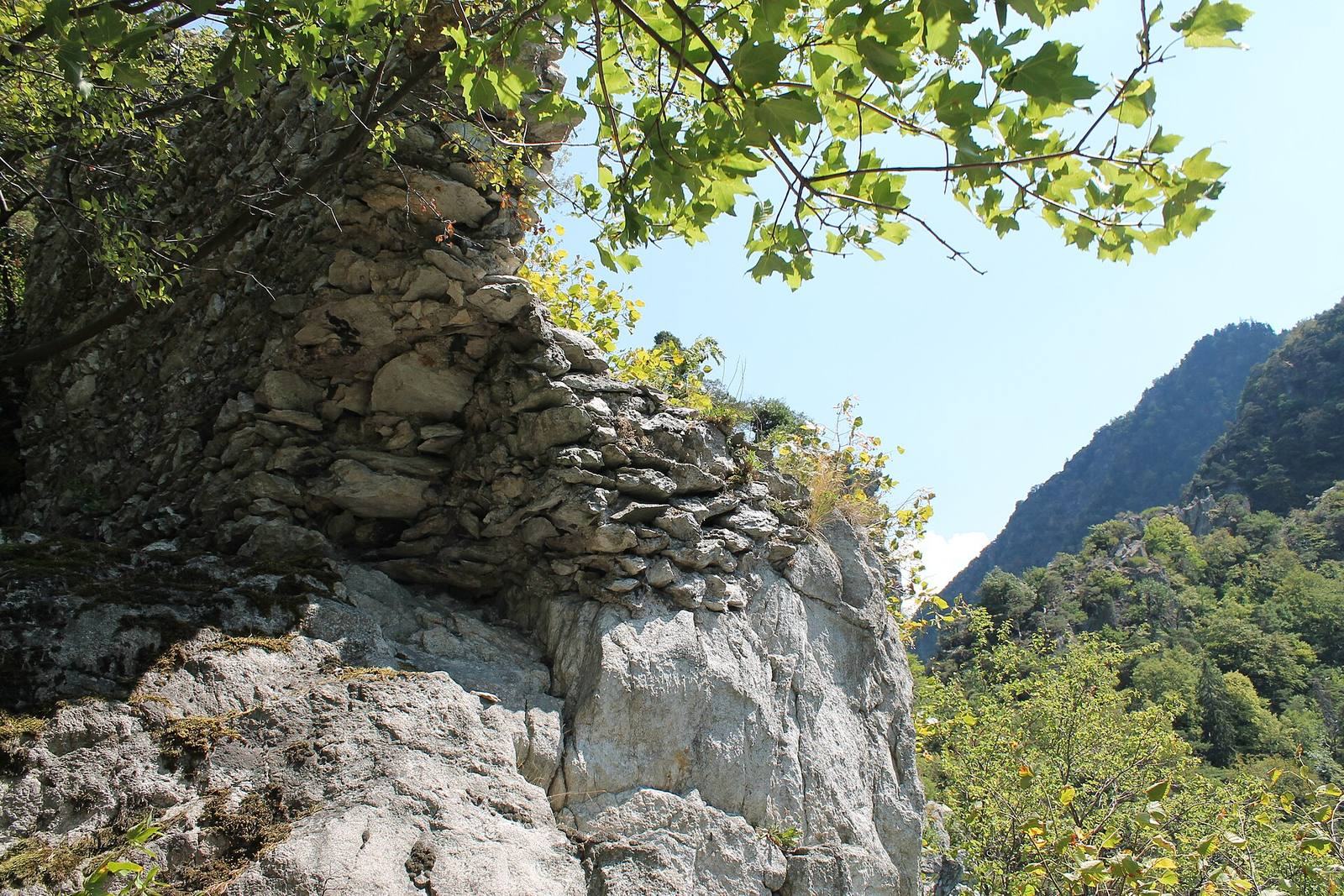
The ruins occupy a steep-sided, triangular rocky platform above a gorge of the Isère, with sharp ridges along its crest. Sparse remains include a curtain wall, two residential buildings, and a keep. The enclosure followed the rock’s ridges and crossed its weaker points. Fragments of herringbone masonry, with stones laid in alternating diagonal courses, appear to belong to the earliest construction, around the twelfth century. At the platform’s highest point, the square keep measures 8.40 metres on each exterior side; its walls now reach only ground level.
Stairway and river crossing
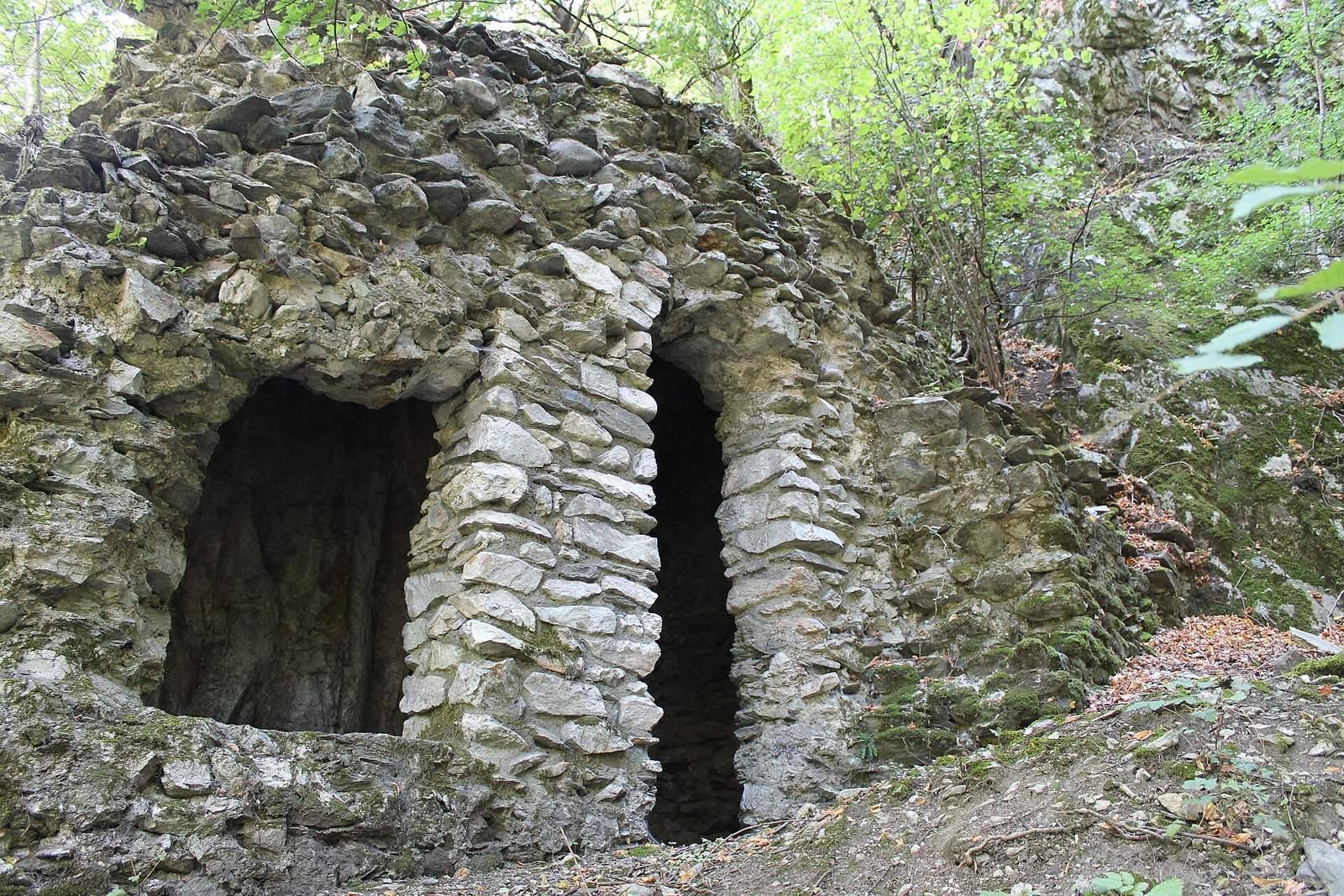
Two smaller towers, linked by a curtain wall, guarded the stairway approach. The larger tower on the right was probably used by the guard; the smaller retains walling and a long chamber with a vaulted ceiling, probably serving as a lookout. From the river side, the approach climbed 240 steps laid on an artificial ramp. The ramp is 60 metres long horizontally and 1.60 metres wide; its steps are 19 centimetres high, with a tread depth of 25 centimetres. The ramp remains visible, and a separate path on the opposite side of the rock also provided access. In 1884, architect and archaeologist Étienne-Louis Borrel described ruins of two buildings at the stairway’s foot, the bases of three walls, and a tower on the left bank, downstream from the present bridge. He proposed that another tower may have stood on the right bank, that the towers served as guard posts and toll offices, and that the bridge may have been built of timber.