Zhongnanhai: An Imperial Garden and Government Compound in Beijing
Site at a Glance
- Popularity
- Very High
- Country
- China
- Primary era
- Early Modern
- Eras represented
- Medieval, Early Modern, Modern
- Civilizations
- Jurchen Jin, Ming, Qing, Yuan
- Site type
- Civic
- Remains
- Palace
On this page29 sections
History
Zhongnanhai is a lake-and-garden compound immediately west of the Forbidden City in Beijing, China. Its northern lake was created in 1189 under Jin emperor Zhangzong, and the grounds later became an imperial park before serving as a center of government. The Jin, Yuan, Ming, and Qing were distinct Chinese ruling houses that held power in different periods.
From Jin and Yuan lakes to a Ming imperial park
In 1189, Zhangzong ordered the construction of the northern lake. Under the Yuan dynasty, Taiye Lake was enlarged to cover roughly the area now occupied by the Northern and Central Seas, and three palaces were built around it.
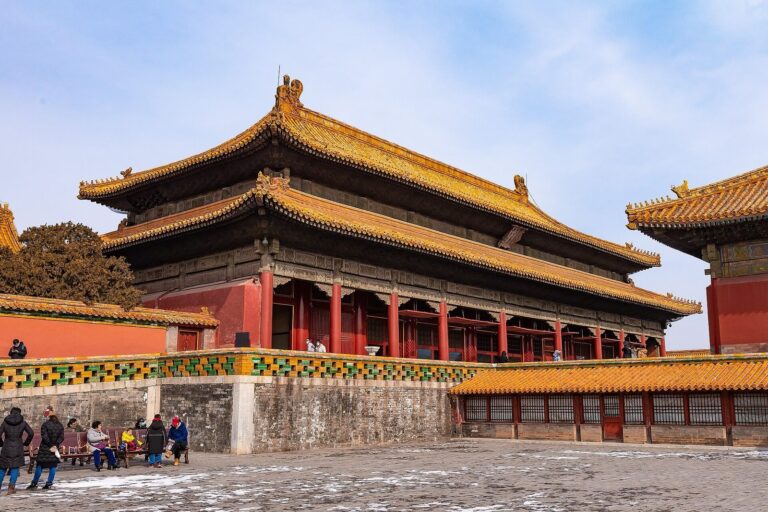
After the Ming court moved its capital to Beijing in 1403, the Yongle Emperor began building a new imperial palace in 1406. A lake called the Southern Sea was excavated south of the existing water. Soil from that work, together with earth from the palace moat, formed Jingshan, north of the Forbidden City. The three connected lakes became part of Xiyuan, the imperial park known as the Western Park.
In the middle of the Ming period, the Zhengde and Jiajing emperors added palaces, Taoist temples, and pavilions around the lakes. They spent more time in the park than in the Forbidden City.
Qing imperial residence and the end of the dynasty
Under the Qing, the imperial park was reduced to an area centered on the three lakes. Emperors built residences and pavilions beside the water and conducted government business there in summer. Empress Dowager Cixi and the emperor often stayed within the compound, going to the Forbidden City mainly for ceremonies.
After the unsuccessful Hundred Days Reform of 1898, an attempted program of political and institutional change, the Guangxu Emperor was confined on Yingtai. He died there in 1908. His death was attributed to poisoning, and Cixi, Yuan Shikai, and court official Li Lianying were named as principal suspects. Cixi also died at Zhongnanhai that year.
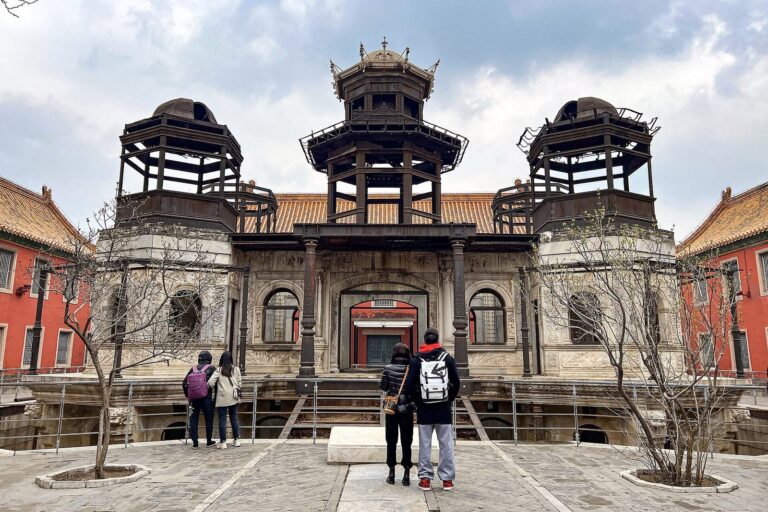
During the Boxer Rebellion, an anti-foreign uprising around the turn of the twentieth century, allied forces occupied Zhongnanhai and looted almost all its artworks and decorations. Afterward, Alfred von Waldersee, the German commander of the Eight-Nation Alliance coalition that intervened in China, made his headquarters in Huairen Hall. The hall was damaged by fire and rebuilt for Cixi in 1902. When Puyi was crowned emperor, his father, Prince Regent Zaifeng, lived briefly in the compound. Zaifeng received land there in 1909 for a palace, but the building remained unfinished when the Qing dynasty ended in 1911.
Republican government and changing use
After the Republic of China was established, Yuan Shikai made Zhongnanhai his presidential residence and reshaped the compound as a formal government center. During his short-lived imperial reign, he renamed it Xinhua Palace. When the republican government transferred its capital to Nanjing, Zhongnanhai opened as a public park.
Under the Beiyang Government, an early republican administration based in Beijing, the Regent Palace housed the prime minister’s office and cabinet. In 1918, President Xu Shichang moved his residence there, while the prime minister and cabinet relocated to Dianxu Hall. Yuan had used Huairen Hall for meetings with foreign guests; it later served for his funeral and became a residence for President Cao Kun. After the Beiyang Government ended, the Beijing city government took over the building.
Party and state center after 1949
After the Chinese Communist Party (CCP) took Beijing in 1949, its leaders first set up headquarters at Xiangshan Park. Ye Jianying recommended Zhongnanhai for security reasons. Mao Zedong hesitated because of its imperial associations, but the party leadership agreed to move there, and Mao arrived late that year. The compound became the principal government center of the People’s Republic of China. Many buildings needed repair and the gardens had become overgrown; extensive work followed, including construction of the West Building compound by 1954.
Zhongnanhai became a setting for meetings with foreign leaders and political figures, among them Nikita Khrushchev, Che Guevara, Richard Nixon, Georges Pompidou, Kakuei Tanaka, and Zulfikar Ali Bhutto. Mao met Khrushchev at the indoor swimming pool in 1958, and Nixon and Tanaka later visited him at Poolside House. Zhou Enlai’s wife, Deng Yingchao, lived at West Flower Hall until 1990.
In 1962, Liu Shaoqi chaired an expanded meeting of the Politburo Standing Committee, a senior CCP decision-making body, in the West Building compound. The leaders discussed economic and fiscal difficulties after the Great Leap Forward, a campaign to rapidly transform China’s economy and agriculture, and pledged to restore farming. At the start of the Cultural Revolution, a major political movement beginning in 1966, Mao moved from the Library of Chrysanthemum Fragrance to Poolside House. He died in Building 202 on September 9, 1976.
Renovations on a large scale in the 1970s altered Zhongnanhai’s buildings and layout, with some older structures demolished and some familiar building names applied to places with changed forms and functions. The compound opened to the public for a period from 1977 to 1985. The 1989 Tiananmen pro-democracy protests brought tighter security and its closure to the public. On April 18, students began a sit-in outside Zhongnanhai; guards attacked demonstrators on April 20. During the protests, President Yang Shangkun and Premier Li Peng moved into the compound for security.
On April 25, 1999, about 10,000 Falun Gong practitioners gathered peacefully near Zhongnanhai to seek recognition of their right to practise. The gathering followed the arrest of 45 practitioners in Tianjin. Premier Zhu Rongji met a delegation and assured its members that practitioners would not be harassed.
Zhongnanhai houses offices and serves as a formal residence for leaders of the CCP and the State Council, China’s chief administrative body. The State Council uses the northern part, while the southern part contains the CCP Central Committee headquarters and meeting places for the Politburo, its Standing Committee, and the Secretariat. The name Zhongnanhai is also used as shorthand for China’s central government and leadership.
Remains
The compound is organized around the Central and Southern Seas, whose names give Zhongnanhai its name. These lakes connect with the Northern Sea, now Beihai Park, to form Taiye Lake; Shichahai connects to Beihai through Qianhai. The lakes were the core of Xiyuan, with a red wall enclosing the western parklands within the Imperial City. Temples and shrines gathered mainly around the Northern Sea, while palaces and pavilions lined the Central and Southern Seas. Sections of the smaller Qing-era wall around the three lakes underpin the present boundary. Gatehouses on either side of Jin’ao Yudong Bridge separate Zhongnanhai’s enclosure from that of Beihai Park.
Northern entrance and government quarter
Xinhuamen
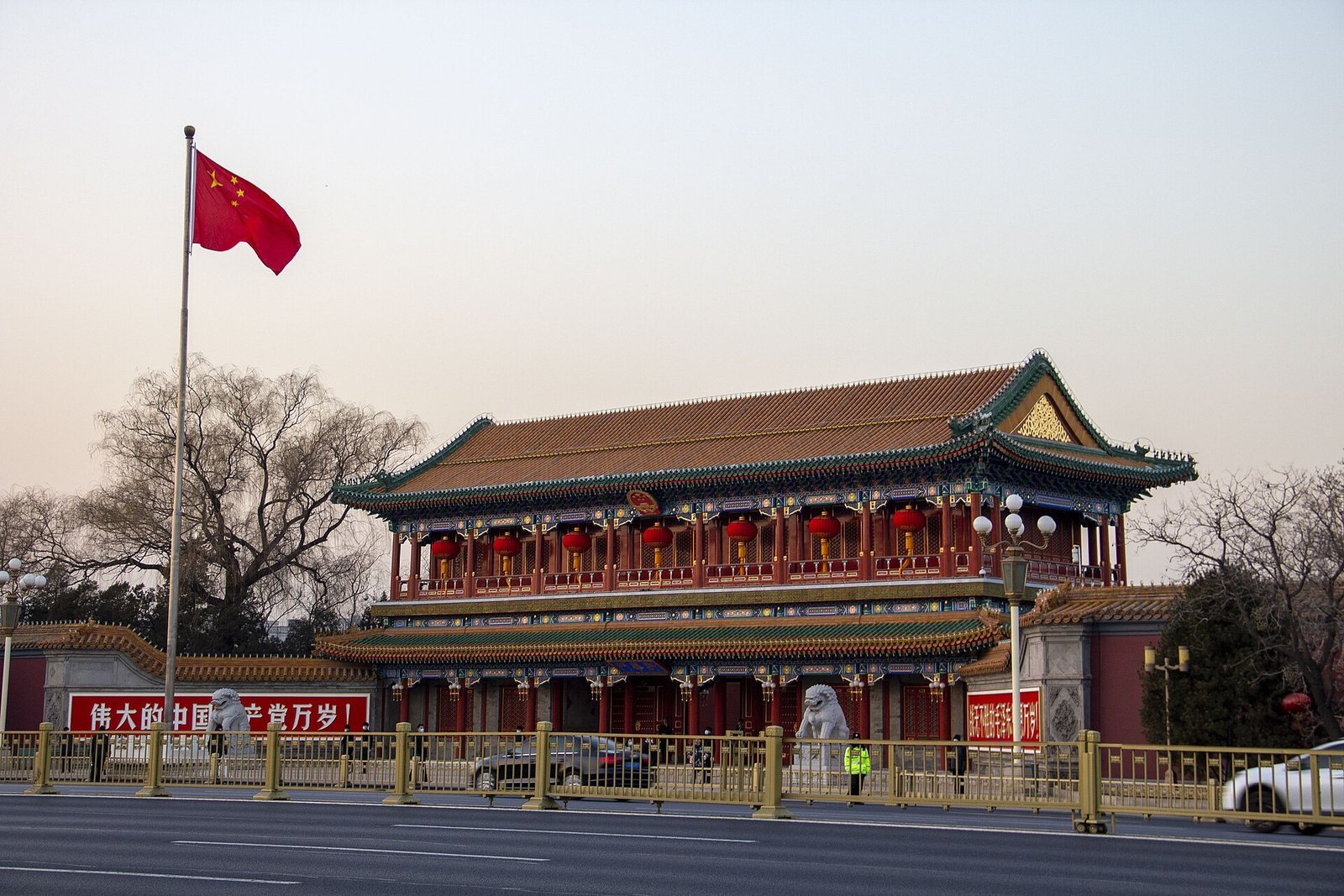
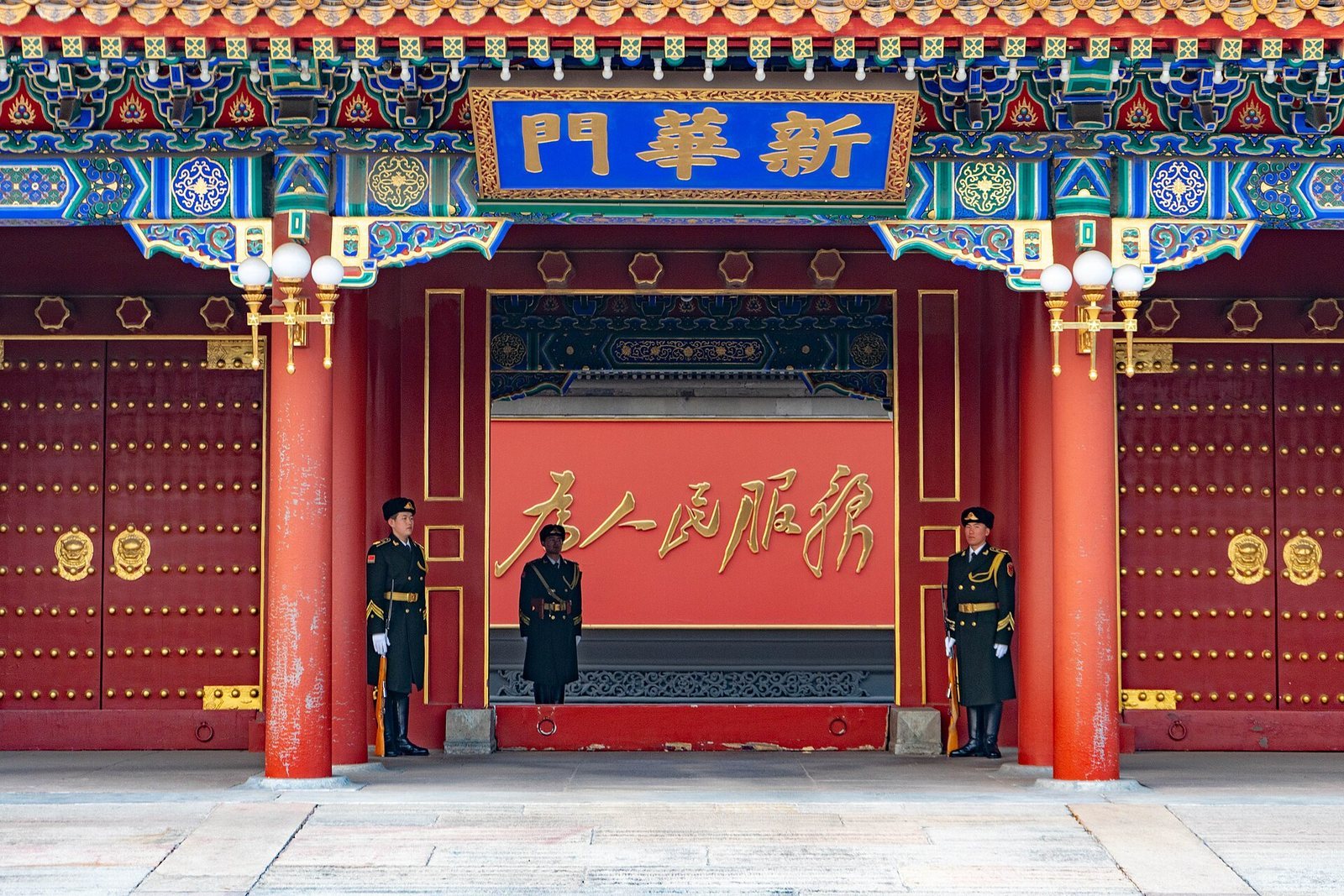
The main entrance, Xinhuamen, stands north of West Chang’an Avenue. It began as a pavilion built by the Qianlong Emperor in 1758 and was converted into a gate by Yuan Shikai in 1912. Slogans flank the entrance, and a traditional screen wall blocks the view beyond it. The wall bears the words “Serve the People” in Mao Zedong’s handwriting. An underground passage linking the gate with the Great Hall of the People was built in 1959 for Politburo Standing Committee members.
Former Regent Palace and State Council offices
A large courtyard mansion once occupied much of the compound’s northwestern corner as the Regent Palace. Its former grounds now contain State Council offices and meeting rooms, including a three-storey building covering much of the southwestern part of the old palace area. Conference rooms one and two stand on opposite sides of a 30-metre corridor used for displays about State Council work. The first room hosts full State Council meetings and weekly meetings of its Standing Committee.
Flower Halls
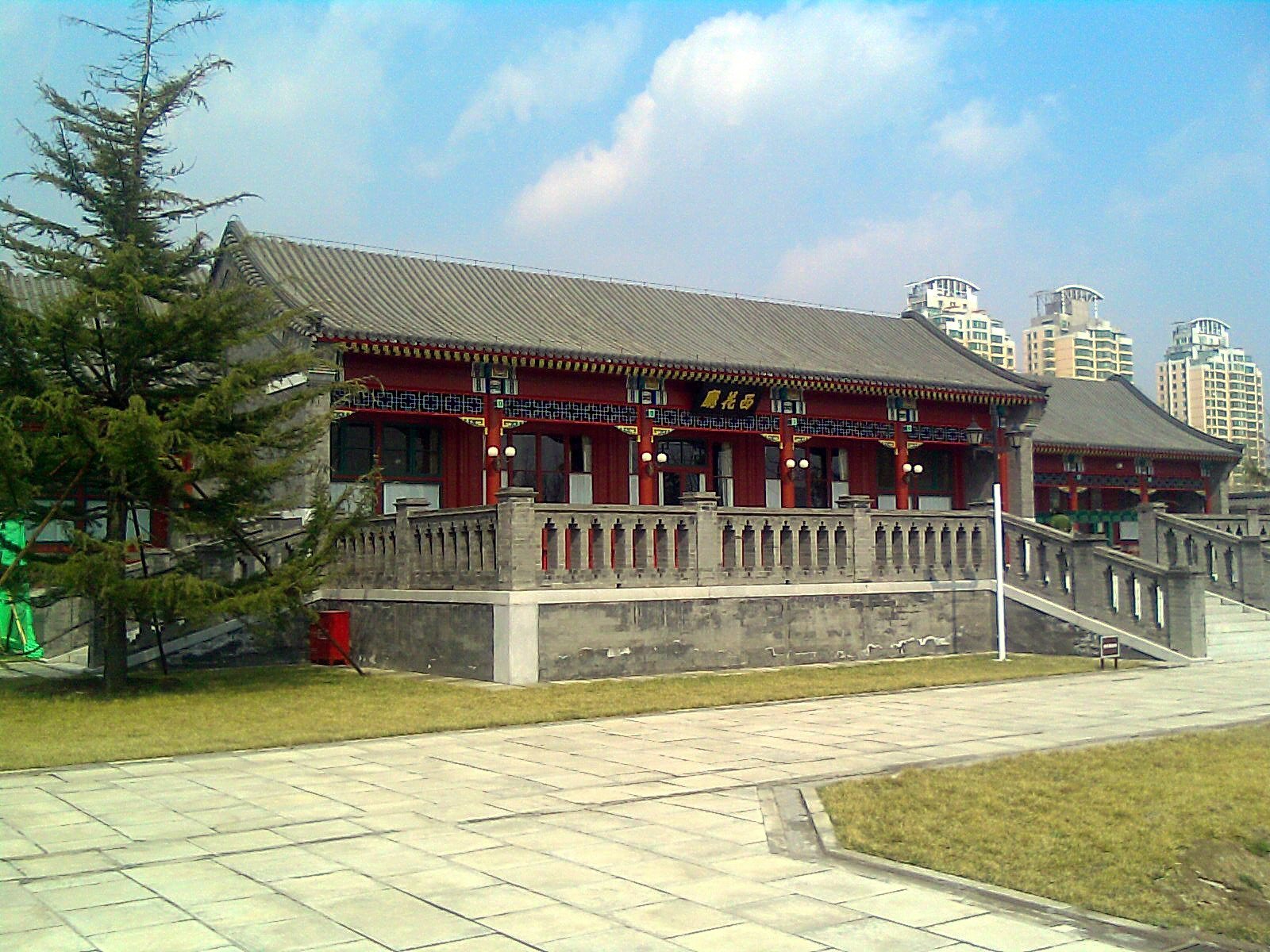
West Flower Hall, formerly part of the Regent Palace complex, has two courtyards. The front courtyard served for meetings and meals with foreign guests; the rear contained a personal office, bedroom, and meeting room. The smaller East Flower Hall adjoins it and has a courtyard with an artificial rock garden. During Zhou Enlai’s time, that courtyard was used as a State Council conference room.
Premier’s Office and conference rooms
The Premier’s Office was built during the 1970s redevelopment of the former Regent Palace grounds. A covered access ramp serves as its entrance, rather than the front gate and courtyard found at other buildings in the area. A building directly to its south houses the State Council General Office. The separate Fourth Conference Room has a traditional gate and courtyard; the room was last rebuilt in 2003.
Ziguang Hall and the State Council Auditorium
Ziguang Hall is a two-storey pavilion on the northwestern bank of the Central Sea. Wucheng Hall behind it joins the pavilion to form a courtyard. A modern conference area was later added on the west side, beside the State Council Auditorium, whose present form dates to a 1979 renovation. Ziguang Hall is used for receptions and talks with foreign diplomats and world leaders; Wucheng Hall is used for photographs with visiting counterparts.
Central Sea residences and religious buildings
Swimming pools and Poolside House
The indoor swimming pool was built in 1955 and later enlarged and remodeled to include a workout area. Poolside House was built beside the outdoor pool as Mao’s residence. It contains a reception room, bedroom, and study. The outdoor pool dates to 1933, when Zhongnanhai was a public park.
Yanqing House
Yanqing House was built around 1922. Fire destroyed the original building in 1947, and by the early 2000s a single-storey building with two courtyards stood on its former site.
Wan Shan and Thousand Sage Hall
Wan Shan, a Buddhist temple on the eastern bank of the Central Sea, has Buddha statues in its main hall. Thousand Sage Hall stands behind it, with a dome and a seven-storey pagoda.
Water Clouds Pavilion
On an island in the Central Sea, Water Clouds Pavilion contains a stone inscription commissioned by the Qianlong Emperor. Its inscription reads “Autumn Wind on the Taiye Lake.”
Southern Zhongnanhai and party buildings
Huairen Hall
Huairen Hall is a two-storey Chinese-style building in Southern Zhongnanhai. It is used for Politburo meetings and, on some occasions, meetings of the Politburo Standing Committee. One courtyard contains a two-storey auditorium built in 1952 to replace an earlier roof made of iron sheets. The hall has also hosted political meetings and artistic performances.
Qinzheng Hall
Originally built by the Kangxi Emperor as Zhongnanhai’s main hall, Qinzheng Hall was rebuilt and opened in 1980. It houses the CCP Secretariat and the general secretary’s offices. Its rooms include a small meeting room along the northern corridor, reception and working areas for secretaries, and a personal office suite with sleeping space. An encrypted hotline links the hall to the White House in Washington, D.C.
Benevolence Hall and the lane buildings
The former Benevolence Hall was a two-storey Western-style palace; its site is now open parkland. The Four Blessing Halls, dating to the Qianlong Emperor’s period, line the eastern side of a narrow lane. On the western side of the Huairen Hall complex, the Four Western Houses, also called Qingyuntang, once provided living quarters for palace eunuchs and maids.
Southwestern compound and gardens
West Building compound
The West Building compound occupies Zhongnanhai’s southwestern corner. Its first buildings were constructed by the Central Guard Regiment’s engineering battalion between 1949 and 1951. The complex included a main hall and buildings designated A, B, C, D, and F. Part of the original compound was demolished in 2007 and 2008 and replaced by a three-storey rectangular building completed by 2010.
Garden of Abundant Beneficence
Buildings in the Garden of Abundant Beneficence began under the Kangxi Emperor, with later additions associated with Qianlong. Some early structures were used to raise silkworms; others later served as libraries and a personal retreat. Wooden plaques at building entrances carry Qianlong’s inscriptions. Chun’ouzhai, in the garden’s northwestern part, once held his seal and artworks.
Dianxu Hall, the library, and Western Eight Houses
Dianxu Hall, the garden’s largest building, has also been called Chong Ya Temple and Yinian Temple. Its small conference rooms were used for Politburo meetings. The Library of Chrysanthemum Fragrance is a four-hall courtyard complex. Its northern hall, Ziyunxuan, contained Mao’s bedroom and study; his office was in the eastern hall, and Jiang Qing lived for a time in the southern hall. An air-raid shelter was dug in the courtyard. The Western Eight Houses, east of the library, housed Mao’s personal aides and secretaries.
Southern Sea structures and later buildings
Yingtai Island and its temples
Yingtai, an artificial island in the Southern Sea, was completed in 1421 and linked to shore by a stone bridge. Its principal temple on the north side is single-storey, while the southern Penglai Pavilion has two storeys. Qingyun Temple and Jingxing Temple stand north of Hanyuan Temple, to its east and west respectively.
Wanzi Gallery
Wanzi Gallery was built in 1742 and later reconstructed. During the Cultural Revolution, its original structure and the adjoining Fuluju were demolished.
Shuqingyuan Pavilion and Building 202
Shuqingyuan Pavilion stood in the northeastern corner of the Southern Sea. Its original building was destroyed in 1959 to make room for a barracks and officers’ quarters for security Unit 8341. Building 202, east of Huairen Hall, was constructed in 1974 as a specially reinforced earthquake shelter.