Meggernie Castle: A Clan Gregor Stronghold in Glen Lyon
Site at a Glance
- Popularity
- Medium
- Country
- United Kingdom
- Primary era
- Early Modern
- Eras represented
- Early Modern, Modern
- Civilizations
- British, Kingdom of Scotland
- Site type
- Military
- Remains
- Castle
On this page9 sections
History
Meggernie Castle stands at Fortingall in Perth and Kinross, Scotland, within the United Kingdom. The date of its oldest fabric remains uncertain: 1582 is given as a construction date, while a date around 1585, sometimes attributed to John Campbell, has also been proposed. Architects and architectural historians David MacGibbon and Thomas Ross placed the original building in the early 17th century. Clan Gregor is identified as the castle’s original builder.
Clan Gregor and the Campbell barony
As the Gregors were gradually driven from their lands, their rivals and neighbours, the Campbells, gained the Barony of Glenlyon, a territorial lordship. A royal grant dated 4 March 1603 transferred land in the area to the Campbells to create the barony. It named Meggernie Tower as the baron’s residence, indicating that a castle was already standing by then. A lintel at the castle bears the later date 1683.
Alterations and later ownership
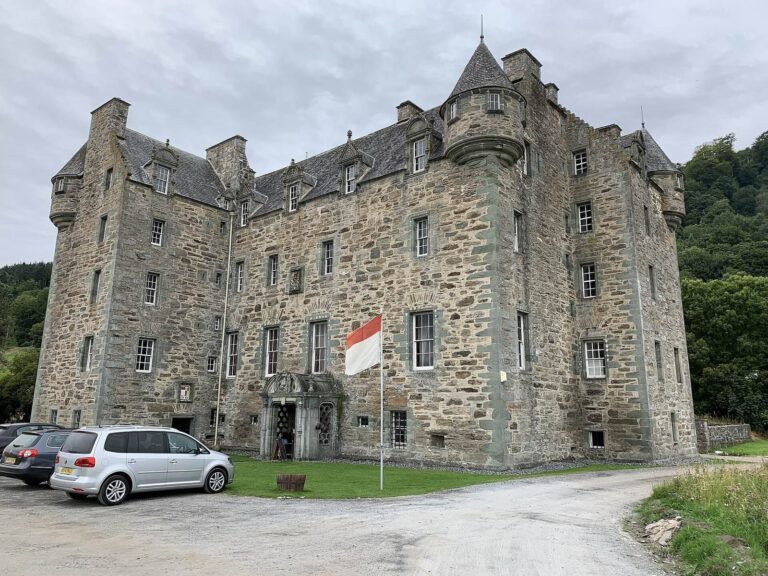
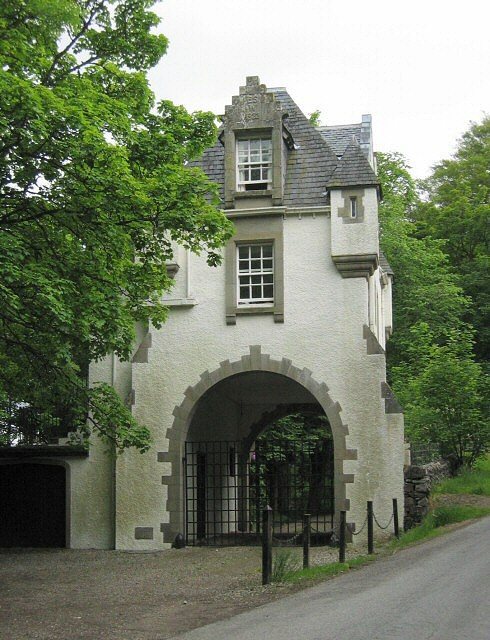
Robert Campbell of Glenlyon directed that the earlier keep, which had a thatched roof, be given a slate one. An eastern addition followed in 1673, and another addition was made in 1848. A courtyard with an entrance at its centre was added on the east in the 19th century. The castle was later restored, and in 1959 its south wall was remodelled and fitted with crenellations, alternating raised sections and gaps along the wall top.
Sir Ernest Wills, 3rd Baronet, owned Meggernie from 1920 until his death in 1958. His son and successor, Lt. Col. Sir (Ernest) Edward de Winton-Wills, 4th Baronet, held it from 1958 until its sale in 1979. The castle is Category A listed, Scotland’s highest listed-building category, and its park and gardens are included in the national Inventory of Gardens and Designed Landscapes.
Local tradition
A ghost story associated with the Menzies of Culdares tells of a family member who supposedly killed his much younger wife in a jealous rage. In the tale, he hid her body in a locked chest in a tower and said that she had drowned during their travels in Europe. He later buried her lower half in the nearby churchyard. Before he could bury the upper half, he was found murdered at the tower entrance; no one was tried for his death.
Guests have reportedly seen a woman’s upper body floating through the castle. One visitor described waking to a burning-hot kiss and seeing a woman’s torso move from his bed through a wall into the next room. The lower half is also said to haunt the churchyard. During restoration work in the mid-19th century, workers were said to have found skeletal remains of a woman’s upper body and taken them away for burial. Reports of sightings followed.
Remains
The lowland castle stands in the heart of Glen Lyon, northwest of Loch Tay. The River Lyon runs through the glen toward the River Tay, joining it shortly below Loch Tay. The castle’s buildings combine a fortified central keep with attached and later extensions around an eastern courtyard.
Castle buildings
The keep
The keep forms the main block and rises four full storeys beneath an attic; the castle is described as five storeys tall overall. Its walls are about 1.5 metres thick. A square tower projects from each corner, and the original keep had narrow slits in place of larger windows.
Mansion and eastern additions
A long, low mansion is attached to one side of the keep and follows a similar style. The eastern addition has two full storeys and an attic, while a further addition has three full storeys and an attic. The courtyard lies to the east and has its entrance in the middle. The buildings are covered with harling, a rough exterior plaster finish, and their gable ends rise in stepped profiles.
Park and gardens
Parts of the 17th-century park and gardens survive, together with sections of the original Scots pine woodland.