Nassau Palace: A Noble Residence in Brussels
Site at a Glance
- Popularity
- Medium
- Country
- Belgium
- Primary era
- Medieval
- Eras represented
- Medieval
- Civilizations
- Duchy of Brabant, Holy Roman Empire
- Site type
- Domestic
- Remains
- Palace
On this page10 sections
History
Nassau Palace was a noble residence in Brussels, Belgium, whose construction began in the 1340s under Willem van Duvenvoorde.
From Duvenvoorde to the Nassau court
When Willem died without legitimate heirs, the residence passed to the Van Polanen family and became known as the Inn of the Lek. In 1403, Johanna van Polanen married Engelbert I of Nassau, bringing the property into the hands of the European noble House of Nassau. The family’s residence near the Palace of Coudenberg, where the rulers of the Burgundian Netherlands lived, helped strengthen its political influence during the fifteenth and sixteenth centuries.
Between 1480 and 1520, Engelbert II and his successor Henry III of Nassau-Breda undertook extensive renovations. The architects included Loys van Boghem, Laurens Keldermans, and Hendrik van Pede, whose work is dated to 1503. Under Henry, the palace became a meeting place for European rulers, artists, and writers. Antonio de Beatis described it in 1517, and Albrecht Dürer visited in 1520, noting details of the building and its contents.
William of Orange and contested ownership
After Henry’s death, the palace passed through René of Chalon to William of Orange. William maintained a lavish court there with 24 squires. The court was regarded as a leading center of European gastronomic culture, while the expense of its feasts left William with debts that at one point reached 900,000 florins. An inventory from 1568 records the palace’s art collection.
In 1568, William supported an uprising against Spanish rule in the Netherlands. His possessions were confiscated, and the palace was seized. Fernando Álvarez de Toledo, the third Duke of Alba, took up residence there, followed by Peter Ernst I von Mansfeld-Vorderort. In 1601, the confiscation was lifted in favor of William’s eldest son, Philip William, Prince of Orange. Philip William had become a committed Catholic while in Spain and reclaimed the family home after returning to Brussels. Following his death, the palace was awarded to John VIII, Count of Nassau-Siegen, whom the Habsburg governors regarded as head of the House of Nassau.
Governors, demolition, and later uses
In the early eighteenth century, the palace housed Isidoro de la Cueva y Benavides, governor and commander of Spanish troops. A fire broke out during his residence in 1701, but firefighters used a recently invented fire engine to extinguish it before extensive damage occurred. After the nearby Palace of Coudenberg burned in 1731, its court moved to Nassau Palace, which became known as the New Court.
Around 1750, Prince Charles Alexander of Lorraine began negotiations to acquire the dilapidated building. It was sold for a small sum and almost entirely demolished to make way for a residence for the governors-general in the neoclassical style. By 1797, the former garden had become a noted botanical garden. It first belonged to the Central School of Brussels and, from 1822, was run by the Society of Flora. The garden was displaced in 1825 for the Palais de l’Industrie nationale.
The surviving chapel underwent a succession of new uses during the nineteenth century. It served as a beer warehouse, a store for Mathieu Kessels’s sculptures, a laboratory for the Museum of Natural Sciences, a catalogue room for Paul Otlet’s International Institute for Bibliography, and a reading room for the General State Archives. The Bernissart iguanodons were displayed there during its use as a laboratory.
Remains
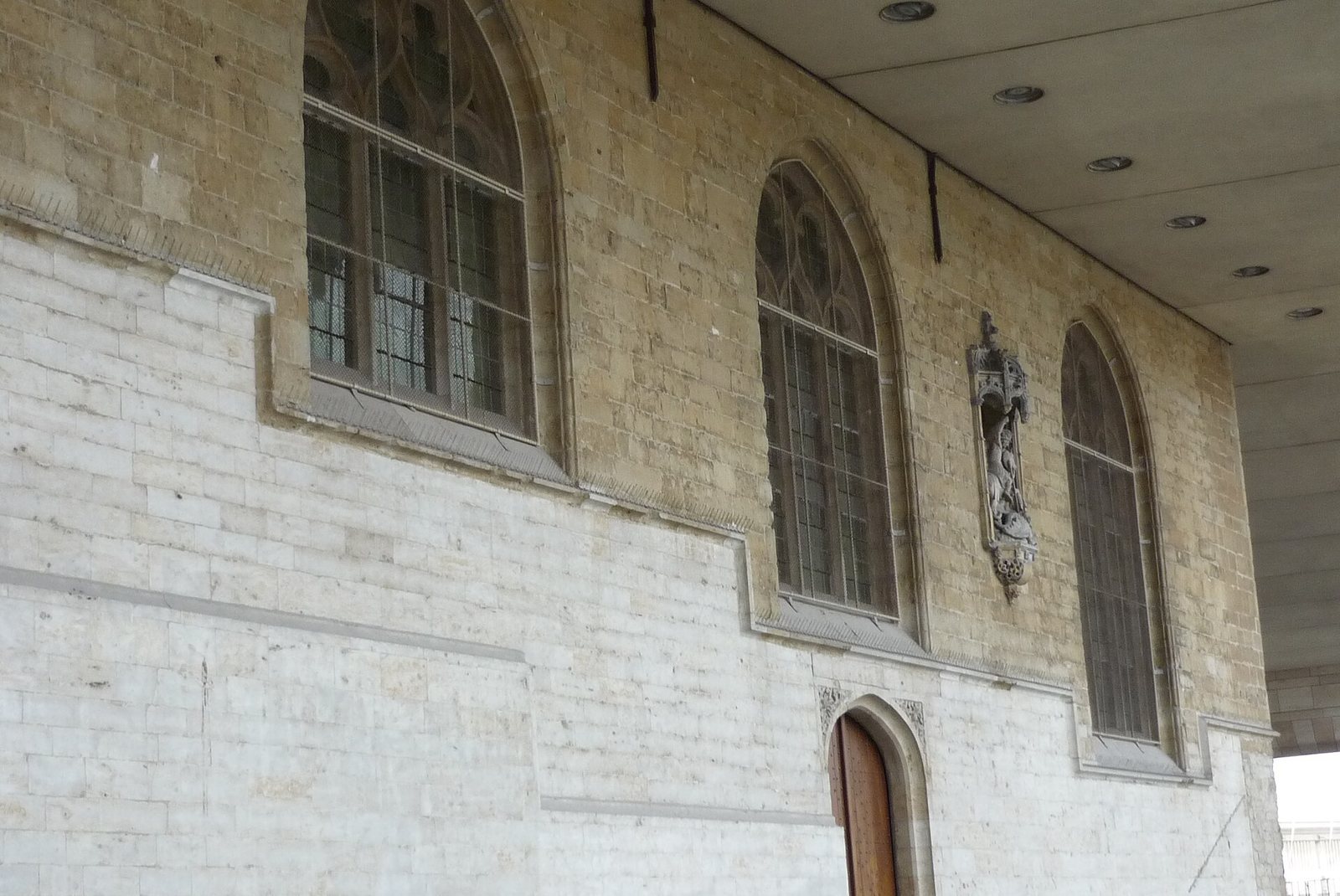
The palace occupied one of the higher parts of Brussels, near the Palace of Coudenberg. Its known spaces included a Great Hall, an art gallery, and a chapel. The palace was almost entirely demolished, leaving the Nassau Chapel as its sole surviving part. The former garden site is now Place du Musée.
The Nassau Chapel
Dedicated to Saint George, the fifteenth-century chapel is built in Brabantine Gothic, a regional style of Gothic architecture associated with Brabant. It probably stands on the site of an earlier chapel dating to 1344. The surviving building was incorporated into the Royal Library of Belgium’s Albertine buildings on Mont des Arts in 1956, after relocation had been considered. Its space is now used for exhibitions. A relief sculpture by Georges Dobbels, showing the palace as it once appeared, was added to the chapel façade in 1969.
Interiors and recorded features
The gallery and paintings
The palace’s art gallery held paintings and tapestries. An inventory from 1618 lists 56 works. A three-panel painting of The Garden of Earthly Delights by Hieronymus Bosch was displayed in the Great Hall. The palace also contained a painting of the Judgment of Paris, showing three goddesses and probably made by Lucas Cranach the Elder. In the chapel, Dürer noted a finely painted work by Hugo van der Goes, likely the lost altarpiece The Seven Sacraments.
Banqueting features and unusual objects
Henry III’s palace had doors painted to create an illusion of depth. It also contained an enormous bed that he reportedly had made to toss drunken banquet guests into. Dürer wrote that it could hold 50 people. A meteorite shown to him was said to have fallen in a field beside the palace.
Slogan and emblem
In 1612, French traveler Pierre Bergeron recorded the palace’s slogan, Ce sera moy Nassau, meaning “It will be me, Nassau.” He also noted its emblem, a sailing ship bearing the Latin motto Tardando progredior, or “I advance by delaying.”