Naworth Castle: A Medieval Border Stronghold in Cumbria
Site at a Glance
- Popularity
- Very High
- Country
- United Kingdom
- Primary era
- Medieval
- Eras represented
- Medieval, Early Modern, Modern
- Civilizations
- British, English
- Site type
- Military
- Remains
- Castle
On this page15 sections
History
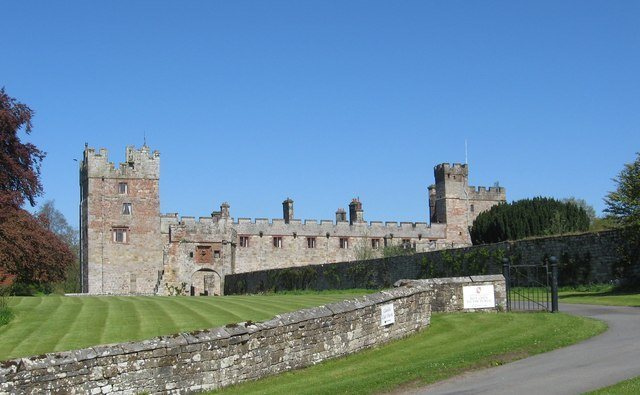
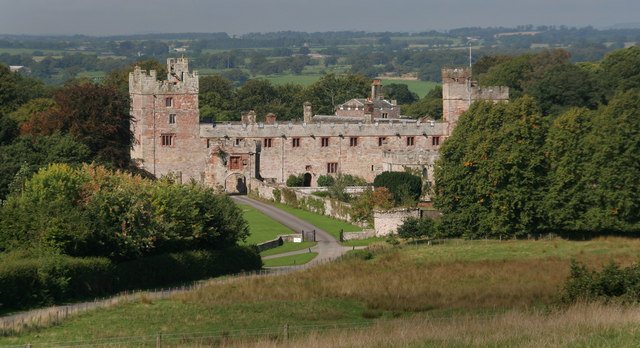
Naworth Castle is a medieval border stronghold in Cumbria, United Kingdom, whose present structure dates from the early fourteenth century. It served the Lord Wardens of the Marches, officials responsible for security and administration along the English-Scottish border, and offered the Dacre family refuge during danger.
Medieval foundations and the Dacres
The castle may have begun in the thirteenth century as a peel tower, a fortified tower on the English-Scottish border. Its first recorded mention dates to 1323. In 1335, Ralph Dacre received a licence to crenellate it, meaning royal permission to add battlements, during the reign of Edward III.
Naworth became the seat of the Barons Dacre. The family was established in Cumberland and resisted Scottish incursions. Marriages connected the Dacres to northern families such as the Nevilles and Percys, but those ties also drew them into rivalries that fed into the Wars of the Roses, a series of fifteenth-century civil wars between competing English dynasties.
Thomas Dacre and the inheritance dispute
Thomas Dacre, 2nd Baron Dacre, was known as Builder Dacre. At the Battle of Flodden in 1513, an English-Scottish conflict, he commanded the English army’s reserve. In the early sixteenth century he built the castle gateway and added residential rooms.
When Thomas Dacre, 4th Baron Dacre, died in 1566, his will left his estates first to his son George and then to his brothers, including Leonard. Thomas’s widow, Elizabeth, married Thomas Howard, 4th Duke of Norfolk, who became stepfather to her four children. Elizabeth died in childbirth within a year, and the duke then sought legal guardianship of the children. George died in an accident while still a minor and without an heir, leaving his sisters as joint heirs. The duke arranged marriages for Anne and Elizabeth Dacre to his sons Philip and William Howard. Mary died before her intended marriage to Thomas Howard could take place.
Leonard Dacre challenged the inheritance and became involved in the Northern Rebellion, a 1569 uprising against Elizabeth I. He fled first to Scotland and then to Flanders, where he died in poverty in 1573. Naworth and the Dacre estates passed to Lord William Howard through his marriage to Elizabeth Dacre. The inheritance also brought the Howard family into the line associated with the Earldom of Carlisle.
The Howard residence
In 1568, while Mary, Queen of Scots, was held at Carlisle Castle, Naworth was considered a strong and suitable place to detain her because it was moated. Lord William Howard later made Naworth his home with his children and grandchildren. Additions were made for him in 1602; he also restored the castle, improved the estate, and re-established order in the area.
William Howard’s elder son Philip became the grandfather of Charles Howard, 1st Earl of Carlisle, while his younger son Francis founded the line of the Howards of Corby. The castle remained associated with the Howard family and the Earls of Carlisle.
Fire, restoration, and later use
A fire broke out at Naworth on 18 May 1844, possibly after soot ignited in the Porter’s Lodge flue. The blaze spread to the north wing, and much of the roof had collapsed by the time two fire engines arrived by train from Carlisle. The fire damaged almost every room on three sides of the quadrangle. Water was carried in buckets from a stream at the foot of the steep slope to the north. Belted Will’s Tower survived, and the fire was brought under control at about one o’clock on Sunday morning. Architect Anthony Salvin restored the castle afterward.
The interiors developed a strong Pre-Raphaelite character. This nineteenth-century artistic movement valued vivid detail and sought forms of art it regarded as earlier than the conventions of Raphael and his successors. George Howard, 9th Earl of Carlisle, was a friend and patron of Edward Burne-Jones, William Morris, and Philip Webb, who visited Naworth and worked with him. Morris stayed in August 1874 and wrote that a room in one tower retained its form from William Howard’s time. George Howard also composed a painting of his daughters, May and Jenny, at the castle.
Rossall School occupied Naworth from 1939 to 1940, after government departments took over the school’s buildings. Naworth was designated a Grade I listed building in 1954, the highest category in England for buildings of special architectural or historic interest. It remains the seat of the Earls of Carlisle and is occupied by the Hon. Philip Howard, younger brother and heir presumptive of the 13th Earl.
Remains
Setting and plan
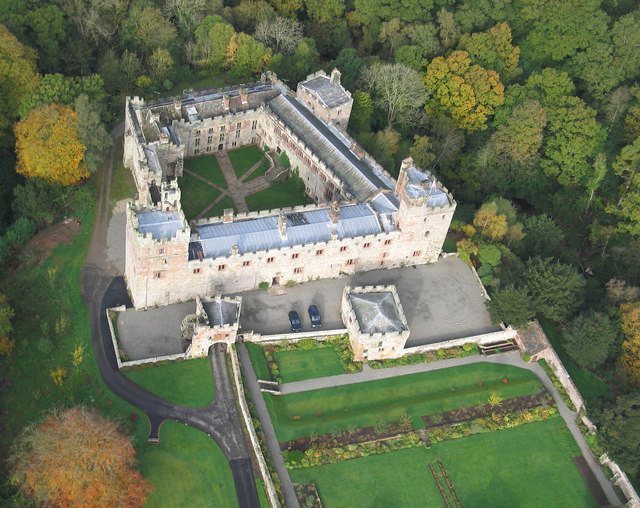
Built of stone, Naworth stands across the River Irthing from Lanercost Priory and within sight of it. The castle’s early plan is thought to have included a square keep, its principal fortified tower, and a bailey, an enclosed area within the castle. The eighteenth-century walled garden is thought to occupy ground within the original moat’s boundaries.
Castle buildings and interiors
The gateway
The gateway built by Thomas Dacre bears his coat of arms and the family motto, Fort en Loialte, meaning Strong in Loyalty. Its heraldic decoration connects the entrance with the Dacre family who developed the castle.
The Great Hall
The Great Hall is reputed to be the largest in northern England. Its windows look onto the courtyard, and a fireplace measuring 15 feet across has an arch compared to a stone bridge. Flemish and French tapestries are also associated with the hall.
The former chapel and library
The castle’s former chapel became a library after the 1844 fire. Above the library fireplace, a shallow raised sculpture designed by Edward Burne-Jones and Sir Edgar Boehm depicts the Battle of Flodden, with Thomas Dacre leading a charge.
Dungeon apartments and priest hole
Four dark dungeon apartments survive, three below ground and one above it, reached by a long staircase. They are described as retaining their original condition. A concealed priest hole, a hiding place for a Catholic priest during religious persecution, is also well preserved.
Carved heraldic figures
Four free-standing wooden figures, each six feet high, were commissioned by Thomas Dacre around 1520. They are believed to have been carved from a single oak tree from the Naworth estate. The figures stood in the Great Hall beneath a ceiling painted with English kings and queens until 2000, when the Victoria and Albert Museum purchased them. They were rescued from the 1844 fire. Nineteenth-century prints helped make them popular with Victorian audiences drawn to medieval romance, and the carvings are said to have inspired John Tenniel’s illustrations for Alice’s Adventures in Wonderland.
The red bull and dolphin
The red bull represents Thomas Dacre, 2nd Baron Dacre, and carries his arms, three silver scallop shells on a red field. A family tradition linked these arms to an ancestor present at the 1291 siege of Acre and the Crusades in the Holy Land. A proposed explanation also connects the Dacre name with d’Acre. The dolphin, or salmon, represents Thomas Dacre’s wife, Elizabeth de Greystoke. In 1488, after they had agreed to marry, he carried her away from Brougham Castle, where she was a royal ward, a minor under the Crown’s guardianship, in the care of Henry Clifford, 10th Baron Clifford. Her figure bears the Greystoke arms: three red wreaths on alternating silver and blue bands.
The black gryphon and white ram
The black gryphon, a creature with a lion’s body and an eagle’s head and wings, represents Dacre ancestry, including Ralph Dacre, 1st Baron Dacre. The family’s descent was traced to the Norman period, and the Dacre barony derived from the de Vaux family, who came to England with William the Conqueror. The gryphon holds a banner with three silver, diamond-shaped cushions. The white ram represents Ralph Dacre’s wife, Margaret de Moulton, whom he carried away from Warwick Castle while she was a royal ward in the care of the Beauchamp family. The ram is associated with the de Moulton arms, and its banner shows a silver shield with three red bars.