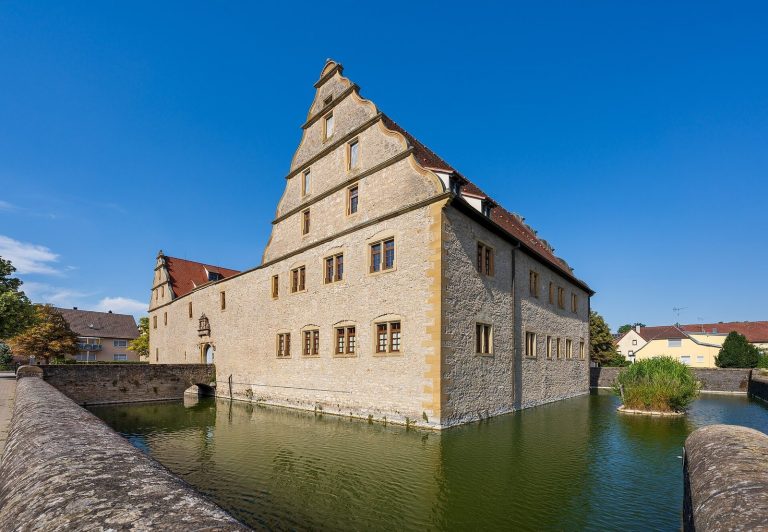
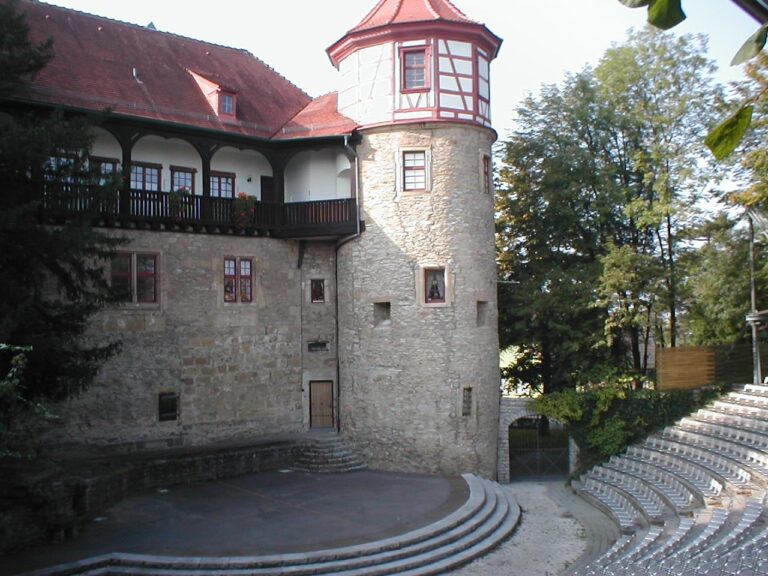
Möckmühl Castle: A Medieval Stronghold in Germany
Site at a Glance
- Popularity
- Medium
- Country
- Germany
- Primary era
- Medieval
- Eras represented
- Medieval, Modern
- Civilizations
- German, Holy Roman Empire
- Site type
- Military
- Remains
- Castle
On this page12 sections
History
Möckmühl Castle is a medieval stronghold in Germany, dating to the 13th century and first mentioned in 1251. Its builder and exact construction date are unknown, but the lords of Dürn are considered its likely founders. From its position near the Seckach and Jagst rivers, it guarded a junction of toll and escort roads. The nearby route from Würzburg to Wimpfen had been important in Roman times for the defense of the Limes, the Roman Empire’s fortified frontier. Customs posts and fairs also operated at the river junction.
Dürn and Hohenlohe rule
The lords of Möckmühl, whose family line ended early, are not considered the castle’s founders. After Konrad von Dürn died in the late 1250s, the castle passed to his widow, Mechtild, the last countess of Lauffen. She used it as a residence and property assigned to her as a widow for 18 years, while managing her lands and estates herself. In 1287, her grandson Count Poppo von Dürn married Agnes von Hohenlohe, and Möckmühl passed to her family, the House of Hohenlohe.
In 1290, Albrecht von Hohenlohe killed a son of Ludwig, Duke of Bavaria, at a tournament. To make amends, Albrecht gave substantial donations to churches and monasteries, a practice continued by his descendants. In 1379, members of the Hohenlohe family founded a collegiate foundation outside the castle gate, an institution served by a community of canons. Its church was destroyed during the French invasion of 1642.
Courtly and literary connections
Möckmühl was associated with medieval courtly poetry. Konrad and Mechtild von Dürn were linked with love poetry, while Gottfried von Hohenlohe and Konrad von Brauneck, relatives of the Hohenlohe family, were minnesingers, court poets who wrote love lyrics. Wolfram von Eschenbach was close to the Dürns and may have stayed at the castle. He is associated with composing part of his romance Parzival in their company.
Albrecht Pilgrim von Buchheim, a ministerial, or member of the medieval service nobility, served Mechtild and was in her retinue from 1274 to 1282. He may have been the minnesinger known as von Buchein and the author of five songs in the Manesse Codex, a medieval collection of German-language songs.
Transfer to Württemberg and military conflict
Möckmühl passed to the Electoral Palatinate in 1445. This was a territory of the Holy Roman Empire governed by an elector. In 1451, the castle became the inheritance of the widow of Elector Ludwig IV. After her marriage to Count Ulrich V of Württemberg in 1453, the castle, town, and estates passed to the House of Württemberg, a transfer that led to prolonged conflicts.
In 1519, Götz von Berlichingen, a German knight and military leader, defended the castle as bailiff, or local administrator, for Duke Ulrich of Württemberg against the Swabian League. Although promised his life if he surrendered, he refused and was captured during a sortie from the castle.
Decline, restoration, and private ownership
As the castle lost its military importance, its fortifications deteriorated and were not rebuilt. Many buildings were demolished in 1781, and the town acquired the ruins in 1829. In 1902, Gustav Hermann von Alvensleben, commanding general of the XIII Army Corps, bought the castle and undertook extensive restoration and expansion. He gave the residence the name Götzenburg.
Artillery bombardment severely damaged the castle in 1945. Achaz von Alvensleben, who had inherited it from his father and grandfather, restored it after the war. The writer Paul Brock lived there for a time in the postwar years. The von Alvensleben family owned the castle until 1996, when it was sold to an investor group.
From 2011, the Sri Chaitanya Saraswat Math community used the castle as an ashram, a religious community or retreat, within the Krishna-devotional tradition associated with the Hare Krishna movement. The community later judged the medieval building unsuitable for meditation and considered Möckmühl insufficiently international. In 2017, the castle was sold to a former investment banker who planned to use it as a family residence. It remains privately owned.
Remains
Plan and defenses
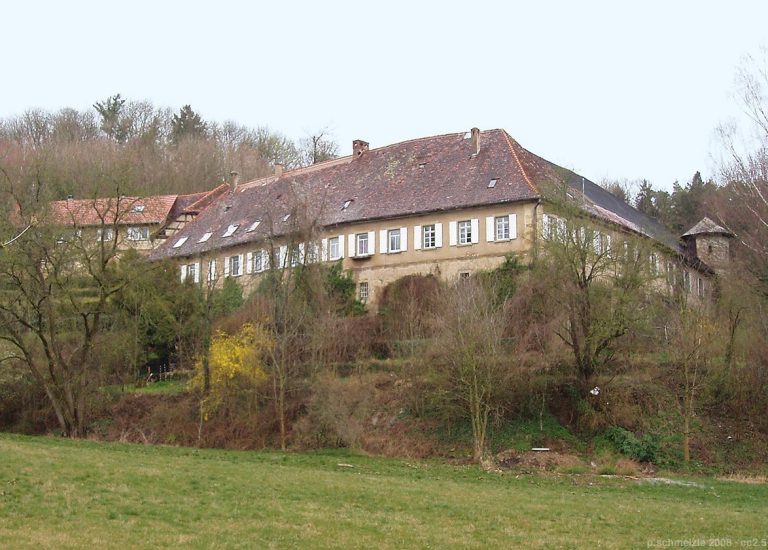
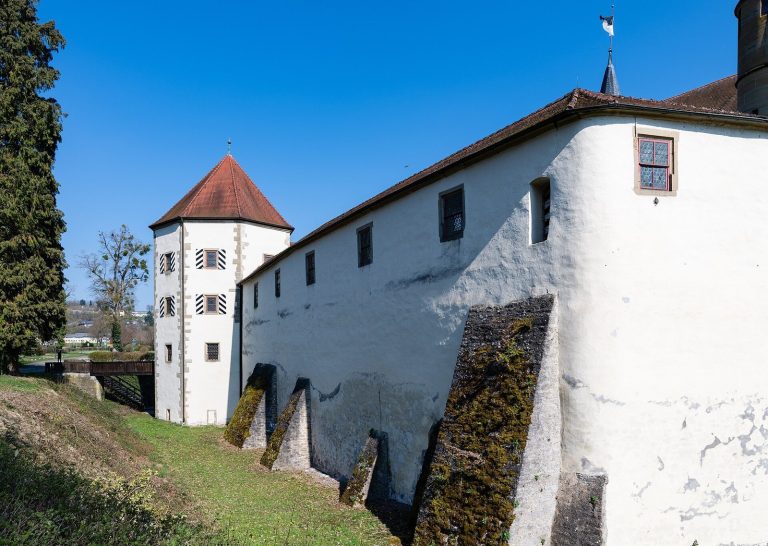
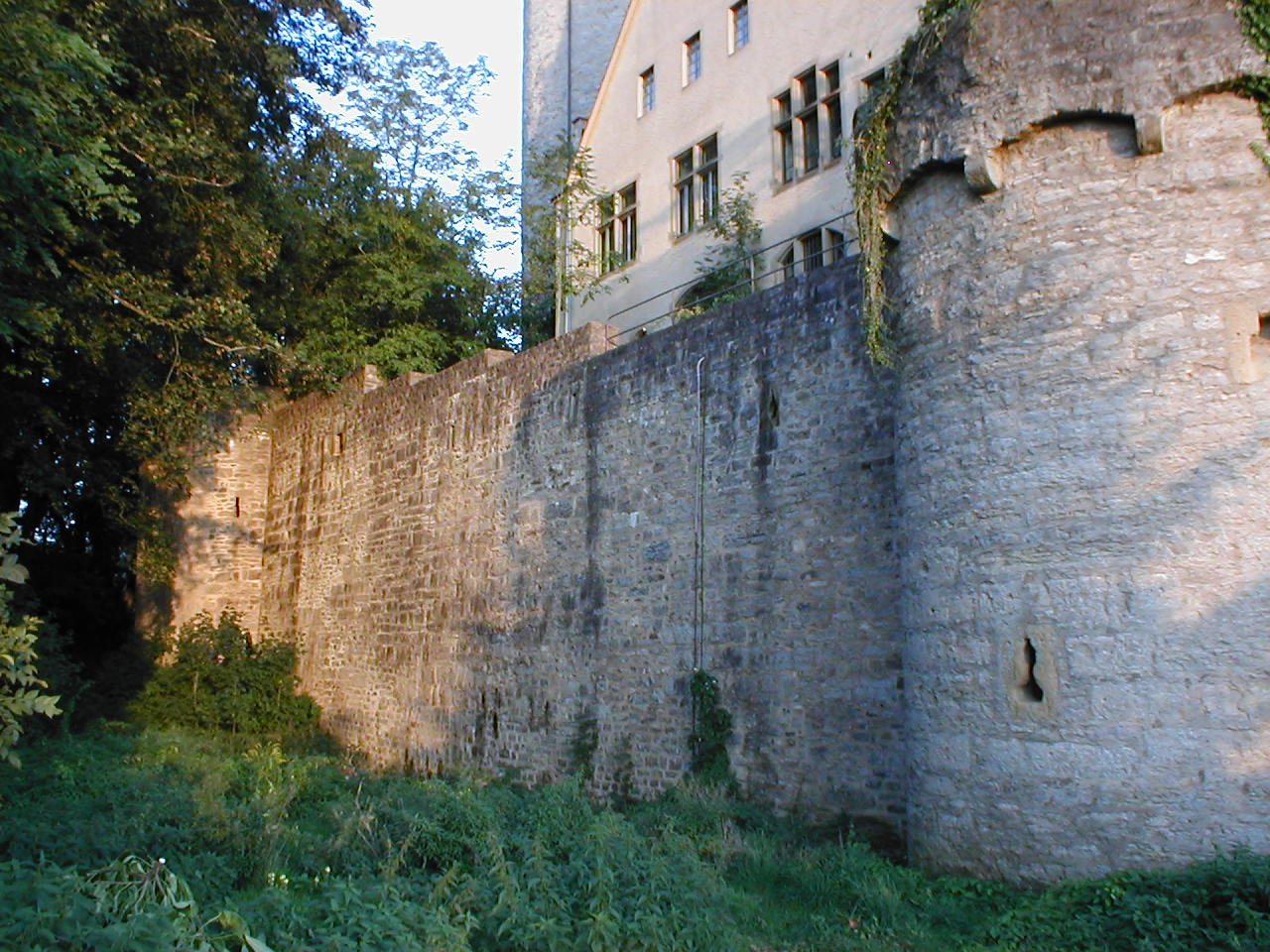
The castle occupies a narrow rocky ridge above Möckmühl, near the confluence of the Seckach and Jagst. Its plan is pentagonal, and its construction includes both stone and brick. It formed part of the town’s outer defenses, linked to them by connecting walls and projecting corner defenses. Sections of the outer fortification wall also survive.
Towers and principal buildings
Götzenturm
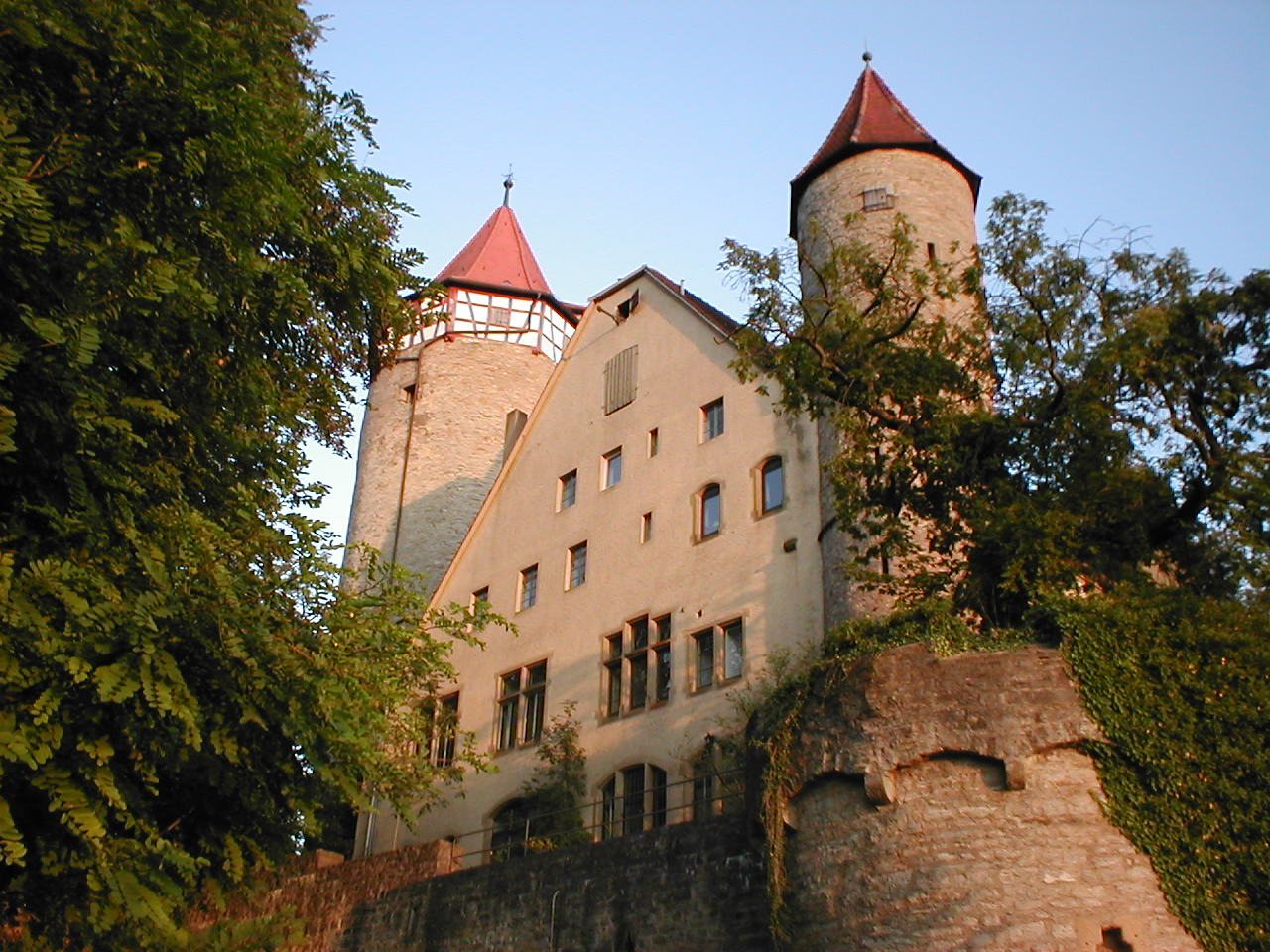
The oldest part of the castle is a round tower now called the Götzenturm. It was built in the Romanesque style, a medieval architectural style characterized by rounded arches. Its access opening stands 13 meters above the surrounding ground.
North-west tower
The north-west tower is also among the castle’s older structures.
Main building and courtyard
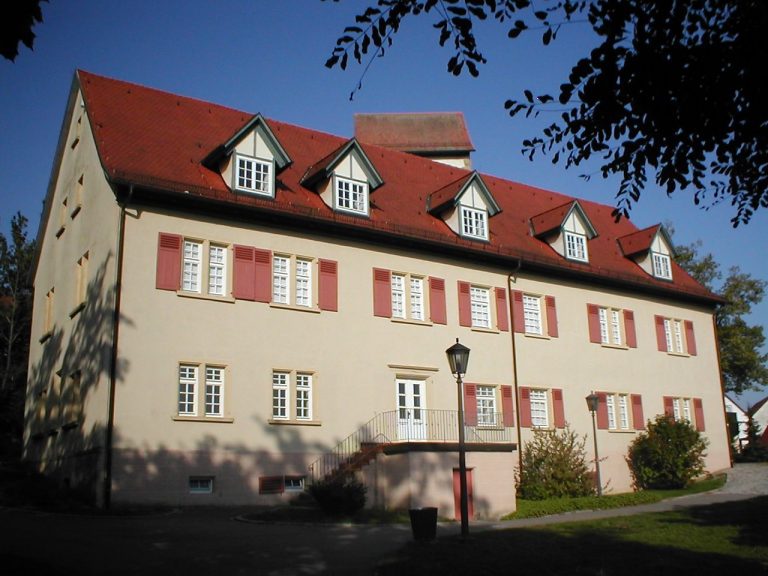
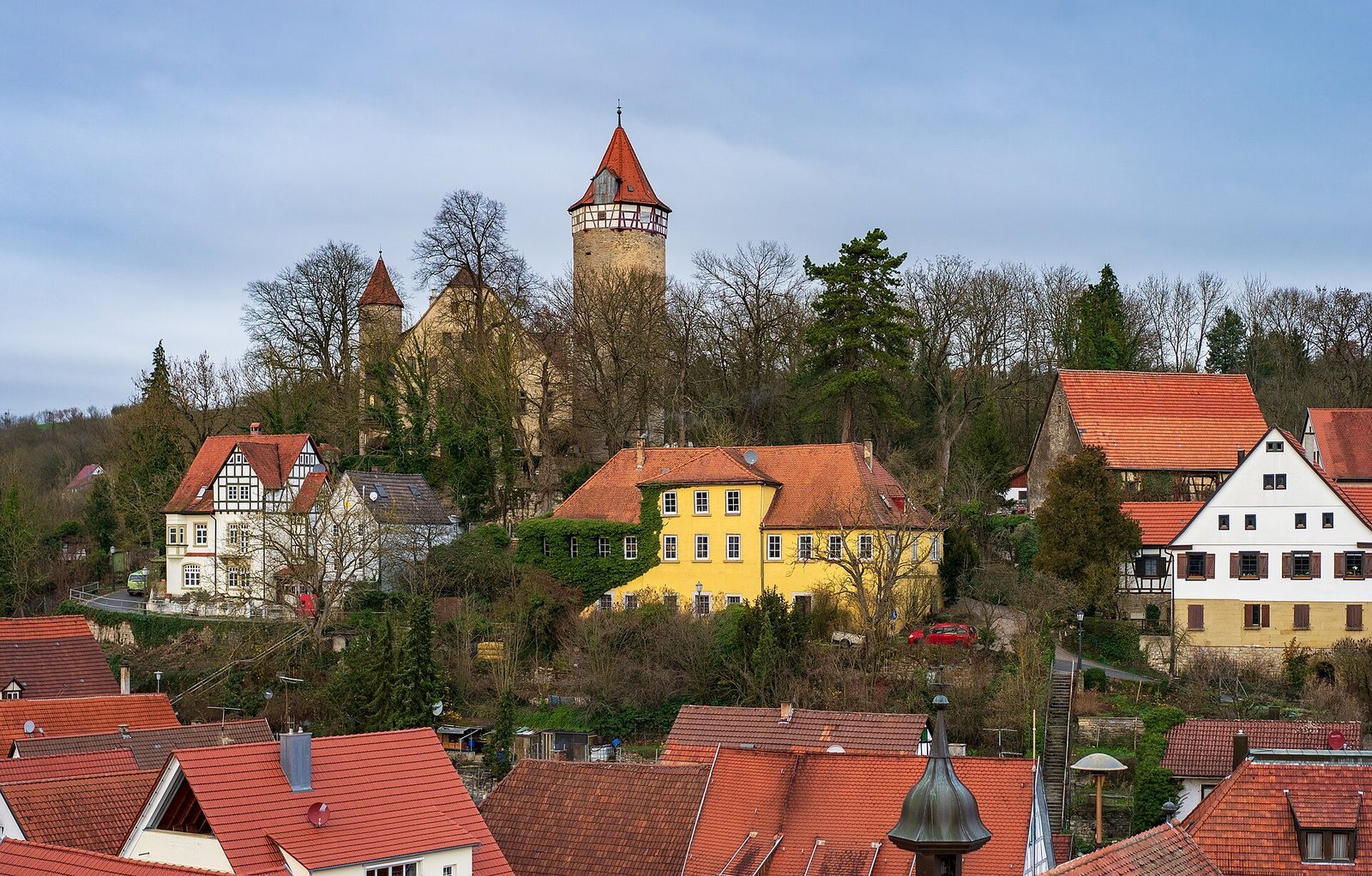
A surviving enclosing wall surrounds the main building and both towers. An arched stone bridge leads into the courtyard. The main building has a raised gable, the upper triangular end of a roof. The castle’s buildings and towers rise above the town and can be seen from a distance.
Earlier views and surviving fabric
Engravings by Matthäus Merian and D. Meissner show an earlier appearance of the castle. Substantial portions of the complex survive in restored condition.