Palace of the Ministry of Revenues and Treasury: Government Offices in Warsaw
Site at a Glance
- Popularity
- Medium
- Country
- Poland
- Primary era
- Modern
- Eras represented
- Early Modern, Modern
- Civilizations
- Kingdom of Poland, Polish–Lithuanian Commonwealth
- Site type
- Civic
- Remains
- Palace
On this page11 sections
History
The Palace of the Ministry of Revenues and Treasury in Warsaw, Poland, began as a residence built in the mid-seventeenth century for Chancellor Jan Leszczyński, probably to a design by Italian architect Giovanni Battista Gisleni. Its later Neoclassical remodelling made it a centre of financial administration and part of a group of government and financial buildings in the city.
Early residence
In the second half of the eighteenth century, the palace belonged first to Józef Potocki, a member of Poland’s magnate nobility, and later to the Zieliński family.
Government offices and public service
From 1823 to 1825, Antonio Corazzi substantially remodelled the palace in Neoclassical form for the Government Commission of Revenues and Treasury. This body managed the finances of the Kingdom of Poland, established in 1815 under the Russian crown. The project was commissioned for its minister, Franciszek Ksawery Drucki-Lubecki. The palace formed part of a neighbouring complex that also included the Minister’s Palace and the Stock Exchange.
Juliusz Słowacki, a leading Polish Romantic poet, worked in the building as a trainee for the Commission from 1829 to 1831. Between 1919 and 1921, Marian Lalewicz directed further alterations for the Ministry of the Treasury. During the interwar years, the palace and the adjoining Minister’s Palace housed the ministry.
War, reconstruction, and civic use
German bombing set the palace on fire in September 1939. During the 1944 Warsaw Uprising, an armed revolt by the Polish resistance against German occupation, the building was almost entirely destroyed, though some walls survived. It was rebuilt in Neoclassical form between 1950 and 1954 under architect Piotr Biegański for the Presidium of the Capital City Council, then Warsaw’s city-council executive.
In 1994, the palace received Historic Monument of Poland status as part of Warsaw’s historic city centre. The designation recognizes properties of national heritage importance; the historic centre is associated with the Royal Route, which connects the Royal Castle with Wilanów Palace. A memorial to Polish President Lech Kaczyński was unveiled on 9 April 2016 amid controversy. The installation lacked approval from Warsaw’s municipal conservator, and Andrzej Kunert, secretary of the public body responsible for commemorating wartime struggle and suffering, questioned part of its inscription.
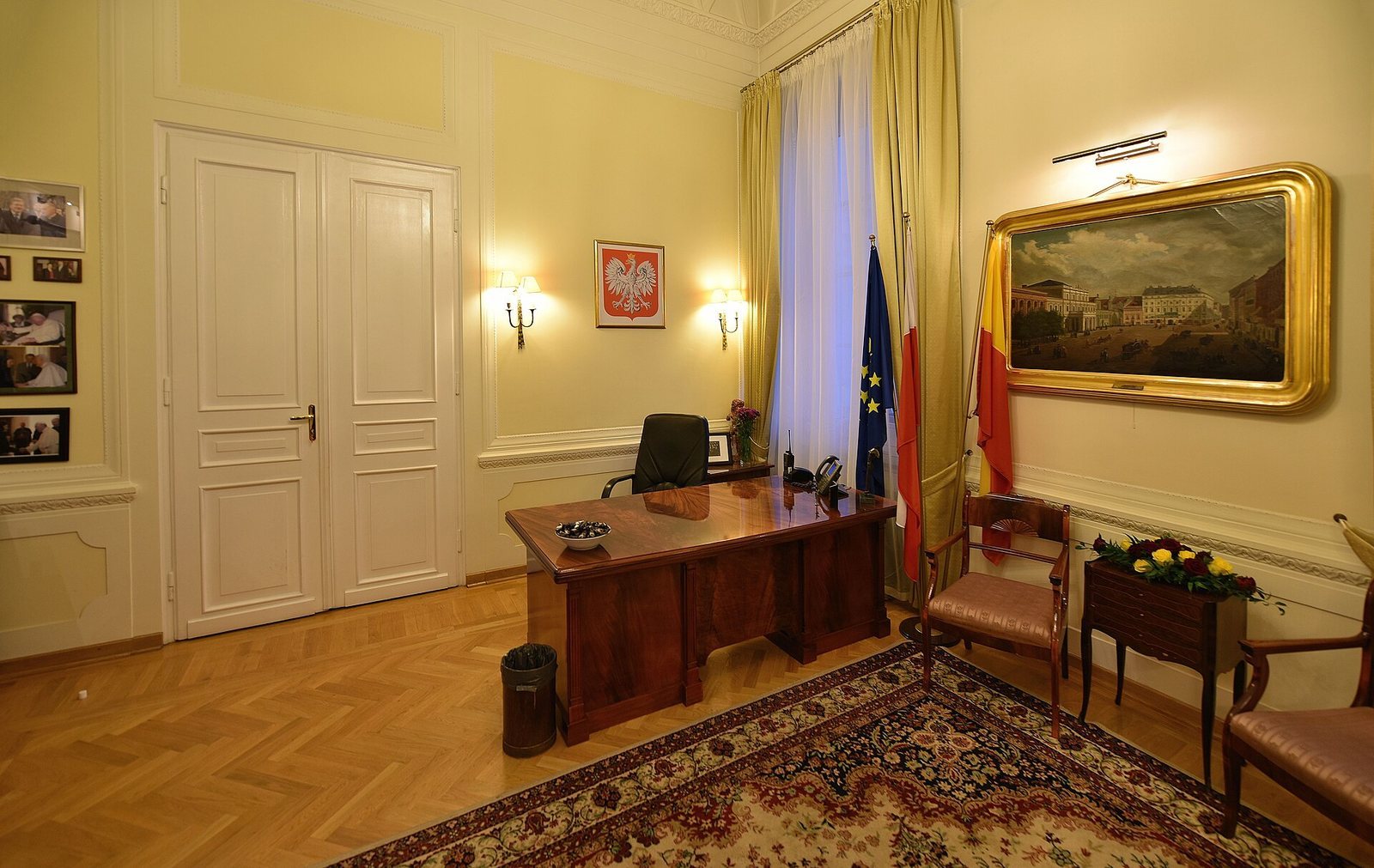
The palace now houses the Mayor of Warsaw, city administration offices, and the Masovian Voivodeship Office. The city administration occupies about 15 percent of the building. The adjoining Minister’s Palace is connected to it, and the two buildings share an address.
Remains
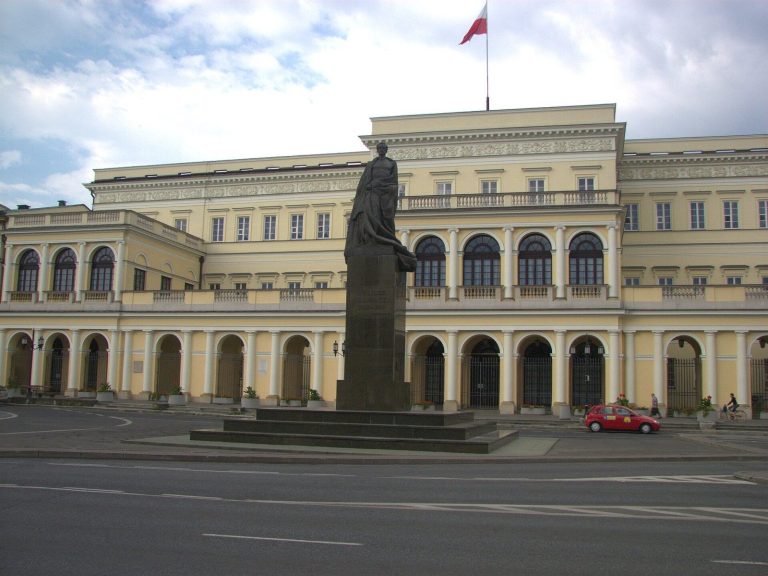
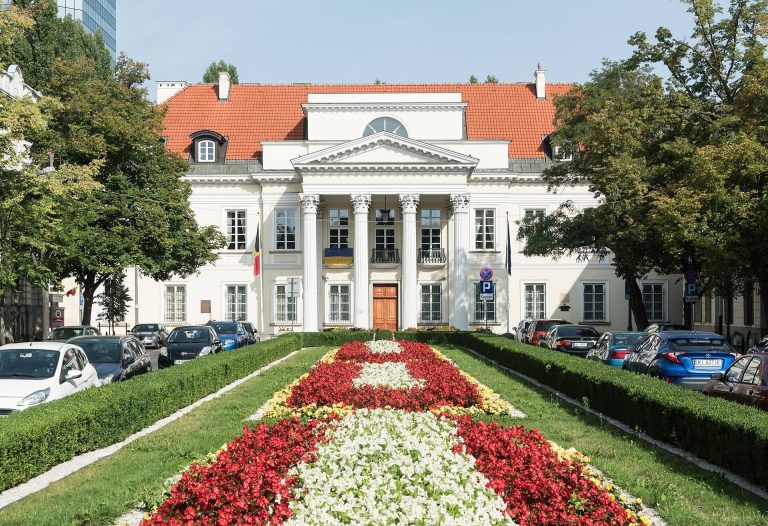
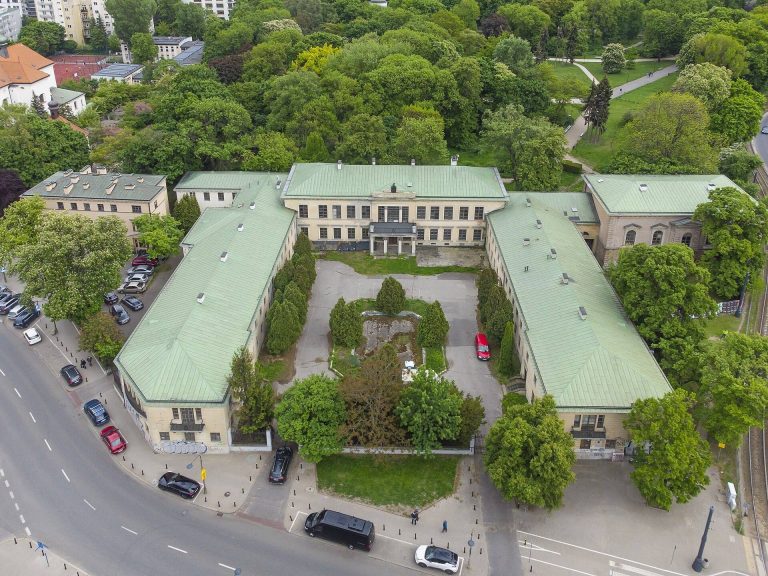
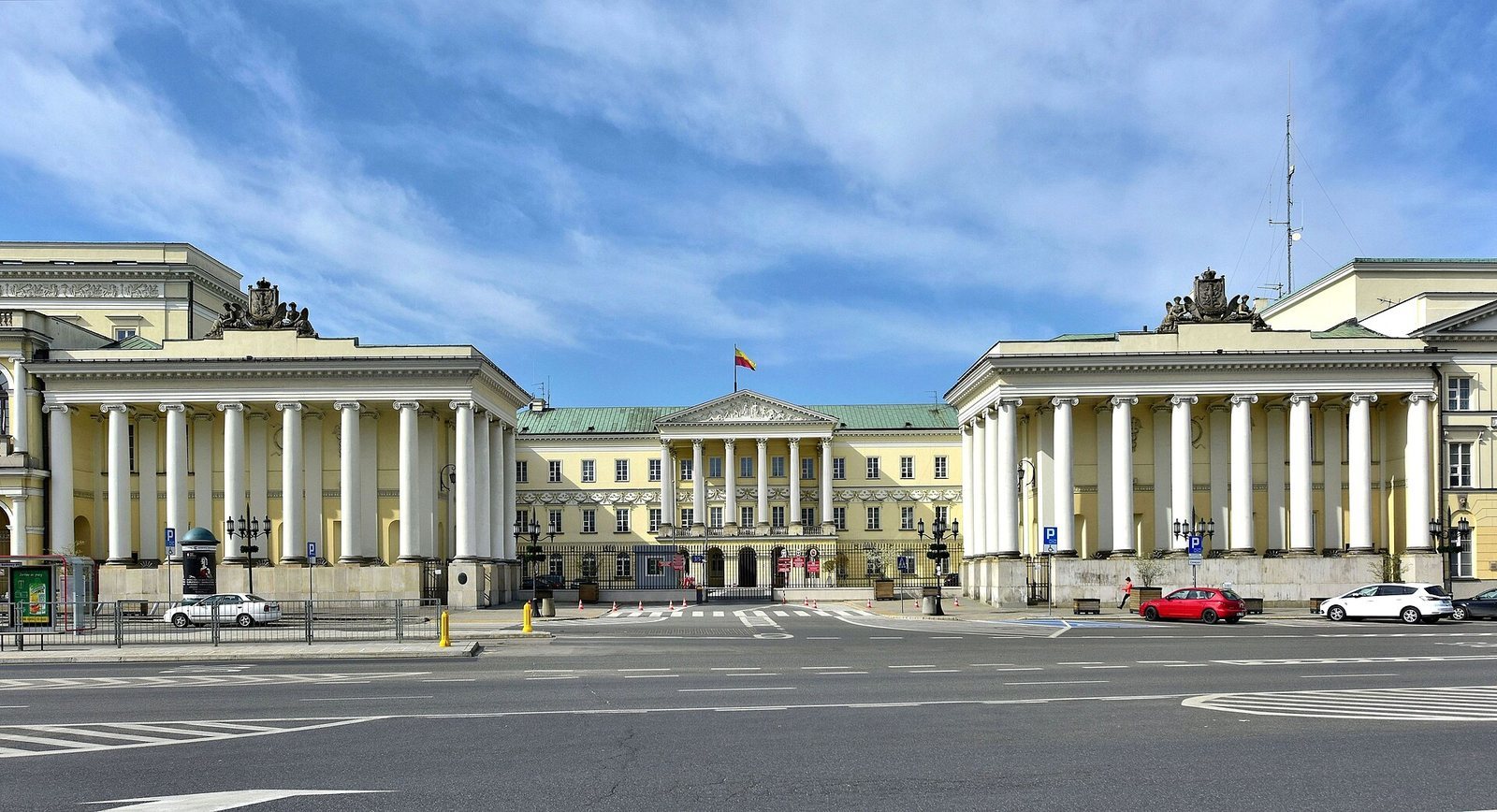
The palace stands at 3/5 Bank Square and has a three-storey, horseshoe-shaped plan arranged around a central courtyard. Its main block is set well back within the courtyard, while two side wings help enclose the space. The surviving composition is Neoclassical, with columned entrances and sculpted decoration.
Classical façades
Main block
A six-column Corinthian portico, a roofed entrance supported by columns with ornate capitals, dominates the main block. Sculptures by Paweł Maliński fill the tympanum, the central field of the pediment. They represent Minerva, the Roman goddess of wisdom; Jason, a hero of Greek mythology associated here with industry; Mercury, a Roman god associated with trade; and the Vistula and Bug rivers. Above the second storey, a horizontal decorative band called a frieze, probably by M. Vincenti, features cherubs and garlands.
Side wings
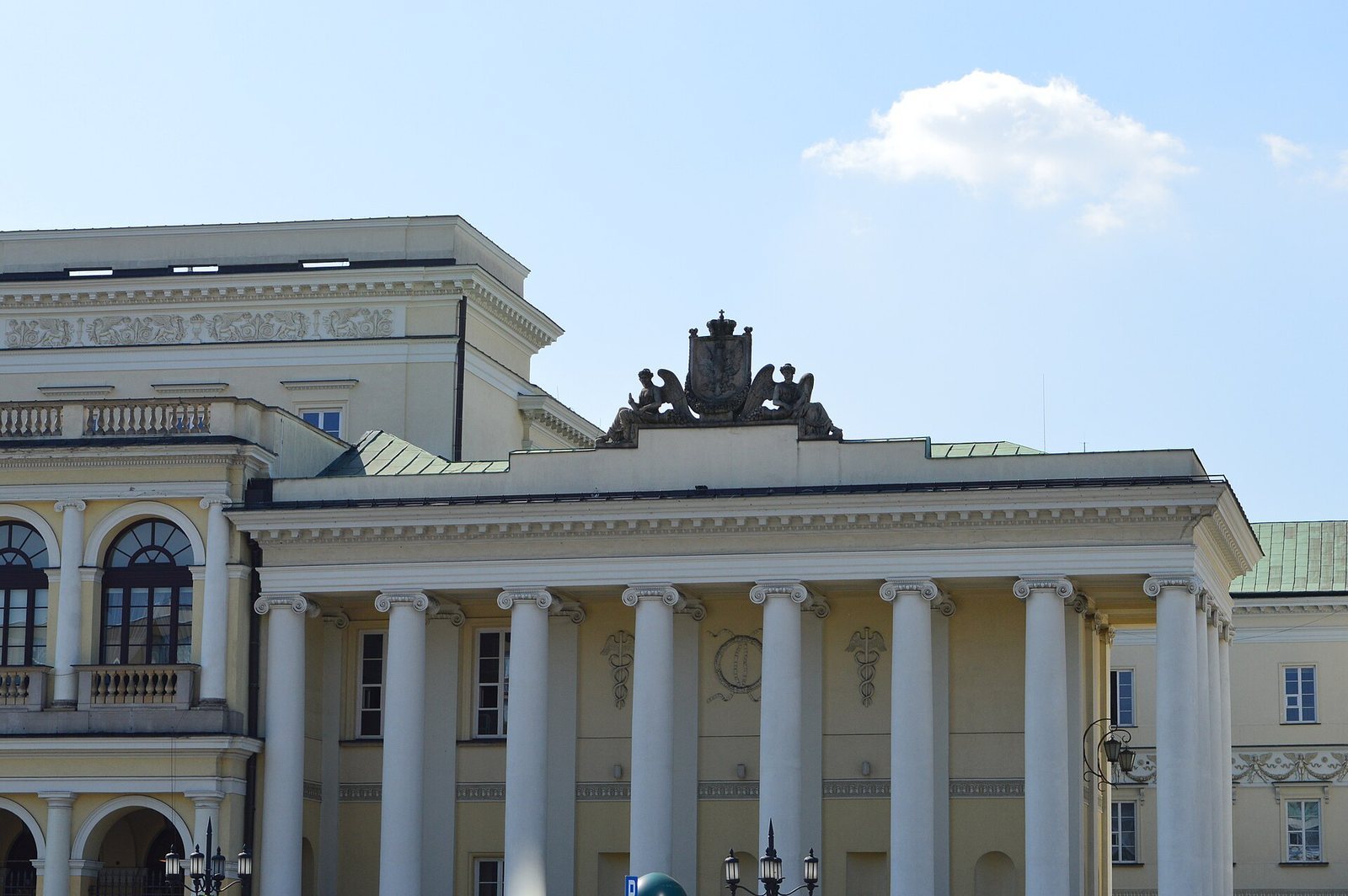
The two wings continue the main block’s architectural style. Each has a four-column Ionic portico facing the courtyard. Toward Bank Square, the wings narrow to two storeys and present monumental Ionic colonnades. Each ends in a stepped gable topped by a cartouche, an ornamental framed panel.
Interior and commemorative features
Interior markers
A half-landing in the main block contains a bust of Słowacki and a commemorative plaque. Plaques between the ground-floor arches honor leaders of the Polish Jacobins, a radical movement associated with late-eighteenth-century revolutionary politics; these were unveiled in 1952. Other plaques commemorate Corazzi, installed in 1977; politician Eugeniusz Kwiatkowski, installed in 2000; and artist Piotr Michałowski, installed in 2011. The offices of the Mayor of Warsaw and the Masovian Voivode are on the main block’s first floor.
Memorials outside
A monument to Słowacki stands in front of one wing. Edward Wittig designed it in 1932, and it was unveiled in 2001 in place of a statue of Felix Dzerzhinsky by Zbigniew Dunajewski. Dzerzhinsky was a Bolshevik revolutionary and a leading figure in the early Soviet security apparatus. A memorial stone and plaque to Kaczyński stand in the courtyard.