Mallin Manor House: A Historicist Estate Residence in Germany
Site at a Glance
- Popularity
- Medium
- Country
- Germany
- Primary era
- Modern
- Eras represented
- Modern
- Civilizations
- German
- Site type
- Domestic
- Remains
- Manor House
On this page5 sections
History
Mallin Manor House is an estate residence in Germany, commissioned in 1870–71 by Karl Ludwig, senior Baron von Hauff, in a historicist blend of Neo-Baroque and Neo-Renaissance forms. Its history is closely tied to the Mallin estate, whose ownership changed hands before the von Hauff family, its last private owners, were expelled in 1945 under land-nationalization laws.
From the von Maltzahns to the von Hauffs
The von Maltzahn family held the Mallin estate from the fifteenth century until 1857, when it passed to the Schröder family. The Barons von Hauff acquired it in 1869. The wider von Hauff family traced its origins to Old Swabia and was raised to noble status in 1563 by Emperor Ferdinand I, a Habsburg ruler and Holy Roman Emperor. Ludwig Hauff, who served repeatedly as a consul, received a Finnish baronial title in 1853; a separate branch of the family was later ennobled in Württemberg.
Karl Ludwig commissioned the house soon after the von Hauffs acquired the estate. Before taking possession, he swore fealty, the formal pledge associated with holding a feudal fief. He remained the estate’s lord until his death in 1876. His widow, Karoline, born Reichert, then moved to Dresden. In 1888 the former fief was converted into allodial property, meaning it was held as freehold rather than under feudal tenure.
Ownership and the estate economy
Karl Ludwig’s son and namesake, Ludwig Baron von Hauff (1872–1923), was probably a temporary heir. Associated with Ida von Hodenberg, he moved in 1896 to the 507-hectare estate at Alt Rehse. His younger brother Hans Nikolaus was officially the owner of Mallin Manor House from 1902, and Hans’s wife, Gudrun, later held that position. A protective proceeding concerning the estate was opened in her name in 1931 and cancelled by the Rostock land office in February 1932.
Shortly before the economic crisis of 1929–30, Mallin was a freehold estate within an inheritance arrangement intended to keep the property in the family. It covered 575 hectares, including 52 hectares of woodland. Its agricultural operation kept 500 sheep, 200 pigs, 180 cattle and 60 working horses. Friedgund von Hauff was born at Mallin in 1936. By 1943 the family had moved to Tübingen, where Almut was born; the couple divorced in 1947.
Dispossession and later use
The von Hauffs were expelled in 1945 under land-nationalization laws. After the Second World War, the house served as apartments, a kindergarten, an artists’ studio and a restaurant. Its former ballroom was used for community celebrations. Following German reunification, the municipality could no longer maintain the property, which stood empty from 1991 and deteriorated. Exterior restoration began in 2007, and renovation resumed in 2017 with the aim of creating apartments.
Remains
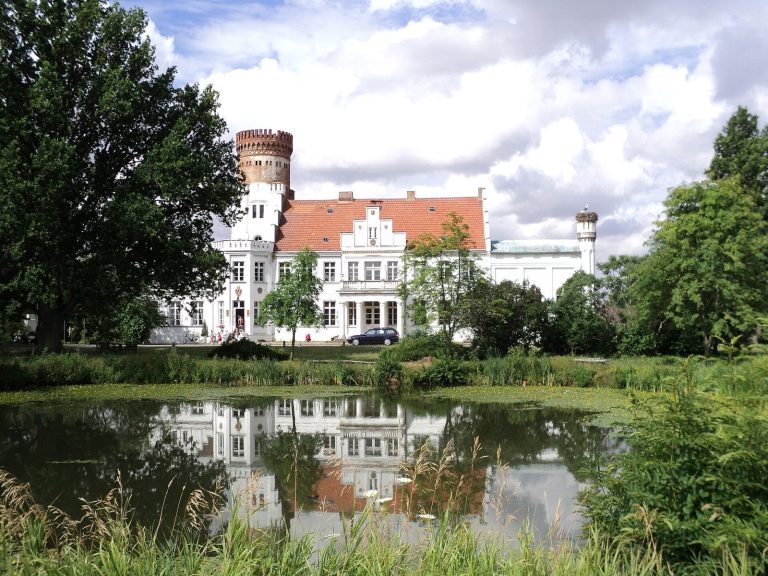
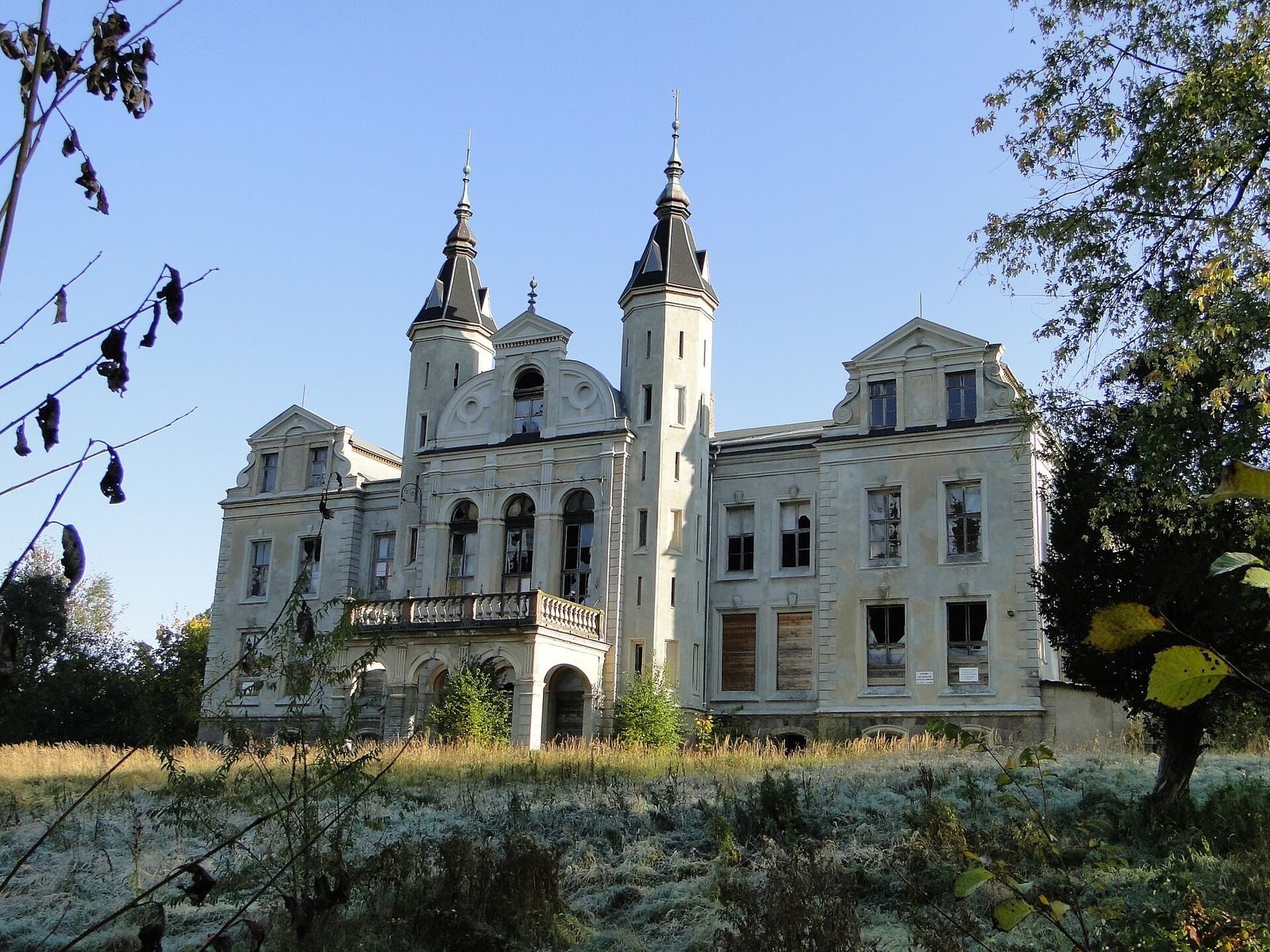
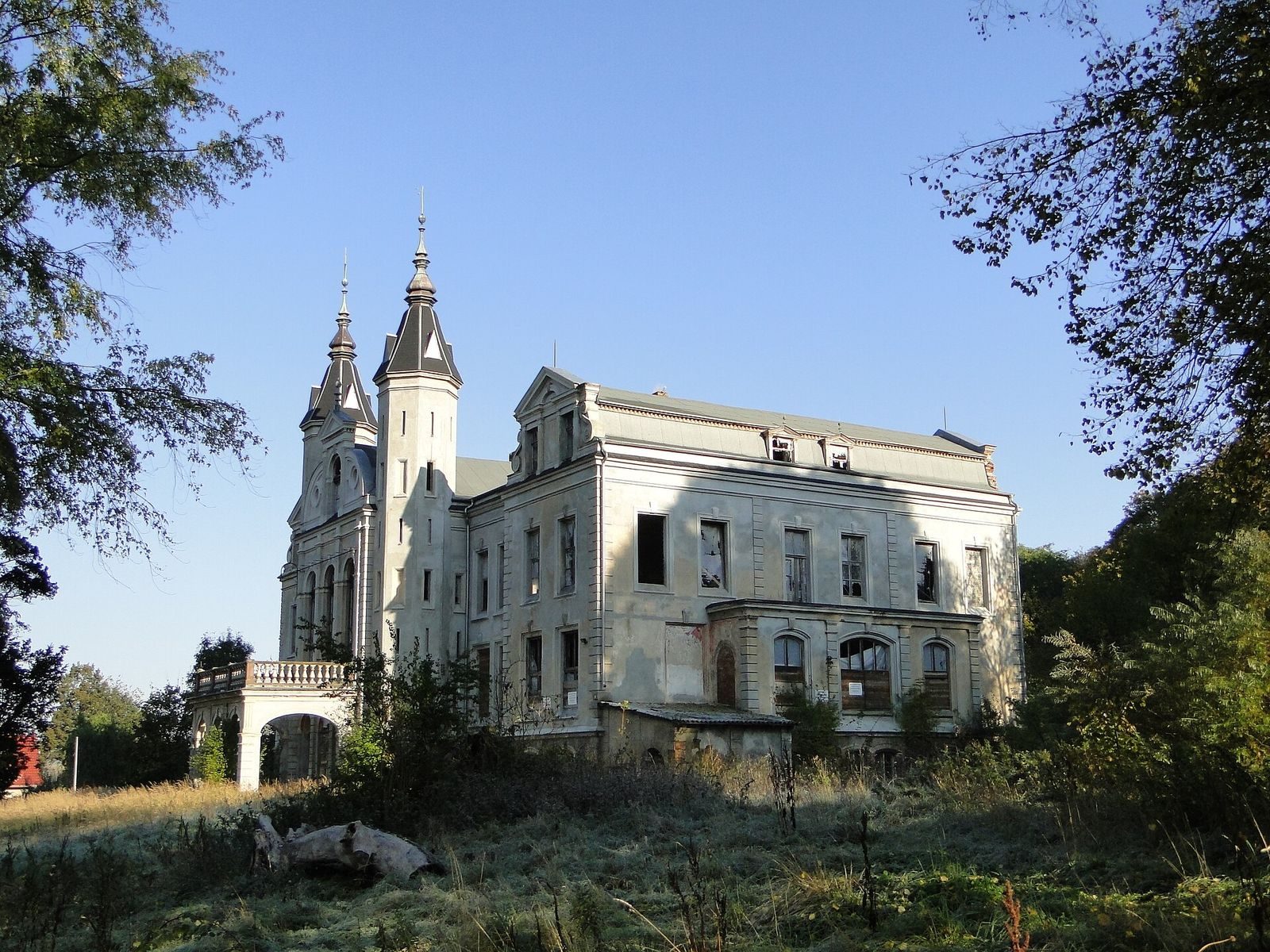
The plastered, two-storey building has a semi-basement and a front divided into eleven vertical sections. Its rectangular main block has a central projection, flanked by Renaissance-style turrets topped with spires. Smaller projecting sections extend from both wings, each crowned by a triangular pediment, or ornamental triangular gable. A three-arched Florentine-style loggia, an open-sided roofed gallery, opens onto a large terrace carried above a columned porch that screens the main entrance. A rectangular pond lies in front of the house, while a landscaped park adjoins and surrounds the building.