Sverresborg in Bergen: A Medieval Fortress and Later Military Site
Site at a Glance
- Popularity
- Medium
- Country
- Norway
- Primary era
- Early Modern
- Eras represented
- Medieval, Early Modern, Modern
- Civilizations
- Denmark–Norway, Norwegian
- Site type
- Military
- Remains
- Fort
On this page11 sections
History
Medieval fortress
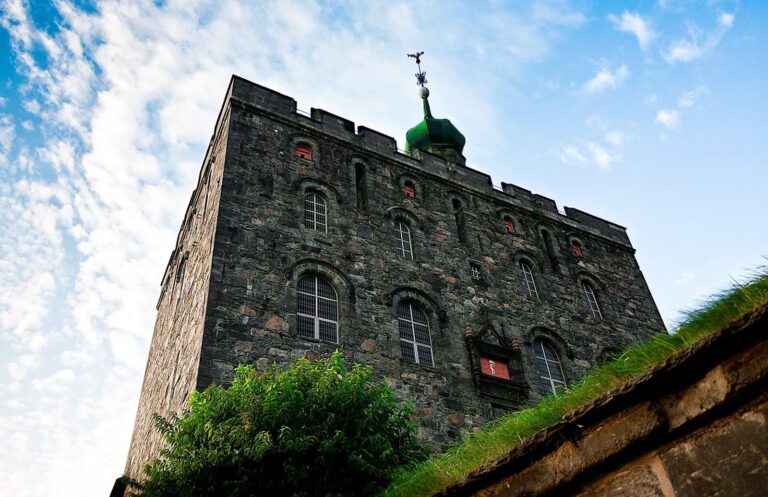
Sverresborg is a fortress on Holmen in Bergen, Norway, built for King Sverre Sigurdsson around 1184–1185, after the Battle of Fimreite. Sverre ruled Norway from 1177 until his death in 1202 and also built a fortress of the same name in Trondheim. Bergen’s fortress was caught up in the Norwegian civil wars, conflicts among rival factions for control of the throne and kingdom. The Baglers, who opposed Sverre and his supporters, repeatedly attacked it.
The Saga of Sverris recounts a raid in 1197 in which Sverre’s enemies entered the fortress, plundered it, seized its garrison, and threw a corpse into a well. A skeleton found in 1938 and studied in 2024 appears consistent with the saga’s account, although the finding does not by itself establish the person’s identity. The saga also describes about 600 men and 40 noblewomen living at the fortress around 1207.
In 1207 the Baglers captured and demolished Sverresborg. They destroyed it twice in the early thirteenth century, before it was rebuilt during the early part of King Håkon Håkonsson’s reign, following Bergen’s great fire of 1248. The fortress saw further battles during the civil-war period. It remained in use into the mid-sixteenth century. In 1477, townsmen complained that Hanseatic merchants, members of a northern European trading association, were taking its walls apart.
Fortifications and separation from Bergenhus
Sverresborg was substantially developed as part of Bergenhus’s defenses in the seventeenth century. During the Battle of Vågen in 1665, it fired cannon in support of the Dutch fleet. Maps from the early eighteenth century, including one by Major General Jacob von Wilster, depict a continuous defensive line extending from Bergenhus across Koengen to Sverresborg.
The last known major expansions occurred in the early nineteenth century during the Napoleonic Wars, European conflicts fought from 1803 to 1815 and centered on Napoleonic France. In the first half of the century, Sverresborg was separated from Bergenhus as a fortification.
Park and public events
A park was established at Sverresborg in the 1830s. Bergenhus commandant Carl von und zu Mansbach arranged for trees to be planted and opened the grounds to the public, making it Bergen’s first public park. The rampart masters, officials responsible for maintaining defensive works and buildings, could also run a small refreshment business under their contracts. The extra income mattered because their noncommissioned-officer pay was low.
Sunday outdoor entertainments known as Vauxhall concerts began in the early 1840s. Crown Prince Oscar Fredrik attended one in July 1860 with county governor Smit, and the crowd cheered him. More than 5,000 people came to a morning concert during a song festival in June 1863. In August 1872, a French opera company held its closing concert in the park. Baritone Emil Lourde performed the Marseillaise, France’s national anthem, in what was its first public performance in Bergen, shortly before fireworks that evening.
The city park opened in 1865, and Brigade music concerts moved there in the 1870s. After Nygårdsparken opened in 1885, Sverresborg fell into increasing neglect and the grounds were no longer kept as open as before. The site was substantially reopened to the public during Bergen’s National Exhibition of 1910. In 1853, malacologist Joachim Friele had identified Norway’s first specimens of the red slug, Arion rufus, in the park.
Twentieth-century military and penal use
Railway construction to Skoltegrunnskaien during the First World War destroyed large parts of the park. During the Second World War, German forces installed two anti-aircraft batteries at Sverresborg. The site became an execution ground during Norway’s postwar legal purge. Seven people were executed there between 1946 and 1947; another person executed in Bergen was put to death at Kvarven Fort. At Sverresborg, the executions took place beside the north wall of a building known as the “pig house.” The condemned were bound at the arms, legs, and neck, blindfolded, and shot from five metres away. Two weapons were loaded with blank cartridges so that those firing would not know who had fired the fatal shot.
Sverresborg has had no operational military role since the Second World War, but the Norwegian military still uses the site for offices and training. It remains under the command of the Bergenhus Fortress commandant.
Remains
Setting and medieval fortress
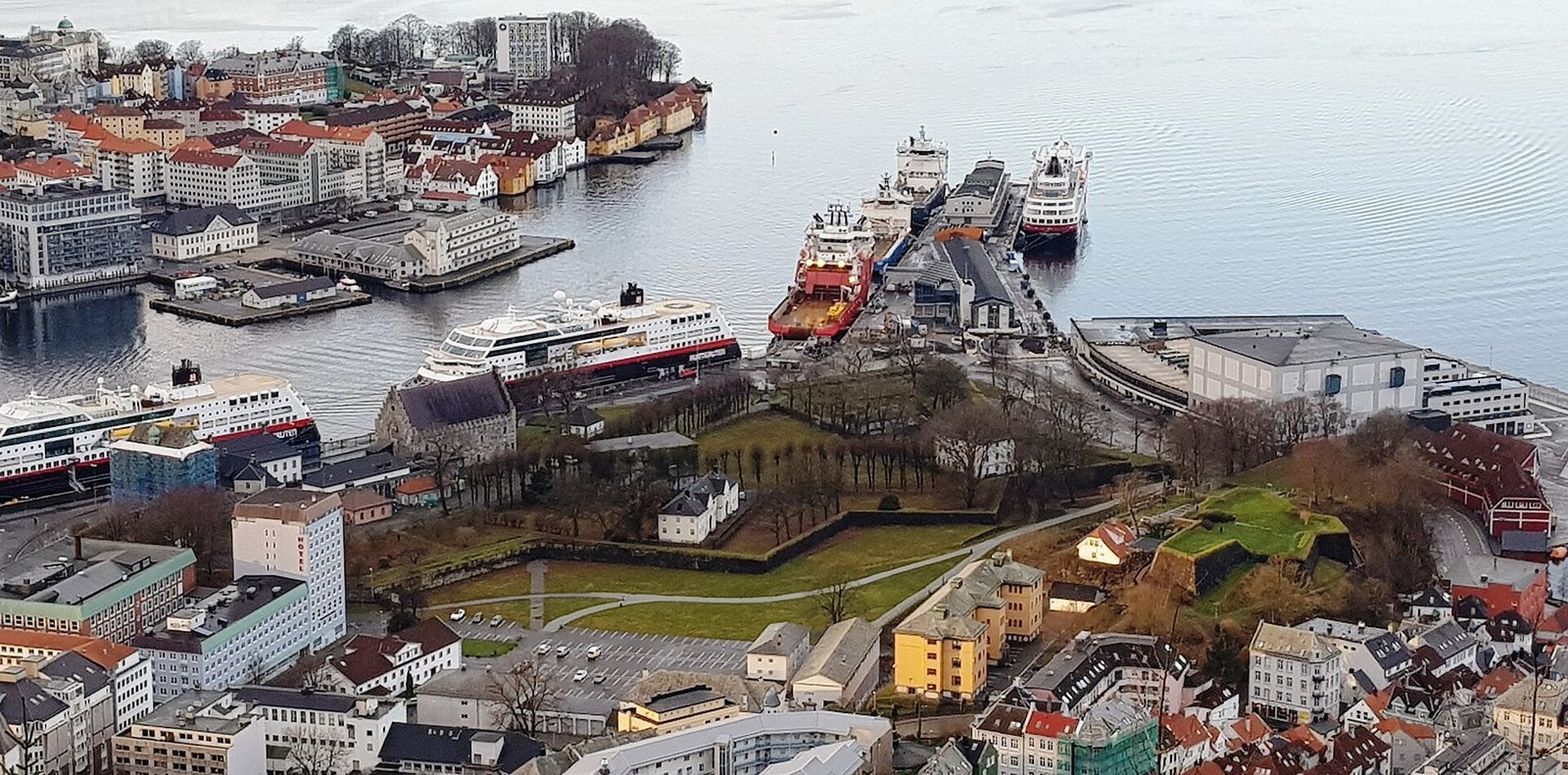
The fortress occupies the highest rocky outcrop of Holmen, about 250 metres northeast of Bergenhus Fortress. The marshy ground between Holmen and the medieval fortress was called Veisan and is now Koengen. The medieval enclosure probably had stone ring walls, with wooden buildings inside them. A well is associated with the raid described in the Saga of Sverris.
Seventeenth-century defenses
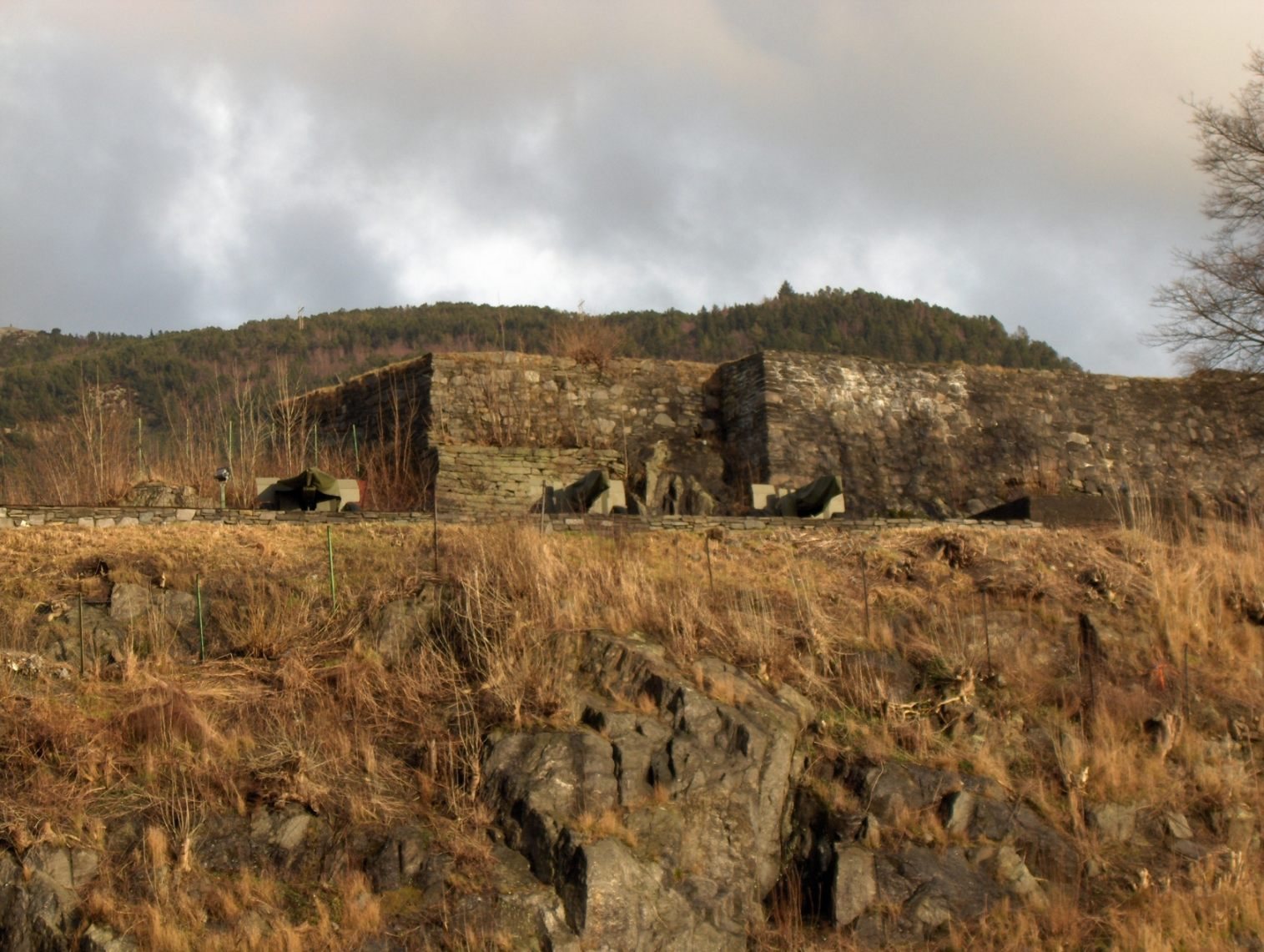
Much of the surviving fortification fabric dates from the seventeenth-century development of the site. It includes ramparts, additional defensive works, and two artillery batteries, forming the main surviving group of military defenses.
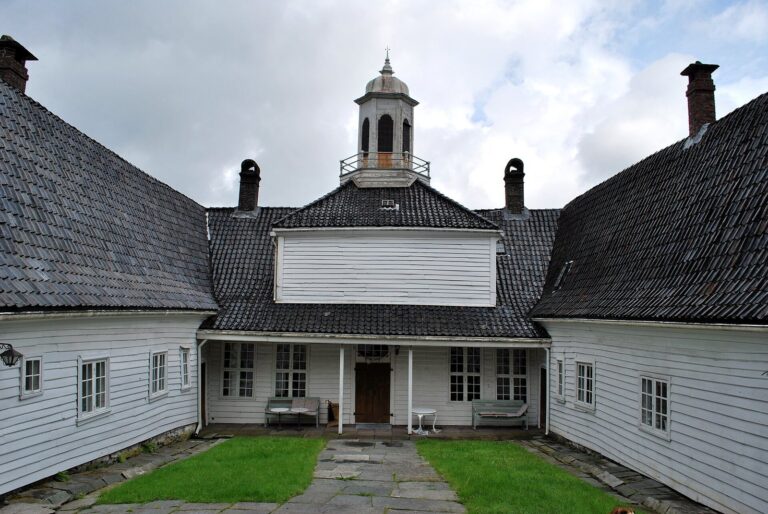
Rampart master’s residence
The rampart master’s residence lies directly beneath Sverresborg. Its oldest parts date to 1720. The rampart master was responsible for maintaining the fortress’s defensive works and buildings.
Cellar
A small cellar was cut into the site under Carl von und zu Mansbach for storing dynamite. It became popularly known as “King Sverre’s grave,” but was not identified as Sverre’s actual burial place. Railway construction during the First World War destroyed it.
Barracks
A barracks was built at Sverresborg in 1911 for the Bergen Brigade’s school for noncommissioned officers, military leaders below commissioned-officer rank.